Liquid metal vapour shielding in linear plasma devices T.W. Morgan 1 - - PowerPoint PPT Presentation

β–Ά
liquid metal vapour shielding in linear plasma devices
SMART_READER_LITE
LIVE PREVIEW

Liquid metal vapour shielding in linear plasma devices T.W. Morgan 1 - - PowerPoint PPT Presentation

Liquid metal vapour shielding in linear plasma devices T.W. Morgan 1 , G.G. van Eden 1 , P. Rindt 2 , V. Kvon 1 , D. U. B. Aussems 1 , M. A. van den Berg 1 , K. Bystrov 1 , N.J. Lopes Cardozo 2 and M. C. M. van de Sanden 1 1 Dutch Institute for


slide-1
SLIDE 1

MOD-PMI | June 2019| NIFS, Japan | T.W. Morgan 1/28 LM VS in linear plasma devices

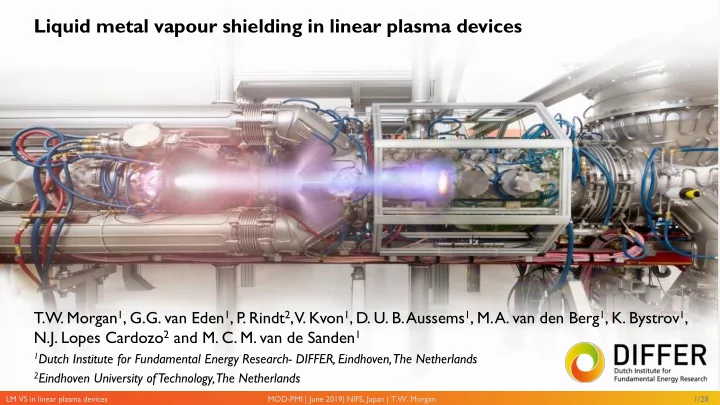
Liquid metal vapour shielding in linear plasma devices

T.W. Morgan1, G.G. van Eden1, P. Rindt2, V. Kvon1, D. U. B. Aussems1, M. A. van den Berg1, K. Bystrov1, N.J. Lopes Cardozo2 and M. C. M. van de Sanden1

1Dutch Institute for Fundamental Energy Research- DIFFER, Eindhoven, The Netherlands 2Eindhoven University of Technology, The Netherlands

slide-2
SLIDE 2

MOD-PMI | June 2019| NIFS, Japan | T.W. Morgan 2/28 LM VS in linear plasma devices

Going from ITER to DEMO involves large jumps in several parameters

Resilience to neutrons and power excursions becomes more important

Property ITER DEMO1 Pulse length ~400 s ~7200 s Duty cycle <2% 60-70% Neutron load 0.05 dpa/yr 1-9 dpa/yr Exhaust power 150 MW 500 MW Divertor area ~4 m2 ~6 m2 Radiated power 80% 97%

Courtesy G. Matthews

slide-3
SLIDE 3

MOD-PMI | June 2019| NIFS, Japan | T.W. Morgan 3/28 LM VS in linear plasma devices

Limiting factors for W in DEMO

High heat/particles

Erosion For 5 mm W lifetime ~2 years1

Thermal shock/fatigue

Cracking (small ELM-like loading)2 Progressive deterioration3

Big ELMs/VDEs/disruptions

Melting- irreversible damage Runaway failure?

1Maissonier NF 2007 2Linke NF 2011 3Loewenhoff FED 2012

slide-4
SLIDE 4

MOD-PMI | June 2019| NIFS, Japan | T.W. Morgan 4/28 LM VS in linear plasma devices

Limiting factors for W in DEMO

High heat/particles

Erosion For 5 mm W lifetime ~2 years1

Thermal shock/fatigue

Cracking (small ELM-like loading)2 Progressive deterioration3

Big ELMs/VDEs/disruptions

Melting- irreversible damage Runaway failure?

Neutrons

Transmutation, H+He creation, defects Smaller operational temperature window Increased brittleness

1Maissonier NF 2007 2Linke NF 2011 3Loewenhoff FED 2012

slide-5
SLIDE 5

MOD-PMI | June 2019| NIFS, Japan | T.W. Morgan 5/28 LM VS in linear plasma devices

Capillary porous structures (CPSs) create conduction based stabilized PFCs to contain liquid metals

Evtikhin JNM 1999

Replace solid surface with liquid MHD forces (jxB) destabilize liquids in tokamaks (droplets) Use surface tension/capillary refilling Replace top region with this combined material

W monoblock Coolant pipe Coolant Thin CPS layer Capillary supply to surface LM reservoir

slide-6
SLIDE 6

MOD-PMI | June 2019| NIFS, Japan | T.W. Morgan 6/28 LM VS in linear plasma devices

Benefits of liquid metals for DEMO

Sputtering

Self replenishment Higher heat fluxes

Thermal shock/fatigue

No cracking Lowered stresses substrate ELMs possible(?)

Big ELMs/VDEs/disruptions

Already molten Vapour protection

Neutrons

Only influences substrate Separation of PSI from neutron issue

slide-7
SLIDE 7

MOD-PMI | June 2019| NIFS, Japan | T.W. Morgan 7/28 LM VS in linear plasma devices

Material options of Li, Sn both have strengths and weaknesses

Lithium Tin Low Z Higher Z High vapour pressure Lower vapour pressure High T retention Lower T retention

Allain and Taylor PoP (2012) Wesson, T

  • kamaks (2004)

Choices once cost, availability, activation etc. taken into account

slide-8
SLIDE 8

MOD-PMI | June 2019| NIFS, Japan | T.W. Morgan 8/28 LM VS in linear plasma devices

Linear devices have good flexibility and diagnostic access: good place to investigate vapour shielding

Plasma source Superconducting magnetic field coil Diagnostic ports through coil Rotatable/tiltable target holder Plasma beam Skimmer plates (differentially pumped chambers) Water cooled vacuum vessel

slide-9
SLIDE 9

MOD-PMI | June 2019| NIFS, Japan | T.W. Morgan 9/28 LM VS in linear plasma devices

Magnum-PSI/Pilot-PSI good utility for LM study due to DEMO relevant heat/particle loading

ITER/DEMO divertor strikepoint conditions (detached)

van Eck FED (2019)

slide-10
SLIDE 10

MOD-PMI | June 2019| NIFS, Japan | T.W. Morgan 10/28 LM VS in linear plasma devices

Vapour shielding: additional loss channels for heat flux (impurity stimulated β€œdetachment”)

π‘Ÿπ‘žπ‘šπ‘π‘‘π‘›π‘ = π‘Ÿπ‘‘π‘π‘œπ‘’ + π‘Ÿπ‘“π‘€π‘π‘ž + π‘Ÿπ‘ π‘π‘’ + π‘Ÿπ‘›π‘π‘‘π‘‘ π‘Ÿπ‘žπ‘šπ‘π‘‘π‘›π‘ = π‘Ÿπ‘‘π‘π‘œπ‘’ Solid metal: Liquid metal:

slide-11
SLIDE 11

MOD-PMI | June 2019| NIFS, Japan | T.W. Morgan 11/28 LM VS in linear plasma devices

Experiment compared performance of Sn CPS with solid Mo reference targets

n.b. Deliberately poorly cooled to reach VS temperature regime

Ion species T

e

(eV) ne (1020 m-3) qref (MW m-2) H or He 0.4-3.1 0.6-7.0 0.47-22

slide-12
SLIDE 12

MOD-PMI | June 2019| NIFS, Japan | T.W. Morgan 12/28 LM VS in linear plasma devices

Vapour interaction with plasma decouples input power from surface temperature

van Eden PRL 2016

Poorly cooled Sn samples exposed to power load series in pilot-PSI Tsurf at target centre

slide-13
SLIDE 13

MOD-PMI | June 2019| NIFS, Japan | T.W. Morgan 13/28 LM VS in linear plasma devices

Vapour interaction with plasma decouples input power from surface temperature

van Eden PRL 2016

Poorly cooled Sn samples exposed to power load series in pilot-PSI Tsurf at target centre

slide-14
SLIDE 14

MOD-PMI | June 2019| NIFS, Japan | T.W. Morgan 14/28 LM VS in linear plasma devices

Vapour interaction with plasma decouples input power from surface temperature

van Eden PRL 2016

Poorly cooled Sn samples exposed to power load series in pilot-PSI

Temperature rise cut off Temperature locked through shot

Tsurf at target centre

slide-15
SLIDE 15

MOD-PMI | June 2019| NIFS, Japan | T.W. Morgan 15/28 LM VS in linear plasma devices

T emperature locking when vapour pressure and plasma pressure ~ matches

Plasma pressure vs vapour pressure Equilibrium Tsurf at target centre

van Eden PRL 2016

slide-16
SLIDE 16

MOD-PMI | June 2019| NIFS, Japan | T.W. Morgan 16/28 LM VS in linear plasma devices

Overall reduction in power to cooling water of ~one third

Evaporation alone cannot explain energy loss: relatively high re-deposition rate means most Ξ΅evap returns to surface

van Eden PRL 2016

slide-17
SLIDE 17

MOD-PMI | June 2019| NIFS, Japan | T.W. Morgan 17/28 LM VS in linear plasma devices

Strong recombination occurs due to lowered T

e

Te Sn shots vs Mo shots Atomic/Molecular processes

van Eden PRL 2016

slide-18
SLIDE 18

MOD-PMI | June 2019| NIFS, Japan | T.W. Morgan 18/28 LM VS in linear plasma devices

Li targets with a reservoir were used to permit long-timescale tests

Component similar to and designed to test design for NSTX-U

Rindt FED 2016

slide-19
SLIDE 19

MOD-PMI | June 2019| NIFS, Japan | T.W. Morgan 19/28 LM VS in linear plasma devices

Helium plasma loading to determine power handling limit in VS conditions

Parameter Value B 1.2 T qref 8-10 MW m-2 T

e

~4 eV ne ~4Γ—1020 m-3

Rindt NF (2019)

slide-20
SLIDE 20

MOD-PMI | June 2019| NIFS, Japan | T.W. Morgan 20/28 LM VS in linear plasma devices

Similar vapour shielding effect observed for Li as for Sn

  • scillations

Temperature cut off

Heat flux (MW m-2) Time (s) 8

High heat load can be sustained (9 MW m-2 peak heat load) Sn vapour limit is ~1700 Β°C Prediction for Li is therefore ~700-900 Β°C Prediction well matched by observation

Rindt NF (2019)

slide-21
SLIDE 21

MOD-PMI | June 2019| NIFS, Japan | T.W. Morgan 21/28 LM VS in linear plasma devices

Analytical description of VS mechanism

π‘Ήπ’’π’Žπ’ƒπ’•π’π’ƒ = π‘ππ©π¨πž(π‘ˆπ‘‘π‘£π‘ π‘”) + (𝟐 βˆ’ 𝑺)𝚫

πŸπ°π›πͺ π‘ˆπ‘‘π‘£π‘ π‘” βˆ™ (𝛝co𝐩𝐦 + π›π’‡π’˜π’ƒπ’’) Heat conducted through target.

𝛝𝐝𝐩𝐩𝐦 =? Net lithium loss rate. Power dissipated by lost LM. Limited by available supply

𝑆=?

Rindt NF (2018)

slide-22
SLIDE 22

MOD-PMI | June 2019| NIFS, Japan | T.W. Morgan 22/28 LM VS in linear plasma devices

Lithium energy dissipation through ionization and radiation can be estimated as ~ 5 eV

Dissipated energy per particle

π‘π’…π’‘π’‘π’Ž [𝒇𝑾] 𝑼𝒇 [𝒇𝑾]

Based on lifetime of Li samples R~0.9 is measured Taking into account energy dissipation via ionization and radiation from non-promptly redeposited Li we get Ο΅cool~5 eV for Magnum-PSI experiments

Goldston NME (2017)

slide-23
SLIDE 23

MOD-PMI | June 2019| NIFS, Japan | T.W. Morgan 23/28 LM VS in linear plasma devices

A temperature plateau occurs when dissipation via Li becomes dominant.

deposited power surface temperature

~10 MW/m2 ~800 oC

Li dissipated regime

conductive regime

Tungsten substrate melting, 3422 oC

slide-24
SLIDE 24

MOD-PMI | June 2019| NIFS, Japan | T.W. Morgan 24/28 LM VS in linear plasma devices

FEM shows good agreement with experiment

Time [s] Temperature [oC] bare molybdenum lithium Temperature plateau when Li dissipation becomes significant.

Rindt NF (2018)

slide-25
SLIDE 25

MOD-PMI | June 2019| NIFS, Japan | T.W. Morgan 25/28 LM VS in linear plasma devices

Benefit for DEMO of vapour shielding

  • Decouples incoming heat load from surface

temperature and reduces cooling requirements

  • Maximum impurity influx ~fixed
  • For Sn adds protection for off-normal events:

adds robustness and is more forgiving

  • For Li constant operation could be possible
slide-26
SLIDE 26

MOD-PMI | June 2019| NIFS, Japan | T.W. Morgan 26/28 LM VS in linear plasma devices

200 400 600 800 1000 1200 10

16

10

18

10

20

10

22

10

24

10

26

Evaporation flux (m

  • 2 s
  • 1)

Temperature (Β°C) Operation point

Wide evaporation range Narrow temperature range

Vapour shielding leads to stable power reduction to target over wide Pinput due to natural negative feedback

slide-27
SLIDE 27

MOD-PMI | June 2019| NIFS, Japan | T.W. Morgan 27/28 LM VS in linear plasma devices

Steady state operation with a Li divertor in DEMO can handle very large heat loads

Want to determine potential of Li VS for DEMO Assume a target with same thermal conductance (C) as ITER monoblocks For steady state detached conditions tolerable power density dominated by conduction For e.g. slow transients Ο΅cool is larger and can in principle handle very large power densities Requires strong baffling however (vapour box*) to limit core influx to tolerable levels

Rindt NF (2019) *Goldston Phys. Scr. (2017)

slide-28
SLIDE 28

MOD-PMI | June 2019| NIFS, Japan | T.W. Morgan 28/28 LM VS in linear plasma devices

An LM-coated surface is also very resilient to transient events

Survival without substrate damage is defined only by loss of all LM surface layer

slide-29
SLIDE 29

MOD-PMI | June 2019| NIFS, Japan | T.W. Morgan 29/28 LM VS in linear plasma devices

An LM-coated surface is also very resilient to transient events

Survival without substrate damage is defined only by loss of all LM surface layer Divertor can withstand ELMs, VDEs, disruptions Evaporation temporarily above tolerable load but should be seen as damage mitigation during loss of control events and can tolerate small ELMs

slide-30
SLIDE 30

MOD-PMI | June 2019| NIFS, Japan | T.W. Morgan 30/28 LM VS in linear plasma devices

Main challenge is to engineer closed divertor and ensure efficient and effective Li extraction

slide-31
SLIDE 31

MOD-PMI | June 2019| NIFS, Japan | T.W. Morgan 31/28 LM VS in linear plasma devices

Conclusions

Strong interactions between impurities and plasma leads to strong cooling and energy loss during high evaporation: vapour shielding Leads to a natural negative feedback with temperature locking at pressure balance point Extrapolation to DEMO indicates high heat loads can be tolerated with Li if a vapour box divertor can be successfully engineered heat plasma Vapour cushion Liquid metal Solid wall