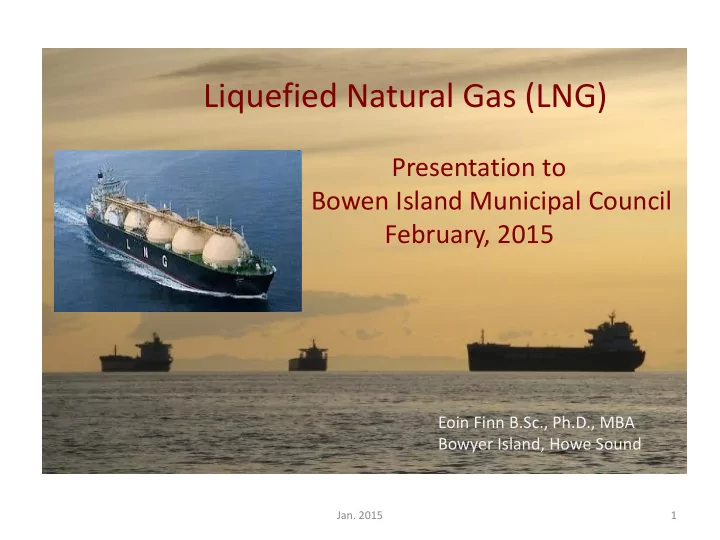
Liquefied Natural Gas (LNG) Presentation to Bowen Island Municipal - - PowerPoint PPT Presentation

liquefied natural gas lng
SMART_READER_LITE
LIVE PREVIEW

Liquefied Natural Gas (LNG) Presentation to Bowen Island Municipal - - PowerPoint PPT Presentation

Liquefied Natural Gas (LNG) Presentation to Bowen Island Municipal Council February, 2015 Eoin Finn B.Sc., Ph.D., MBA Bowyer Island, Howe Sound Jan. 2015 1 November, 2013: Howe Sound (Woodfibre) LNG Announcement Premier Clark .. Woodfibre


slide-1
SLIDE 1

Liquefied Natural Gas (LNG)

Presentation to Bowen Island Municipal Council February, 2015

Eoin Finn B.Sc., Ph.D., MBA Bowyer Island, Howe Sound

1

  • Jan. 2015
slide-2
SLIDE 2

November, 2013: Howe Sound (Woodfibre) LNG Announcement Premier Clark

slide-3
SLIDE 3

.. Woodfibre LNG is part of the effort to re-industrialize Howe Sound…

Incinerator LNG Plant Gravel Mill Gas Pipeline Run-of-river Hydro Gas Pipeline Gas Pipeline Gas Pipeline Run-of-river Hydro Woodlots Compressor

3 July, 2014

slide-4
SLIDE 4

Burnco Gravel Mine & Mill

July, 2014 4

  • Burnco wants to open-pit mine the estuary
  • f McNab Creek for sand & gravel
  • Proponent is a Calgary-based building

materials company

  • 1-4 million tonnes annually. 1-4 barge-loads

daily up/down the Sound past Bowyer/Passage

  • +12 jobs – none residing there. Job loss at

existing suppliers (Jervis Inlet, Port McNeil)

  • Turned down (twice) by DFO – no local

mitigation possible for loss of fish habitat

  • Status: In a Federal/Provincial joint Envir.

Assessment since early 2012

  • Issues: Mill noise (there are 17 cabins

there), loss of fish & wildlife habitat (and the $million spent rehabilitating past logging damage), siltation of eelgrass and glass sponge beds, light pollution, barge traffic

slide-5
SLIDE 5

Metro Vancouver Incinerator

  • Port Mellon – next to the Pulp Mill - is
  • ne of four locations shortlisted as a site

for locating Metro Vancouver’s incinerator (aka “Waste-to-Energy facility”)

  • Proponents include Aquilini Group and

Squamish First Nation (the land owner)

  • Closed-containment salmon farm next to

the incinerator

  • $500 million proposal is for “mass-burn”

technology – from Denmark

  • 370,000 tonnes waste p.a. would be

barged up Howe Sound (likely between Bowyer and Bowen)

  • Issues include air quality effects (GHGs, soot/particulates/dioxans, safe disposal of

fly-ash and contaminated residual ash, landfill smells), barge traffic, “play or pay” contract terms and health effects on locals (asthmatics especially)

  • Status: Very contentious. Still in feasibility, selection stage at Metro Vancouver.

Gambier Island LTC has commented negatively to Metro’s Maria Harris

April 18, 2014 5

slide-6
SLIDE 6

The promise(s) of LNG

  • 75,000 long-term jobs. Maybe!
  • British Columbians first in line for those jobs

(but BC has signed an agreement with China for LNG TFWs)

  • A debt-free BC. (BC’s current provincial debt is ~ $69

billion*)

  • “Cleanest fossil fuel on the planet” = cleaner

air (in China. Not counting fugitive emissions)

July, 2014 7

* not counting BC Hydro’s multi-billion$$ run-of-river contractual commitments

slide-7
SLIDE 7

NEB approved 9 BC LNG export projects

October, 2014 8

slide-8
SLIDE 8

UBCM Resolution (2008)

WHEREAS the waters of Georgia and Malaspina Straits provide a vital habitat for diverse bird and fish species, a corridor for commercial and recreational marine traffic and an attraction for upland settlement; AND WHEREAS WestPac LNG is soliciting interest to build an LNG import facility and associated 600MW gas-fired electricity generating plant on Texada Island, which will involve the passage of a significant number of LNG tankers in the Georgia Strait, which will interfere with existing marine traffic, put at risk these ecologically important and sensitive inland waters, and negatively impact upland development along this route: THEREFORE BE IT RESOLVED that the UBCM urge the federal government to ban the passage of LNG tankers in the waters of the Malaspina, Georgia, Juan de Fuca and Haro Straits, and Boundary Pass.

9 July, 2014

slide-9
SLIDE 9

.. A typical LNG tanker is big!

150,000 tonnes DWT +60,000 tonnes LNG 300 metres long (3 football fields) 40 metres wide 30 metres tall

… compared to a BC ferry

slide-10
SLIDE 10

LNG Tankers – view from Bowyer Island!

slide-11
SLIDE 11

the view inside a membrane-type tank

13 June, 2014

slide-12
SLIDE 12

LNG tankers in Boston harbour get tight security

slide-13
SLIDE 13

International Maritime Dangerous Goods (IMDG) Code Classification System

The 9 classes:

Class 1 Explosives Class 2 Gases Class 3 Flammable liquids Class 4 Flammable solids Class 5 Oxidizing substances and organic peroxides Class 6 Toxic and infectious substances Class 7 Radioactive material Class 8 Corrosive substances Class 9 Miscellaneous dangerous substances & articles These 9 hazard classes have been established internationally by a United Nations (UN) committee to ensure that all modes of transport (road, rail, air and sea) classify dangerous goods in the same way.

IMDG Code reference: 2.0

Danger

slide-14
SLIDE 14

An LNG tanker spill would be lethal to a nearby population*

16 July, 2014 * Sources: U.S. Dept. of Energy/ Sandia National Labs Research Report on LNG Security & Safety, July, 2008 and 2009 http://www.narucmeetings.org/Presentations/NARUC_Committee_July22_08.pdf and http://www.safetybeforelng.ie/safetyresearch/sandialngpoolfiretestsonwater2009.pdf

slide-15
SLIDE 15

Worst case …. 50% fatalities out to 3.7 km*

17 July, 2014

slide-16
SLIDE 16

Howe Sound Safety Exclusion Zones (as recommended by Sandia)

  • Zone 1: 500 m. on each side of

transiting tanker

  • Zone 2: 1600m. on each side of

transiting tanker

  • Zone 3: 3500m. on each side of

transiting tanker

slide-17
SLIDE 17

Howe Sound (Woodfibre) LNG : 2.4 MTPA-Annual AIR emissions*

IF POWERED by GAS (10% of supply)

  • 735,000 T/a CO2 (=137,000 vehicles)
  • 487 T/a NOx (smog, = 27,000 vehicles)
  • 40 T/a SO2 ( = 170,000 vehicles)
  • 40 T/a PM2.5 ( = 70,000 vehicles)
  • Mercury (unknown)
  • Higher alkanes (unknown)
  • H2S (hydr. sulfide/rotten eggs- unknown)

IF POWERED by ELECTRICITY (140MW)

  • 142,000 T/a CO2 (=26,500 vehicles)
  • 50 T/a NOx (smog, = 3,000 vehicles)
  • 8 T/a SO2 ( = 34,000 vehicles)
  • 8 T/a PM2.5 ( = 14,000 vehicles)
  • Mercury (unknown)
  • Higher alkanes (unknown)
  • H2S (unknown)

*: Estimated based on comparable emissions from the Sabine Pass LNG facility, Texas

Flare stack Storage tankers (permanent) Liquefaction Plant

  • Admin. Buildings

Cooling towers

slide-18
SLIDE 18

Howe Sound (Woodfibre) LNG : Water, wildlife effects

  • Liquefaction plant will be cooled by sea-water from the Sound
  • Will discharge 17,000 tonnes* of this each hour (24x7x365) into the Sound
  • Discharge-pipe water temperature will be +100C above that of the intake
  • Hypochlorite will be added to the discharge to reduce growth, fouling

The effects on the Sound’s recovering marine life and mammals are unknown!

  • Transiting LNG Tankers, the liquefaction plant, storage tankers and the flare

stack will all transmit noise – over the water and through the water Noise effects on the Sound’s marine life are also little studied!

  • Light, sound and air pollution effects on other species – elk, grizzlies,

migratory birds etc. - are unknown.

*: 7 Olympic-sized 50m. swimming pools

Flare stack Storage tankers (permanent) Liquefaction Plant

  • Admin. Buildings

Cooling towers

slide-19
SLIDE 19

LNG tanker wakes may also be an issue in the Sound

  • 300m.-long LNG tankers will be travelling at 8-

12 knots in the Sound (80 transits p.a.)

  • Likely accompanied by tug(s) to Passage Is.
  • Bow and stern wave sizes unknown
  • Not practical to go slower (high windage,

minimum engine revs.)

  • Shoreline waves will be an issue for children
  • n beaches, floats/moorages, beach erosion
slide-20
SLIDE 20

Woodfibre and the Fortis pipeline lie directly on several fault lines

Source: http://www.cbc.ca/m/news/multimedia/every-fault-line-in-british-columbia-1.2919420

slide-21
SLIDE 21

The Gas comes form fracking operations in NE BC

slide-22
SLIDE 22
slide-23
SLIDE 23

… and a fracking area eventually looks like this..

July 2014 26

Natural gas wells in Wyoming

slide-24
SLIDE 24

..frustrating BC’s emission reduction plans..

BC’s GHG emissions reduction target

slide-25
SLIDE 25

But… the Asian LNG price has plummeted…

July, 2014 29

January 28th , 2015

slide-26
SLIDE 26

Woodfibre LNG and Fortis Eagle Mountain pipeline

45 days

slide-27
SLIDE 27

Woodfibre lies directly on several fault lines

Source: http://www.cbc.ca/m/news/multimedia/every-fault-line-in-british-columbia-1.2919420

Woodfibre Squamish

slide-28
SLIDE 28

Fortis (formerly Terasen) Pipeline

slide-29
SLIDE 29

Fossil fuel traffic in the Straits is set to increase dramatically ….

Canadian Source* Current (annual, 1-way) Proposed (annual, 1-way) Origin of Increase Oil/Dilbit Tankers 60 408 Trans Mountain Kinder Morgan Expansion LNG Tankers 510+ Woodfibre LNG 40+, Discovery/Quicksilver LNG 400+, Tilbury/Wespac/Fortis 70+? Coal Carriers 250 (25m. Tonnes) ~350 (35m. Tonnes) Westshore, DeltaPort/Texada expansions Coal Carriers ~480 Gateway Pacific (Cherry Point, Wa.)

Total 310 1,748 460% INCREASE!

*: U.S.-sourced oil tanker traffic to/from Port Angeles, Anacortes terminals will also increase

56 July, 2014

slide-30
SLIDE 30

This means more ship traffic in the Straits …and 5x greater collision, grounding risk

10am April 9 snapshot https://www.marinetraffic.com/en/ 57 July, 2014

slide-31
SLIDE 31

Hazard Areas – Tilbury to tidewater

slide-32
SLIDE 32

BC has missed the window of opportunity to export LNG to Asia

slide-33
SLIDE 33

.. as have BC’s 2000-2014 natural gas royalties… $2B in 2006; $169M in 2013

October, 2014 69

2006 2014 2000

At this rate, it will take 408 years to pay off BC’s provincial debt!

slide-34
SLIDE 34

2013: Oil & Gas, Mining

slide-35
SLIDE 35

A fair return for BC ? … not if we follow Alberta’s standards!

*: Economic Rents. Source: "Misplaced Generosity: Update 2012", Parkland Institute, U. of Alberta

More than $285 Billion of bitumen and synthetic crude oil profits have been produced from the tar sands, of which the oil companies’ share has been over $260 Billion, and the public’s less than 10% of that (< $25 Billion).

slide-36
SLIDE 36

The promises? of LNG

  • 75,000 long-term jobs?
  • British Columbians first in line for those jobs?

(but BC has signed an agreement with China for LNG TFWs)

  • A debt-free BC? (BC’s current provincial debt is ~ $69

billion*)

  • “Cleanest fossil fuel on the planet” = cleaner

air? (Maybe in China. Not counting fugitive emissions)

July, 2014 74

* not counting BC Hydro’s multi-billion$$ run-of-river contractual commitments