
SLIDE 1
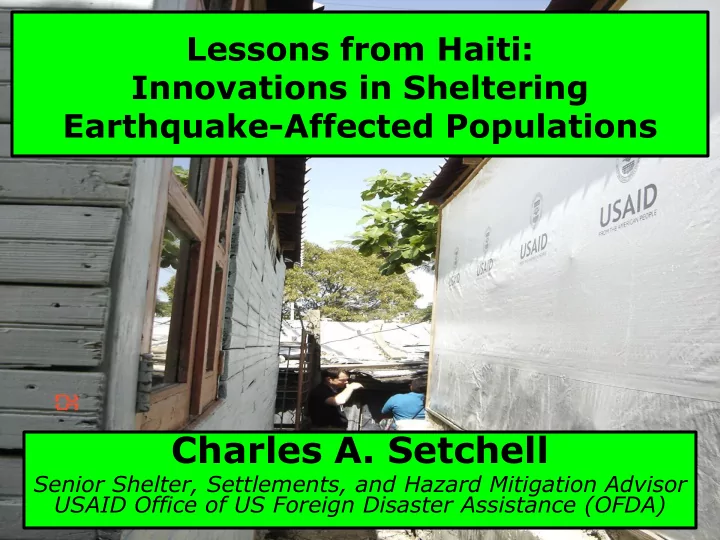
Lessons from Haiti: Innovations in Sheltering Earthquake-Affected Populations
Charles A. Setchell
Senior Shelter, Settlements, and Hazard Mitigation Advisor USAID Office of US Foreign Disaster Assistance (OFDA)
Lessons from Haiti: Innovations in Sheltering Earthquake-Affected - - PowerPoint PPT Presentation
Lessons from Haiti: Innovations in Sheltering Earthquake-Affected Populations Charles A. Setchell Senior Shelter, Settlements, and Hazard Mitigation Advisor USAID Office of US Foreign Disaster Assistance (OFDA) Shelter, the Humanitarian
Lessons from Haiti: Innovations in Sheltering Earthquake-Affected Populations
Charles A. Setchell
Senior Shelter, Settlements, and Hazard Mitigation Advisor USAID Office of US Foreign Disaster Assistance (OFDA)
Shelter, the Humanitarian Counterpart to Housing, Doesn’t Exist in a Vacuum, but in…
(the Places Where People Live, from Transit Centers to Mega-Cities)
The Location, Condition, and Management of Settlements…
Will largely determine whether they become the sites of future disasters
community responses
BY NOW YOU’VE SEEN
by nearly 1 of every 6 human beings
Basic Q: Who “Owns” the Debris??
How Much Debris?
From WP, 3-7-10
WHERE to Dispose of Minimum 1,000 Truckloads a Day for 1,000 Days??
A Critical Initial Challenge: Exchanging Bed Sheets for Plastic Sheets
USAID/OFDA “S&S” Outputs
($106.1 million, 26 percent of $404.3 million total)
500,000-600,000 people
(Approximately 70% evolving into permanent housing solutions)
5,501 damaged structures)
Greater than 47,500 “Shelter Solutions” Objective (approx. $1,695 per HH)
Tracking Displacement as Clue for Assistance
Hosting Support
Hosting (“STEALTH” Shelter) Really Does Work
family, friends, neighbors, etc.
arrive on the scene, i.e., self-selected,
sheltering, and
In Haiti, 70% of OFDA hosting support apparently evolving into permanent housing solutions.
Assessing Damage to Inform Repair Programs
“TS” Not New; Rooted, in part, in “Earthquake Refugee Shacks,” San Francisco, 1906
“EQ Shack” (actually two, and raised), being upgraded (again), 2003
The Utility of Shelter Assistance to Response and Recovery
So) jump-start and re-engage affected populations in the incremental, longer- term housing development process
DRR, and
vacuum, all the more reason to emphasize TRANSITION and CONTEXT.
Settlements-based Activities
and NGO Agencies to Engage in “Emergency Urban Planning”
Neighborhood-based projects
Neighborhood Approach in Concept
…To This:
Multiple Shelter Solutions in Context
First-ever Two-Story “TS” Produced by “HA” Community, Reflecting Context
BEYOND THE TWO-STORY T-S AND HOOPLA OF THE “NA” EFFORT IN HAITI…
through settlements planning process
routes, improved drainage, etc., i.e., safer shelters and a safer settlement
for shelter, and ALSO changed market for land, making pre-event vacant land more valuable. We’re facilitating the upgrading of lots to permanent housing!
Also Beyond the Hoopla: Upgrading
Side-by-Side, with “Complete” and “In Progress” Stages, Based on Re-engaging Pre-Event Processes
“TS” Upgrading to Permanence
GETTING FROM THIS…
To This NOT the Responsibility of the Humanitarian Community, but…
Re-conceiving the Road to Recovery Requires Re- conception of Core Processes
RRR: Recognizing The Centrality of Settlements
all” context for shelter interventions
the focus from households and shelter to neighborhoods and larger communities, and
particularly useful in urban areas.
RRR: FOCUSING ON SETTLEMENTS SIDE OF SECTOR
Issue is LAND
Nothing Would Happen, so Something’s
it Out Sooner
30% of land area due to Rubble, making sheltering all the more difficult, and
preferred over “clear cut” efforts; requires creative “S&S” work (e.g., settlements planning and
land readjustment)
RRR: HA Actors Can Help “Frame” the Future
reconstruction is critical; this includes “emergency master planning,” as most official plans are aspirational, perhaps even inspirational, but not operational
removal of 1.2 million people from city, based on view that it was “too big”.
RRR: URGENT NEED TO PLAN THE CONFIGURATION AND RECONFIGURATION OF RISK- PRONE SETTLEMENTS
Challenges Remain: Exchanging Plastic Sheets for Longer-term Shelter
… and the Transformation of “Pledged Funds” to “Completed Projects”
Status of $5.3 B Pledged at March 2010 International Donors Conference for Recovery:
Disbursed - 53.2%, $2.837 B
(up from 45.3% in April 2012)
Committed - 38.7%, $2.063 B Pending - 8.1% $432.69 M
Note: This analysis does not include funds pledged for humanitarian relief activities. It is also exclusive of pledges made by privately funded organizations at the New York donors’ conference. Source: http://www.haitilibre.com/en/news-5492-haiti-reconstruction-between-pledges-and-disbursements.html Some Final “Take-Aways”…
THANK YOU FOR YOUR TIME AND ATTENTION. QUESTIONS?
CSETCHELL@USAID.GOV