Leerstrategien inzetten en evalueren bij gebruik maken van - - PowerPoint PPT Presentation

leerstrategie n inzetten en evalueren bij
SMART_READER_LITE
LIVE PREVIEW

Leerstrategien inzetten en evalueren bij gebruik maken van - - PowerPoint PPT Presentation

8/02/18 Inleiding : Plaats van leerstrategien Bij het uitvoeren van de gesprekstaken kunnen de leerlingen rekening houden met de belangrijkste conventies bij mondelinge interactie; het doel van de interactie bepalen en hun taalgedrag


slide-1
SLIDE 1

8/02/18 VELOV Congres - 8 februari 18 - Joelle.DePessemier@kuleuven.be 1 Leerstrategieën inzetten en evalueren bij taaltaken

Joelle.DePessemier@kuleuven.be SLO Talen - Frans

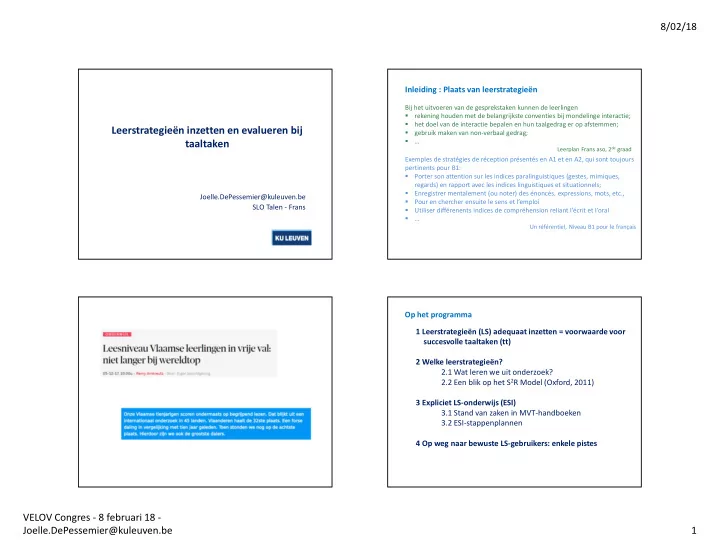
Inleiding : Plaats van leerstrategieën

Bij het uitvoeren van de gesprekstaken kunnen de leerlingen

  • rekening houden met de belangrijkste conventies bij mondelinge interactie;
  • het doel van de interactie bepalen en hun taalgedrag er op afstemmen;
  • gebruik maken van non-verbaal gedrag;

Leerplan Frans aso, 2de graad

Exemples de stratégies de réception présentés en A1 et en A2, qui sont toujours pertinents pour B1:

  • Porter son attention sur les indices paralinguistiques (gestes, mimiques,

regards) en rapport avec les indices linguistiques et situationnels;

  • Enregistrer mentalement (ou noter) des énoncés, expressions, mots, etc.,
  • Pour en chercher ensuite le sens et l’emploi
  • Utiliser différenents indices de compréhension reliant l’écrit et l’oral

Un référentiel, Niveau B1 pour le français

1 Leerstrategieën (LS) adequaat inzetten = voorwaarde voor succesvolle taaltaken (tt) 2 Welke leerstrategieën? 2.1 Wat leren we uit onderzoek? 2.2 Een blik op het S2R Model (Oxford, 2011) 3 Expliciet LS-onderwijs (ESI) 3.1 Stand van zaken in MVT-handboeken 3.2 ESI-stappenplannen 4 Op weg naar bewuste LS-gebruikers: enkele pistes Op het programma

slide-2
SLIDE 2

8/02/18 VELOV Congres - 8 februari 18 - Joelle.DePessemier@kuleuven.be 2

1 LS adequaat inzetten = voorwaarde voor succesvolle tt.

Taaltaken tonen wat de leerder ‘echt’ kan.

Implicaties voor de leerder

  • Extra aandacht voor context,

communicatie en cultuur

  • OVUR-strategieën = onmisbaar
  • Impact van motivatie = groot

Taaltaken

  • doelgericht en gefinaliseerd
  • verankerd in de werkelijkheid
  • De leerder kiest de middelen
  • en gaat over naar actie

Socio-culturele interactie Affectieve Procedure Cognitie

2 Welke leerstrategieën?

2.1 Wat leren we uit onderzoek?

  • Definitie: “activities consciously chosen by learners for the purpose of

regulating their own language learning” (Griffith, 2008)

  • Identificatie: LS zijn niet altijd observeerbaar
  • Referentiekader: classificatie volgens
  • vaardigheid (Cohen & Weaver, 2006)
  • functie (O’ Malley & Chamot, 1990 - Oxford,

2011)

  • Explicit Strategy Instruction (ESI):
  • vakoverstijgende vs vakgebonden
  • generiek vs taakgebonden
  • moedertaal vs doeltaal
  • expliciet vs impliciet

!

Enkele ‘issues’

Consensus Explicit Strategy Instruction (ESI)

  • Het metacognitief begrip van de meerwaarde van LS bij taalleerders
  • ntwikkelen is belangrijk.
  • Taalleerders moeten strategieën kunnen inoefenen.
  • Ze moeten ook de kans krijgen om hun inzet van strategieën te evalueren.

(Cohen, 1998 - Chamot, 1999 – Graham & Harris, 2003)

2.2 Een blik op het Strategic Self Regulating (S²R) Model van

  • R. Oxford (2011)

Cognitive strategies

Help the learners construct, transform and apply L2 knowledge

Affective strategies

Help the learner create positive emotions and attitudes and stay motivated

Sociocultural-Interactive strategies (SI)

Help the learner interact to learn and communicate and deal with culture

1 Using the Senses to Understand and Remember 2 Activating Knowledge 3 Reasoning 4 Conceptualizing with Details 5 Conceptualizing Broadly 6 Going Beyond the Immediate Data 1 Activating Supportive Emotions, Beliefs, and Attitudes 2 Generating and Maintaining Motivation 1 Interacting to Learn and Communicate 2 Overcoming Knowledge Gaps in Communicating 3 Dealing with Sociocultural Contexts and Identities

Metastrategies

Help the learner manage the cognitive, affective and SI dimension

slide-3
SLIDE 3

8/02/18 VELOV Congres - 8 februari 18 - Joelle.DePessemier@kuleuven.be 3

Metastrategies

help the learner manage the cognitive, affective and SI dimension

Metastrategies for general management and control

  • Paying attention
  • Planning
  • Obtaining and using resources
  • Organizing
  • Implementing Plans
  • Orchestrating Strategy Use
  • Monitoring
  • Evaluating

= OVUR-strategieën ‘Metacognitive strategies’ - voorbeelden Planning for Cognition Orchestrating Cognitive Strategy Use Monitoring Cognition Evaluating Cognition … Setting cognitive goals … for balance Monitoring cognitive performance during a task Evaluating cognitive strategy use I think about the textbook’s stated

  • bjectives for a lesson and then set

my own goals. I have to think about which strategies to use for what purposes, and I try to tie them together in a balanced way so I can do what I want to do. I look for mistakes while I am writing in French by using the spelling and grammar checker on the computer. At the end of every unit in my ESL textbook, there is a checklist that helps me think about the strategies I

  • used. I consider whether they worked

for me. ‘Cognitive strategies’ - voorbeelden Using the Senses to Understand and Remember Activating Knowledge Reasoning Conceptual- izing with Details Conceptual- izing Broadly Going Beyond the Immediate data … Using the auditory sense to understand and remember Brainstorming Using inductive reasoning Making distinctions Combining similar things Predicting The background noise on the Russian CD helps me understand the meaning. I brainstorm aloud with a small group what we know about the topic. I try to figure out the grammar rules in Russian based on the evidence from my newspaper readings in Izvestiya. I distinguish between more important and less important information that I read in Hungarian. I create a semantic map linking ideas. I predict what will be said on the TV based on facts I have picked up in the newspaper. ‘Meta-affective strategies’ - voorbeelden Planning for Affect Obtaining and Using Ressources for Affect Monitoring Affect Evaluating Affect … Setting affective goals … technological ressources Monitoring affective state during a task Evaluating affective progress and states I want to learn to relax when doing the listening exercises in this lesson. I find blogs and websites to learn more about reducing my anxiety in language learning. I monitor how I am feeling when my thoughts wander. Am I interested? Am I unmotivated? Am I physically fatigued? Am I feeling overwhelmed? In considering how well I did in writing the essay, I thought about how much was in my control and how much was out of my control

slide-4
SLIDE 4

8/02/18 VELOV Congres - 8 februari 18 - Joelle.DePessemier@kuleuven.be 4

‘Affective strategies’ - voorbeelden Activating Supportive Emotions, Beliefs, and Attitudes Generating and Maintaining Motivation … Using positive self- talk for the short term Increasing intrinsic motivation Increasing extrinsic motivation I use positive self-talk (“I know I can do this”) to get started on the next Hebrew task. I listen to music in the language, and this makes me very excited and happy. I remind myself that I will get to watch a film when I finish this task, and that keeps me motivated. ‘Meta-SI strategies’ - voorbeelden Obtaining and Using Resources for Contexts, Communica- tion and Culture Monitoring for…. Evaluating for… … … print resources Monitoring cultural understanding and communication Evaluating effectiveness

  • f strategy use for

communication I read everything I could about the

  • country. This did not help me with

producing the language, but it made me more comfortable talking with native speakers. I monitor whether I still have the trust of the native speaker throughout the conversation, and this tells me whether I am effectively using my understanding of the situation. I ask mysef whether I relied too much

  • n masking, gestures, and asking for

repetition during the last task I did. ‘SI strategies’ - voorbeelden Interacting to Learn and Communicate Overcoming Knowledge Gaps in Comm. Dealing with Sociocultural Contexts … Asking for explanation, clarification… Using other words to continue to comm. Exploring the meaning of social roles, identity, power and the media I ask for help to understand the meaning of “acid rain” in the article. If I don’t know a word, I “talk around it”. I try to understand the cultural beliefs in the statements of a TV news commentator.

Meerwaarde van het S²R Model van R. Oxford

  • Overzichtelijk en operationeel referentiekader
  • Erkenning van
  • Metastrategieën die ook de SI en affectieve strategieën

reguleren

  • SI-strategieën die de rol van de context erkennen
  • Affectieve strategieën die de attitudes kunnen

beïnvloeden

  • Erkenning van het belang van metastrategieën

> ‘self-regulated learner’ = gaat bewust om met strategieën

slide-5
SLIDE 5

8/02/18 VELOV Congres - 8 februari 18 - Joelle.DePessemier@kuleuven.be 5

3 Expliciet leerstrategieënonderwijs (ESI)

3.1 Stand van zaken in MVT-handboeken

Vaststellingen

  • Hoe?
  • in instructies, onder vorm van ‘tools& tips’,

handleiding, zelfevaluatieroosters…

  • meestal taakgericht maar stilaan meer aandacht voor

generieke aanpak

  • impliciet bij de receptieve vaardigheden, ook expliciet

bij de productieve

  • meestal in doeltaal
  • Welke strategieën?
  • overwegend cognitieve en metacognitieve
  • zeer weinig SI en affectieve (meta)strategieën

Source: Réussir le DELF B1, Didier, Paris Source: Strategy Guide Spark, Pelckmans

“No one best way to conduct strategy instruction” (Cohen, 2011) Drie aandachtspunten in ESI

  • inzet + meerwaarde van LS bespreken met leerlingen
  • leerlingen aanmoedigen om bewust LS in te zetten +

te transponeren

  • tools aanreiken om de inzet van LS te controleren en

te evalueren = inzetten op metastrategieën

3.2 ESI-stappenplannen

slide-6
SLIDE 6

8/02/18 VELOV Congres - 8 februari 18 - Joelle.DePessemier@kuleuven.be 6

Twee modellen ESI-stappenplannen

Chamot (2009) 4 stappen 1 Planning: The instructor presents the students with a language task and explains the rationale behind it. Students are then asked to plan their approach to the task, choosing S that they think will facilitate its completion. 2 Monitoring: During the task, the students are asked to “self-monitor” their performance by paying attention to their S use and checking comprehension. 3 Problem solving: As they encounter difficulties, the students are expected to find their own solutions. 4 Evaluation: After the task had been completed, the learners are then given time to debrief the activity by evaluating the effectiveness of the S that they used during the task. Oxford (1990, updated 2006) 6 stappen 1 Prepare: Identify Current Strategies, Raise Initial Awareness (identificatie) 2 Continue to Raise Awareness (‘cold’-task zonder ESI + bespreking) 3 Model and Name Strategies 4 Practise (oefenen + ‘strategy chains’) 5 a Evaluate and Transfer b Expand and Adapt 6 Learners continue to increase Ownership

  • Tools aanreiken: zelfevaluatieroosters, generieke “Strategy Guides”
  • LS meer opnemen in de eerste stappen van het didactisch proces:
  • ok receptieve LS expliciteren (zie bundel)
  • eerst eigenschappen van tekstsoorten laten herkennen

+ inoefenen (zie bundel) dan pas de taaltaak laten uitvoeren

  • producties van taalleerders bespreken (vb. opnames CIEP)
  • Coöperatief leren > ervaringen i.v.m. LS laten delen

www.carla.umn.edu/strategies/sp_grammar

  • Overleg binnen MT-vakgroep > visie ontwikkelen

4 Op weg naar bewuste LS-gebruikers: enkele pistes Om verder te gaan

  • Oxford, R. (2011) Teaching and Researching Language Learning
  • Strategies. London, Routledge
  • Cohen, A. (2011) Strategies in Learning and Using a Second
  • Language. London, Routledge
  • Chamot, A.U. (2005) Language learner strategy instruction:

Current Issues and research. Annual Review of Applied Linguistics, 25, 112-30

  • Griffith, C. & Oxford, R. (2014) Twenty-first century landscape
  • f language learning strategies. System, 43, 1-10

ESI:

  • Cohen, D. & Weaver S. (2013) Styles- and Strategies-Based

Instruction: A Teacher’s Guide, Minneapolis, Carla Illustratiemateriaal:

  • Spark, Strategy Guide, Kappelen, Pelckmans
  • Insight, Upper-Intermediate Student’s Book, Oxford, Oxford

U.P.

  • Life Upper Intermediate B2, Handover, National Geographic

Learning

  • Coup de Pouce 3, Mechelen, Plantyn
  • Quartier français 4, Kappelen, Pelckmans
  • Alter Ego 3 B1, Paris, Hachette FLE