EAVISE: VIPER Visual Person Detection made Reliable - Research - - PDF document

eavise
SMART_READER_LITE
LIVE PREVIEW

EAVISE: VIPER Visual Person Detection made Reliable - Research - - PDF document

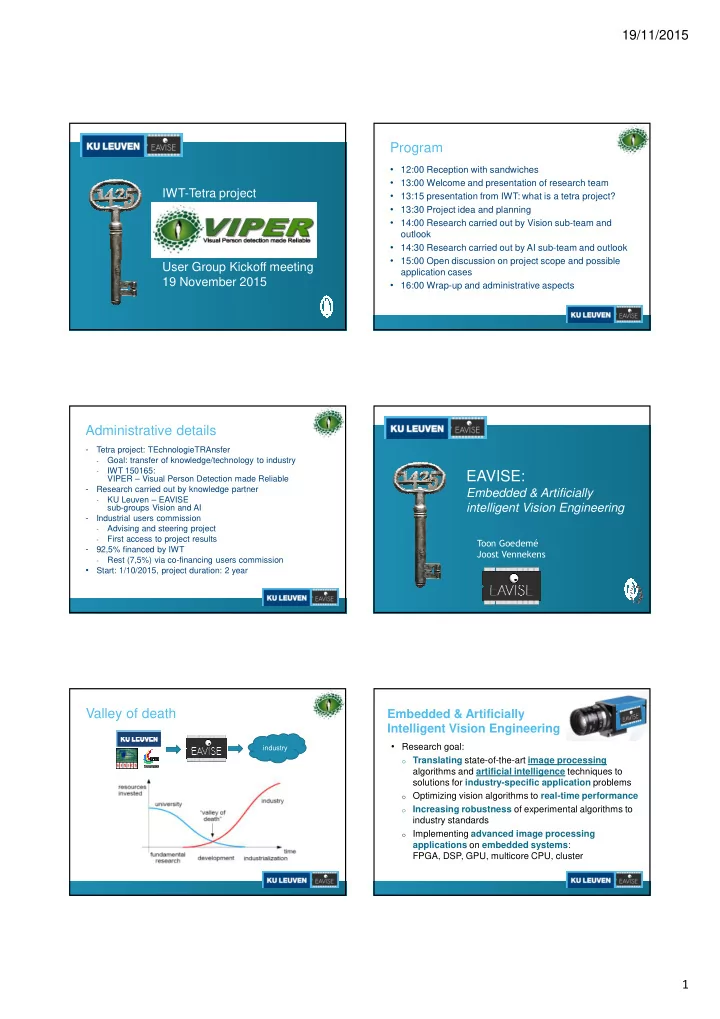
19/11/2015 Program 12:00 Reception with sandwiches 13:00 Welcome and presentation of research team IWT-Tetra project 13:15 presentation from IWT: what is a tetra project? 13:30 Project idea and planning 14:00 Research carried


slide-1
SLIDE 1

19/11/2015 1

IWT-Tetra project User Group Kickoff meeting 19 November 2015

Program

  • 12:00 Reception with sandwiches
  • 13:00 Welcome and presentation of research team
  • 13:15 presentation from IWT: what is a tetra project?
  • 13:30 Project idea and planning
  • 14:00 Research carried out by Vision sub-team and
  • utlook
  • 14:30 Research carried out by AI sub-team and outlook
  • 15:00 Open discussion on project scope and possible

application cases

  • 16:00 Wrap-up and administrative aspects

Administrative details

  • Tetra project: TEchnologieTRAnsfer
  • Goal: transfer of knowledge/technology to industry
  • IWT 150165:

VIPER – Visual Person Detection made Reliable

  • Research carried out by knowledge partner
  • KU Leuven – EAVISE

sub-groups Vision and AI

  • Industrial users commission
  • Advising and steering project
  • First access to project results
  • 92,5% financed by IWT
  • Rest (7,5%) via co-financing users commission
  • Start: 1/10/2015, project duration: 2 year

EAVISE:

Embedded & Artificially intelligent Vision Engineering

Toon Goedemé Joost Vennekens

Valley of death

industry

Embedded & Artificially Intelligent Vision Engineering

  • Research goal:
  • Translating state-of-the-art image processing

algorithms and artificial intelligence techniques to solutions for industry-specific application problems

  • Optimizing vision algorithms to real-time performance
  • Increasing robustness of experimental algorithms to

industry standards

  • Implementing advanced image processing

applications on embedded systems: FPGA, DSP, GPU, multicore CPU, cluster

slide-2
SLIDE 2

19/11/2015 2 People@EAVISE

  • Prof. Toon Goedemé

research leader Computer Vision

  • Prof. Joost Vennekens

research leader AI & KR Kristof Van Beeck blind spot cam Wim Abbeloos 3D bin picking Dries Hulens robotic UAV Sander Beckers Actual causality Stijn De Beugher Eyetracking Steven Puttemans

  • bject detection

Wiebe Van Ranst Person detection startup Bram Aerts KR for cinematography Sander Grielens robot-vision calibration Andy Warrens IR person detection Shana Van Dessel timetabling Kristof Van Engeland AI surveillance Floris De Smedt Person detection startup Inge Coudron visual navigation

START UP

AI VISION

People@EAVISE

  • Prof. Toon Goedemé

research leader Computer Vision

  • Prof. Joost Vennekens

research leader AI & KR Kristof Van Beeck blind spot cam Wim Abbeloos 3D bin picking Dries Hulens robotic UAV Sander Beckers Actual causality Stijn De Beugher Eyetracking Steven Puttemans

  • bject detection

Wiebe Van Ranst Person detection startup Bram Aerts KR for cinematography Sander Grielens robot-vision calibration Andy Warrens IR person detection Shana Van Dessel timetabling Kristof Van Engeland AI surveillance Floris De Smedt Person detection startup Inge Coudron visual navigation

VIPER

START UP

People@EAVISE

  • Prof. Toon Goedemé

research leader Computer Vision

  • Prof. Joost Vennekens

research leader AI & KR Kristof Van Beeck blind spot cam Wim Abbeloos 3D bin picking Dries Hulens robotic UAV Sander Beckers Actual causality Stijn De Beugher Eyetracking Steven Puttemans

  • bject detection

Wiebe Van Ranst Person detection startup Bram Aerts KR for cinematography Sander Grielens robot-vision calibration Andy Warrens IR person detection Shana Van Dessel timetabling Kristof Van Engeland AI surveillance Floris De Smedt Person detection startup Inge Coudron visual navigation

Example projects

EAVISE: some statistics

  • Personnel:
  • 2 research leaders
  • 11 internal researchers
  • 30+ projects since 2008:
  • 9 IWT-tetra
  • 10 KMO-portefeuille
  • 9 IWT O&O
  • 1 KUL-GOA, 1 IWT-SB
  • 84 international publications since 2008
  • 9 book chapters
  • 12 journal articles
  • 55 conference papers
  • 18 publications in 2015
  • Awards:
  • Best paper award at CVPR Embedded Vision Workshop, 2015
  • Best poster award at TC ESAT/CW Research Day, 2015

(potential) industrial users group

slide-3
SLIDE 3

19/11/2015 3 Program

  • 12:00 Reception with sandwiches
  • 13:00 Welcome and presentation of research team
  • 13:15 presentation from IWT: what is a tetra project?
  • 13:30 Project idea and planning
  • 14:00 Research carried out by Vision sub-team and
  • utlook
  • 14:30 Research carried out by AI sub-team and outlook
  • 15:00 Open discussion on project scope and possible

application cases

  • 16:00 Wrap-up and administrative aspects

Gebruikersgroep VIPER

rol en werking van de gebruikersgroep

Tom Heiremans – 19/11/2015

Doelstelling Collectieve programma’s

De belangrijkste doelstelling van onze collectieve programma’s is het verhogen van de kennis en competitiviteit van bedrijven. De resultaten die voortvloeien uit collectieve projecten moeten op korte of lange termijn leiden tot een economische meerwaarde bij de bedrijven.

TETRA

= TETRA project = voor TETRA project = na TETRA project

Rol van de Gebruikersgroep

slide-4
SLIDE 4

19/11/2015 4 Rol van de Gebruikersgroep

  • Bevestigen valorisatiepotentieel van het project voor hun bedrijf of
  • rganisatie via cofinanciering en valorisatie-intenties
  • Ondersteunen projectaanvragers
  • bij het opmaken van de aanvraag; werkplan; … (input)
  • nemen actief deel aan gebruikersgroep
  • hebben een actieve rol bij valorisatie-activiteiten
  • Zijn een klankbord voor de projectuitvoerders
  • Verwerven kennis tijdens het project en zorgen dat projectresultaten

achteraf nuttig kunnen ingezet worden in hun onderneming of een andere onderneming

Rol van de Gebruikersgroep

  • Eigenaar van de projectresultaten = projectconsortium

(hoofdaanvrager + partner(s))

  • Algemene inzichten worden ruim verspreid
  • Economisch valoriseerbare resultaten

transfer van eigendoms- of gebruiksrechten (licenties)

  • niet-exclusief
  • aan marktconforme voorwaarden
  • elk geïnteresseerd bedrijf/organisatie in de EU
  • Leden van de gebruikersgroep
  • hebben geen preferente toegang tot de projectresultaten
  • kunnen bijdrage in cofinanciering in mindering brengen
  • indien nodig (tijdelijke) geheimhoudingsovereenkomst

Rol van de Gebruikersgroep

On-line bevraging van de leden van de gebruikersgroep <GebruikersPoll>

  • IWT heeft een elektronische tool uitgewerkt voor de
  • unieke registratie van de leden van de gebruikersgroep
  • bevraging van de (aanwezige) leden na elke vergadering
  • Het gaat in eerste instantie om de doelgroepbedrijven
  • De bedoeling is om in overleg met de gebruikersgroep

en binnen de doelstellingen, het project nog beter af te stemmen op de verwachtingen

  • Feedback wordt besproken op de volgende vergadering

Rol van de Gebruikersgroep

  • In welke mate is het onderwerp van het project nog steeds relevant voor uw onderneming

{scoren op schaal (i) zeer relevant; (ii) relevant, (iii) neutraal, (iv) minder prioritair, (v) niet langer relevant }

  • Hoe scoort u het projectverloop en de tot nu toe behaalde projectresultaten in functie van de te bereiken

doelstellingen? { scoren op schaal (i) minder dan voorzien , (ii) zoals voorzien, (iii) beter dan voorzien

  • Hoe tevreden bent u over de ruimte voor interactie en sturing door de ondernemingen (gebruikers)

binnen het project? { scoren op schaal : (i) zeer tevreden, (ii) tevreden, (iii) neutraal, (iv) ontevreden, (v) zeer ontvreden}

  • Hoe tevreden bent u met de behandelde punten in de gebruikersgroepvergaderingen?

{ scoren op schaal : (i) zeer tevreden, (ii) tevreden, (iii) neutraal, (iv) ontevreden, (v) zeer ontvreden; Indien (iv) of (v) korte toelichting geven}

  • Hoe hoog scoort u de (mogelijke) toepassing van concrete, bruikbare resultaten bij uw eigen
  • nderneming (of uw ledenbedrijven) op korte termijn?

[KT is tijdens of < 1 jr na afloop] { scoren op schaal: (i) de resultaten worden al toegepast in de onderneming (ii) de resultaten zullen wellicht binnen het jaar na afloop van het project worden toegepast in de onderneming, (iii) de resultaten zijn tot op heden

  • p kt niet bruikbaar voor de onderneming, maar mits bedrijfsspecifiek vervolgonderzoek wel nog mogelijk in de

toekomst (iv) de resultaten blijken niet bruikbaar voor de onderneming }

AIO Algemeen Wat kan AIO nog voor u doen?

O&O-bedrijfs-projecten & ICON

Baekeland mandaten

  • nderzoek
  • ntwikkeling

engineering

AIO (IWT) subsidies voor innovatie

ideeën- generatie bedrijfstype O&O- H- studies kmo- innovatie- projecten kmo grote

  • nderneming
(of kmo met groot project)

technologieverkenning fase van innovatie

haalbaar- heidsstudie financiële steun voor bedrijven

projectkos t

€ 10.000 € 100.000 € 1.000.000 Baekeland mandaten kmo-haalbaarheid- studies

slide-5
SLIDE 5

19/11/2015 5

25

meer informatie

  • via het VIN-netwerk : zie www.innovatienetwerk.be
  • p onze website : www.iwt.be onder ‘subsidies’
  • Kijk ook eens naar : http://www.iwt.be/nieuws/cases
  • Website AIO: http://www.vlaio.be/
  • rechtstreeks bij het IWT : voorbespreking (IWT-bedrijfsprojecten@iwt.be of

kmo.programma@iwt.be )

Koning Albert II-laan 35, bus 16 B-1030 Brussel Tel.: +32 (0)2 432 42 00 Fax.: +32 (0)2 432 43 99 E-mail: info@iwt.be www.iwt.be agentschap voor Innovatie door Wetenschap en Technologie

Contact: Tom Heiremans THE@iwt.be 02 432 43 04

Program

  • 12:00 Reception with sandwiches
  • 13:00 Welcome and presentation of research team
  • 13:15 presentation from IWT: what is a tetra project?
  • 13:30 Project idea and planning
  • 14:00 Research carried out by Vision sub-team and
  • utlook
  • 14:30 Research carried out by AI sub-team and outlook
  • 15:00 Open discussion on project scope and possible

application cases

  • 16:00 Wrap-up and administrative aspects

Project abstract

  • Camera-based safety and security

systems

  • Real-time reaction on incidents?
  • Manual monitoring
  • Automatic processing and incident

detection

  • Needed components:

1.

Very reliable detection of persons in camera images

2.

Reasoning system that can decide if an alarm must be generated

Enabling factors

  • State-of-the-art person detection algorithms show

astonishing results

  • Accuracy great on standard benchmark data sets
  • EAVISE succeeded in running these in real-time on

limited hardware

  • Both open source and commercial-grade

implementations available

  • Price of LWIR-cameras descends steeply, with increasing

resolution

  • Knowledge-representation based probabilistic reasoning
  • ffers potential to analyse each situation

Project idea

  • Making people detection reliable,

also in difficult circumstances (fog, smoke, rain, dust, motion blur, …):

  • Combine RGB and LWIR

camera

  • Adapt state-of-the-art person

detection algorithms for this sensor combination

  • Use probabilistic KR for analysis
  • f situation: must an alarm be

generated?

slide-6
SLIDE 6

19/11/2015 6 Project goals

  • Developing a sensor combination and software for ultra-

reliably detecting people in real-time

  • Composing a real-life reference image database for

evaluating person detection techniques in difficult circumstances

  • Studying techniques for automatic analysis of the observed

situation and classification as normal or abnormal

  • Studying the certification procedure for camera-based safety

and security systems

  • The demonstration and dissemination of the project results

via 5 real-life user cases

  • Supporting industrial companies to adopt the developed

techniques in their products and services

Work packages

WP1: Hardware WP4: Evaluation and dissemination 1.A Study on sensors 1.B Hardware imple- mentation & calibration 1.C Benchmark database WP2: Person detection 2.A Study on algorithms 2.B Person detection SW implementation 2.C Evaluation on Benchmark database WP3: Alarm system 3.A Study on AI 3.B Learning of ranking 3.C Online learning 3.D Evaluation 4.A User Cases 4.B Evaluation and documentation 4.C Study on certification and legal aspects 4.D Broad dissimination

Planning

Q1 Q2 Q3 Q4 Q5 Q6 Q7 Q8 WP1.A: Study on sensors WP1.B: Hardware realisation and calibration WP1.C: Benchmark database

MP8

WP2.A: Study on algoriths for person detection WP2.B: Implementation algorithm person detection

MP6

WP2.C: Evaluation on benchmark database

MP7

WP3.A: Study on learning alarm system WP3.B: Learning of ranking WP3.C: Online learning WP3.D: Evaluation on benchmark database

MP7

WP4.A: User cases

MP1 MP2 MP3 MP4 MP5

WP4.B: Evaluation and documentation

MP7

WP4.C: Certification & legal aspects

MP9

WP4.D: Broad dissemination and networking

MP9

Program

  • 12:00 Reception with sandwiches
  • 13:00 Welcome and presentation of research team
  • 13:15 presentation from IWT: what is a tetra project?
  • 13:30 Project idea and planning
  • 14:00 Research carried out by Vision sub-team and
  • utlook
  • 14:30 Research carried out by AI sub-team and outlook
  • 15:00 Open discussion on project scope and possible

application cases

  • 16:00 Wrap-up and administrative aspects

Research Vision part

Overview:

  • 1. Person detection algorithms overview
  • 2. Results on RGB person detection
  • 3. IR camera market study
  • 4. How to combine RGB and IR for person detection?

What is pedestrian detection?

  • Localize pedestrian appearances in an image/dataset
  • pedestrian detection

pedestrian recognition Floris

slide-7
SLIDE 7

19/11/2015 7 Pedestrian detection approach

37

  • Create a model for pedestrians
  • Examples of positives (pedestrians)
  • Examples of negatives (non-pedestrians)
  • Convert to feature representation
  • Good distinction between pedestrians and

background

  • Robust for scene changes (e.g. illumination)
  • Train a model
  • Machine Learning: Adaboost, Support Vector

Machines, Neural networks, …

  • Distinction between “Pedestrian” and “Background”
  • Intra-class variation: pedestrians can have many

appearances

Pedestrian detection approach

At every location…and multiple scales sliding window

38

Search the model in the image features (Sliding Window):

  • Calculate features at multiple

scales Feature pyramid

  • Similarity between the model and

the features forms the certainty of a pedestrian at that location

  • A threshold defines the boundary

between “background” and “detection”

  • Non-Maximum-Suppression
  • Sliding window results in

clusters of detections around pedestrians

  • NMS reduces this to only

the highest scoring detection

  • f each cluster
87.81 68.71 68.46 26.89 8.405

Pedestrian detection approach State-of-the-art detectors

40

  • Histogram of Oriented Gradients

[Dalal&Triggs, CVPR2005]

  • Uses gradient information
  • Deformable Part Models

[Felzenszwalb, CVPR2008]

  • Allows deformation of the

parts relative to the root- model

State-of-the-art detectors

41

Channel based detectors

  • Use both gradient and color information
  • Feature values are calculated as the sum of pixel values in

rectangles

  • Integral Channel Features [Dollár, BMVC2009]
  • 30 000 random rectangles inside model window
  • Aggregate Channel Features [Dollár, PAMI2014]
  • Approximation of the features at most scales
  • All possible squares of a specific size inside the model window
  • Squared Channel Features [Benenson, CVPR2014]
  • All possible squares of which the side is a multiple of that

specific scale

Measure accuracy

Precision vs. Recall Miss rate vs. False Positives per Image

42

Miss Rate: The share of pedestrians that is not found FPPI: Average number of false detections (non- pedestrian) per image Best point: bottom left Recall: share of pedestrians found Precision: share of detections that is a pedestrian Best point: top right

slide-8
SLIDE 8

19/11/2015 8 Result using our combination technique

43

[Floris De Smedt*, Kristof Van Beeck*, Tinne Tuytelaars and Toon Goedemé; The Combinator: optimal combination of multiple pedestrian detectors; ICPR 2014.] HOG ICF DPM

Accuracy

44

Reduction of 77% in false detections

Ground plane integration

  • For each scale we determine the boundaries on the ground
  • Extend this with pedestrians height

45

Ground plane constraint

46

Twofold advantage

  • Accuracy improvement by

avoiding false detections

  • Speed improvement by

reducing the search space

Application on mobile mapping blurring

[Steven Puttemans, Stef Van Wolputte and Toon Goedemé; Safeguarding privacy by reliable automatic blurring in mobile mapping images, submitted to VISAPP2016]

Detection of vulnerable road users in a truck’s blind spot

  • Critical real-time constraint!
  • 15 fps
  • (+ Response time)
  • Difficult view-point
  • Scale variation
  • Rotation
  • High accuracy

GPU-accelerated DPM

  • High speed

48

Generalised ground constraint Each position has a predictable scale & rotation Warping Window technique

[A warping window approach to real-time vision-based pedestrian detection in a truck’s blind spot zone, Van Beeck et al. (2012)]

slide-9
SLIDE 9

19/11/2015 9

Integration with Warping-Window approach

49

  • Search-space reduction
  • Kalman-based tracking-

by-detection framework

  • Warping-Window

ground plane constraint

  • Each track will be

evaluated individually by the hybrid framework

5 10 15 20 25 100 200 300 400 500 600 700

Detection speed Number of pedestrians per image Speed

FPS (frames per second) 140x75 Hz (detections per second) 140x75

Application evaluation

50

0.2 0.4 0.6 0.8 1 0.1 0.2 0.3 0.4 0.5 0.6 0.7 0.8 0.9 1 Recall Precision

Precision vs Recall

± 12.9x faster than Matlab implementation Speed-up by hybrid GPU-CPU implementation

20 pedestrians 25fps 500Hz

Demo movies blind spot detection Let a UAV follow a person

  • Goal: Steer autonomous

towards the pedestrian

  • On-board processing
  • Pedestrian detection
  • Pedestrian tracking
  • Controlling the UAV
  • Low computational power
  • Real-time constraint
  • ACF detector + adaptive

ground constraint

52

Experiments & results

[De Smedt, Floris, Hulens, Dries, Goedemé, Toon; On-Board Real- Time Tracking of Pedestrians on a UAV; Embedded Vision Workshop; CVPR2015.]

Study on IR sensors

Advantages: Better people detection

through body heat sensing

Sees clearly in complete

darkness without any illumination

Works in bright sunlight,

through smoke, dust or even light fog.

Disadvantages: Expensive Low image resolution

slide-10
SLIDE 10

19/11/2015 10 Study on IR sensors

heat wave radiation

Study on IR sensors

SWIR/NIR LWIR = heat radiation

Types of IR sensors

Micro bolometer (greater resolution) Thermopile (16x4, 1x8 pixels)

Other properties of IR sensors

NETD

  • Noise equivalent

temperature difference

  • Standard deviation of pixel

value

  • 50 – 150mK for uncooled

(at 30°C)

Field of view

Market study (1/2)

Manufacturer Name Price Resolution Omron D6T-8L-06 41.38 € 1x8 Omron D6T-44L-06 42.59 € 4x4 Melexis MLX90621 (obsolete) 50.43 € 16x4 Melexis MLX90620 59.55 € 16x4 FLIR Lepton 500-0643-00 160.93 € 80x60 FLIR Lepton 500-0659-01 168.29 € 80x60 FLIR Lepton 500-0690-00 168.29 € 80x60 Seek Thermal Compact 299.00 € 206x156 Seek Thermal Compact XR 349.00 € 206x156 Fluke Ti90 1,195.99 € 80x60 FLIR Tau2 160 1,400.00 € 160x128 FLIR Tau2 168 1,400.00 € 168x128 FLIR Tau2 162 1,400.00 € 162x128 FLIR FLIR Vue 336 1,499.00 € 336x256 DRS Technology Tamarisk 320 1,894.43 € 320x240 Fluke Ti100 1,995.99 € 160x120

Market study (2/2)

Manufacturer Name Price Resolution FLIR Quark 336 2,500.00 € 336x256 FLIR Quark 640 2,500.00 € 640x512 FLIR Tau2 324 2,500.00 € 324x256 FLIR Tau2 336 2,500.00 € 336x256 FLIR Tau2 640 2,500.00 € 640x512 FLIR FLIR Vue 640 2,999.00 € 640x512 Mobotix FlexMount S15 3,634.00 € 336x252 Acal Tamarisk 320 3,674.82 € 320x240 COX CX320 3,877.14 € 320x240 COX CX320 3,877.14 € 384x288 Mobotix AllroundDual M15 3,998.00 € 336x252 Fluke Ti200 5,495.99 € 200x150 COX CX640 5,503.03 € 640x480 Fluke Ti300 6,195.99 € 240x180 Xenics Gobi-384 7,500.00 € 384x288 Fluke Ti400 7,995.99 € 320x240

slide-11
SLIDE 11

19/11/2015 11 Market study

30-40 uncooled IR sensors 50% with a price under 2500,00 EUR 66% with a resolution larger than 350 px (in X direction)

0-500 1,0-1,5 1,5-2,0 2,0-2,5 2,5-3,0 3,0-3,5 3,5-4,0 4,0-4,5 4,5-5,0 5,0-5,5 5,5-6,0 6,0-6,5 6,5-8,0 8000+ 1 2 3 4 5 6 7 8 9 10 Aantal sensoren per prijsklasse Prijsklasse (1000 euro) n <100 100-150 150-200 200-250 250-300 300-350 350-400 400-450 450-500 500-550 550-600 600-650 2 4 6 8 10 12 14 Aantal sensoren per x-resolutie Resolutie in x-richting n

Market study

Selectie

Naam Prijs Resolutie FLIR Lepton 2 168,29 € 80x60 SEEK Thermal Compact 299,00 € 206x156 FLIR AX8 840 € 80x60 IR (640x480 RGB) FLIR Vue 336 1499,00 € 336x256

How to combine RGB person detection with IR cameras?

Multiple options:

  • 1. Person detection algorithms on IR data
  • 2. IR preprocessing + person detection on RGB images
  • 3. Person detection on RGB + IR verification
  • 4. Integrated IR+RGB person detection

IR RGB

Integrating IR in RGB person detection

  • Example: ICF detector

IR

Program

  • 12:00 Reception with sandwiches
  • 13:00 Welcome and presentation of research team
  • 13:15 presentation from IWT: what is a tetra project?
  • 13:30 Project idea and planning
  • 14:00 Research carried out by Vision sub-team and
  • utlook
  • 14:30 Research carried out by AI sub-team and outlook
  • 15:00 Open discussion on project scope and possible

application cases

  • 16:00 Wrap-up and administrative aspects

Research AI part

Overview:

  • Typical approach
  • Our own research focus
  • Use cases and needs of application?
slide-12
SLIDE 12
slide-13
SLIDE 13

19/11/2015 12 Cases

nr Test case Industrial partner Complexity image processing Safety critical Complexity AI Responsa- bility of the system 1 Security from fixed cameras Seris, Flir ITS, Melexis… * * ** * 2 Security from UAVs DroneMatrix, Xtendit, … *** * ** * 3 Safety from fixed cameras Havenbedrijf Antwerpen, WenZ, .. * *** * ** 4 Safety from manned driving vehicles CNHi, GrootJebbink, Dana, … ** *** * * 4bis Safety from unmanned driving vehicles MABO, Octinion, … ** *** * *** 5 Patient/sporter monitoring Sensolid, Alphatronics, Brenso, … * ** *** **

CNHi use case proposal 19th November 2015 68

Person detection in dust for agricultural (larger crops particles in Ag dust) and construction vehicles Person detection for commercial vehicles in difficult environmental condition with high reliability (>99,xx %?) in:

  • Blind spot all-around vehicle,
  • Vehicle path.

Data acquisition equipment and sensors from EAVISE. CNHi acquire data in real condition.

VIPER project: interesting use cases for CNHi

Spin-off

“Pedestrian Detection for real-life applications” (PhD F. De Smedt) Applications

Program

  • 12:00 Reception with sandwiches
  • 13:00 Welcome and presentation of research team
  • 13:15 presentation from IWT: what is a tetra project?
  • 13:30 Project idea and planning
  • 14:00 Research carried out by Vision sub-team and
  • utlook
  • 14:30 Research carried out by AI sub-team and outlook
  • 15:00 Open discussion on project scope and possible

application cases

  • 16:00 Wrap-up and administrative aspects

Practical issues

  • All feedback is always welcome via mail/tel/…
  • Website: www.eavise.be/viper (in preparation)
  • IWT e-tool “gebruikerspoll”
  • Collects feedback after every user group meeting
  • Meeting frequence?
  • IP-rights
  • “Regelement van Orde”
  • Co-financing

Thank you for your attention!

Contact:

toon.goedeme@kuleuven.be Joost.vennekens@kuleuven.be