Lecture Outline Systeem- en Regeltechniek II Previous lecture: Bode - - PowerPoint PPT Presentation

lecture outline systeem en regeltechniek ii
SMART_READER_LITE
LIVE PREVIEW

Lecture Outline Systeem- en Regeltechniek II Previous lecture: Bode - - PowerPoint PPT Presentation

Lecture Outline Systeem- en Regeltechniek II Previous lecture: Bode plots, stability, stability margins. Lecture 9 Lead and Lag Compensators Robert Babu ska Today: PID controller design. Delft Center for Systems and Control Faculty


slide-1
SLIDE 1

Systeem- en Regeltechniek II

Lecture 9 – Lead and Lag Compensators

Robert Babuˇ ska Delft Center for Systems and Control Faculty of Mechanical Engineering Delft University of Technology The Netherlands e-mail: r.babuska@tudelft.nl www.dcsc.tudelft.nl/˜babuska tel: 015-27 85117

Robert Babuˇ ska Delft Center for Systems and Control, TU Delft 1

Lecture Outline

Previous lecture: Bode plots, stability, stability margins. Today:

  • PID controller design.
  • Lead and lag compensators.
  • Design example - hydraulic actuator.

Robert Babuˇ ska Delft Center for Systems and Control, TU Delft 2

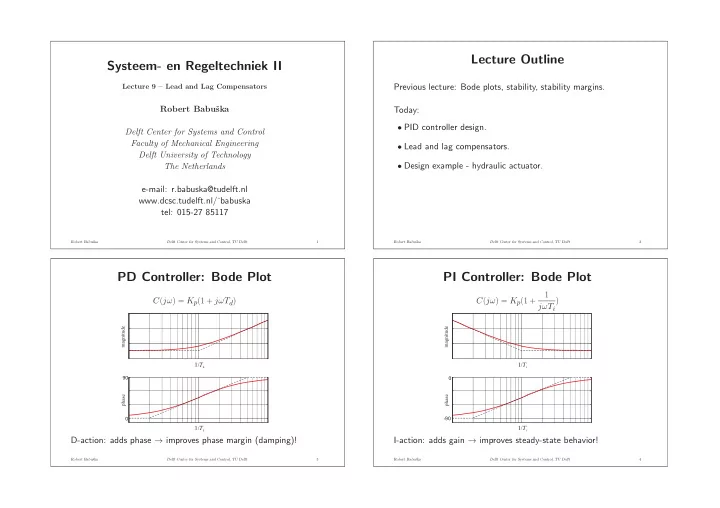
PD Controller: Bode Plot

C(jω) = Kp(1 + jωTd)

magnitude 90 phase

1/Td 1/Td

D-action: adds phase → improves phase margin (damping)!

Robert Babuˇ ska Delft Center for Systems and Control, TU Delft 3

PI Controller: Bode Plot

C(jω) = Kp(1 + 1 jωTi )

magnitude

  • 90

phase

1/Ti 1/Ti

I-action: adds gain → improves steady-state behavior!

Robert Babuˇ ska Delft Center for Systems and Control, TU Delft 4

slide-2
SLIDE 2

PID Controller

Parallel form (see earlier lectures): C(s) = Kp

  • 1 + 1

Tis + Tds

  • Serial form (more commonly used in FD design):

C(s) = Kp

  • 1 + 1

Tis

  • (1 + Tds)

= Kp(Tis + 1)(Tds + 1) Tis

Robert Babuˇ ska Delft Center for Systems and Control, TU Delft 5

PID Controller: Bode Plot

C = Kp(Tis + 1)(Tds + 1) Tis

magnitude

  • 90

90 phase

1/Td 1/Ti

Robert Babuˇ ska Delft Center for Systems and Control, TU Delft 6

PID Controller Design

  • Adjust the proportional gain to get the required crossover fre-

quency and/or steady-state tracking error.

  • If needed, use the derivative action to add phase in the neigh-

borhood of ωc in order to increase the phase margin.

  • If needed, use the integral action to increase the gain at low fre-

quencies in order to guarantee the required steady-state tracking error.

Robert Babuˇ ska Delft Center for Systems and Control, TU Delft 7

Example: PD Satellite Attitude Control

Transfer function: G(s) = Θ(s) T(s) = 1 s2 Performance specs: bandwidth of ≈ 0.2 rad/s, good damping.

Robert Babuˇ ska Delft Center for Systems and Control, TU Delft 8

slide-3
SLIDE 3

Drawbacks of the PID Controller

  • The derivative action introduces very large gain for high fre-

quencies (noise amplification).

  • The integral action introduces infinite gain for zero frequency

(it is open-loop unstable) if the loop is broken.

magnitude

  • 90

90 phase

1/Td 1/Ti

Robert Babuˇ ska Delft Center for Systems and Control, TU Delft 9

Lead and Lag Compensation

Lead compensator: Clead(s) = Tleads + 1 αTleads + 1 α < 1 Lag compensator: Clag(s) = β Tlags + 1 βTlags + 1 β > 1 Lead-lag compensator: C(s) = β T(leads + 1)(Tlags + 1) (αTleads + 1)(βTlags + 1)

Robert Babuˇ ska Delft Center for Systems and Control, TU Delft 10

Lead Compensator: Bode Plot

magnitude 90 phase

1/T 1/T

Ts + 1 αTs + 1

Robert Babuˇ ska Delft Center for Systems and Control, TU Delft 11

Lead Compensator vs. PD Controller

magnitude 90 phase

1/T 1/T

Ts + 1 αTs + 1

Robert Babuˇ ska Delft Center for Systems and Control, TU Delft 12

slide-4
SLIDE 4

Lead Compensator – Maximal Phase Lead

90 phase

1/T

ωmax = 1 T√α sin φmax = 1 − α 1 + α ⇒ α = 1 − sin φmax 1 + sin φmax

Robert Babuˇ ska Delft Center for Systems and Control, TU Delft 13

Lag Compensator: Bode Plot

magnitude

  • 90

phase

1/T 1/T 1/T

  • 1/T

β Ts + 1 βTs + 1

Robert Babuˇ ska Delft Center for Systems and Control, TU Delft 14

Lag Compensator vs. PI Controller

magnitude

  • 90

phase

1/T 1/T 1/T

  • 1/T

β Ts + 1 βTs + 1

Robert Babuˇ ska Delft Center for Systems and Control, TU Delft 15

Lead-Lag Compensator: Bode Plot

magnitude

  • 90

90 phase

  • Robert Babuˇ

ska Delft Center for Systems and Control, TU Delft 16

slide-5
SLIDE 5

Closed Loop Control

Closed loop TF: Gcl(s) = G(s)D(s)K 1 + G(s)D(s)K D(s) is either the lead, the lag or the lead-lag compensator – lead compensator = realistic PD controller – lag compensator = gain-limited PI controller

Robert Babuˇ ska Delft Center for Systems and Control, TU Delft 17

Lead Compensator Design

  • 1. Determine the crossover frequency. Typically:

ωc ≤ ωbw ≤ 2ωc

  • 2. Calculate how much extra phase must be added by the lead

compensator at the crossover frequency. Compute: α = 1 − sin φmax 1 + sin φmax 1 Tlead = ωc √α

  • 3. Compute the overall controller gain K such that the required

ωc is obtained.

  • 4. Check whether the specs are met, if not, revise choices.

Robert Babuˇ ska Delft Center for Systems and Control, TU Delft 18

Lag Compensator Design

  • 1. Determine the crossover frequency. Typically:

ωc ≤ ωbw ≤ 2ωc

  • 2. Determine β to meet the steady-state requirements.
  • 3. Choose Tlag ∈
  • 1

0.5ωc , 1 0.1ωc

  • .
  • 4. Check whether the specs are met, if not, revise choices, iterate
  • n the design.

Robert Babuˇ ska Delft Center for Systems and Control, TU Delft 19

Design Example: Hydraulic Actuator

Load

Oil pump

ps x i Servo valve Q

Robert Babuˇ ska Delft Center for Systems and Control, TU Delft 20

slide-6
SLIDE 6

Hydraulic Actuator – Physical Model

M ¨ x + b ˙ x + Mg = App V Eo ˙ p + Lep + Ap ˙ x = Q Q + τ ˙ Q =  Kv

  • 1 − |p|

ps   i x – piston position (to be controlled) p – oil pressure in the cylinder Q – oil flow-rate i – servo valve current (control input)

Robert Babuˇ ska Delft Center for Systems and Control, TU Delft 21

Hydraulic Actuator – Control Specs

closed-loop bandwidth: ωbw ≈ 40 rad/s phase margin: PM ≈ 60◦ steady-state ramp tracking error: ess ≤ 0.01 m/s rise time: tr = 1.8/ωbw ≈ 0.045 s relative damping: ζ ≈ PM/100 ≈ 0.6

  • vershoot:

Mp = e

−πζ

1−ζ2 ≈ 10 %

crossover frequency: ωc = ωbw/2 ≈ 20 rad/s

Robert Babuˇ ska Delft Center for Systems and Control, TU Delft 22

Hydraulic Actuator – Linearized Model

G(s) = X(s) I(s) = 5574416 s(s + 25)(s2 + 91.53s + 8068) System type: 1 (one pure integrator) Kv = 5574416/(25 · 8068) = 27.58 Steady-state error for ramp: 1/Kv = 0.036 Required steady-state error: 0.01

Robert Babuˇ ska Delft Center for Systems and Control, TU Delft 23

Bode Plot of Loop TF

−200 −150 −100 −50 50 Magnitude (dB) Bode Diagram Frequency (rad/sec) 10 10

1

10

2

10

3

10

4

−360 −270 −180 −90 Phase (deg) System: G Frequency (rad/sec): 20 Phase (deg): −142

Phase(ωc)= 180-142 = 38 deg → additional 22 deg needed.

Robert Babuˇ ska Delft Center for Systems and Control, TU Delft 24

slide-7
SLIDE 7

Lead Compensator Design

Take additional phase of 27 deg (extra margin of 5 deg): α = 1 − sin(27π/180) 1 + sin(27π/180) = 0.375 1 Tlead = ωc √α → Tlead = 0.08 s Clead = Tleads + 1 αTleads + 1 = 0.08s + 1 0.03s + 1 K = 1/ |G(jωc)Clead(jωc)| = 0.553

Robert Babuˇ ska Delft Center for Systems and Control, TU Delft 25

Lead-Compensated Loop TF

10 10

1

10

2

10

3

−360 −270 −180 −90 Phase (deg) Bode Diagram Frequency (rad/sec) −100 −50 50 System: untitled2 Frequency (rad/sec): 20.1 Magnitude (dB): −0.0395 Magnitude (dB)

K = 0.553 (-5.11 dB).

Robert Babuˇ ska Delft Center for Systems and Control, TU Delft 26

Lag Compensator Design

The lead compensator satisfies the bandwidth and PM specs. However, it cannot meet the steady-state error requirement ess = 0.01: G(s)Clead(s)K = 5574416 s(s + 25)(s2 + 91.53s + 8068) · 0.08s + 1 0.03s + 1 · 0.553 Kv = 5574416 · 0.553/(25 · 8068) = 15.32 ess = 1 Kv = 0.0653

Robert Babuˇ ska Delft Center for Systems and Control, TU Delft 27

Lag Compensator Design

Clag(s) = β Tlags + 1 βTlags + 1 β > 1 Additional steady-state gain β = 0.0653/0.01 = 6.53. Choose Tlag = 1/(0.1ωc) = 0.5 s (rule of thumb) Clag(s) = 6.53 · 0.5s + 1 3.27s + 1

Robert Babuˇ ska Delft Center for Systems and Control, TU Delft 28

slide-8
SLIDE 8

Lead-Lag Compensator Bode Plot

C(s) = K · Clag(s) · Clead(s) = 0.553 · 6.53 · 0.5s + 1 3.27s + 1 · 0.08s + 1 0.03s + 1

−5 5 10 15 Magnitude (dB) 10

−2

10

−1

10 10

1

10

2

10

3

−90 −45 45 Phase (deg) Bode Diagram Frequency (rad/sec)

Robert Babuˇ ska Delft Center for Systems and Control, TU Delft 29

Lead-Lag-Compensated Loop TF

−200 −150 −100 −50 50 100 Magnitude (dB) Bode Diagram Frequency (rad/sec) 10

−2

10

−1

10 10

1

10

2

10

3

10

4

−360 −270 −180 −90 Phase (deg) System: untitled1 Phase Margin (deg): 60 Delay Margin (sec): 0.052 At frequency (rad/sec): 20.1 Closed Loop Stable? Yes

Requirements met!

Robert Babuˇ ska Delft Center for Systems and Control, TU Delft 30

Hydraulic Actuator – Step Response

Step Response Time (sec) Amplitude 0.2 0.4 0.6 0.8 1 1.2 1.4 1.6 1.8 0.2 0.4 0.6 0.8 1 1.2 1.4 System: Gc Settling Time (sec): 0.964 System: Gc Rise Time (sec): 0.051 System: Gc Peak amplitude: 1.11 Overshoot (%): 10.7 At time (sec): 0.119

Robert Babuˇ ska Delft Center for Systems and Control, TU Delft 31

Bode Plots: Homework Assignments

  • Read Sections 6.1 through 6.7, except for the Nyquist criterion.
  • Work out examples in these sections and verify the results by

using Matlab.

  • Reproduce the derivation of the frequency response as given on

the overhead sheets.

  • Work out a selection of problems 6.3 – 6.9, and problems 6.16,

6.17, 6.42 – 6.45, 6.55 – 6.57 and verify your results by using Matlab.

Robert Babuˇ ska Delft Center for Systems and Control, TU Delft 32