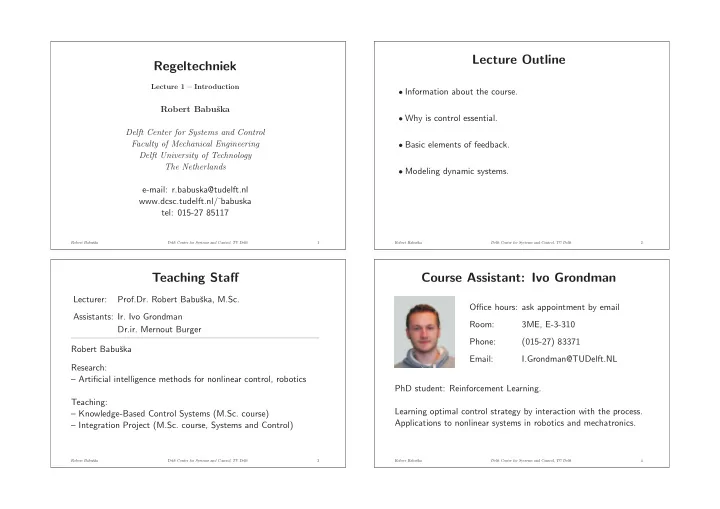
Lecture Outline Regeltechniek Lecture 1 Introduction Information - - PowerPoint PPT Presentation

lecture outline regeltechniek
SMART_READER_LITE
LIVE PREVIEW

Lecture Outline Regeltechniek Lecture 1 Introduction Information - - PowerPoint PPT Presentation

Lecture Outline Regeltechniek Lecture 1 Introduction Information about the course. Robert Babu ska Why is control essential. Delft Center for Systems and Control Faculty of Mechanical Engineering Basic elements of feedback.


slide-1
SLIDE 1

Regeltechniek

Lecture 1 – Introduction

Robert Babuˇ ska Delft Center for Systems and Control Faculty of Mechanical Engineering Delft University of Technology The Netherlands e-mail: r.babuska@tudelft.nl www.dcsc.tudelft.nl/˜babuska tel: 015-27 85117

Robert Babuˇ ska Delft Center for Systems and Control, TU Delft 1

Lecture Outline

  • Information about the course.
  • Why is control essential.
  • Basic elements of feedback.
  • Modeling dynamic systems.

Robert Babuˇ ska Delft Center for Systems and Control, TU Delft 2

Teaching Staff

Lecturer: Prof.Dr. Robert Babuˇ ska, M.Sc. Assistants: Ir. Ivo Grondman Dr.ir. Mernout Burger Robert Babuˇ ska Research: – Artificial intelligence methods for nonlinear control, robotics Teaching: – Knowledge-Based Control Systems (M.Sc. course) – Integration Project (M.Sc. course, Systems and Control)

Robert Babuˇ ska Delft Center for Systems and Control, TU Delft 3

Course Assistant: Ivo Grondman

Office hours: ask appointment by email Room: 3ME, E-3-310 Phone: (015-27) 83371 Email: I.Grondman@TUDelft.NL PhD student: Reinforcement Learning. Learning optimal control strategy by interaction with the process. Applications to nonlinear systems in robotics and mechatronics.

Robert Babuˇ ska Delft Center for Systems and Control, TU Delft 4

slide-2
SLIDE 2

Course Assistant: Mernout Burger

Office hours: ask appointment by email Room: 3ME, E-3-310 Phone: (015-27) 83371 Email: M.Burger@TUDelft.NL Postdoc: Model-Based Predictive Control for Intelligent Micro- Transportation Systems. Scheduling small autonomous water-taxis, optimizing energy effi- ciency while respecting transportation demand and charging.

Robert Babuˇ ska Delft Center for Systems and Control, TU Delft 5

Goals of the Course

  • Represent dynamic systems as transfer function and state-space

models.

  • Analyze closed-loop dynamics by using:

– the root-locus method, – Bode plots, – Nyquist plots

  • Design controllers by using the above methods.
  • Design state-feedback controllers by pole placement.
  • Use effectively Matlab and Simulink for analysis, design and

simulation.

Robert Babuˇ ska Delft Center for Systems and Control, TU Delft 6

Course Organization Please, enroll in the course via Blackboard!

Robert Babuˇ ska Delft Center for Systems and Control, TU Delft 7

Course Structure

  • Two lectures every week:

– Monday 13:45 – 15:30, 3mE lecture room A and C – Friday 13:45 – 15:30, 3mE lecture room A and C

  • Instruction (problem-solving) sessions:

– week 3 (calendar week 38) – Thursday 10:45 – 12:30, Aula – lecture room A – week 5 (calendar week 40) – Thursday 10:45 – 12:30, Aula – lecture room A – week 7 (calendar week 42) – Friday 13:45 – 15:30, Aula – lecture room A

Robert Babuˇ ska Delft Center for Systems and Control, TU Delft 8

slide-3
SLIDE 3

Course Structure - contn’d

  • Matlab computer sessions:

– week 4 (calendar week 39) - introduction to Matlab – week 6 (calendar week 41) - root locus and freq. domain – week 7 (calendar week 42) - experimental setup (lab) Week 4 and 6 in computer room 020 (CT), week 7 in Meetshop. See Blackboard for the schedule.

  • Guest lecture – robotics and wind turbines

– week 3 (calendar week 38) Wednesday 13:45 – 15:30, 3mE - lecture room A and C

  • Examination: check Blackboard for dates and times

Robert Babuˇ ska Delft Center for Systems and Control, TU Delft 9

Practical Matlab Sessions

I hear and I forget. I see and I remember. I do and I understand.” – Confucius

  • Get hands-on experience, learn to use Matlab and Simulink.
  • Compulsory for everyone who has not passed yet.
  • Work in groups of two students (you choose your partner).
  • Assignment in the second and third Matlab session

– written report (deliver 1 report per group).

  • Report is graded (1 – 10).
  • Final grade = 0.75*exam grade + 0.25*assignment grade, If

final grade < 6 or exam grade < 5 Then resit; If assignment grade < 5 Then additional assignment.

Robert Babuˇ ska Delft Center for Systems and Control, TU Delft 10

Organization of Matlab Sessions

In weeks 4, 6 four sessions in the week are scheduled in computer room 020 (CT). Each group only comes once in week 4 and once in week 6. In week 7 in meetshop – DC motor setup 14 sessions are scheduled and again each group only comes once in week 7. For space reasons, you cannot come whenever you wish. Instead, please, register (= indicate your non-availability and your group partner) via Blackboard and we will assign you to a time slot. Registration open: September 10 through 16 (24:00), 2012.

Robert Babuˇ ska Delft Center for Systems and Control, TU Delft 11

Organization of Matlab Sessions

All students following this course must register for the practical Matlab sessions via Blackboard (next week). Two exceptions:

  • Students who already passed the Matlab practical in one of the

past years (grade for the report > 5) and who do not wish to improve their grade must NOT register for the Matlab sessions.

  • Students who follow this course as a part of the Robotics Minor

(lecturer Dr. Martijn Wisse) must NOT register for the Matlab sessions (they are already assigned to a time slot).

Robert Babuˇ ska Delft Center for Systems and Control, TU Delft 12

slide-4
SLIDE 4

Complete Schedule

Robert Babuˇ ska Delft Center for Systems and Control, TU Delft 13

Course Material

Book: Feedback Control of Dynamic Systems. Franklin, Powell, and Emami-Naeini. Fifth Edition, Prentice Hall. Transparencies: available through Blackboard MATLAB/Simulink software available through Blackboard

Robert Babuˇ ska Delft Center for Systems and Control, TU Delft 14

Recommended Prerequisites

Regeltechniek I (WB 2104) or similar Brush up (at least) the following concepts:

  • Differential equations, Laplace transform.
  • Transfer functions, block diagrams.
  • Poles and zeros, stability, dynamic response.
  • Basic properties of feedback.
  • PID controller, system type.

Chapters 1 through 4 of the course book.

Robert Babuˇ ska Delft Center for Systems and Control, TU Delft 15

Link With the Mechatronics Project

Module P2-6: Controller Design for Ed-Ro.

Robert Babuˇ ska Delft Center for Systems and Control, TU Delft 16

slide-5
SLIDE 5

Examination

  • Closed-book exam – no books are allowed
  • You may bring only

– your own hand-written notes

  • It is not allowed to bring any printouts or copies.
  • Open questions (answers in dedicated boxes).

Note: not everything will be discussed in the lectures, some parts

  • f the book are left for self-study.

See ”Exam demands” in the download section of the course web- site.

Robert Babuˇ ska Delft Center for Systems and Control, TU Delft 17

Course Information on the Web

Blackboard (mirrored also at www.dcsc.tudelft.nl/˜wb2207)

  • Basic course information.
  • Important dates, messages.
  • Lecture sheets handouts.
  • Sample exams (representative for difficulty degree).
  • Matlab and Simulink examples.

Enroll! Check the page regularly!

Robert Babuˇ ska Delft Center for Systems and Control, TU Delft 18

Final Remarks

Where to Run Matlab:

  • Your own computer (download from Blackboard).
  • Computer rooms at the faculty, meetshop.

Response group: a group of 4–5 students meeting with the lecturer and assistants 3 times (on 18-9, 2-10 and 16-10) at the lunch time – to give feedback on the course, discuss possible improvements,

  • etc. Interested students, please, come to the lecturer during the

break.

Robert Babuˇ ska Delft Center for Systems and Control, TU Delft 19

Purpose of Control

Design systems that

  • maintain desired performance (or optimize performance),
  • despite disturbances and
  • changes in the controlled system or its environment

Basic principle: – feed back a measured quantity – influence system behavior through actuation By means of control, we can modify system’s behavior! Main interest is in dynamic systems.

Robert Babuˇ ska Delft Center for Systems and Control, TU Delft 20

slide-6
SLIDE 6

Elements of a Control System

  • utputs

Process

inputs disturbances reference

Controller

feedback

Robert Babuˇ ska Delft Center for Systems and Control, TU Delft 21

Example: Aircraft Autopilot

engine elevator altitude speed pilot commands

Autopilot

+ less workload for pilot + improved comfort, handling, safety + lower fuel consumption

Robert Babuˇ ska Delft Center for Systems and Control, TU Delft 22

Elements of the Feedback Loop

  • utputs

Sensor

inputs reference

Process Actuator Controller

disturbances Make distinction between:

  • Signals (lines) – physical quantities, information
  • Systems (blocks) – process information

Robert Babuˇ ska Delft Center for Systems and Control, TU Delft 23

Applications of Control

Control systems are invisible, but omnipresent in a tremendous range of processes and products (“from steam engine to space station”):

  • electronics, home appliances, CD players
  • industrial processes, manufacturing, robots
  • computers, networks, communication systems
  • transportation systems: cars, planes, spacecraft

(our safety often depends on a controller!) Feedback is also one of the important basic mechanisms in living

  • rganisms.

Robert Babuˇ ska Delft Center for Systems and Control, TU Delft 24

slide-7
SLIDE 7

Robotics

HONDA HONDA

Robert Babuˇ ska Delft Center for Systems and Control, TU Delft 25

Process Industry

Robert Babuˇ ska Delft Center for Systems and Control, TU Delft 26

Manufacturing Systems

Robert Babuˇ ska Delft Center for Systems and Control, TU Delft 27

Traffic and Transport

  • Traffic flow control
  • In-car driver assistance systems
  • Autonomous vehicles

Robert Babuˇ ska Delft Center for Systems and Control, TU Delft 28

slide-8
SLIDE 8

Car Engine Management Systems

Engine Management System

Fuel injector Air MTC SOI, T inj IGA Burn gases Crankshaft Spark plug

Robert Babuˇ ska Delft Center for Systems and Control, TU Delft 29

Feedback can make things better . . .

yr u 1 y

  • 1

( 1)( ) s+ s+a e u

Closed loop

y 1 ( 1)( ) s+ s+a

Open loop

50 100 150 200 100 200 300 Time [s] Output

Step response

5 10 15 0.5 1 1.5 Time [s] Output

a = 0.01 a = 0 a = −0.01

Robert Babuˇ ska Delft Center for Systems and Control, TU Delft 30

. . . but also worse!

yr u 1 y

  • e

u

Closed loop

y

Open loop

400(1-as) ( 1)(s+20)(a 1) s+ s+ 400(1-as) ( 1)(s+20)(a 1) s+ s+

1 2 3 10 20 Time [s] Output

Step response

0.2 0.4 0.6 0.8 1 1 2 Time [s] Output

a = 0 a = 0.015 a = 0.03

Robert Babuˇ ska Delft Center for Systems and Control, TU Delft 31

Key Ingredients of Control Engineering

  • need to understand dynamics, analyze complex systems
  • use provably correct techniques for the design
  • based on mathematics and understanding of the physics
  • “systems-oriented approach” is essential

Control

Systemstheory Applicationdomain Mathematics

Robert Babuˇ ska Delft Center for Systems and Control, TU Delft 32

slide-9
SLIDE 9

Control Design Procedure

Disturbances Goal(reference)

Controller

Synthesis Mathematical model Modeling u

Process

y

Robert Babuˇ ska Delft Center for Systems and Control, TU Delft 33

Main Steps

  • Model the process (using insight in the physics, etc.)
  • Analyze the model (stability, response, etc.)
  • Design a controller, meeting given performance criteria
  • Implement the controller (usually on a digital computer)

Robert Babuˇ ska Delft Center for Systems and Control, TU Delft 34

Dynamic Process Modeling

Three alternative frameworks:

  • 1. Time domain (differential equations).
  • 2. Laplace transform (transfer function, s-domain).
  • 3. State-space representation (set of 1st-order DE).
  • 2. and 3. are the two main options for control design, each with

its own pro’s and con’s – this course will give you insight in both.

Robert Babuˇ ska Delft Center for Systems and Control, TU Delft 35

Linear Differential Equations

lineardynamic system

y t ( ) u t ( )

any(n)(t) + an−1y(n−1)(t) + · · · + aoy(t) = bmu(m)(t) + bm−1u(m−1)(t) + · · · + bou(t)

Robert Babuˇ ska Delft Center for Systems and Control, TU Delft 36

slide-10
SLIDE 10

Example 1: Motion Under Viscous Friction

ma(t) = Fn(t) ma(t) = F(t) − Ff(t) m ¨ d(t) = F(t) − b ˙ d(t)

  • Linear differential equation
  • Not directly suitable for analysis or control design
  • Can be used to simulate the process

Solution either by hand (tedious in general) or by numerical integration (use, e.g., Matlab or Simulink).

Robert Babuˇ ska Delft Center for Systems and Control, TU Delft 37

Example 1 (cont’d): Block Diagram

F

  • d

b

Ff

  • .

d Fn

1 m

  • Implementation and simulation in Simulink.

Robert Babuˇ ska Delft Center for Systems and Control, TU Delft 38

Example 2: DC Motor

V T J R L + V = K

b t

b

  • +
  • Ldi

dt + Ri = V − Vb

, Vb = Ktω = Ktdθ

dt

J d2θ

dt2 + bdθ dt = T

, T = Kti

Robert Babuˇ ska Delft Center for Systems and Control, TU Delft 39

Example 2 (cont’d): Differential Equations

Ldi(t)

dt + Ri(t)

= V (t) − Kt

dθ(t) dt

electrical part J d2θ(t)

dt2 + bdθ(t) dt

= Kti(t) mechanical part Inductance often negligible – we can assume L = 0.

Robert Babuˇ ska Delft Center for Systems and Control, TU Delft 40

slide-11
SLIDE 11

Example 2 (cont’d): Block Diagram

V

  • .

i

  • b

Kt Kt 1 L

  • 1

J

  • R
  • Robert Babuˇ

ska Delft Center for Systems and Control, TU Delft 41

Summary

  • Control design: modeling, analysis, synthesis, implementation.
  • Modeling dynamic systems: the basis are differential equations.
  • Representation of a DE as a block diagram.
  • Simulation in Simulink (or other software).

Robert Babuˇ ska Delft Center for Systems and Control, TU Delft 42