Lecture 27 Logistics HW8 due Friday Ants problem due Friday Ants - - PDF document

lecture 27
SMART_READER_LITE
LIVE PREVIEW

Lecture 27 Logistics HW8 due Friday Ants problem due Friday Ants - - PDF document

Lecture 27 Logistics HW8 due Friday Ants problem due Friday Ants problem due Friday Lab kit must be returned to Tony by Friday Review Sunday 12/7 3pm, Location TBD Last lecture State encoding One-hot encoding


slide-1
SLIDE 1

Lecture 27

Logistics

HW8 due Friday Ants problem due Friday Ants problem due Friday Lab kit must be returned to Tony by Friday Review Sunday 12/7 3pm, Location TBD

Last lecture

State encoding

One-hot encoding Output encoding

1

CSE370, Lecture 25

Today:

Optimizing FSMs

Pipelining Retiming Partitioning

27

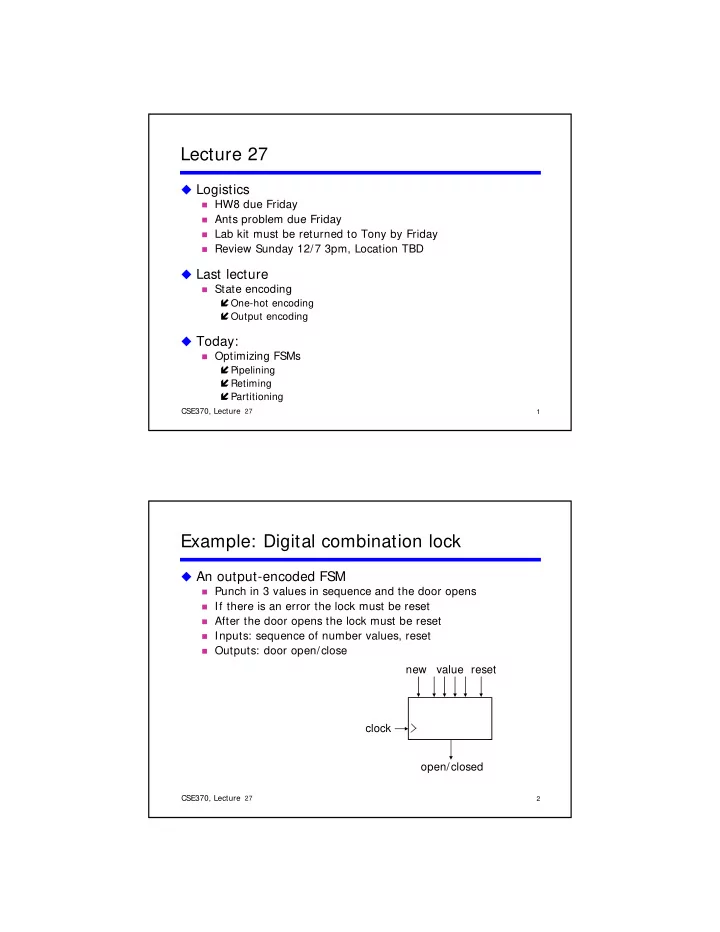
Example: Digital combination lock

An output-encoded FSM

Punch in 3 values in sequence and the door opens If there is an error the lock must be reset If there is an error the lock must be reset After the door opens the lock must be reset Inputs: sequence of number values, reset Outputs: door open/close

reset value new

2

CSE370, Lecture 25

  • pen/closed

clock

22

27

slide-2
SLIDE 2

C1 C2 C3 mux control 4 4 4 C1i C2i C3i mux control valuei

Design the datapath

comparator

equal

multiplexer

control 4 4 value control

Choose simple control

3-wire mux for datapath

3

CSE370, Lecture 25

equal

3 wire mux for datapath

Control is 001, 010, 100

Open/closed bit for lock state

Control is 0/1

22

27

Output encode the FSM

FSM outputs

Mux control is 100, 010, 001 Lock control is 0/1 Lock control is 0/1

State are: S0, S1, S2, S3, or ERR

Can use 3, 4, or 5 bits to encode Have 4 outputs, so choose 4 bits

Encode mux control and lock control in state bits Lock control is first bit, mux control is last 3 bits S0 = 0001 (lock closed, mux first code) S1 0010 (l k l d d d )

4

CSE370, Lecture 25

S1 = 0010 (lock closed, mux second code) S2 = 0100 (lock closed, mux third code) S3 = 1000 (lock open) ERR = 0000 (error, lock closed)

22

27

slide-3
SLIDE 3

Encode 4 state bits

closed not equal & not equal ERR

A clever way for ERR is to use Preset/reset in existing flipflops.

closed mux= C1 start equal & new & new not equal & new not equal & new not new not new not new S0 S1 S2 S3 closed mux= C2 equal & new closed mux= C3 equal & new

  • pen

Not equal & new

5

CSE370, Lecture 25

S0+ = S0N’ S1+ = S0EN + S1N’ S2+ = S1EN + S2N’ S3+ = S2EN + S3

26

Preset0 = start Preset1,2,3 = 0 Reset0 = start’(E’N + (Q0+ Q1+ Q2+ Q3)’) Reset1,2,3 = start + (E’N + (Q0+ Q1+ Q2+ Q3)’)

Not equal & new Already in ERR

27

D0 = Q0N’ D1 = Q0EN + Q1N’ D2 = Q1EN + Q2N’ D3 = Q2EN + Q3

S0 S1 S0 S0 E N

Preset0 = start Preset1,2,3 = 0 Reset0 = start’(E’N + (Q0+ Q1+ Q2+ Q3)’) Reset1,2,3 = start + (E’N + (Q0+ Q1+ Q2+ Q3)’)

S2 S1 N’ S1 E N S2 N’ S0 6

CSE370, Lecture 25 26

S3 S2 E N S0 S1 S2 S3 27

slide-4
SLIDE 4

FSM design

FSM-design procedure

  • 1. State diagram

g

  • 2. state-transition table
  • 3. State minimization
  • 4. State encoding
  • 5. Next-state logic minimization
  • 6. Implement the design

7

CSE370, Lecture 25 26

27

Last topic: more FSM optimization techniques

Want to optimize FSM for many reasons beyond state

minimization and efficient encoding

Additional techniques

Pipelining --- allows faster clock speed Retiming --- can reduce registers or change delays Partitioning --- can divide to multiple devices, simpler logic

8

CSE370, Lecture 25

27

slide-5
SLIDE 5

Pipelining related definitions

Latency: Time to perform a computation

Data input to data output

Throughput: Input or output data rate

Typically the clock rate

Combinational delays drive performance

Define

d ≡ delay through slowest combinational stage n ≡ number of stages from input to output

Latency ∝ n * d (in sec)

Th h t 1/d (i H )

9

CSE370, Lecture 25 Throughput ∝ 1/d (in Hz)

27

Pipelining

What?

Subdivide combinational logic Add registers between logic

Logic Reg

Add registers between logic

Why?

Trade latency for throughput Increased throughput

Reduce logic delays Increase clock speed

May increased latency

Logic Reg Logic Reg

10

CSE370, Lecture 25 Increase circuit utilization

Simultaneous computations

27

slide-6
SLIDE 6

Pipelining

When?

Need throughput more than latency

Signal processing

Reg Logic Reg

Signal processing

Logic delays > setup/hold times Acyclic logic

Where?

At natural breaks in the

combinational logic

Adding registers makes sense

11

CSE370, Lecture 25

27

Retiming

Pipelining adds registers

To increase the clock speed

Retiming moves registers around

Reschedules computations to optimize performance

Change delay patterns Reduce register count

Without altering functionality

12

CSE370, Lecture 25

27

slide-7
SLIDE 7

Retiming examples

Reduce register count

a D Q a D Q

Change output delays

a b d x D Q b d x D Q

13

CSE370, Lecture 25

27

FSM partitioning

Break a large FSM into two or more smaller FSMs Rationale Rationale

Less states in each partition

Simpler minimization and state assignment Smaller combinational logic Shorter critical path

But more logic overall

Partitions are synchronous

Same clock!!!

14

CSE370, Lecture 25 Same clock!!!

27

slide-8
SLIDE 8

Example: Partition the machine

Partition into two halves

C1 C2 C3 S1 S2 S6 S5

15

CSE370, Lecture 25

C4 C5 S3 S4

27

Introduce idle states

SA and SB handoff control between machines

C1 S1 S6

C1

S6

C1•S1

S1

(C2•S6)’

C2 C3 C4 C5 S1 S3 S2 S6 S4 S5

16

CSE370, Lecture 25 C2 C5•S2

S4 S5 SB

C3•S2+ C4•S3 (C1•S1+ C3•S2+ C4•S3+ C5•S2)’ C4

S3 S2 SA

C2•S6 C3+ C5 (C2 S6)

27

slide-9
SLIDE 9

Partitioning rules

Rule # 1: Source-state transformation Replace by transition to idle state (SA)

S1 S6 C1 SA S1 C1

Replace by transition to idle state (SA) Rule # 2: Destination state transformation Replace with exit transition from idle state

17

CSE370, Lecture 25

S1 S6 C2 SA S1 C2• S6

p

27

Partitioning rules (con’t)

Rule # 3: Multiple transitions with same source or destination Source ⇒ Replace by transitions to idle state (SA)

S2 S3 S5 S4 C4 C5 C3 S2 S3 SA C3+C5 C4 S5 S4 C5•S2 SB C3•S2 + C4•S3

Destination ⇒ Replace with exit transitions from idle state

18

CSE370, Lecture 25

SA S1 C2•S6 C2•S6

Rule # 4: Hold condition for idle state OR exit conditions and invert

27

slide-10
SLIDE 10

Mealy versus Moore partitions

Mealy machines undesirable

Inputs can affect outputs immediately

“output” can be a handoff to another machine!!!

  • utput can be a handoff to another machine!!!

Moore machines desirable

Input-to-output path always broken by a flip-flop But…may take several clocks for input to propagate to output

19

CSE370, Lecture 25

27

Example: Six-state up/down counter

Break into 2 parts

U t

D U S0 S1 S5 S4 U U D D D D D

U ≡ count up D ≡ count down

20

CSE370, Lecture 25

S2 S3 U U U D

27

slide-11
SLIDE 11

Example: 6 state up/down counter (con’t)

Count sequence S0, S1, S2, S3, S4, S5

S2 goes to SA and holds, leaves after S5

S t S d h ld l ft S

D•S0 U

S5 S4

U D

SB

(D•S0+

S0 S1

U U•S5 D D

SA

(D•S3 + S5 goes to SB and holds, leaves after S2 Down sequence is similar

21

CSE370, Lecture 25

S3 S4

U U•S2 D D

SB

U•S2)’ D•S3 U

S2 S1

U D

SA

U•S5)’

27

Minimize communication between partitions

Ideal world: Two machines handoff control

Separate I/O, states, etc.

Real world: Minimize handoffs and common I/O

Minimize number of state bits that cross boundary Merge common outputs

22

CSE370, Lecture 25

27

slide-12
SLIDE 12

Done!

23

CSE370, Lecture 25

27