
SLIDE 1
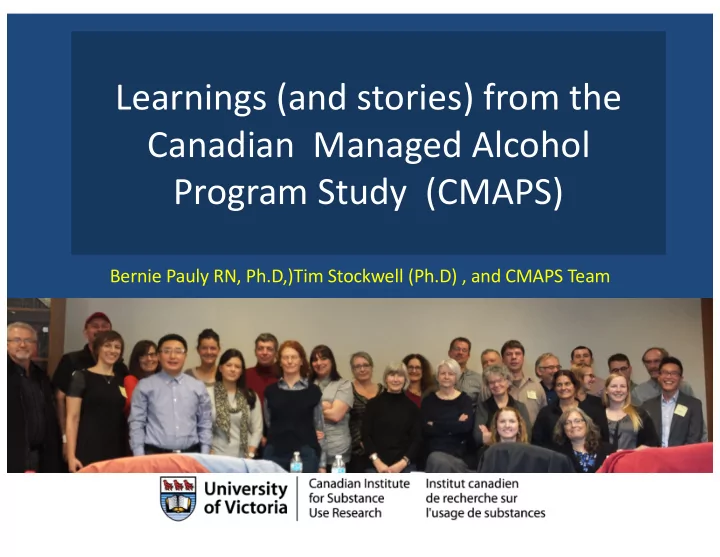
Learnings (and stories) from the Canadian Managed Alcohol Program Study (CMAPS)
Bernie Pauly RN, Ph.D,)Tim Stockwell (Ph.D) , and CMAPS Team
Learnings (and stories) from the Canadian Managed Alcohol Program - - PowerPoint PPT Presentation
Learnings (and stories) from the Canadian Managed Alcohol Program Study (CMAPS) Bernie Pauly RN, Ph.D,)Tim Stockwell (Ph.D) , and CMAPS Team Territorial Acknowledgement Funded by: Harms of Alcohol Use Acute Social Chronic Injuries
Bernie Pauly RN, Ph.D,)Tim Stockwell (Ph.D) , and CMAPS Team
Injuries Poisoning Acute illness
Problems with: Housing Finances Relationships Law Workplace
Liver disease Cancers Strokes Gastrointestinal disease
Marketing and Advertising Minimum Legal Drinking Age
SBIR Server Training and Management
Shelters and housing programs differ in how they approach alcohol use: Abstinence-based or “dry” shelters/housing: no drinking is allowed Tolerant shelters/housing: allow drinking but do not manage it (e.g. Collins, Larimer) Managed alcohol programs: shelters/housing that actively manage and provide alcohol for some people
consumption which is often criminalized and stigmatized (illicit drinking) (Crabtree et al., 2013)
exposure and death
The purpose of our research is to rigorously evaluate MAPs in Canada and generate insights into the implementation and outcomes Do MAPs reduce consumption, alcohol related harms, improve housing tenure, health and quality of life and reduce economic costs?
Outcomes Process Process
(Pauly et al., 2018)
consumption and potentially NBA use
health services.
Source: The Guardian
22 MAPS in 13 Canadian Cities
Kwae Kii Win Centre, Thunder Bay: 18 participants, Indigenous men and women in Transitional housing; 20 matched controls Station Street, Vancouver: 7 participants
Pauly et al., 2015 Stockwell et al, 2013
MAP is safer than the streets, jails, or shelters (Pauly et al, 2016)
Family, Home and Hope
But this program … has given me hope and has allowed me to really think what I wanna do with the rest of my
could say rock bottom, going home couldn’t get me out
here… I know there’s a horizon waiting for me. (Pauly et al.,
2016)
and social harms (esp housing, safety, legal, financial and withdrawal).
harms
Stockwell et al., 2013; Vallance et al., 2016,
Pauly et al., 2015
Reduced Police and Health Service Use (TB) 43% fewer police contacts and 33% Less Time in Custody 47% fewer hospital Admissions and 70% Decrease in Detox Use
Reducing Economic Costs
Hammond, Gagne, Pauly & Stockwell, 2016
This means a savings of 1.09 to 1.21 for every dollar invested in MAP
Sample size and response rate
Sample
Physic-al health
Learn-ing difficulty
Assault Seizure Passed
Controls (n=189) 61% 33% 33% 15% 62% New MAPs (n=65) 41%** 13%* 35% 11% 34%* Long-term MAPs (n=109) 30%*** 18%* 15%* 2%** 26%***
MAP participants experience fewer physical harms (***P<.001)
(Stockwell et al., 2018)
Sample
Friends/ Social Life Finance Legal Work Housing Controls (n=189) 43% 68% 40% 29% 36% New MAPs (n=65) 25% 45%** 31% 12% 22% Long-term MAPs (n=109) 15%*** 29%*** 10%*** 8%** 9%***
MAP participants experience fewer social harms. (***P<.001) (Stockwell et al., 2018)
Sample
Mean # Drink Days/30 Mean # drinks per day NBA drink days/30 NBA drinks per day Controls (n=189) 23 22 3.78 5.8 New MAPs (n=65) 27* 20 6.5 9.4 Long-term MAPs (n=109) 29*** 15*** 1.5* 3.0*
MAP Participants drink more days but drink less overall and less NBA. (***P<.001) (Stockwell et
al., 2018)
Longer term MAP Participants were less likely to re-budget for essentials, use illicit drugs, steal from liquor stores
and more likely to seek treatment.
Situational Analysis visually explores the elements in a “situation” and the relationships between them (i.e. the implementation of MAPs within existing housing, health, and social systems)
Photo by Alina Grubnyak on Unsplash
53 Current residents, 4 past residents
50 program staff
– Diploma (34%) – Bachelor’s degree (24%) – Graduate degree (22%)
displacement, precarity, unmet needs despite frequent contact with services
harm reduction practices, protection from street friends and family.
intervention in a continuum of largely abstinence-based arenas
displacement, survival, and disconnection
self, family, community and culture
ü Important dimensions of MAP programs (Pauly et al., 2018) ü a safer pattern of consumption: less NBA, lower daily quantities, safer setting than the street (Vallance et al., 2016; Stockwell et al., 2017)
inspite of drinking on more days per month (Stockwell et al., 2017)
ü significantly fewer self-reported health and social harms (Vallance;
Stockwell; Pauly et al., 2016)
ü Reduced hospital admissions and time in police custody = economic savings (cost-benefits) (Hammond et al., 2016) ü Less likely to re-budget for essentials, drink NBA, steal or commit crimes and more likely to go to treatment (Erickson et al., 2018) ü Participants more likely to retain housing, experience increased safety and improved quality of life, re-connection to family & community (Pauly et al. 2016)
MAPs do not benefit everyone overtime.
assessment) do have better outcomes.
“sweet spot” of housing security, matching needs with supports, community belonging, connectedness and alcohol admin policies.
q Future analysis of morbidity, mortality data and economic costing q Examining feasibility of cannabis substitution to reduce chronic harms q Role of social inclusion, integrating culture q Elements of Programs for young adults
*MAP Community
Researchers
Bernie Pauly, NPI, Uvic Tim Stockwell, Co-PI, UVic Clifton Chow, Research Lead Kate Vallance, Research Coord Ashley Wettlaufer, Research Coord Meaghan Brown, Research Coord/RA Chanelle Larocque, RA Bonnie Krysowaty, RA Josh Evans, Co-I, Athabasca U Colin van Zoost, Co-I, Dahlhousie Dyanne Semogas, Co-I, McMaster Jamie Muckle, Co-I, Ottawa Erin Gray, Co-I, Lakehead U. Patty Hajdu, Co-I, Thunder Bay Thomislav Svoboda, Co-I, U of T Norman Giesbrecht, Co-I, CAMH Vicky Stergiopoulos, Co-I, U of T Ron Joe, Co-I, UBC Jinhui Zhao, Co-I, UVic Alexis Crabtree, Co-I, UBC
Knowledge Users
Denise DePape, PKU, BC MOH Patti Melanson, Halifax Wendy Muckle, Ottawa Clare Hacksell, Toronto/Vancouver Karen Smith, Toronto Liz Evans, Vancouver Siavash Jafari, VCH, Vancouver Manik Saini, BC MOH Joe Power, Island H, Victoria Irene Haig Gidora, VCAS, Victoria
Collaborators
Rachelle Sender, Hamilton Dean Waterfield, Hamilton Heather Cooke, Kamloops Nancy Campbell, Lethbridge Jeff Turnbull, Ottawa Inner City Health Anabella Wainberg, City of Toronto Anne Bowlby, Toronto Tom Henderson, Toronto Rolando Barrios, Vancouver EIDGE, Eastside Illicit Drinkers Group for Education – Brittany Graham and Ron Kheul Kathy Stinson, VCAS, Victoria Trevor Corneil, IH Mike O’Shea, Sault Ste. Marie Jen Driscoll, Cranbrook Dean Nicholson, Cranbrook Ashley van Ryn, Lethbridge Shawn Yoder, Toronto Tracey Thompson, Victoria Nichole Riese, Winnepeg Jonathan Chick, Edinburgh John Saunders, University of Sydney Katie Keating, Toronto
Collaborators
Rachelle Sender, Hamilton Dean Waterfield, Hamilton Heather Cooke, Kamloops Nancy Campbell, Lethbridge Jeff Turnbull, Ottawa Inner City Health Anabella Wainberg, City of Toronto Anne Bowlby, Toronto Tom Henderson, Toronto Rolando Barrios, Vancouver EIDGE, Eastside Illicit Drinkers Group for Education – Brittany Graham and Ron Kheul Kathy Stinson, VCAS, Victoria Trevor Corneil, IH Mike O’Shea, Sault Ste. Marie Jen Driscoll, Cranbrook Dean Nicholson, Cranbrook Ashley van Ryn, Lethbridge Shawn Yoder, Toronto Tracey Thompson, Victoria Nichole Riese, Winnepeg Jonathan Chick, Edinburgh John Saunders, University of Sydney Katie Keating, Toronto