Le Centre Galactique vu par linstrument GRAVITY du VLTI Karine - - PowerPoint PPT Presentation

le centre galactique vu par l instrument gravity du vlti
SMART_READER_LITE
LIVE PREVIEW

Le Centre Galactique vu par linstrument GRAVITY du VLTI Karine - - PowerPoint PPT Presentation

Le Centre Galactique vu par linstrument GRAVITY du VLTI Karine PERRAUT Institut de Plantologie et dAstrophysique de Grenoble and the GRAVITY Team The GRAVITY collaboration, Astr. & Astrophys. 2017, 692, 94 The GRAVITY collaboration,


slide-1
SLIDE 1

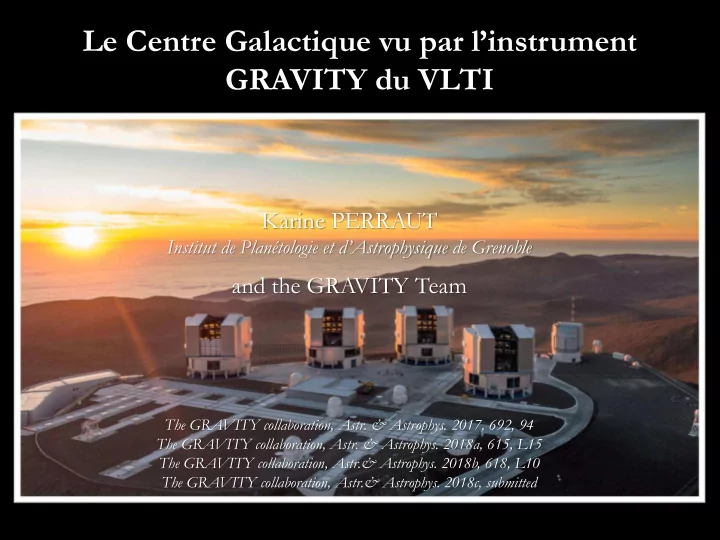
Le Centre Galactique vu par l’instrument GRAVITY du VLTI

Karine PERRAUT

Institut de Planétologie et d’Astrophysique de Grenoble

and the GRAVITY Team

The GRAVITY collaboration, Astr. & Astrophys. 2017, 692, 94 The GRAVITY collaboration, Astr. & Astrophys. 2018a, 615, L15 The GRAVITY collaboration, Astr.& Astrophys. 2018b, 618, L10 The GRAVITY collaboration, Astr.& Astrophys. 2018c, submitted

slide-2
SLIDE 2

Testing the Massive Black Hole Paradigm from Stellar Orbits in the Galactic Center

Schödel +02, +03, Ghez et al. +03, +08, Eisenhauer +03, +05, Gillessen +09a,b, +17, Meyer +12, Chatzopoulos +15, Fritz +17, Plewa +16

M=4.1x10⁶ M Mextended/M< a few 10-2 M & SgrA* coincident <1 mas [1 mas = 4,86 10-9 radians]

Image in radio 8 kpc or 2,5 1017 km

  • r 26 000 light years
slide-3
SLIDE 3

A Quest of 3 Decades

The ESO Very Large Telescope

NACO PARSEC

SINFONI

GRAVITY SHARP @ NTT

l = [2.0 ; 2.5 µm] Spectrometry Imaging

slide-4
SLIDE 4

The VLT, Very Large Telescope Cerro Paranal, Chile

slide-5
SLIDE 5

One of the 8.20-m telescopes of the VLT

slide-6
SLIDE 6

GRAVITY has combined 4 telescopes since 2016

~ 140 m Interferometry to synthetize a giant mirror of 140 m

Astrometry with 2 reference stars

IRS16 NW IRS16 C

l = [2.0 ; 2.5 µm]

Angular resolution of 3.5 mas @ 2.2 µm Accuracy ~ a few 10µas

slide-7
SLIDE 7

7 institutes over 4 countries ~10 M€ and 160 FTE (INSU/CNRS: 1.5 M€ and ~55 FTE) Duration ~ 10 years

slide-8
SLIDE 8
slide-9
SLIDE 9

GRAVITY collaboration+18, A&A, 615, L15

Precision Measurements of S2 Orbit with GRAVITY, SINFONI & NACO

1 mas = 4,86 10-9 radians NACO image GRAVITY images

S2 SINFONI spectrum

March 2018 May/June 2018

slide-10
SLIDE 10

GRAVITY collaboration+18

50 mas April/May 2018 May/June 2018 June/July 2018 June 2017 July 2017 August 2017 End March 2018 April 2017 May 2017 22 July 2018

Routine Faint Milli-arcsec Imaging with GRAVITY

slide-11
SLIDE 11

S2 Passing Peri – 19 May 2018

< 50 µas orbit precision

3 1 30 27 24 26 28 2 4

April May

Peri 19 May

June

Moving at 8000 km/s

GRAVITY collaboration+18

Motion of S2 seen from day to day ~120 au  1400 Rs

slide-12
SLIDE 12

Look for Gravitational Redshift in S2’s Orbit

SHARP – 4 mas NACO – 0.5 mas GRAVITY – 30-50 µas

GRAVITY collaboration+18a, A&A, 615, L15

Orbit Radial velocities

slide-13
SLIDE 13

Radial velocity difference (km/s)

Look for Gravitational Redshift in S2’s Orbit

slide-14
SLIDE 14

Light stretched to longer wavelengths by the very strong gravitational field of the black hole. Change in wavelength agrees precisely with that predicted by Einstein’s GR theory. First observation of this deviation in the motion of a star around a supermassive black hole.

Gravitational Redshift in S2’s Orbit

slide-15
SLIDE 15

Baganoff +2001, Genzel et al. 2003, Ghez et al. 2004, Do et al. 2008, Dodds-Eden et al. 2009, 2010, Ponti et al. 2017, Witzel et al. 2018, Broderick & Loeb 2006, Hamaus et al. 2009, Markoff et al. 2001, Yuan et al. 2004, Moscibrodzka et al. 2015, Dexter et al. 2013, Doeleman et al. 2008, Broderick et al. 2011, Johnson et al. 2017

Detection of orbital motions near SgrA*s ISCO

slide-16
SLIDE 16

Looking at the flares in the near-infrared

In addition to the radio emission, variable X and infrared emission appears as « flares » several times per day during 1-2 hours. The flares originate from transiently heated electrons of the inner accretion and

  • utflow region but their origin is still matter of debate.
slide-17
SLIDE 17

Different flare models

Material blobs ejected in a jet Hot spot on the closest stable orbit Statistical fluctuations in the accretion flow Similar to AGN jets Consistent with the light curve in the near-infrared and the polarization changes Consistent with the long-term variations

  • f the light curve
slide-18
SLIDE 18

On-sky centroid positions

Hot spot model Statistical fluctuations Jet

10 µas = 1 Rs time time time

slide-19
SLIDE 19

Centroid positions measured with GRAVITY

Sgr A* flux recorded with GRAVITY

(normalized to S2 flux)

Positions recorded with GRAVITY

GRAVITY measurements July 22nd, 2018 vorb~0.3 c 10 µas = 1 Rs

 Consistent with the hot spot model

slide-20
SLIDE 20

GRAVITY detection of polarization loops

GRAVITY collaboration 2018b, A&A, 618, L10

Total flux / Flux in linear polarization

(normalized to S2 flux)

Several flare observations are consistent with the same parameters

Polarization loop with time

 Provide information on inclination (low), magnetic field (poloidal), …

slide-21
SLIDE 21

Conclusion and perspectives

  • Sgr A*:
  • The « largest » black hole we can study
  • A unique lab to study GR
  • GRAVITY:
  • Fantastic instrument to do that
  • Very complementary to other diagnosis
  • Application to AGN

Next steps starting in March 2019:

  • Look for other stars around SgrA*, closest than S2
  • Look at new flares
  • Look for higher order effects (Schwarzschild precession,

Lense-Thirring effects) to better constrain the black hole parameters and physics

Mass = 4.1440.023106 (610-3 precision) Distance = 817420 pc (210-3)