SLIDE 1 Last time: integrating in polar coordinates
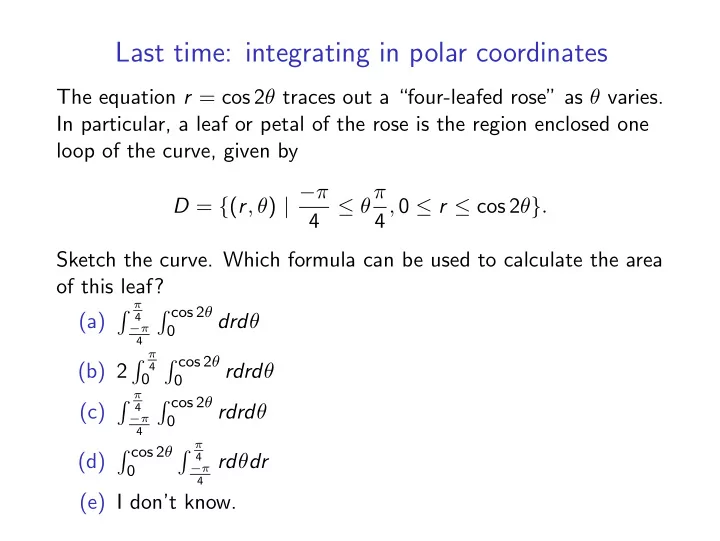
The equation r = cos 2θ traces out a “four-leafed rose” as θ varies. In particular, a leaf or petal of the rose is the region enclosed one loop of the curve, given by D = {(r, θ) | −π 4 ≤ θπ 4 , 0 ≤ r ≤ cos 2θ}. Sketch the curve. Which formula can be used to calculate the area
(a) ∫︁ π
4 −π 4
∫︁ cos 2θ drdθ (b) 2 ∫︁ π
4
∫︁ cos 2θ rdrdθ (c) ∫︁ π
4 −π 4
∫︁ cos 2θ rdrdθ (d) ∫︁ cos 2θ ∫︁ π
4 −π 4 rdθdr
(e) I don’t know.
SLIDE 2
Practice with triple integrals
We wrote E = {(x, y, z) | (x, z) ∈ D2, x2 + z2 ≤ y ≤ 4}, where D2 = {(x, z) | x2 + z2 ≤ 4}. so V (E) = ∫︂∫︂∫︂
E
dV = ∫︂∫︂
D2
∫︂ 4
x2+z2 dy dA
= ∫︂∫︂
D2
[y]4
x2+z2 dA
= ∫︂∫︂
D2
4 − x2 − z2dA.
SLIDE 3
Practice with triple integrals
So we need to calculate ∫︁∫︁
D2 4 − x2 − z2dA. We could write D2 as
a region of type I or II, but it is easier to use polar coordinates (in the xz-plane): x = r cos θ, z = r sin θ; ∫︂∫︂
D2
4 − x2 − z2dA = ∫︂ 2π ∫︂ 2 (4 − r2)r drdθ ∫︂ 2π [︃ 2r2 − 1 4r4 ]︃2 dθ ∫︂ 2π 4dθ = 8π.
SLIDE 4
Practice with triple integrals
E is the region bounded by the planes x = 2, y = 2, z = 0 and x + y − 2z = 2, and D is its triangular shadow in the xy-plane. Fill in the blanks, and discuss with your neighbour: D = {(x, y) | ? ≤ x ≤?, ?? ≤ y ≤??}. (a) We’re working on it. (b) We’re stuck. (c) We have answers, but they’re different and we don’t know who is right. (d) We have the same answer.
SLIDE 5
Practice with triple integrals
Now find u1(x, y) and u2(x, y) such that E = {(x, y, z) | (x, y) ∈ D, u1(x, y) ≤ z ≤ u2(x, y)}. (a) We’re working on it. (b) We’re stuck. (c) We have answers, but they’re different and we don’t know who is right. (d) We have the same answer.