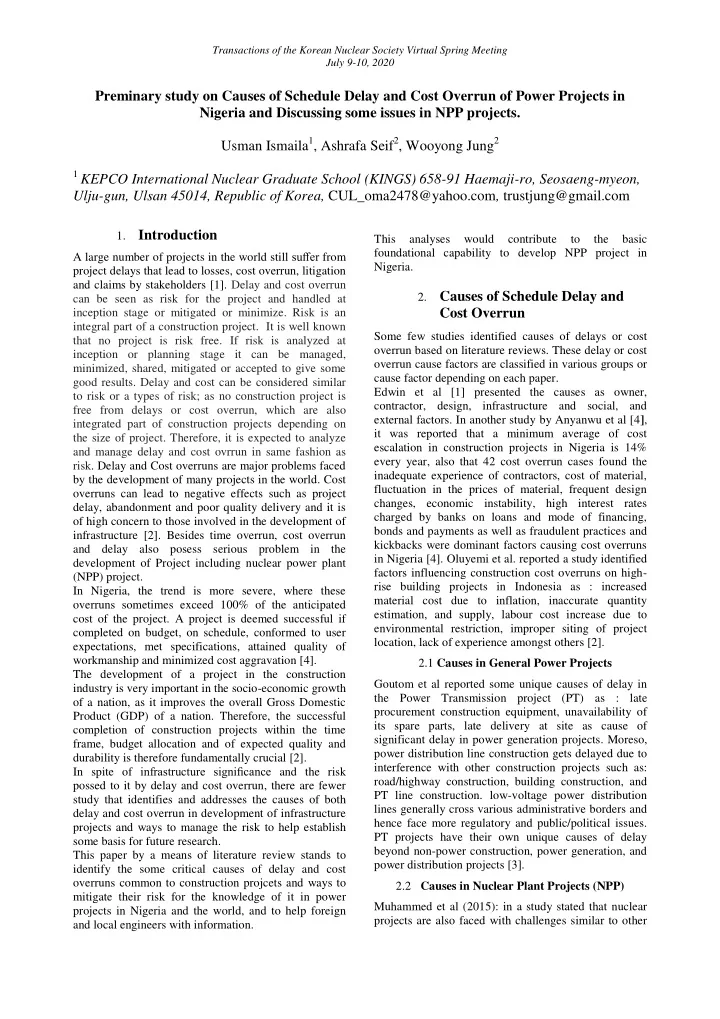
July 9-10, 2020 Preminary study on Causes of Schedule Delay and Cost - - PDF document

july 9 10 2020 preminary study on causes of schedule
SMART_READER_LITE
LIVE PREVIEW

July 9-10, 2020 Preminary study on Causes of Schedule Delay and Cost - - PDF document

Transactions of the Korean Nuclear Society Virtual Spring Meeting July 9-10, 2020 Preminary study on Causes of Schedule Delay and Cost Overrun of Power Projects in Nigeria and Discussing some issues in NPP projects. Usman Ismaila 1 , Ashrafa Seif


slide-1
SLIDE 1

Transactions of the Korean Nuclear Society Virtual Spring Meeting July 9-10, 2020

Preminary study on Causes of Schedule Delay and Cost Overrun of Power Projects in Nigeria and Discussing some issues in NPP projects. Usman Ismaila1, Ashrafa Seif2, Wooyong Jung2

1 KEPCO International Nuclear Graduate School (KINGS) 658-91 Haemaji-ro, Seosaeng-myeon,

Ulju-gun, Ulsan 45014, Republic of Korea, CUL_oma2478@yahoo.com, trustjung@gmail.com

  • 1. Introduction

A large number of projects in the world still suffer from project delays that lead to losses, cost overrun, litigation and claims by stakeholders [1]. Delay and cost overrun can be seen as risk for the project and handled at inception stage or mitigated or minimize. Risk is an integral part of a construction project. It is well known that no project is risk free. If risk is analyzed at inception or planning stage it can be managed, minimized, shared, mitigated or accepted to give some good results. Delay and cost can be considered similar to risk or a types of risk; as no construction project is free from delays or cost overrun, which are also integrated part of construction projects depending on the size of project. Therefore, it is expected to analyze and manage delay and cost ovrrun in same fashion as

  • risk. Delay and Cost overruns are major problems faced

by the development of many projects in the world. Cost

  • verruns can lead to negative effects such as project

delay, abandonment and poor quality delivery and it is

  • f high concern to those involved in the development of

infrastructure [2]. Besides time overrun, cost overrun and delay also posess serious problem in the development of Project including nuclear power plant (NPP) project. In Nigeria, the trend is more severe, where these

  • verruns sometimes exceed 100% of the anticipated

cost of the project. A project is deemed successful if completed on budget, on schedule, conformed to user expectations, met specifications, attained quality of workmanship and minimized cost aggravation [4]. The development of a project in the construction industry is very important in the socio-economic growth

  • f a nation, as it improves the overall Gross Domestic

Product (GDP) of a nation. Therefore, the successful completion of construction projects within the time frame, budget allocation and of expected quality and durability is therefore fundamentally crucial [2]. In spite of infrastructure significance and the risk possed to it by delay and cost overrun, there are fewer study that identifies and addresses the causes of both delay and cost overrun in development of infrastructure projects and ways to manage the risk to help establish some basis for future research. This paper by a means of literature review stands to identify the some critical causes of delay and cost

  • verruns common to construction projcets and ways to

mitigate their risk for the knowledge of it in power projects in Nigeria and the world, and to help foreign and local engineers with information. This analyses would contribute to the basic foundational capability to develop NPP project in Nigeria.

  • 2. Causes of Schedule Delay and

Cost Overrun

Some few studies identified causes of delays or cost

  • verrun based on literature reviews. These delay or cost
  • verrun cause factors are classified in various groups or

cause factor depending on each paper. Edwin et al [1] presented the causes as owner, contractor, design, infrastructure and social, and external factors. In another study by Anyanwu et al [4], it was reported that a minimum average of cost escalation in construction projects in Nigeria is 14% every year, also that 42 cost overrun cases found the inadequate experience of contractors, cost of material, fluctuation in the prices of material, frequent design changes, economic instability, high interest rates charged by banks on loans and mode of financing, bonds and payments as well as fraudulent practices and kickbacks were dominant factors causing cost overruns in Nigeria [4]. Oluyemi et al. reported a study identified factors influencing construction cost overruns on high- rise building projects in Indonesia as : increased material cost due to inflation, inaccurate quantity estimation, and supply, labour cost increase due to environmental restriction, improper siting of project location, lack of experience amongst others [2]. 2.1 Causes in General Power Projects Goutom et al reported some unique causes of delay in the Power Transmission project (PT) as : late procurement construction equipment, unavailability of its spare parts, late delivery at site as cause of significant delay in power generation projects. Moreso, power distribution line construction gets delayed due to interference with other construction projects such as: road/highway construction, building construction, and PT line construction. low-voltage power distribution lines generally cross various administrative borders and hence face more regulatory and public/political issues. PT projects have their own unique causes of delay beyond non-power construction, power generation, and power distribution projects [3]. 2.2 Causes in Nuclear Plant Projects (NPP) Muhammed et al (2015): in a study stated that nuclear projects are also faced with challenges similar to other

slide-2
SLIDE 2

Transactions of the Korean Nuclear Society Virtual Spring Meeting July 9-10, 2020

complex mega projects with additional nuclear specific

  • issues. The study, found top five most important

specific delay causes of NPP as; policy changes, political instability and public intervention; uncompromising regulatory criteria and licensing documents conflicting with existing regulations; robust design document review procedures; redesign due to errors in design and design changes; and worldwide shortage of qualified and experienced nuclear specific equipment manufacturers [6]. Also, Ashraf et al (2016) in another study identified some similar but unique casual causes of delay as implemented by some NPP in the world as: missing Schedule up schedule, design error, scope change, missed milestone and deliverable by contractor, vendor specification not met, inadequate funding, inaccurate time estimate, inaccurate manpower estimate [7] . 2.3 Classification of Causes and Discussion [5] Some Past study classifies delay as:

 Excusable but non-compensable delay -these are delays caused by occurrences which are not attributable to any of the parties.  Compensable delay - these delays result from acts

  • r omissions of the owner or someone for whose

acts an owner is liable.

Inexcusable delay - these delays result from a contractor's own fault or his subcontractors or material suppliers.

[1,2] The effects of delay and cost overruns on construction projects include; added cost above initially agreed upon by the client, less returns on investment on the contractor part, loss of profits for the contractor, tarnishing of the reputations of the professionals, economic loss of profits, project abandonment, litigation, decrease in property and service production for the project industry and the nation, decrease in the rate of national growth. Moreso, Some studies suggested ways to also mitigate the risk of project delay and cost overrun. See table 6.

  • 3. Methodology

This paper through a literature review identified some cause and mitigation of delay and cost overrun in the development of some specific project in industries and grouped accordingly for the knowledge of it. This is done through grouping of the collected cause data according to industry. 3.1. Data collected Cause in Building construction No. Cause Factor Reference 1

Inadequate experience of contractors [2,4] 2 Cost of material due to Inflation [2,4] 3 Fluctuation in the prices of material [4] 4 Design changes [4] 5 Economic instability [4] 6 High interest rates [4] 7 Fraudulent practices [4] 8 Inaccurate quantity estimation and supply [2] 9 labour cost increase due to Political Instability [2] 10 Improper siting of project [2]

Table 1

Causes in general Power Project

No. Cause Factor Reference

1 Late

procurement

  • f

construction equipment, unavailability of its spare parts, late delivery at site [3]

2

Interference with other projects (public issues) [3]

3

Regulatory and public Issues [1,3]

4

political issues [1,3]

5

Design Error [1]

Table 2

Causes in NPP Projects No. Cause Factor Reference 1

Policy changes [6]

2

political instability and Public issues [6]

3

Regulatory and licensing Issues [6]

4

Redesign due to errors in design and design changes [6,7]

5

Worldwide shortage of qualified and experienced nuclear specific equipment manufacturers [6]

6

Scope Change [7]

7

Missing Schedule [7]

8

Missed Milestone and deleverable by contractor [7]

9

Vendor Specification note met [7]

10

Inadequate Funding [7]

11

Inaccurate Time Estimate [7]

12

Inadequate Manpower [7]

Table 3

Causes Common to Building, General Power and NPP Projects No. The common Cause Factor Reference 1

Political Instability [1,2,4,6,7]

2

Public Issues [3,6]

3

Design Error/Issues [1,4,6,7]

4

Regulatory Issues [1,3,6]

5

Inadequate Manpower [2,4,7]

Table 4

Ways to Mitigate the risk of Delay and Cost overrun No. Ways to Mitigate the Risk Reference

1 Proper planning of project financial arrangements/adequate financing [1,3,4] 2 good work experience/ close supervision [1,3,4] 4 Adequate time estimation skills/ application of project management scheduling tools [1,3,4] 5 availability of skilled workforce, materials, and equipment. [1,2, 4] 6 Timely payments of completion certificates [1, 4] 7 good presentation of information during tendering. [1, 4] 8 Workers motivation / morale, training, good logistic management [1,2,4,] 10 top management’s support [1,4]

12

Good communication between project stakeholders

[1,4] Table 5

slide-3
SLIDE 3

Transactions of the Korean Nuclear Society Virtual Spring Meeting July 9-10, 2020

4.0 Findings: This study identified some causes that are closely common to both delay and cost overrun in projects. Table 1,2, and 3 are the identified cause in the

  • industries. Where as, Table 5, are the identified ways of

mitigating the risk of both. However, Table 4, are the identified five (5) most common cause in the development of projects obtained by comparing the causes in the industries and filtering the common causes that featured most or common to all . 5.0 Discussion and Conclusion: This study through qualitative review of literature and extraction of opinions on some cause of delay and cost

  • verrun in development of construction, building, other

power projects; including Nuclear Power Plants identified 5 most common cause that may lead to risk of delay and cost overrun in projects as: Political Instability, public issues, design error, regulatory issues and Inadequate manpower. Amongst those, political instability featured more as a cause. In conclusion, these identified common causes and mitigation mitigative strategy would add to the foundational opinion base for the benefit of research and analyses in delay and cost overrun in the development of project, especially for the construction power projects. This study is limited and will in the future cover survey of power industry opinion on the cause.

References

[1] Edwin Thomas Banobi, Wooyong Jung, Causes and

Mitigation Strategies of Delay in Power Construction Projects: Gaps between Owners and Contractors in Successful and Unsuccessful Projects, Sustainability ,2019.

[2] Oluyemi Ayibiowu, B. D. Aiyewalehinmi, O. E.,

and Omolayo, O. J : Most Critical Factors Responsible for Cost Overruns in Nigeria Building Construction Industry, IOSR Journal

  • f

Business and Management ,July 2017.

[3] Goutom K. Pall, Adrian J. Bridge, Jason Gray and

Martin Skitmore, Causes

  • f

Delay in Power Transmission Projects : An Empirical Study, Energies ,2020.

[4] Anyanwu Columbus Ikechukwu, Fidelis, I. Emoh,

Okorocha A. Kelvin : Causes and Effects of Cost Overruns in Public Building Construction Projects Delivery, In Imo State, Nigeria. IOSR Journal of Business and Management, July 2017.

[5] Frank D. K. Fugar and Adwoa B. Agyakwah Baah ,

Delays in Building Construction Projects in Ghana : Australasian Journal of Construction Economics and Building; 10 (1/2) 103‐116.

[6] Muhammed Mufazzal Hossen, Sunkoo Kang, and

Jonghyun Kim; Construction Schedule Delay Risk Assessment by using combined AHP-RII methodology for an international NPP, 2015.

[7] Samer Alsharif , Aslihan Karatas : A Framework for

Identifying Causal Factors of Delay in Nuclear Power Plant Projects, 2016. Affiliation: KEPCO International Nuclear Graduate School (KINGS).

Acknowledgement:

This research was supported by the 2020 Research Fund

  • f the KEPCO International Nuclear Graduate School

(KINGS), the Republic of Korea. +