July 17, 2020 Small Meeting Main Questions and Answers [Digital - - PDF document

july 17 2020 small meeting main questions and answers
SMART_READER_LITE
LIVE PREVIEW

July 17, 2020 Small Meeting Main Questions and Answers [Digital - - PDF document

July 17, 2020 Small Meeting Main Questions and Answers [Digital Strategy] Q. What are the strengths and challenges in DX? A. One of our strengths is that by having a shared platform for TSUBASA FinTech, we can smoothly advance cooperation


slide-1
SLIDE 1

1

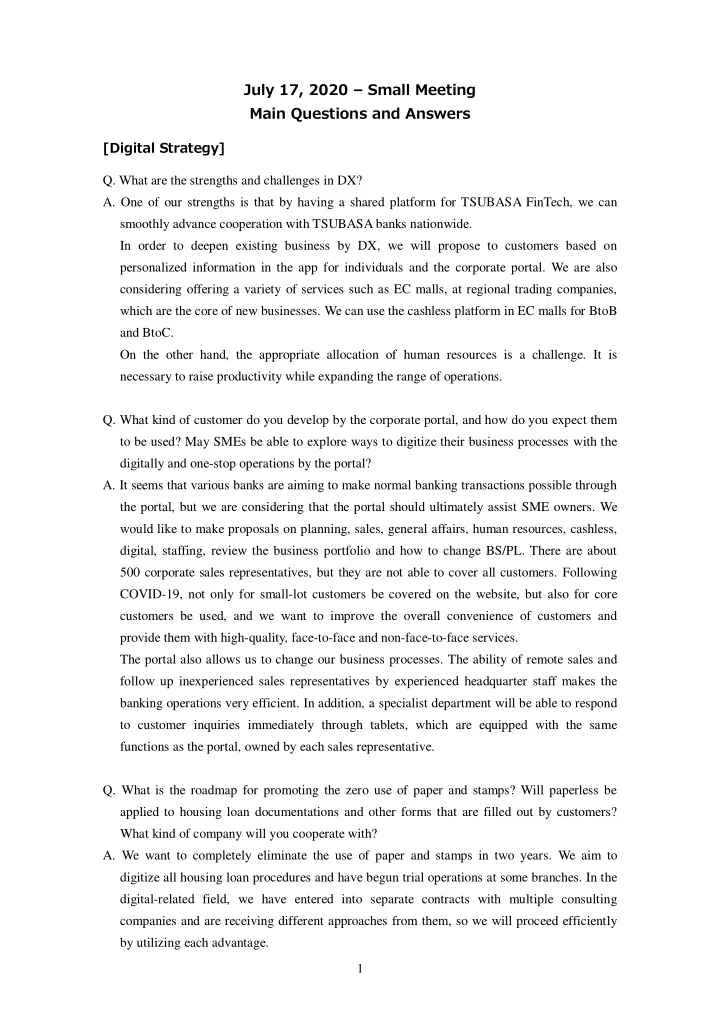
July 17, 2020 – Small Meeting Main Questions and Answers

[Digital Strategy]

  • Q. What are the strengths and challenges in DX?
  • A. One of our strengths is that by having a shared platform for TSUBASA FinTech, we can

smoothly advance cooperation with TSUBASA banks nationwide. In order to deepen existing business by DX, we will propose to customers based on personalized information in the app for individuals and the corporate portal. We are also considering offering a variety of services such as EC malls, at regional trading companies, which are the core of new businesses. We can use the cashless platform in EC malls for BtoB and BtoC. On the other hand, the appropriate allocation of human resources is a challenge. It is necessary to raise productivity while expanding the range of operations.

  • Q. What kind of customer do you develop by the corporate portal, and how do you expect them

to be used? May SMEs be able to explore ways to digitize their business processes with the digitally and one-stop operations by the portal?

  • A. It seems that various banks are aiming to make normal banking transactions possible through

the portal, but we are considering that the portal should ultimately assist SME owners. We would like to make proposals on planning, sales, general affairs, human resources, cashless, digital, staffing, review the business portfolio and how to change BS/PL. There are about 500 corporate sales representatives, but they are not able to cover all customers. Following COVID-19, not only for small-lot customers be covered on the website, but also for core customers be used, and we want to improve the overall convenience of customers and provide them with high-quality, face-to-face and non-face-to-face services. The portal also allows us to change our business processes. The ability of remote sales and follow up inexperienced sales representatives by experienced headquarter staff makes the banking operations very efficient. In addition, a specialist department will be able to respond to customer inquiries immediately through tablets, which are equipped with the same functions as the portal, owned by each sales representative.

  • Q. What is the roadmap for promoting the zero use of paper and stamps? Will paperless be

applied to housing loan documentations and other forms that are filled out by customers? What kind of company will you cooperate with?

  • A. We want to completely eliminate the use of paper and stamps in two years. We aim to

digitize all housing loan procedures and have begun trial operations at some branches. In the digital-related field, we have entered into separate contracts with multiple consulting companies and are receiving different approaches from them, so we will proceed efficiently by utilizing each advantage.

slide-2
SLIDE 2

2

  • Q. I think that the deployment of DX will make efforts to prevent information leaks and build

security systems more complicated. Please tell us about the measures and costs of these efforts?

  • A. With regard to the handling of information, we will carefully organize the status of consent to

the purpose of use, and promote while ensuring appropriate protection. Regarding the use of external information, we will consider how to cooperate while observing laws, regulations and rules, as well as taking sufficient security measures. [Cashless Business Strategy]

  • Q. One of the main pillars in the top line of the medium-term management plan is to increase

fees income by the cashless business. What do you think is the probability of earnings prospects? Please tell us if there are any incidental transactions that have not been factored into the plan with the aim of achieving higher earnings?

  • A. In October last year, we began the cashless business for merchants at the bank itself, and in

the six months since then, about 3,000 stores have signed up for the service. Around 10 sales personnel at subsidiaries have been active so far, but now there are around 500 corporate sales representatives at the bank itself working day by day. Moreover, given the large amount

  • f information and customer base that it already possesses as the top bank in the region, we

believe it is possible to achieve the plan of increasing the number of stores to 20,000 as of March 2024. Our share of the cashless payment market in Chiba Prefecture is estimated to be about 10% at present, but we plan to increase this to about 20%. The cashless payment market has been expanding, and is expected to expand at an accelerating pace as the number

  • f customers seeking touch-less payments has increased due to COVID-19. We will achieve

the profit target by increasing the volume of franchised stores handled to approximately ¥780 billion per annum in FY2022, with the expansion of number of members, our share and market. We are also developing services in collaboration with companies in other industries. We are promoting cashless payments at real stores, and consider providing EC payments for BtoC and BtoB in the future. Until now, banking transfers have been the mainstay for BtoB payments, but in the future, we will propose to wholesalers customers how to make their

  • perations more efficient by using cashless settlements. We think that the effects of

efficiency improvement will be significant, because it will be possible to complete processes

  • f posting invoices, receiving and reconciling payments, and sending receipts on the website.

About recurring, for example, in the case of rent payments by credit cards give an advantage such as point programs for tenants, and we believe that they have needs to change from a direct debit from the account to a credit card payment. As our operations and systems in the cashless business are in-house, the flexibility in the development of services has enhanced. We intend to provide new services that meet customer needs and increase the volume of transactions.

slide-3
SLIDE 3

3

  • Q. What are the inquiries from TSUBASA banks about the expansion of the cashless business?

Is it systematically difficult to expand to non-alliance banks?

  • A. TSUABSA banks are constantly sharing information, and some of them have interests. As

the cashless payment business operates under a different system from the banking mainframe, we can develop jointly with banks that have different mainframe systems and expand to

  • ther than TSUBASA banks.
  • Q. Do you promote developing franchised stores in conjunction with lending?
  • A. We basically promote at the same time as lending and other business activities, and this leads

to an increase in the number of new borrowers. There are both cases in which franchised contracts lead to new loans and lending links franchised contracts. The cashless business for merchants is part of the advisory services for customers, and it is one of a wide range of solution proposals, including business portfolio reviews, capital loans, staffing, planning, sales, general affairs, and human resources.

  • Q. I think that the multi-payment terminal that Chiba Bank has introduced is the same type as

the Bank of Ryukyus. When expanding to TSUBASA, will other banks also be introduced in the future? Will each bank issue debit cards?

  • A. Multi-payment terminals are provided by the same manufacturer as the Bank of Ryukyus,

and we plan to use the same products at TSUBASA banks as well. We also consider conducting the business at each bank by jointly using TSUBASA cashless payment platform, which consists of a paperless application system using tablets and a franchised management system. The same platform may be used for Visa debit card issuance by each bank.

  • Q. What is the bottleneck in the cashless business for merchants? What are the particularly

strong needs of franchised stores? Please tell us about the unique value by banks, including relationships or differences with competitors.

  • A. As it is a new business, there are some issues such as securing human resources who are

familiar with the industry and systems, absorbing know-how, and expanding partners that can cooperate with, but we aim to increase transaction volume through collaboration with

  • ther industrial companies, including major cash register manufacturers.

Customers frequently say that they want to lower commissions or increase the timing of deposits from twice a month. We think that our cost competitiveness is comparable to that of competitors, because we control costs by internalizing operations and systems. It is able to receive daily payments with a paid option, and this point is also superior to other companies in the industry.

slide-4
SLIDE 4

4

  • Q. Please tell us about BtoB payment operations if there are similar or competing services,

including your thinking about any differentiating factors. Are there difficulties in promoting at the bank itself?

  • A. BtoB payments are also provided by some credit card companies. The strengths as regional

banks are that we have relationships with customers after understanding their business details, products and clients. We believe that we can improve customers' productivity by making suggestions tailored to their needs.

  • Q. Is the franchise commission rate lower than 3.25%? Are there any effects of a reduction in

interbank remittance fees?

  • A. Until June, the ceiling was 3.25%. The current commission rate varies by industry and other

conditions, and we are flexibly adapting. We expect that banks will continue to have an advantage, while many cashless operators may shorten the deposit cycle with lower banking transfer fees.

  • Q. As the potential for BtoB payments is large, what do you expect about fees structure and

contribution to earnings?

  • A. Currently, we are in the process of considering introducing the service, and examining the

appropriate fees structure and the level of future contribution to earnings. End