
SLIDE 1
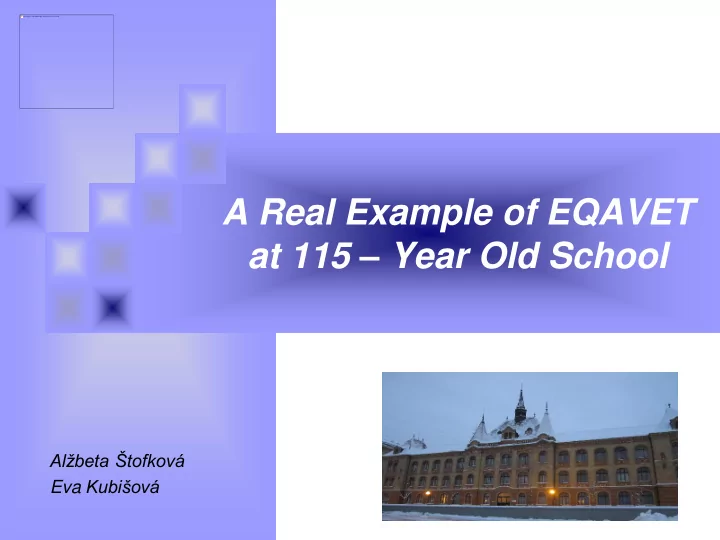
A Real Example of EQAVET at 115 – Year Old School
Alžbeta Štofková Eva Kubišová
A Real Example of EQAVET at 115 Year Old School Albeta tofkov Eva - - PowerPoint PPT Presentation
A Real Example of EQAVET at 115 Year Old School Albeta tofkov Eva Kubiov SLOVAKIA situated in the centre of Europe its capital BRATISLAVA neighbouring Vienna, Budapest and Prague The Mint of Mincova Kremnica with a Screw-press
Alžbeta Štofková Eva Kubišová
situated in the centre of Europe it´s capital BRATISLAVA neighbouring Vienna, Budapest and Prague
Kremnica Mint by the well-known Swedish engineer, engraver and medal-maker Daniel Warou in 1710.
seven centuries it has continuously been producing mint articles that rank, in many terms, among the world's top products
minting creates capacity to produce a wide variety of extraordinarily high- quality products, and thus satisfy hundreds of customers every year
certificates
focus extends beyond coins and medals
combined with the talents of its people, makes it capable of manufacturing high- quality plaques, tokens, badges, pendants, tie pins, stamps, labels, awards, Mayor's chains, orders and many other articles
Stredná priemyselná škola strojnícka „Fajnorka“ bola založená
„mohli ich deti získať kvalitné technické vzdelanie vo svojom meste a nemuseli za ním odchádzať do cudziny...“
Školu prišiel oceniť osobne posledný cisár Rakúsko- uhorskej monarchie Karol I Habsburský s rodinou
Počas prvej svetovej vojny sa v dielňach školy vyrábali protézy pre vojnových invalidov, ktorých tu zároveň učili tieto používať
in Mechanical Engineering 3 study fields:
high-quality technical education in the technical-engineering field and at the same time provide them with high-quality general education, which prepares them to enter into life, into the world of work, for further development and study.
application in the labour market and the complex development of the personality of their children.
appreciation of their work and social security.
and fully educated, creative and flexible workforce and the possibility of further training of their employees.
possibility of lifelong learning.
the west-southwest part of Slovakia, forming the smallest region of the country with an area of 2 053
at the historical crossing
trading routes – Danubian and north-south, the so called “Amber Route”. The region’s central location within the mid- European area, good transport access and the functions of international crossing both in road and railway transport, increasing importance of water and air transport and high rate of economic and social growth are amongst the most important development factors of the Bratislava Region.
Slovakia, the Bratislava Region generates approximately 26 % of the country’s GDP. The Bratislava Region exceeds the EU 25 average by 15, 9 % in GDP per capita in purchase power parity. The region´s economy comprises of all sectors that are based on traditional industrial production of goods; the most important sectors are; the chemical industry, automotive industry, mechanical engineering, electro-techncial and food processing industry.
to 30 % of Slovakia’s exports. The current structural changes within the economy of the Region contribute to growth of the tertiary sector, mainly trade and services, banking and insurance
the lowest unemployment rate among Slovak regions, with the average nominal monthly wage exceeding the overall Slovak average.
in recent years, the competitive struggle for a student in secondary schools has been rising, the demographic curve has fallen, and the number of primary-school leavers is
condition of a school´s survival. In addition to providing quality education, the school must also
service, and therefore cannot close itself.
Overall data F M Total Number of teachers 13 15 physically28(full time 24,1) Number
staff 6 4 9,5 Number of students Current year 9 216 225 Previous year 8 197 205 Year before previous year 8 177 185 General success/graduation rate reporting year: 2017 75% 73,6% 73,8%
Data for study branches F M Total Student/pupil enrolment in study branch: 2381 M Mechanical Engineering Current year
2 64 66
Previous year
1 55 56
Year before previous year
1 60 61
Success/Graduation rate (%; reporting year : 2017)
0 % 90,9 % 83,3 %
Student/pupil enrolment in study branch : 2387 M Mechatronics Current year
3 96 99
Previous year
2 98 100
Year before previous year
3 89 92
Success/Graduation rate (%; reporting year : 2017)
no girls in 1st class
80,9 % 80,9 %
Student/pupil enrolment in study branch : 3918 M Technical lyceum Current year
4 56 60
Previous year
5 44 49
Year before previous year
4 28 32
Success/Graduation rate (%; reporting year 2017)
100 % 25 % 45,4 %
the school development plan in the field of practical training is:
been a member of EFVET (European Forum for Technical and Vocational Education and Training).
cooperating businesses in the region;
schools and companies;
realization of student internships in companies in Slovakia as well as abroad;
and the interest of the pedagogical staff in innovation and modernization of the educational process, improvement of the school education program.
Assessment of Quality by Peer Review in European VET in SPS Strojnícka, February 2018
Assessment of Quality Areas:
qualifications (soft skills)
relations and internationalisation
contacts
cooperation with relevant stakeholders
The weakness in the implementation plan is:
communicate in a foreign language, especially in the 40+ category;
implementing mobility as a state school we have a very tense budget;
between classification rules and credit transfer. The quality indicator is the image
the school and the school creates its image itself. The quality of the school and the creation of its good image lies above all in the achievement of the objectives set, the fulfilment
the requirements of pupils and parents.
To make strategic decision, you need to:
small steps in daily life.
your client! An important role in evaluating of the fulfilment of the objectives play the advisory bodies of the school head which have their specific tasks: School´s Panel Board (GRS):
Manager, Educational Counselor, Chair of the School Board, Coordinator of Digitization and Working with Talented Students, International Co-ordinator and Admission Coordinator, KCOV co-
and e-testing, Coordinator of Student´s board, and trade union representative.
the schedule for the school year.
and pedagogical process.
The coordinator of the School´s Board activities is a teacher appointed by the school head.
invites other school staff if necessary.
If If you
each me me, I will forget et. If If youmoti tivate vate me me, I will out utperf perform