
SLIDE 1
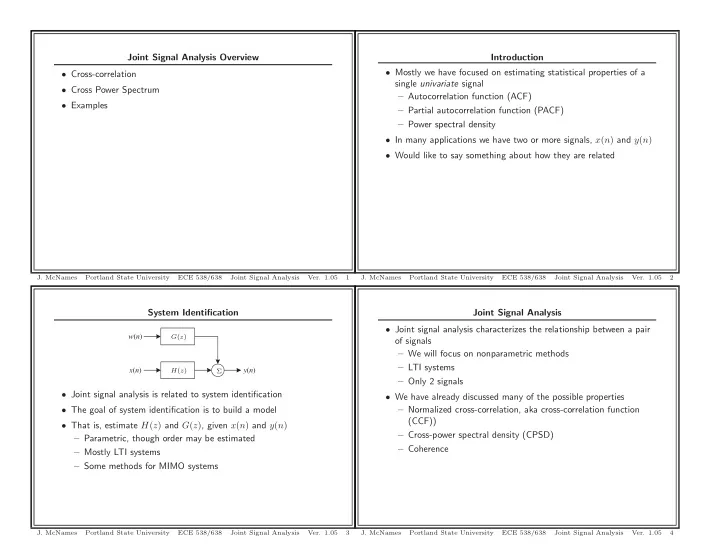
System Identification
w(n) x(n) y(n)
G(z) H(z) Σ
- Joint signal analysis is related to system identification
- The goal of system identification is to build a model
- That is, estimate H(z) and G(z), given x(n) and y(n)
– Parametric, though order may be estimated – Mostly LTI systems – Some methods for MIMO systems
- J. McNames
Portland State University ECE 538/638 Joint Signal Analysis
- Ver. 1.05
3
Joint Signal Analysis Overview
- Cross-correlation
- Cross Power Spectrum
- Examples
- J. McNames
Portland State University ECE 538/638 Joint Signal Analysis
- Ver. 1.05
1
Joint Signal Analysis
- Joint signal analysis characterizes the relationship between a pair
- f signals
– We will focus on nonparametric methods – LTI systems – Only 2 signals
- We have already discussed many of the possible properties
– Normalized cross-correlation, aka cross-correlation function (CCF)) – Cross-power spectral density (CPSD) – Coherence
- J. McNames
Portland State University ECE 538/638 Joint Signal Analysis
- Ver. 1.05
4
Introduction
- Mostly we have focused on estimating statistical properties of a
single univariate signal – Autocorrelation function (ACF) – Partial autocorrelation function (PACF) – Power spectral density
- In many applications we have two or more signals, x(n) and y(n)
- Would like to say something about how they are related
- J. McNames
Portland State University ECE 538/638 Joint Signal Analysis
- Ver. 1.05