Digital Signal Processing Solutions Digital Signal Processing - - PowerPoint PPT Presentation

digital signal processing solutions digital signal
SMART_READER_LITE
LIVE PREVIEW

Digital Signal Processing Solutions Digital Signal Processing - - PowerPoint PPT Presentation

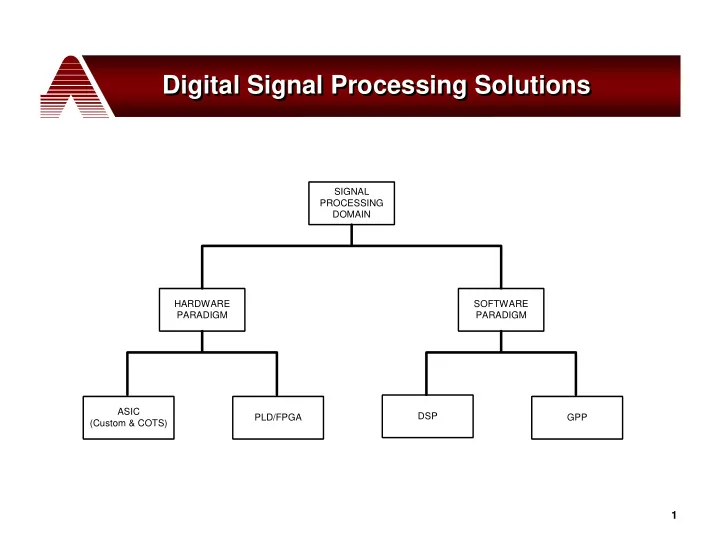
Digital Signal Processing Solutions Digital Signal Processing Solutions SIGNAL PROCESSING DOMAIN HARDWARE SOFTWARE PARADIGM PARADIGM ASIC DSP PLD/FPGA GPP (Custom & COTS) 1 Hardware Paradigm Hardware Paradigm


slide-1
SLIDE 1

1

Digital Signal Processing Solutions Digital Signal Processing Solutions

SIGNAL PROCESSING DOMAIN PLD/FPGA ASIC (Custom & COTS) DSP GPP HARDWARE PARADIGM SOFTWARE PARADIGM
slide-2
SLIDE 2

2

Hardware Paradigm Hardware Paradigm

  • Application-Specific Integrated Circuit (ASIC)

– A kind of semi custom integrated circuit, often referred to as "gate-array" or "standard-cell" products, developed and designed to satisfy a specific application requirement as

  • pposed to a general purpose circuit, such as a

microprocessor.

  • Field Programmable Gate Array (FPGA)

– Pioneered by Xilinx as a class of programmable logic devices (PLD) that feature a gate-array-like architecture with a matrix of logic cells surrounded by a periphery of I/O cells where the interconnect mask is defined after the IC has been manufactured.

slide-3
SLIDE 3

3

ASIC - Introduction ASIC - Introduction

  • ASICs are customized or tailored to perform specific

functions to a particular system or application

  • ASICs are typically employed as bus interfaces, glue logic,

functional accelerators, and/or a System-On-Chip (SoC).

  • ASIC Types are:

– Full-Custom – Standard-Cell–Based – Gate-Array–Based – Channeled Gate Array – Channel less Gate Array – Structured Gate Array

slide-4
SLIDE 4

4

ASIC - Benefits ASIC - Benefits

  • Improve performance
  • Reduce power consumption
  • Reduce production costs
  • Mix Analog and Digital Designs
  • Design optimization through IC manufacturing process
  • Development Tools support HDL and Schematic design

approach

slide-5
SLIDE 5

5

ASIC - Drawbacks ASIC - Drawbacks

  • Inflexible design
  • Higher Risk Of Obsolescence (driven by market)
  • Large NRE (up to 16 million) from development and testing
  • Deployed systems can not be upgraded
  • Mistakes in product development are costly
  • Updates requires a redesign
  • Impediment to rapid time-to-market designs
  • Complex and expensive development tools
slide-6
SLIDE 6

6

FPGA - Introduction FPGA - Introduction

  • FPGA is a sub class of ASICs
  • Matrix of configurable logic

blocks (CLBs) that can implement combinational or sequential logic

  • Provides a method for

programming the CLBs and interconnects

slide-7
SLIDE 7

7

FPGA - Benefits FPGA - Benefits

  • Reconfigurable / Reprogrammable Hardware
  • Shorter development allows for fast time to market
  • Design and debug changes can be made instantaneously
  • Allows for:

– design reuse – parallel design – SOC design

  • Development Tools support HDL and Schematic design

approach

  • Offer greater performance compare to software solutions

with lower clock speeds

  • Designs started in FPGA’s can be migrated to ASICs
  • Reduces processor obsolesces
slide-8
SLIDE 8

8

FPGA - Drawbacks FPGA - Drawbacks

  • More expensive than a ASIC on a per unit basis
  • Typically have much higher power dissipation
  • Un-programmed at power up
  • Need a PROM or Host to store image
  • More difficult to debug compared to a software

approach

slide-9
SLIDE 9

9

Software Paradigm Software Paradigm

  • Digital Signal Processor (DSP)

– A microprocessor whose architecture is specially designed for numerical computations on discrete number sequences specifically tailored to the processing of signals.

  • General Purpose Processor (GPP)

– A family of microprocessors and microcontrollers whose architecture are represented by complex instruction set computer (CISC), reduced instruction set computer (RISC), or the very long instruction word (VLIW). GPPs are best suited for performing a broad array of tasks that are not specifically tailored for any particular application.

slide-10
SLIDE 10

10

DSP - Benefits DSP - Benefits

  • Increased Performance through:

– Circular Buffering – Single-cycle MACs – Execution predictability – Dedicated fixed or floating point processors

  • Hard Real-time performance
  • Flexible through software programmability
  • Development and testing cycle mirrors GPP development
  • Use standard software programming languages
  • Low power consumption
  • Reduced system cost
slide-11
SLIDE 11

11

DSP - Drawbacks DSP - Drawbacks

  • Increased Product Development Time and Cost

– Breadth and quality of development and debug tools – Processor ease of use – Availability of software libraries – May require use of assembly language

  • No general DSP system architecture like the

personal computer (PC)

  • Fixed point processors must deal with numeric

effects

  • Code reuse limited due lack of standard

instruction set, interface, and operating system (OS)

slide-12
SLIDE 12

12

GPP - Benefits GPP - Benefits

  • Flexible through software programmability
  • Reduced Product Development Time and Cost through:

– Large set of development and debug tools – Large set of commercial off the shelf (COTS) OS – Large set of available libraries

  • High-performance GPPs are becoming more DSP like with
  • ptimized instructions
  • High Performance GPPs include a fixed and floating point

processor

  • Standard system architecture defined for many High

Performance GPPs

  • Large variety and wide availability of GPPs
  • Large deployment of GPPs
slide-13
SLIDE 13

13

GPP - Drawbacks GPP - Drawbacks

  • High-performance GPPs timing behavior appears to be stochastic

and can only support soft real-time performance due to heavy use

  • f:

– Caches – Branch prediction – Superscalar execution – Data dependent instruction execution

  • Difficult to program DSP algorithms (FIRs, IIRs, FFTs)
  • Compliers do not or partial support DSP optimization instructions
  • Processor optimizations are highly dependent on the compiler
  • DSP-oriented tools are rare
  • Few DSP libraries available
  • Higher power consumption
  • Higher cost
slide-14
SLIDE 14

14

Conclusion Conclusion

  • ASICs too expensive to implement on a small

scale

  • COTS ASICs subject to market demands
  • FPGAs & DSPs have huge potential for use in

deployment custom solutions

  • GPP is effective for low rates:

– Use of COTS software and hardware packages – Large pool of knowledgeable developers – Rapidly deployed