J-DSP and Sensor Motes for Universally accessible DSP functions - - PDF document

j dsp and sensor motes for
SMART_READER_LITE
LIVE PREVIEW

J-DSP and Sensor Motes for Universally accessible DSP functions - - PDF document

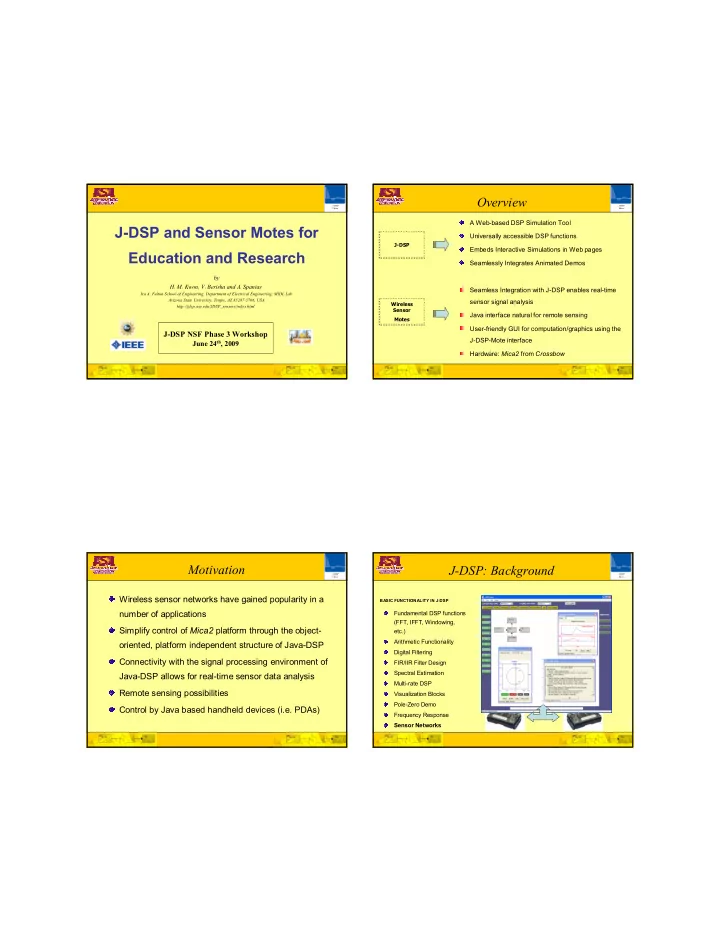
Overview J-DSP J-DSP Editor Editor A Web-based DSP Simulation Tool J-DSP and Sensor Motes for Universally accessible DSP functions J-DSP Embeds Interactive Simulations in Web pages Education and Research Seamlessly Integrates Animated


slide-1
SLIDE 1

J-DSP Editor

1

by

  • H. M. Kwon, V. Berisha and A. Spanias

Ira A. Fulton School of Engineering, Department of Electrical Engineering, MIDL Lab Arizona State University, Tempe, AZ 85287-5706, USA http://jdsp.asu.edu/JDSP_sensors/index.html

J-DSP and Sensor Motes for Education and Research

J-DSP NSF Phase 3 Workshop June 24th, 2009

J-DSP Editor

2

Overview

A Web-based DSP Simulation Tool Universally accessible DSP functions Embeds Interactive Simulations in Web pages Seamlessly Integrates Animated Demos

Wireless Sensor Motes

Seamless Integration with J-DSP enables real-time sensor signal analysis Java interface natural for remote sensing User-friendly GUI for computation/graphics using the J-DSP-Mote interface Hardware: Mica2 from Crossbow

J-DSP

J-DSP Editor

3

Motivation

Wireless sensor networks have gained popularity in a number of applications Simplify control of Mica2 platform through the object-

  • riented, platform independent structure of Java-DSP

Connectivity with the signal processing environment of Java-DSP allows for real-time sensor data analysis Remote sensing possibilities Control by Java based handheld devices (i.e. PDAs)

J-DSP Editor

4

J-DSP: Background

Fundamental DSP functions (FFT, IFFT, Windowing, etc.) Arithmetic Functionality Digital Filtering FIR/IIR Filter Design Spectral Estimation Multi-rate DSP Visualization Blocks Pole-Zero Demo Frequency Response Sensor Networks

BASIC FUNCTIONALITY IN J-DSP

slide-2
SLIDE 2

J-DSP Editor

5

Hardware Platform

  • Targeted Applications: Environmental Monitoring, Security, Source

Localization, Tracking, Biological Applications

MIB(510) Gateway : serial port programmer

J-DSP Editor

6

Java-DSP and the Motes

J

  • D

S P J

  • D

S P J-DSP

Internet “Collaborative Sensor Signal Processing enabled by J-DSP”

J-DSP Editor

7

Tiny OS and Java-DSP

Wireless Channel J-DSP BS Application

Java-DSP acts as an additional layer at the base station Lower layer processing is seamless to the user

J-DSP Editor

8

Tiny OS & nesC

  • Simple and powerful OS for low power
  • Re-use of component
  • “Hurry up and sleep”
  • Scheduling based on events and tasks
  • FIFO structure
  • TinyOS syntax and structure
  • Dialect of C language
  • A pre-processor

– Converts wiring of high level modules into efficient code – nesC output is a c program file that is compiled and linked using gnu-gcc tools for a specific Mote

Tiny OS nesC Language

slide-3
SLIDE 3

J-DSP Editor

9

The Motes (MICA2 Platform)

  • Microprocessor: Atmel ATmega 128L

– 7.3728 MHz clock – 128 kB of Flash for program memory – 4 kB of SRAM for data and variables – 2 UARTs – Serial Pot Interface (SPI) bus – Inter IC (I2C) bus

  • Radio: Chipcon’s CC1000
  • External serial flash memory: 512 kB
  • 51-pin expansion connector

– Eight 10-bit analog I/O – 21 general purpose digital I/O

  • User interface: 3 LEDs
  • JTAG port
  • Powered by two AA batteries

– 1850 mAh capacity

J-DSP Editor

10

The MOTE Block

GUI for the motes Control panel is used to control the individual motes and the RS232 settings MOTE block in J-DSP allows users to control individual motes Real-time graph plots data as it comes

Control Panel Plot Area

J-DSP Editor

11

Sensor Network Signal Processing with J-DSP

A number of advanced signal processing features available in J-DSP You can connect the incoming data to existing blocks to create DSP systems Example: Fitting incoming data to an auto-regressive model

J-DSP Editor

12

Remote Sensing with J-DSP

Preliminary example shows possibilities for sensing and security applications Display panel shows which sensors are active Active Sensors:

Light Sound Temperature Accelerometer

slide-4
SLIDE 4

J-DSP Editor

13

Future Directions

J-DSP and Motes for Research

Source localization using the Motes Target tracking Interfacing with advanced J- DSP features (i.e. HMM) Collaborative remote sensing using J-DSP Implement sensor networks using J-DSP/Motes for smart home and security applications

J-DSP and Motes for Education

Train UG and grad. students the basics of working with wireless Motes using the J-DSP GUI Train engineers and practitioners in real-time analysis of sensor data Use hands-on hardware/ software approach to create a workforce trained in using sensors for security and other applications

J-DSP Editor

14

Summary

Simulation modules and blocks in J-DSP have been developed to control the Crossbow Motes Object-oriented structure of J-DSP allows for easy manipulation of the Motes Please visit http://jdsp.asu.edu for more information on J-DSP J-DSP also supports: Statistical DSP simulations, Communications, Speech analysis-synthesis, 2D and Image processing, Spectrogram/time-frequency experiments, and Controls simulations

Some figures taken from http://www.xbow.com