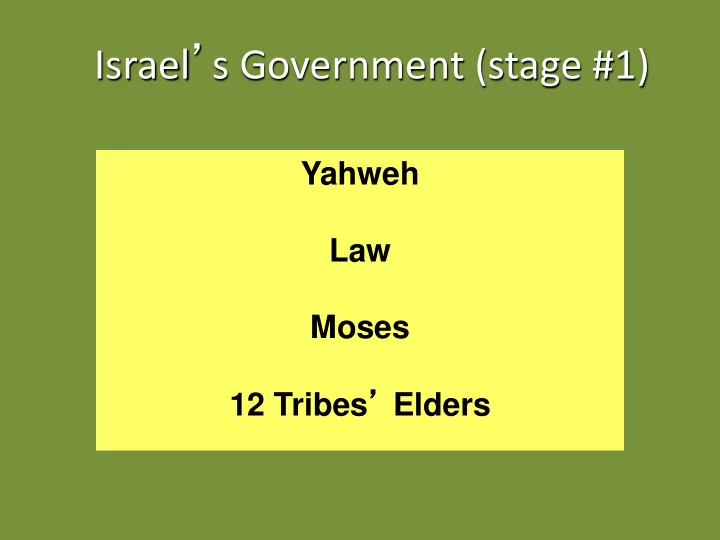
Israel s Government (stage #1) Yahweh Law Moses 12 Tribes Elders - - PowerPoint PPT Presentation
Israel s Government (stage #1) Yahweh Law Moses 12 Tribes Elders Israel s Government (stage #2) Yahweh Law Moses Officers (sarim ) Marching Units Israel s Government (stage #3) Yahweh Law Moses 70 Empowered Shoterim
Israel’s Government (stage #2)
Yahweh Law Moses Officers (“sarim”) Marching Units
Israel’s Government (stage #3)
Yahweh Law Moses 70 Empowered Shoterim Officers (“sarim”) Marching Units
Israel’s Government (stage #4)
Yahweh Law Supreme Court (priests & shoter) City 1 City 2 City 3 shoterim shoterim shoterim sarim sarim sarim
Ecclesiastical Civil Supplied the law of God and interceded with God for proper judgment (“Urim and Thummim” Num 27:21?) Proclaims the verdict and enforces the punishment (custodian of judicial force)
“The Egyptian belief [was] that the universe is changeless and that all apparent opposites must, therefore, hold each other in
- equilibrium. Such a belief has definite consequences in the field
- f moral philosophy. It puts a premium on whatever exists with
a semblance of permanence. It excludes ideals of progress, utopias of any kind, revolutions, and any other radical changes in existing conditions. . . .In this way the belief in a static universe enhances, for instance, the significance of established authority.”
Henri Frankfort
EGY GYPTIA IAN R N RELIGION IGION
earth heaven Horus
"[Pharaoh] was the fountainhead of all authority, all power, and all wealth. The famous saying of Louis XIV, l'etat c'est moi, was levity and presumption when it was uttered, but could have been
- ffered by Pharaoh as a statement of fact in which his subjects
concurred. It would have summed up adequately [Egyptian] political philosophy.”
Henri Frankfort
“The politics of the anti-Christian will. . inescapably be the politics of guilt. In the politics of guilt, man is perpetually drained in his social energy and cultural activity by his overriding sense of guilt and his masochistic activity. He will progressively demand of the state a redemptive role. What he cannot do personally, i.e., to save himself, he demands that the state do for him, so that the state, as man enlarged, becomes the human savior of
- man. The politics of guilt, therefore, is not directed as the Christian
politics of liberty, to the creation of the state. . . .The politics of guilt cultivates the slave mind in order to enslave men, and to have the people themselves demand an end to liberty. Slaves, true slaves, want to be rescued from freedom; their greatest fear is liberty. . . .Even as a timid and fearful child dreads dark, so does the slave mind fear liberty; it is full of the terrors of the unknown. As a result, the slave mind clings to statist or state slavery, cradle-to-grave welfare care, as a fearful child clings to its mother. The advantage of slavery is precisely this, security in the master or in the state.”