[Emblem of the State of Israel] State of Israel Ministry of Defense - - PowerPoint PPT Presentation

emblem of the state of israel state of israel ministry of
SMART_READER_LITE
LIVE PREVIEW

[Emblem of the State of Israel] State of Israel Ministry of Defense - - PowerPoint PPT Presentation

Unofficial translation by Gisha. For inquiries, contact info@gisha.org. [Emblem of the State of Israel] State of Israel Ministry of Defense Coordination of Government Activities in the Territories Economics Branch 30 - 1719777 Tel: 30 -


slide-1
SLIDE 1

Unofficial translation by Gisha. For inquiries, contact info@gisha.org.

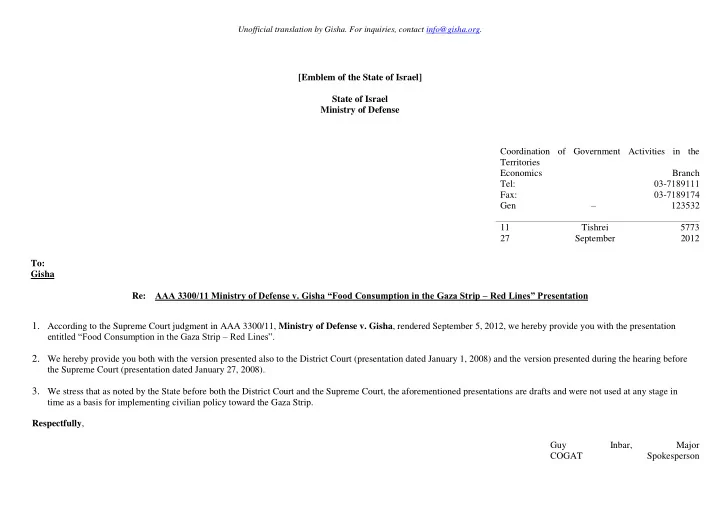
[Emblem of the State of Israel] State of Israel Ministry of Defense Coordination of Government Activities in the Territories Economics Branch Tel: 30-1719777 Fax: 30-1719717 Gen – 123532 11 Tishrei 5773 27 September 2012 To: Gisha Re: AAA 3300/11 Ministry of Defense v. Gisha “Food Consumption in the Gaza Strip – Red Lines” Presentation

  • 1. According to the Supreme Court judgment in AAA 3300/11, Ministry of Defense v. Gisha, rendered September 5, 2012, we hereby provide you with the presentation

entitled “Food Consumption in the Gaza Strip – Red Lines”.

  • 2. We hereby provide you both with the version presented also to the District Court (presentation dated January 1, 2008) and the version presented during the hearing before

the Supreme Court (presentation dated January 27, 2008).

  • 3. We stress that as noted by the State before both the District Court and the Supreme Court, the aforementioned presentations are drafts and were not used at any stage in

time as a basis for implementing civilian policy toward the Gaza Strip. Respectfully, Guy Inbar, Major COGAT Spokesperson

slide-2
SLIDE 2

Unofficial translation by Gisha. For inquiries, contact info@gisha.org.

SLIDE 1 Ministry of Defense Coordination of Government Activities in the Territories

– Gaza Strip Food Consumption in the Red Lines

1 January 2008

slide-3
SLIDE 3

Unofficial translation by Gisha. For inquiries, contact info@gisha.org.

SLIDE 2

Goals of Analysis

 As part of the policy formulated by the Security Cabinet on September 19, 2007, Israel will limit the entry of goods into the Gaza Strip.  In order to allow for a basic fabric of life in the Gaza Strip, the deputy defense minister approved allowing 106 trucks carrying basic humanitarian products into the Gaza Strip, mostly food (all products are specified in the appendices). In addition, food in seed form was approved for entry via the aggregate conveyor belt located near the Karni crossing.  This research examines the main food component.  The goal of the analysis – to identify the point of intervention for prevention of malnutrition in the Gaza Strip.  The basis for the analysis is a model formulated by the Ministry of Health (at this point, according to average Israeli consumption) and a model formulated by the Palestinian Ministry of Economy.  The Ministry of Health is conducting work for calculating the minimal subsistence basket based on the Arab sector in Israel. The “minimum basket” allows nutrition that is sufficient for subsistence without the development of malnutrition.

slide-4
SLIDE 4

Unofficial translation by Gisha. For inquiries, contact info@gisha.org.

SLIDE 3

Main Working Assumptions

 The research analyzes the situation according to the food that enters the Gaza Strip and does not take into account distribution/division inside the area.  There is internal food production in the Gaza Strip (mostly vegetables and protein, detailed in appendices).  The figures used in the consumption models were “converted” into supply over five days and translated, in some of the sections, into truckloads, taking into account packaging weight.  Wheat, which is a major food component, was converted into flour according to a scale of 1,000 kilograms of wheat being the equivalent of 720 kilograms of flour.

slide-5
SLIDE 5

Unofficial translation by Gisha. For inquiries, contact info@gisha.org.

SLIDE 4

Working Assumption – Daily Humanitarian Portion Required to Enter Gaza Strip

Basic Products Daily truck movement, according to 106 Basic food Flour and yeast 10 Rice 5 Agriculture (fruit, vegetables and agricultural inputs) 18 Powdered milk and baby formula 3 Dairy products 10 Meat/poultry/fish 10 Legumes 2 Oil 5 Sugar 10 Salt 4 Total basic food 77 Other Products Other food products 11 Agriculture - agricultural inputs 2 Medicine 3 Medical equipment 3 Hygiene products 5 Essential humanitarian infrastructure products 5 Total 106

*In addition, the aggregate conveyor belt at Karni Crossing transports wheat and animal feed (From Oct – Dec 2007, approximately 60 trucks of wheat per week – average of 12 per day (based on 5 business days)

slide-6
SLIDE 6

Unofficial translation by Gisha. For inquiries, contact info@gisha.org.

SLIDE 5

Food Consumption in the Gaza Strip According to Ministry of Health Index for Daily Food Portion (discounting internal production)

Age/Type of food Average daily portion per person (in grams) Required daily food for general population (in tons) Required daily truckload supply (5 business days) Flour 140 196 10 Rice 70 98 6 Potatoes 70 98 7 Vegetables 279 385 28 Fruit 479 662 48 Milk 521 720 42 Meat 232 321 31 Legumes/tahina 40 56 3 Oil 15 21 1 Sugar 40 55 3 Total 1,886 2,612 178

 Food is brought in 5 days per week. Therefore, in calculating the number of truckloads, the daily required amount of food was multiplied by a factor of 7/5.  The number of truckloads takes into consideration the transfer of two truckloads (40 tons) of powdered milk per day which are equivalent to 27 truckloads of fresh milk.

slide-7
SLIDE 7

Unofficial translation by Gisha. For inquiries, contact info@gisha.org.

SLIDE 6

General Daily Food Consumption in the Gaza Strip per Ministry of Health Scale (in tons)

Age/Type

  • f food

Male/Female Female Male Total for general population (minus 6- 12 month age bracket) Food additive for -12 month age bracket) Total quantity required for general population 2-3 4-6 7-10 11-24 24-50 51+ 11-14 15-18 19-24 24-50 51+ Grains 11.94 37.15 40.43 63.94 53.52 14.65 25.66 25.71 25.71 68.33 15.23 382.28 3.98 386.26 Vegetables 12.62 37.00 40.52 60.03 50.25 14.64 24.64 24.68 24.68 65.61 14.85 369.53 4.21 373.74 Fruit 16.99 58.80 67.42 102.65 85.92 23.84 43.69 45.02 45.02 119.68 25.80 636.86 6.33 643.19 Milk 39.49 70.18 68.53 140.88 78.61 26.18 51.40 26.34 46.34 82.13 22.13 672.22 13.16 685.38 Meat 14.09 39.83 62.61 60.93 51.00 15.57 24.08 23.38 23.38 62.15 14.95 371.98 4.70 376.67 Oil 0.00 1.18 1.81 0.00 3.39 0.56 0.82 2.22 1.85 7.87 1.06 20.75 0.00 20.75 Sugar 4.35 5.04 5.58 4.95 5.27 2.01 2.87 5.18 4.07 12.78 1.85 53.95 1.45 55.40  The figures are in tons per calendar day (consumption over seven days per week, unlike supply which is calculated based on five days per week).  The portion of consumption is measured by the Health Ministry in Israel and provides for 2,000-2,500 calories per adult and 1,550 calories per child.  The quantities in this table are average consumption according to Israeli standards and are not minimal subsistence portions.  The Ministry of Health has been requested to calculate the minimal subsistence basket according to the Arab sector in Israel. The “minimal basket” allows for nutrition that is sufficient for subsistence without the development of malnutrition.

slide-8
SLIDE 8

Unofficial translation by Gisha. For inquiries, contact info@gisha.org.

SLIDE 7

Energy (calories) and Daily Food Portion (in grams) in the Gaza Strip According to Ministry of Health Scale – Broken Down by Age and Gender

Age/Type

  • f Food

Male/Female Female Male Average portion 2-3 4-6 7-10 11-24 24-50 51+ 11-14 15-18 19-24 24-50 51+ Flour (0.67) 84.65 148.14 165.07 190.47 190.47 156.61 209.52 232.79 232.79 232.79 192.58 93.1 Rice (0.33) 41.70 72.97 81.31 93.81 93.81 77.13 103.19 114.66 114.66 114.66 94.86 186.3 Vegetables 133.45 220.20 246.89 266.91 266.91 233.55 300.27 333.64 333.64 333.64 280.25 270.4 Fruit 200.83 349.93 410.79 456.43 456.43 380.36 532.50 608.57 608.57 608.57 486.86 465.3 Milk 417.60 417.60 417.60 626.40 417.60 417.60 626.40 626.40 626.40 417.60 417.60 495.8 Meat 149.00 237.04 259.61 270.90 270.90 248.33 293.48 316.05 316.05 316.05 282.19 272.5 Oil 0.00 7.00 11.00 0.00 18.00 9.00 10.00 30.00 25.00 40.00 20.00 15.0 Sugar 46.00 0.00 34.00 22.00 28.00 32.00 35.00 70.00 55.00 65.00 35.00 40.1 Total grams per day 1073.23 1452.88 1626.27 1926.92 1742.12 1554.58 2110.36 2332.11 2312.11 2128.31 1809.34 1838.6 Total calories per day 1300 1800 2000 2200 2200 1900 2500 3000 2900 2900 2300

slide-9
SLIDE 9

Unofficial translation by Gisha. For inquiries, contact info@gisha.org.

SLIDE 8

The Gaza Strip – Self Produced Food

Type of food % of local production in required intake Daily local production (tons) Equivalent in truckloads (5 days of supply) Flour 0% Rice 0% Potatoes 100% 100 7 Vegetables 80% 308 21 Fruit* 10% 66 4 Milk 8% 60 6 Meat 47% 186 18 Legumes/tahini 0% Oil 0% Sugar 0% Baby food 0% Salt 0% Total 720 56

 Fruit – the assumption is that 50% of need is met by eating vegetables.  Food is brought in five days per week. Therefore, in calculating the number of truckloads, the daily required amount of food was multiplied by a factor of 7/5. *Fruit –

The assumption is that approximately 10% of need is met by eating either fruit or vegetables that are grown in Gaza.

slide-10
SLIDE 10

Unofficial translation by Gisha. For inquiries, contact info@gisha.org.

SLIDE 9

Ministry of Health Model, Taking into Account Gaza Self-Production (in trucks)

Type of food % Local production Total food required for general population (tons) Local production (tons) Total food minus self- produced (tons) Total trucks minus local production Flour 0% 196 196 10 Rice 0% 98 98 5.5 Potatoes 100% 98 100 Vegetables 80% 385 308 77 5 Fruit 10% 662 66 596 42 Milk 8% 720 60 660 35 Meat 49% 321 186 163 16 Legumes/Tahina 0% 56 56 3 Oil 0% 21 21 1 Sugar 0% 56 56 3 Baby food 0% 11 11 1.5 Salt 0% 57 57 4 Total 2,624 720 1,934 126  Food is brought in five days per week. Therefore, in calculating the number of truckloads, the daily required amount of food was multiplied by a factor of 7/5.  Ministry of Health figures include the weight of the packaging (1%-5% of the total weight)  The number of truckloads according to the Ministry of Health model and the 106 model takes into consideration movement of 2 trucks (40 tons) of powdered milk per day which are equivalent to 27 truckloads of fresh milk. Weight per truck (tons) 27 25 20 20 20 15 15 25 30 10 20 20

slide-11
SLIDE 11

Unofficial translation by Gisha. For inquiries, contact info@gisha.org.

SLIDE 10

Consumption Model Compared to Working Assumption (in truckloads)

Basic Products Daily truck movement , according to 106 + Karni conveyor belt Basic food Flour and wheat through Karni conveyor belt 22 Rice 5 Agriculture (fruit, vegetables and agricultural inputs) 18 Dairy products 10 Powdered milk and baby formula 3 Meat/poultry/fish 10 Legumes 2 Oil 5 Sugar 10 Salt 4 Total basic food 89 Other food products 11  Food is brought in five days a week. Therefore, in calculating the number of truckloads, the daily required amount of food was multiplied by a factor of 7/5.  Ministry of Health figures include the weight of the packaging (1%-5% of the total weight).  The number of truckloads according to the Ministry of Health model and the 106 model takes into consideration movement of 2 trucks (40 tons) of powdered milk per day which are equivalent to 27 truckloads of fresh milk.

Type of food Per Ministry of Health Model (minus local production) Flour 10.0 Rice 5.5 Potatoes 0.0 Vegetables 5.0 Fruit 23.0 Milk 33.0 Baby Formula 1.5 Meat 15.0 Legumes/Tahini 3.0 Oil 1.0 Sugar 3.0 Salt 4.0 Total 104.0

slide-12
SLIDE 12

Unofficial translation by Gisha. For inquiries, contact info@gisha.org.

SLIDE 11

Basic Food Consumption in the Gaza Strip according to the Palestinian Ministry of Economy

Type of product Daily consumption (tons) Daily supply (tons) Daily supply (truckloads) Flour and wheat 450 630 21 Rice 72 101 3 Legumes 23 32 1 Sugar 110 154 5 Oil 43 60 2 Total basic food 698 977 33  Consumption figures are in tons per day  “Daily supply” figures and truckload figures are based on supply over five days per week.  The figures of the Palestinian Trade Ministry reflect market demand.  The figures of the Palestinian Trade Ministry do not include specific reference to fruit, vegetables, meat and milk.

slide-13
SLIDE 13

Unofficial translation by Gisha. For inquiries, contact info@gisha.org.

SLIDE 12

Daily Supply – Models Compared to Working Assumptions (figures in truckloads)

Number of Trucks Type of food Ministry of Health (after eliminating local production) According to 106 + Karni conveyor belt Palestinian Ministry

  • f

Economy Flour 10 22 21 Rice 5.5 5 3 Potatoes No figures Vegetables 5.0 3 No reference Fruit 23 15 Milk + Powdered Milk 33 12 No figures Meat 15 10 Legumes 3 2 1 Oil 1 5 2 Sugar 2.5 10 5 Baby formula 1.5 1 No reference Salt 4 4 Total 104 89  Figures are in trucks per day of commercial transport (five days per week).  Palestinian Trade Ministry figures reflect market demand.

slide-14
SLIDE 14

Unofficial translation by Gisha. For inquiries, contact info@gisha.org.

SLIDE 13

Additives in Wheat

Number Added Vitamin/Mineral Quantity 1 Thiamine (Vitamin B1) 4.4 Milligram per Kilogram 2 Vitamin B2 2.6 Milligram per Kilogram 3 Niacin 35 Milligram per Kilogram 4 Folic Acid 0.4 Milligram per Kilogram 5 Iron 25 Milligram per Kilogram 6 Folato 1 Milligram per Kilogram 7 Vitamin B6 2.5 Milligram per Kilogram 8 Zinc 15 Milligram per Kilogram 9 Vitamin A 1 Milligram per Kilogram 11 Vitamin B3 0.02 Milligram per Kilogram

slide-15
SLIDE 15

Unofficial translation by Gisha. For inquiries, contact info@gisha.org.

SLIDE 14

Summary and Conclusions

 According to the model supplied by the Israeli Ministry of Health, there is a need for a daily supply of 104 food trucks (5 days a week).  The model takes into account an exaggerated consumption of milk (3 times the known consumption in the Gaza Strip). Thus, on decreasing the milk component, the working assumption of 106 trucks (+ Karni conveyor belt) which includes about 90 truckloads of basic food, certainly meets nutritional needs in the Gaza Strip.  The Ministry of Health Model assumes lower consumption of flour than what is known to be in effect.  The Ministry of Health model is based on the average Israeli consumption, rather than a minimalist basket according to consumption habits in the Arab sector (the Ministry of Health is currently analyzing this).  Following receipt of the new basket, it will be possible to define a red line as a warning sign.  The Ministry of Health estimates that the new basket will be 20% lower than the current basket.

slide-16
SLIDE 16

Unofficial translation by Gisha. For inquiries, contact info@gisha.org.

SLIDE 15

APPENDICES

slide-17
SLIDE 17

Unofficial translation by Gisha. For inquiries, contact info@gisha.org.

SLIDE 16

Breakdown of Palestinian Population in the Gaza Strip

Breakdown of Palestinian Population in the Gaza Strip according to Age and Gender (COGAT figures)

Gaza Total Gaza Age Male Female 0-1 48,132 45,906 94,038 2-3 48,332 46,244 94,576 4-7 86,568 81,480 168,048 8-15 167,811 160,414 328,225 16-24 147,965 142,848 290,813 25-50 196,660 188,253 384,913 51+ 52,994 62,687 115,681 Total 748,462 727,832 1,476,294

 Puzzle figures – derived on November 11, 2007

slide-18
SLIDE 18

Unofficial translation by Gisha. For inquiries, contact info@gisha.org.

SLIDE 17

Working Estimates for Formulation of Ministry of Health Model

General

 The amounts in this table are based on average consumption by Israeli standards and are not portions for minimal subsistence.  The weight figures in the Ministry of Health model pertain to a calendar day (consumption over seven days a week, unlike supply which is calculated on the basis of five days per week). In the comparison slide, these figures include the percentage of packaging.  In the slide that compares the Ministry of Health model to the 106 list, the Ministry of Health figures include the weight of the packaging (1%-5% of the weight).  The truckloads figures in all models are per day of transport of goods (five days per week). Therefore, the amount of food required by the population per day was multiplied by a factor of 5/7.  Seventy-two percent of the weight of wheat is used for producing flour. Calculations are based on 75%, as cooked wheat is also used for food (no exact figures).  The Ministry of Health model, on which the research work is based, includes legumes in the group of meat products as it is a protein substitute. We emphasize that the Ministry of Health was asked to isolate this product in the "minimal" model, in consideration of the fact that legumes can also serve as a substitute for grains.

slide-19
SLIDE 19

Unofficial translation by Gisha. For inquiries, contact info@gisha.org.

SLIDE 18

Working Estimates for Formulation of Ministry of Health Model – Continued

Gaza Self-Produced Food Fruit and Vegetables

 The Gaza Strip produces approximately 1,000 tons of vegetables per year (gross yearly average, including damaged produce).  The percentage of self-produced fruit in the Gaza Strip is less than 15%, but in effect, nutritionally, fruits can be substituted by vegetables. Since we do not have exact figures on the types of vegetables and the rate of fruit to vegetable conversion, the rate of self-produced fruit was calculated as 50%. This estimate requires further examination.  Most of the vegetables in the food basket are produced inside the Gaza Strip, with the exception of carrot, onion, garlic and more which account for 20% and must be brought in from Israel.

Milk and Dairy

 Self-produced milk is calculated based on 4,000 dairy cows in the Gaza Strip which produce 15 liters of milk per day.  Production from powdered milk is calculated based on a conversion rate of 100 grams of powder per 1 liter of milk.  According to the conversion rate, 2 truckloads of powdered milk (40 tons) are equivalent to 27 truckloads of fresh milk.

slide-20
SLIDE 20

Unofficial translation by Gisha. For inquiries, contact info@gisha.org.

SLIDE 19

Working Estimates for Formulation of Ministry of Health Model – Continued

Gaza Self-Produced Food – continued Meat and Substitutes

 Poultry – approximately 9 million meat producing chickens are raised per year in the Gaza Strip - approximately 13,500 tons (37 tons per day).  Eggs – There are approximately 1 million egg producing chickens in the Gaza Strip. The calculation is 0.8 eggs per chicken, per day. One meat portion is equivalent to 1.5 eggs.  The rate of self-produced of meat is calculated based on the production of 13,500 tons of chicken meat and 292 million eggs per year.

slide-21
SLIDE 21

Unofficial translation by Gisha. For inquiries, contact info@gisha.org.

SLIDE 1 Ministry of Defense Coordination of Government Activities in the Territories

– Strip Food Consumption in the Gaza Red Lines

27 January 2008

slide-22
SLIDE 22

Unofficial translation by Gisha. For inquiries, contact info@gisha.org.

In order to review the composition of food required by the population and in order to validate the “working assumption” (“736”), work was undertaken in cooperation with Ministry of Health officials in order to analyze the food basket required by the population and, as a derivative, the scope of food that enters. SLIDE 2

Background

 The security situation in the Gaza Strip and, on the other hand, the interest in preventing a humanitarian crisis have created a need for a solution to the issue of bringing essential goods into the Gaza Strip.  The issue became more pressing following the Security Cabinet decision of September 19, 2007, according to which Israel would limit the entry of goods into the Gaza Strip.  In order to allow for a basic fabric of life in the Gaza Strip, the deputy defense minister approved allowing 106 trucks carrying basic humanitarian products into the Gaza Strip, including 77 basic food products. In addition, food in grain form was approved for entry via the aggregate conveyor belt located near the Karni crossing.

Main Working Assumptions

 The work that was undertaken analyzed the situation in terms of the food that enters the Gaza Strip and did not take into account distribution/division inside the area.  There is internal food production in the Gaza Strip (vegetable and chicken farming), which was taken into account as a component of the food basket and needs to be addressed in terms of inputs.  The figures used in the consumption models were “converted” into supply over five days and translated, in some of the sections, into truckloads, taking into account packaging weight.

slide-23
SLIDE 23

Unofficial translation by Gisha. For inquiries, contact info@gisha.org.

SLIDE 3

Working Assumption – Daily Humanitarian Portion Required to Enter Gaza Strip

Basic Products Daily truck movement, according to 106 Basic food Flour and yeast 10 Rice 5 Agriculture (fruit, vegetables and agricultural inputs) 18 Powdered milk and baby formula 3 Dairy products 10 Meat/poultry/fish 10 Legumes 2 Oil 5 Sugar 10 Salt 4 Total basic food 77 Other Products Other food products 11 Agriculture - agricultural inputs 2 Medicine 3 Medical equipment 3 Hygiene products 5 Essential humanitarian infrastructure products 5 Total 106

 In addition, the aggregate conveyor belt at Karni Crossing transports wheat and animal feed, In the period – November 2007 to January 2008:

Approximately 60 trucks per week – Wheat – average of 12 per day (based on 5 business days) Approximately 65 trucks per week – Grain – average of 13 trucks per day (based on 5 business days)

slide-24
SLIDE 24

Unofficial translation by Gisha. For inquiries, contact info@gisha.org.

SLIDE 4

Energy (Calories) and Daily Food Portion (in grams) in the Gaza Strip According to Ministry of Health Index – Broken Down by Age and Gender

Male/Female Female Male 2-3 4-6 7-10 11-24 24-50 51+ 11-14 15-18 19-24 24-50 51+ Flour 95 166 185 213 213 175 235 261 261 261 216 Rice 32 55 62 71 71 58 78 87 87 87 72 Vegetables 133 220 247 267 267 234 300 334 334 334 280 Fruit 201 350 411 456 456 380 533 609 609 609 487 Milk 418 418 418 626 418 418 626 626 626 418 418 Meat 143 228 249 260 260 238 282 303 303 303 271 Legumes 18 28 31 33 33 30 35 38 38 38 34 Oil 7 11 18 9 10 30 25 40 20 Sugar 46 34 22 28 32 35 70 55 65 35 Total 1,085 1,472 1,647 1,949 1,764 1,574 2,134 2,357 2,337 2,154 1,832 Total calories per day 1,300 1,800 2,000 2,200 2,200 1,900 2,500 3,000 2,900 2,900 2,300

Powdered baby formula – 10.2 tons required per day for general population.

Gender Age Group Component in calibrated portion according to age group (grams) Component in calibrated portion according to population (calories) Children Up to 10 1,448 1,758 Women 11 + 1,831 2,162 Men 11 + 2,181 2,784 General population 1,836 2,279

Average daily by food portions group:

Caloric value per food portion in the Gaza Strip according to international external sources ( communications ): figures WFP - 2,100 UNRWA - 1,890

slide-25
SLIDE 25

Unofficial translation by Gisha. For inquiries, contact info@gisha.org.

SLIDE 5

Food Consumption in the Gaza Strip According to Ministry of Health Index for Daily Food Portion (discounting internal production)

Age/Type of food Average daily portion per person (in grams) Required daily food for general population (in tons) Required daily truckload supply (5 business days) Flour/wheat 207 289.7 15.6 Rice 69 96.6 5.5 Vegetables 267 373.74 26.9 Fruit 461 643.19 46.4 Milk + powder 486 685.38 29.7 Meat 258 361.6 35.4 Legumes 32 45.2 2.6 Oil 15 20.75 1.0 Sugar 39 55.40 2.6 1,836 2,571.5 165.6

 The table does not include baby formula (approx. 0.7 trucks per day) and salt (approx. 4 trucks per day)  Food is brought in 5 days per week. Therefore, in calculating the number of truckloads, the daily required amount of food was multiplied by a factor of 7/5.  The total amount of food takes into consideration “sampling” by toddlers under the age of 2 (adds 34 tons per day to the general population).  Milk - The number of truckloads takes into consideration transfer of 3 trucks of powdered milk per day which are equivalent to 40 truckloads of fresh milk.

slide-26
SLIDE 26

Unofficial translation by Gisha. For inquiries, contact info@gisha.org.

SLIDE 6

The Gaza Strip – Self Produced Food

Type of food % of local production in required intake Daily local production (tons) Equivalent in truckloads (5 days of supply) Vegetables 80% 299 21.6 Fruit 50% 322 23.2 Milk 8% 60 5.6 Meat 47% 186 18.2 Total 867 68.6

Fruits and Vegetables

 Most of the vegetables in the food basket are produced inside the Gaza Strip, with the exception of watermelon, melon, carrot, onion, garlic and others which account for 20% and must be brought in from Israel.  According to the projection of the Gaza Agricultural Coordinator – the amount of vegetables produced in the Gaza Strip is in decline in view of the absence of inputs and lowered expectations for the development of agricultural marketing to Israel (production is expected to drop from 1,000 tons per day to 500 tons within a few months). This means that in a few months, only 30% of fruit consumption will be met.

Milk and Dairy Products

 Milk self-production is calculated based on 4,000 dairy cows in the Gaza Strip which produce 15 liters of milk per day.  Production from powdered milk is calculated based on a conversion rate of 100 grams of powder per 1 liter of milk.  According to the conversion rate, 2 truckloads of powdered milk (40 tons) are equivalent to 27 truckloads of fresh milk.

Meat

 Poultry – approximately 9 million meat producing chickens are raised per year in the Gaza Strip - approximately 13,500 tons (37 tons per day).  Eggs – There are approximately 1 million egg producing chickens in the Gaza Strip. The calculation is 0.8 eggs per chicken, per day. One meat portion is equivalent to 1.5 eggs.  Self-production of meat producing chickens is in decline due to difficulties in bringing in eggs for reproduction.  Food enters five days per

  • week. Therefore, in

calculating the number of truckloads, the amount of food required per day was multiplied by a factor of 7/5.

slide-27
SLIDE 27

Unofficial translation by Gisha. For inquiries, contact info@gisha.org.

SLIDE 7

Ministry of Health Model Taking into Account Gaza Self Production, Including Baby Formula and Salt (in trucks)

 Food enters five days per week. Therefore, in calculating the number of truckloads, the amount of food required per day was multiplied by a factor of 7/5  Ministry of Health figures include the weight of the packaging (1%-5% of the weight).  The number of trucks according to the Ministry of Health model and the 106 model take into account movement of 4 trucks of powdered milk per day which are equivalent to 54 trucks of fresh milk.

Age/Type of food Required truck supply (5 business days) Self production (in truckloads, based on 5 days of supply) Truckload supply per day, self deducted (5 business days) Wheat/flour 15.6 15.6 Rice 5.5 5.5 Vegetables 26.9 21.6 5.3 Fruit 46.4 23.2 23.2 Milk + 3 powder 29.7 5.6 24.1 Meat 35.4 18.2 17.2 Legumes 2.6 2.6 Oil 1.0 1.0 Sugar 2.6 2.6 Baby formula 0.7 0.7 Salt 4.0 4.0 Total 101.8 Weight per truck (tons) 35 25 20 20 15 15 25 30 20 20 20

slide-28
SLIDE 28

Unofficial translation by Gisha. For inquiries, contact info@gisha.org.

SLIDE 8

Ministry of Health Consumption Model Compared to Working Assumption (in trucks)

Basic products

Movement of trucks carrying basic food based on 77 + 12 Karni Ministry of Health Model Ministry of Health Model adjusted to culture and experience

Basic food Flour + wheat via Karni conveyor belt 22 15.6 22 Rice 5 5.5 5.5 Agriculture (fruit, vegetables, without agricultural inputs) 18 28.5 18 Dairy products 10 21.1 12 Powdered milk and baby formula 3 3.7 3.7 Meat/poultry/fish 10 17.2 14 Legumes 2 2.6 2.6 Oil 5 1 2 Sugar 10 2.6 5 Salt 4 4 4 Total basic food 89 101.8 88.8

Only 77 of the 106 are basic food products. There are 29 additional truckloads of different types (medicine, medical equipment, hygiene products, agricultural inputs, essential humanitarian infrastructure products and other food products)

slide-29
SLIDE 29

Unofficial translation by Gisha. For inquiries, contact info@gisha.org.

SLIDE 9

Conclusion and Recommendations

 There is a need for ongoing food supply in accordance with the 106 model over time in order to avoid a situation of malnutrition – emphasis on children.  The Ministry of Health model appears correct and leaves a “safety margin”. The model meets the caloric model formulated by the World Health Organization (2,100 calories per person per day).  A “minimum bar” for meat is required (calves – the recommendation is 300 per week) as well as for the quantity of agricultural inputs and eggs for reproduction in order to enable the continuation of internal food production which is an integral part of Gaza’s food economy.  Action is required vis-à-vis the international community and the Palestinian Ministry of Health for provision of nutritional supplements (only some of the flour in the Gaza Strip is enriched), as well as education for proper nutrition.

The stability of the humanitarian effort is critical to prevent the development of malnutrition.

slide-30
SLIDE 30

Unofficial translation by Gisha. For inquiries, contact info@gisha.org.

SLIDE 10

APPENDICES

slide-31
SLIDE 31

Unofficial translation by Gisha. For inquiries, contact info@gisha.org.

SLIDE 11

General Breakdown – “106” and Conveyor Belt near Karni

Basic Products Daily truck movement per 106 Basic food Flour and yeast 10 Rice 5 Agriculture (fruit, vegetables and agricultural inputs) 18 Powdered milk and baby formula 3 Dairy products 10 Meat/Poultry/Fish 10 Legumes 2 Oil 5 Sugar 10 Salt 4 Total basic food 77 Additional products Additional food products 11 Agriculture - agricultural inputs 2 Medicine 3 Medical equipment 3 Hygiene products 5 Essential humanitarian infrastructure products 5 Total 106 Karni conveyor belt - wheat 12 Karni conveyor belt - grain 13 Total 131

 In addition, the aggregate conveyor belt at Karni Crossing transports wheat and animal feed, In the period – November 2007 to January 2008:

Wheat – Approximately 60 trucks per week – average of 12 per day (based on 5 business days) Grain – Approximately 65 trucks per week – average of 13 trucks per day (based on 5 business days)

slide-32
SLIDE 32

Unofficial translation by Gisha. For inquiries, contact info@gisha.org.

SLIDE 12

Nutritional Additives in Wheat

Number Added Vitamin/Mineral Quantity 1 Thiamine (Vitamin B1) 4.4 Milligram per Kilogram 2 Vitamin B2 2.6 Milligram per Kilogram 3 Niacin 35 Milligram per Kilogram 4 Folic Acid 0.4 Milligram per Kilogram 5 Iron 25 Milligram per Kilogram 6 Folato 1 Milligram per Kilogram 7 Vitamin B6 2.5 Milligram per Kilogram 8 Zinc 15 Milligram per Kilogram 9 Vitamin A 1 Milligram per Kilogram 11 Vitamin B3 0.02 Milligram per Kilogram

slide-33
SLIDE 33

Unofficial translation by Gisha. For inquiries, contact info@gisha.org.

SLIDE 13

Breakdown of Palestinian Population in the Gaza Strip

Breakdown of Palestinian Population in the Gaza Strip according to Age and Gender (COGAT figures)

Gaza Total Gaza Age Male Female 0-1 48,132 45,906 94,038 2-3 48,332 46,244 94,576 4-7 86,568 81,480 168,048 8-15 167,811 160,414 328,225 16-24 147,965 142,848 290,813 25-50 196,660 188,253 384,913 51+ 52,994 62,687 115,681 Total 748,462 727,832 1,476,294

 Puzzle figures – derived on November 11, 2007

slide-34
SLIDE 34

Unofficial translation by Gisha. For inquiries, contact info@gisha.org.

SLIDE 14

Working Estimates for Formulation of Ministry of Health Model

General

 The weight figures in the Ministry of Health model pertain to a calendar day (consumption over seven days a week, unlike supply which is calculated on the basis of five days per week). In the comparison slide, these figures include the percentage of packaging.  In the slide that compares the Ministry of Health model to the 106 list, the Ministry of Health figures include the weight of the packaging (1%-5% of the weight).  The truckload figures in all models are per day of transport of goods (five days per week). Therefore, the amount of food required by the population per day was multiplied by a factor of 5/7.  Seventy-two percent of the weight of wheat is used for producing flour. Calculations are based on 75%, as cooked wheat is also used for food (no exact figures).

Gaza Self Produced Food Fruit and Vegetables

 The Gaza Strip produces approximately 1,000 tons of vegetables per year (gross yearly average, including damaged produce).  The percentage of self produced fruit in the Gaza Strip is less than 15%, but in effect, nutritionally, fruits can be substituted by vegetables. Since we do not have exact figures on the types of vegetables and the rate of fruit to vegetable conversion, the rate of self produced fruit was calculated as 50%. This estimate requires further examination.  Most of the vegetables in the food basket are produced inside the Gaza Strip, with the exception of carrot, onion, garlic and more which account for 20% and must be brought in from Israel.

slide-35
SLIDE 35

Unofficial translation by Gisha. For inquiries, contact info@gisha.org.

SLIDE 15

Working Estimates for Formulation of Ministry of Health Model – Continued

Gaza Self Produced Food – continued Milk and Dairy

 Self-produced milk is calculated based on 4,000 dairy cows in the Gaza Strip which produce 15 liters of milk per day.  Production from powdered milk is calculated based on a conversion rate of 100 grams of powder per 1 liter of milk.  According to the conversion rate, 2 truckloads of powdered milk (40 tons) are equivalent to 27 truckloads of fresh milk.

Meat and Substitutes

 Poultry – approximately 9 million meat producing chickens are raised per year in the Gaza Strip - approximately 13,500 tons (37 tons per day).  Eggs – There are approximately 1 million egg producing chickens in the Gaza Strip. The calculation is 0.8 eggs per chicken, per day. One meat portion is equivalent to 1.5 eggs.  The rate of self-produced of meat is calculated based on the production of 13,500 tons of chicken meat and 292 million eggs per year.