Optical Levitation of a Mirror for Probing Macroscopic Quantum - - PowerPoint PPT Presentation

optical levitation of
SMART_READER_LITE
LIVE PREVIEW

Optical Levitation of a Mirror for Probing Macroscopic Quantum - - PowerPoint PPT Presentation

Nano Science Seminar (Institute of Industrial Science, U of Tokyo) December 10, 2019 Optical Levitation of a Mirror for Probing Macroscopic Quantum Mechanics Yuta Michimura Department of Physics, University of Tokyo Self Introduction Yuta


slide-1
SLIDE 1

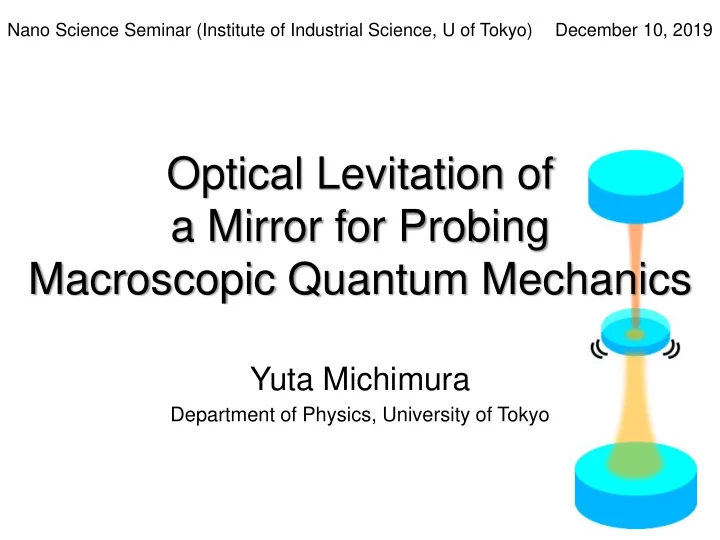
Optical Levitation of a Mirror for Probing Macroscopic Quantum Mechanics

December 10, 2019 Nano Science Seminar (Institute of Industrial Science, U of Tokyo)

Yuta Michimura

Department of Physics, University of Tokyo
slide-2
SLIDE 2

Self Introduction

  • Yuta Michimura (道村 唯太)

Assistant Professor at Department of Physics, University of Tokyo

  • Laser interferometric

gravitational wave detectors

  • KAGRA
  • DECIGO
  • Fundamental physics with

laser interferometry

  • Lorentz invariance test
  • Macroscopic quantum

mechanics

  • Axion search etc…

2

slide-3
SLIDE 3

Plan of This Talk

  • Macroscopic Quantum Mechanics

Motivations Standard quantum limit Review of current status of experiments

  • Optical Levitation of a Mirror

Principles Experiment to demonstrate the stability

  • Fabrication of a Levitation Mirror

Result of the trial New idea to use photonic crystals

  • Summary

3

slide-4
SLIDE 4

Power change

Michelson Interferometer

  • Measures the differential arm length change

4

Photodiode Laser source Beam splitter Suspended mirror Interference Top view

slide-5
SLIDE 5

Quantum Gravity??

  • Whether photon goes X-arm or Y-arm is in quantum

superposition

  • Which mirror moves via photon radiation pressure

is in quantum superposition

5

Suspended mirror Interference Beam splitter Photodiode Laser source Top view

Gravitational field of a mirror also in superposition??

slide-6
SLIDE 6

Macroscopic Quantum Mechanics

  • Quantum mechanics do not depend
  • n scales
  • But macroscopic quantum

superposition has never been

  • bserved (double-slit experiment

upto 25 kDa (4e-23 kg))

  • Two possibilities at macroscopic scales
  • Quantum mechanics is valid, but

too much classical decoherence

  • Quantum mechanics should be

modified

(e.g. non-linear Schrödinger Eq., Gravitational decoherence …)

6

Nature Physics 15, 1242 (2019)

slide-7
SLIDE 7

Experimental Proposals 1 / 4

  • Towards Quantum Superpositions of a Mirror

Marshall+, PRL 91, 130401 (2003)

  • If no decoherence, photon

interference fringe should revive at the period of mirror oscillation

  • Ground state and

ultra-strong coupling necessary

7

Single photon source

Photon path and mirror motion is entangled If mirror has decoherence, photon interference fringe will also disappear

slide-8
SLIDE 8

Experimental Proposals 2 / 4

  • Entanglement of Macroscopic Test Masses and the

Standard Quantum Limit in Laser Interferometry Muller-Ebhardt+, PRL 100, 013601 (2008)

  • Quantum correlation between mirror common

mode and differential mode

  • Need to reach SQL for common/differential

measurement

8

slide-9
SLIDE 9

Experimental Proposals 3 / 4

  • Large Quantum Superpositions and Interference of

Massive Nanometer-Sized Objects Romero-Isart+, PRL 107, 020405 (2011)

  • Prepare superposition of nanoparticle at left or right

(not at the center), and drop it to see the interference pattern

9

slide-10
SLIDE 10

Experimental Proposals 4 / 4

  • Quantum correlation of light mediated by gravity

Miao+, arXiv:1901.05827

  • Search for quantum correlation between two beams

mediated by gravitational coupling of two mirrors

  • Thermal noise should be smaller than quantum

radiation pressure noise

10

slide-11
SLIDE 11

Requirements to Optomechanics

  • These systems are called optomechanical systems

Interaction between light and mechanical oscillator

  • Common requirements
  • Make thermal fluctuation smaller than quantum

radiation pressure fluctuation (make cooperativity larger than 1)

  • Reach standard quantum limit
  • Ground state cooling of mirror (make photon

number smaller than ~1)

11

slide-12
SLIDE 12

Standard Quantum Limit

  • Displacement sensitivity cannot surpass standard

quantum limit just by changing the laser power

12

arXiv:1909.12033

Radiation pressure noise increases with laser power

(Fluctuation of number of photons

  • n mirror scales with √N)

Shot noise reduces with laser power

(Fluctuation of number of photons on photodiodes scales with √N, and signal scales with N)

slide-13
SLIDE 13

Optomechanical Systems

  • SQL not yet reached above Planck mass scale

13 fg pg ng ug mg g kg

nanobeam, 331 fg Chan+ (2011) Ground state cooling membrane, 48 pg Taufel+ (2011) Ground state cooling membrane, 7 ng Peterson+ (2016)

Planck mass (22 ug)

Ground state cooling suspended disk, 7 mg Matsumoto+ (2019) suspended bar, 10 mg Komori+ (2019) suspended disk, 1 g Neben+ (2012) suspended disk, 40 kg Advanced LIGO Factor of ~3 to SQL Quantum radiation pressure cantilever, 50 ng Cripe+ (2019) molecules, 40 zg Fein+ (2019) Double-slit

slide-14
SLIDE 14

Optomechanical Systems

  • SQL not yet reached above Planck mass scale

14 fg pg ng ug mg g kg

nanobeam, 331 fg Chan+ (2011) Ground state cooling membrane, 48 pg Taufel+ (2011) Ground state cooling membrane, 7 ng Peterson+ (2016)

Planck mass (22 ug)

Ground state cooling suspended disk, 7 mg Matsumoto+ (2019) suspended bar, 10 mg Komori+ (2019) suspended disk, 1 g Neben+ (2012) suspended disk, 40 kg Advanced LIGO Factor of ~3 to SQL Quantum radiation pressure cantilever, 50 ng Cripe+ (2019) molecules, 40 zg Fein+ (2019) Double-slit

We are focusing on mg-scale experiments to probe boundary between quantum world and gravitational world

slide-15
SLIDE 15

7 mg Suspended Disk Experiment

  • Displacement sensitivity at

3e-14 m/√Hz @ 280 Hz

  • Thermal noise limited
  • Possible to measure 100 mg gravity in a second
  • Currently developing a suspension with lower

mechanical loss

15

Matsumoto, …, YM+, PRL 122, 071101 (2019)

slide-16
SLIDE 16

Optical Levitation

  • Alternative approach is to support a mirror with

radiation pressure alone

  • Both suspended mirror and levitated mirror will be

ultimately limited by thermal noise from residual gas and mirror coating

16

Suspended mirror Levitated mirror Gravity Tension Gravity Radiation pressure Suspension thermal noise

slide-17
SLIDE 17

Sandwich Configuration

  • Optical levitation have never been realized
  • Simpler configuration than previous

proposals

YM, Kuwahara+, Optics Express 25, 13799 (2017)

  • Proved that stable levitation is

possible and SQL can be reached

17

  • S. Singh+: PRL 105, 213602 (2010)
  • G. Guccione+: PRL 111, 183001 (2013)

Levitated mirror

slide-18
SLIDE 18

Stability of Levitation

  • Rotational motion is stable with gravity
  • Vertical motion is stable with optical spring
  • Horizontal motion is stable with cavity axis change

18 Center

  • f

curvature

Rotation Vertical Horizontal

Gravity Optical spring Cavity axis change

slide-19
SLIDE 19

Reaching SQL

  • 0.2 mg fused silica mirror, Finesse of 100,

13 W + 4 W input

19

Quantum

Laser frequency

SQL can be reached at 23 kHz

Calculation by Y. Kuwahara

slide-20
SLIDE 20

Experiment to Verify the Stability

  • Especially, stability of the horizontal motion is

special for this sandwich configuration

  • Experiment with torsion pendulum

is underway to measure the restoring force

20 Horizontal motion Yaw motion

slide-21
SLIDE 21

Experiment to Verify the Stability

  • Resonant frequency of torsion pendulum increased

when optical cavity is locked → Successfully measured the restoring force

21

Spring constant increase with power Resonant frequency measurement

slide-22
SLIDE 22

Fabrication of Levitation Mirrors

  • So far, fused silica mirror with dielectric multilayer

coating have been tried

  • Cracks due to coating stress

22 For SQL Prototype For suspended experiment Mass 0.2 mg ~1.6 mg ~ 7 mg Size (mm) φ 0.7 mm t 0.23 mm φ 3 mm t 0.1 mm φ 3 mm t 0.5 mm RoC 30 mm convex 30±10 mm convex (measured: 15.9±0.5 mm) 100 mm concave (previously flat

  • nes were used)

Reflectivity 97 % (finesse 100) >99.95 % (measured: >99.5%) 99.99% Comment

Optics Express 25, 13799 (2017)

Only one out of 8 without big cracks Succeeded

slide-23
SLIDE 23

Photonic Crystal Mirror ?

  • High reflectivity demonstrated, also in the context of

gravitational wave detector to reduce coating thermal noise

  • D. Friedrich+, Optics Express 19, 14955 (2011)

R=99.2 % @ λ=1064 nm

  • X. Chen+, Light: Science & Applications 6,

e16190 (2017) R = 0 to 99.9470±0.0025% @ λ=1μm

23

slide-24
SLIDE 24

Curved Mirror Seems Possible

  • D. Fattal+, Nature Photonics 4, 466 (2010)

R = 80-90% RoC = 20 ± 3 mm

  • Beam focusing confirmed

24

Groove width in various locations

slide-25
SLIDE 25

Curved Mirror Seems Possible

  • M. S. Seghilani+, Optics Express 22, 5962 (2014)

R > 99% RoC = 20 mm

25 Distributed Bragg reflector (DBR) for high reflectivity

slide-26
SLIDE 26
  • Polarization-independent beam focusing

by high-contrast grating reflectors

  • W. Su+, Optics Communications 325, 5 (2014)
  • curved mirror by grating with parabolic

surface

  • ~9 um focal length
  • focusing consistent with diffraction limit
  • Self-stabilizing photonic levitation and

propulsion of nanostructured macroscopic objects

  • O. Ilic & H. A. Atwater,

Nature Photonics 13, 289 (2019)

  • levitation by tailoring

asymmetric scattering

  • f light

Other Proposals

26

too dirty for us! too small for us!

slide-27
SLIDE 27

Transmission vs Mirror Mass

  • Mirror reflectivity can be smaller if the mirror mass

is smaller and with higher input power

27 Calculation by T. Kawasaki

(Mirror thickness 0.5 mm, fused silica assumed to calculate radius.)

97%, 0.2 mg (for SQL)

If critical couple, no detuning 9.8 m/s2 Mirror power transmission (R=1-T)

99.95%, 1.6 mg (for levitation demonstration)

Intra-cavity power

slide-28
SLIDE 28

Summary

  • Optical levitation of a mirror is a promising way to

prepare a system to test quantum mechanics at macroscopic scales

  • Milligram scale mirror can be levitated with realistic

parameters

  • Succeeded in experimentally verifying the stability
  • f the levitation
  • Next step is the fabrication of a milligram mirror

with high reflectivity and curvature

  • Photonic crystal mirror might be a solution

28