Investigational Device Exemptions (IDEs) and Genomics Workshop June - - PDF document

investigational device exemptions ides and genomics
SMART_READER_LITE
LIVE PREVIEW

Investigational Device Exemptions (IDEs) and Genomics Workshop June - - PDF document

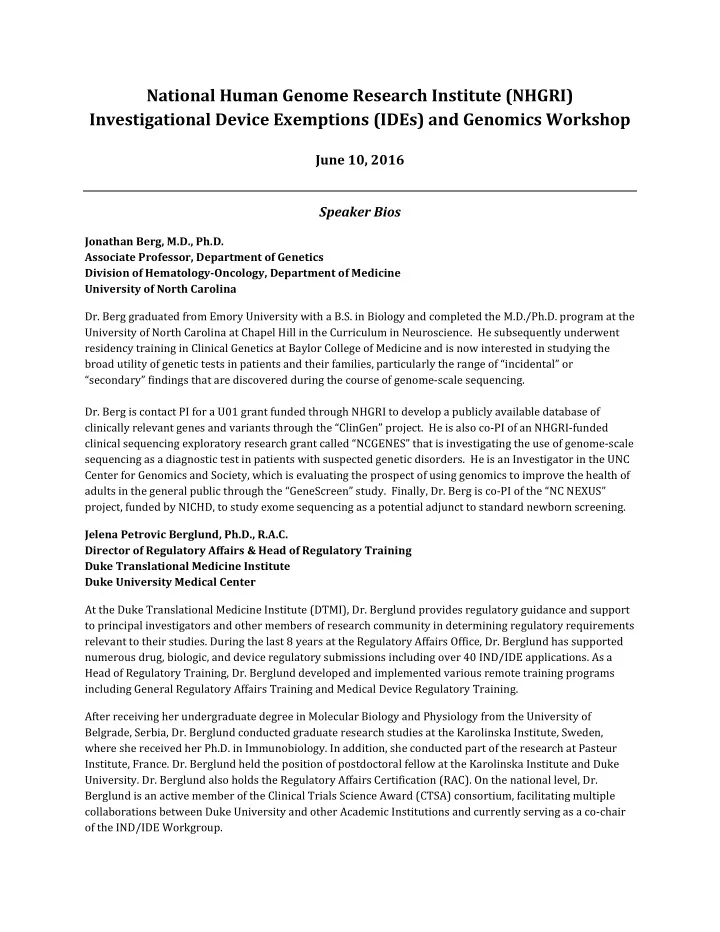
National Human Genome Research Institute (NHGRI) Investigational Device Exemptions (IDEs) and Genomics Workshop June 10, 2016 Speaker Bios Jonathan Berg, M.D., Ph.D. Associate Professor, Department of Genetics Division of Hematology-Oncology,


slide-1
SLIDE 1

National Human Genome Research Institute (NHGRI) Investigational Device Exemptions (IDEs) and Genomics Workshop

June 10, 2016 Speaker Bios

Jonathan Berg, M.D., Ph.D. Associate Professor, Department of Genetics Division of Hematology-Oncology, Department of Medicine University of North Carolina

  • Dr. Berg graduated from Emory University with a B.S. in Biology and completed the M.D./Ph.D. program at the

University of North Carolina at Chapel Hill in the Curriculum in Neuroscience. He subsequently underwent residency training in Clinical Genetics at Baylor College of Medicine and is now interested in studying the broad utility of genetic tests in patients and their families, particularly the range of “incidental” or “secondary” findings that are discovered during the course of genome-scale sequencing.

  • Dr. Berg is contact PI for a U01 grant funded through NHGRI to develop a publicly available database of

clinically relevant genes and variants through the “ClinGen” project. He is also co-PI of an NHGRI-funded clinical sequencing exploratory research grant called “NCGENES” that is investigating the use of genome-scale sequencing as a diagnostic test in patients with suspected genetic disorders. He is an Investigator in the UNC Center for Genomics and Society, which is evaluating the prospect of using genomics to improve the health of adults in the general public through the “GeneScreen” study. Finally, Dr. Berg is co-PI of the “NC NEXUS” project, funded by NICHD, to study exome sequencing as a potential adjunct to standard newborn screening. Jelena Petrovic Berglund, Ph.D., R.A.C. Director of Regulatory Affairs & Head of Regulatory Training Duke Translational Medicine Institute Duke University Medical Center At the Duke Translational Medicine Institute (DTMI), Dr. Berglund provides regulatory guidance and support to principal investigators and other members of research community in determining regulatory requirements relevant to their studies. During the last 8 years at the Regulatory Affairs Office, Dr. Berglund has supported numerous drug, biologic, and device regulatory submissions including over 40 IND/IDE applications. As a Head of Regulatory Training, Dr. Berglund developed and implemented various remote training programs including General Regulatory Affairs Training and Medical Device Regulatory Training. After receiving her undergraduate degree in Molecular Biology and Physiology from the University of Belgrade, Serbia, Dr. Berglund conducted graduate research studies at the Karolinska Institute, Sweden, where she received her Ph.D. in Immunobiology. In addition, she conducted part of the research at Pasteur Institute, France. Dr. Berglund held the position of postdoctoral fellow at the Karolinska Institute and Duke

  • University. Dr. Berglund also holds the Regulatory Affairs Certification (RAC). On the national level, Dr.

Berglund is an active member of the Clinical Trials Science Award (CTSA) consortium, facilitating multiple collaborations between Duke University and other Academic Institutions and currently serving as a co-chair

  • f the IND/IDE Workgroup.
slide-2
SLIDE 2

Paula Caposino, Ph.D. Scientific Reviewer Division of Chemistry & Toxicology Devices, Office of In Vitro Diagnostics and Radiological Health Center for Devices and Radiological Health, FDA Paula Velasco Caposino was born in Cali, Colombia. She received a B.A. in Biology from Boston University in 1996 and received her Ph.D. in Cell Biology at the Christian-Albrechts University in Kiel, Germany in 2005. After completing a three-year Fellowship at the HIV and AIDS Malignancy Branch in the Center for Cancer Research (National Cancer Institute, National Institutes of Health), she joined the Division of Chemistry and Toxicology Devices in the Office of In Vitro Diagnostic Devices Evaluation and Safety (Center for Devices and Radiological Health, Food and Drug Administration) in 2008 as a Scientific Reviewer. Haja El Mubarak, M.Sc., Ph.D. Master Reviewer Division of Microbiology Devices, Office of In Vitro Diagnostics and Radiological Health Center for Devices and Radiological Health, FDA

  • Dr. El Mubarak is a Master reviewer and Center Expert in Serological and Molecular Diagnostics of Viral Infections

at the Division of Microbiology Devices (DMD) of the Office of In-Vitro Diagnostics and Radiological Health (OIR).

  • Dr. El Mubarak received her Ph.D. in Virology from the Erasmus University in the Netherlands in January 2004 and

joined the FDA in 2007 as a scientific reviewer. Since coming to FDA, Dr. El Mubarak has taken a lead role in a broad range of high-complexity projects as an FDA expert on serological and molecular in-vitro diagnostic device applications for a variety of viral, infections. Since March of 2012, she has been responsible for chairing the FDA Genetics and Genomics Team. She currently leads the Herpes, Measles, Mumps, Rubella and Polyomavirus submission review team, developing strategies to streamline the premarket review process for novel technologies and indications. Dr. El Mubarak served as the FDA representative on Clinical and Laboratory Standards Institute’s Subcommittee on “Quantitative Molecular Methods for Infectious Diseases” (MM6) and the Sub- committee on “Establishing Molecular Testing in Clinical Laboratory Environments” (MM19). Dr. El Mubarak currently serves as a Program Manager for the FDA Center for Devices and Radiological Health Partnering with Patients Program. Eric Green, M.D., Ph.D. Director National Human Genome Research Institute, NIH Born and raised in St. Louis, Missouri, Dr. Green received his B.S. degree in Bacteriology from the University

  • f Wisconsin-Madison in 1981, and his M.D. and Ph.D. degrees from Washington University in 1987. During

residency training in clinical pathology (laboratory medicine), he worked in the laboratory of Dr. Maynard Olson, where he launched his career in genomics research. In 1992, he was appointed Assistant Professor of Pathology and Genetics as well as a Co-Investigator in the Human Genome Center at Washington University. In 1994, he joined the newly established Intramural Research Program of the National Center for Human Genome Research, later renamed the National Human Genome Research Institute. As Director of NHGRI, Dr. Green is responsible for providing overall leadership of the Institute’s research portfolio and other initiatives. In 2011, Dr. Green led NHGRI to the completion of a strategic planning process that yielded a new vision for the future of genomics research, entitled 17TCharting a course for genomic medicine from base pairs to bedside (Nature 470:204-213, 2011). 1T17TBeyond NHGRI-specific programs, Dr. Green has also played an instrumental leadership role in the development of a number of high-profile efforts relevant to genomics, including the Smithsonian-NHGRI exhibition Genome: Unlocking Life’s Code, the NIH Big Data to Knowledge (BD2K) program, the NIH Genomic Data Sharing Policy, and the U.S. Precision Medicine Initiative.1T

slide-3
SLIDE 3

Sara Chandros Hull, Ph.D. Director Bioethics Core, Office of the Clinical Director National Human Genome Research Institute, NIH

  • Dr. Hull directs the Bioethics Core of the National Human Genome Research Institute (NHGRI), which

provides bioethics education, consultation, and administrative support to investigators in the intramural research program. She has been a member of the NHGRI Institutional Review Board since 2003 and currently serves as its Chair. As a faculty member in the Department of Bioethics, Dr. Hull's research interests focus primarily on the intersection between research ethics and new technological developments. Current projects focus on secondary genomic research findings, informed consent and data sharing for genomic research, the role and limits of centralized IRB review of multisite research, diversifying genomic research and clinical/diagnostic tools, and developing collaborative research ethics training programs with American Indian and Alaska Native Tribal IRBs and research review committees. Cristina Kapustij, M.S. Chief Policy and Program Analysis Branch, Division of Policy, Communication, & Education National Human Genome Research Institute, NIH As chief of the PPAB, Cristina Kapustij examines the policy implications of advancing research and technology in genomics. She oversees policy and program activities and evaluation, including tracking federal and state policies that could impact the institute and developing positions on policy issues that arise with developments in genomic research and their translation to society. With experience on Capitol Hill, managing research grants, and analyzing policy decisions and positions, she furthers the mission of the DPCE, promoting the understanding and application of genomics to advance health and society. Prior to the NIH, she received her M.S. in biotechnology at Georgetown. She was a Christine Mirzayan Science and Technology Policy Graduate Fellow at the National Academies, was a policy analyst for the Institute for Genome Sciences and Policy at Duke University, and completed the ASHG/NHGRI Genetics and Public Policy

  • Fellowship. She also served as the program manager for a $5 million dollar, NIH research grant at the

Institute for Human Genetics at the University of California, San Francisco. Kellie Kelm, Ph.D. Chief, Cardio-Renal Diagnostic Devices Branch Division of Chemistry & Toxicology Devices, Office of In Vitro Diagnostics and Radiological Health Center for Devices and Radiological Health, FDA

  • 11TDr. Kelm has worked at FDA for 10 years, including more than 8 years as a lead reviewer 11Tof premarket

submissions and pre-submissions for chemistry, toxicology, genetic/genomic and newborn screening devices. She also reviewed Investigational Device Exemption (IDE) applications for clinical studies. She has represented the FDA on several external committees such as the Clinical and Laboratory Standards Institute (CLSI) Expert Panel on Newborn Screening and several CLSI Document Development Committees as well as the Association of Public Health Laboratories’ NewSTEPs Steering Committee. She is the FDA representative to the Secretary of Health and Human Services’ Advisory Committee for Heritable Disorders in Newborn and

  • Children. Dr. Kelm received her BA at Dartmouth College and her PhD from the Johns Hopkins University

School of Medicine.

slide-4
SLIDE 4

Stephen Kingsmore, M.D., D.Sc. President/CEO Rady Pediatric Genomic and Systems Medicine Institute Rady Children’s Hospital Stephen F. Kingsmore is President/CEO of the Rady Pediatric Genomic and Systems Medicine Institute at Rady Children’s Hospital, San Diego, which is implementing pediatric genomic/precision medicine at unprecedented scale. Previously he was the Dee Lyons/Missouri Endowed Chair in Genomic Medicine at the

  • Univ. of Missouri-Kansas City School of Medicine and Director of the Center for Pediatric Genomic Medicine at

Children’s Mercy Hospital, Kansas City. He has been the President/CEO of the National Center for Genome Resources, Santa Fe, New Mexico, Chief Operating Officer of Molecular Staging Inc., Vice President of Research at CuraGen Corporation, founder of GatorGen, and Assistant Professor at the University of Florida’s School of

  • Medicine. Dr. Kingsmore received MB ChB BAO and DSc degrees from the Queen’s University of Belfast. He

trained in clinical immunology in Northern Ireland and did residency in internal medicine and fellowship at Duke University Medical Center. He is a fellow of the Royal College of Pathologists. He was a MedScape Physician of the year in 2012, and received the 2013 Scripps Genomic Medicine award and 2013 ILCHUN prize of the Korean Society for Biochemistry and Molecular Biology. TIME magazine ranked his rapid genome diagnosis one of the top 10 medical breakthroughs of 2012. Sharon Liang, M.D., Ph.D. Regulatory Scientist Division of Molecular Genetics and Pathology, Office of In Vitro Diagnostics and Radiological Health Center for Devices and Radiological Health, FDA Sharon Liang, M.D., Ph.D., is a genetics expert leading reviews of new and upcoming technologies in the Division of Molecular Genetics and Pathology in CDRH/OIR, developing and articulating medical device policies, including copy number variation detection, companion diagnostics, direct-to-consumer tests, NGS, bioinformatics pipelines for NGS data. Dr. Liang is a member of the FDA activity steering committee for the Precision Medicine Initiative leading the bioinformatics working group. She received her Ph.D. in Human Genetics and M.S. in Applied Statistics from Vanderbilt University, followed by a post-doctoral cancer research fellowship at NCI, and was a Commissioner’s fellow at the FDA. David Litwack, Ph.D. Personalized Medicine Staff Office of In Vitro Diagnostics and Radiological Health Center for Devices and Radiological Health, FDA

  • Dr. Litwack received a B.S. in Chemistry from the University of Chicago, and a Ph.D. in Biology from MIT. After

postdoctoral studies at the Salk Institute for Biological Studies, he joined the faculty of the University of Maryland School of Medicine as an Assistant Professor in the Department of Anatomy and Neurobiology and a member of the Program in Neuroscience. In that role, Dr. Litwack directed an NIH-funded lab that studied the role of transcription factors in neurogenesis in the mammalian brain and in human embryonic stem cells, and was a founding member of the School’s Center for Stem Cell Biology and Regenerative Medicine. In 2010, Dr. Litwack was awarded an AAAS Science and Technology Policy Fellowship in NCI’s Office of Biorepositories and Biospecimen Research. During this fellowship, he led several efforts to develop policy and programs to advance the use of biobanking for personalized medicine. In 2012, Dr. Litwack joined the Personalized Medicine Staff of the Office of In Vitro Diagnostics and Radiological Health at the FDA, where he develops policies to guide the review of investigational biomarker tests, companion diagnostics, and next generation technologies.

slide-5
SLIDE 5

Laura Lyman Rodriguez, Ph.D. Director Division of Policy, Communication, and Education National Human Genome Research Institute, NIH Laura Lyman Rodriguez, Ph.D., is the Director for the Division of Policy, Communication, and Education at the National Human Genome Research Institute (NHGRI), National Institutes of Health (NIH). Dr. Rodriguez works to develop and implement policy for research initiatives at the NHGRI, as well as trans-NIH programs, design communication and outreach strategies to engage the public in genomic science, and prepare health care professionals for the integration of genomic medicine into clinical care. Laura is particularly interested in the policy and ethics questions related to the inclusion of human research participants in genomics and genetics research and sharing human genomic data through broadly used research resources (e.g., genomic databases and biobanks).

  • Dr. Rodriguez received her bachelor of science with honors in biology from Washington and Lee University in

Virginia and earned a doctorate in cell biology from Baylor College of Medicine in Texas. Jeffrey Seidman, M.D. Medical Officer Division of Molecular Genetics & Pathology, Office of In Vitro Diagnostics and Radiological Health Center for Devices and Radiological Health, FDA

  • Dr. Jeffrey Seidman graduated from State University of New York/Downstate Medical Center and did his

pathology training at Georgetown University, University of Maryland, and the Armed Forces Institute of

  • Pathology. He practiced pathology for 18 years at the Was0 hington Hospital Center and joined the FDA in
  • 2013. He is an active member of the International Society of Gynecological Pathologists and co-author of

numerous publications including the World Health Organization Classification of Tumours of the Female Reproductive System. His main area of interest and expertise is ovarian and fallopian tube cancer. Anastasia Wise, Ph.D. Epidemiologist Division of Genomic Medicine National Human Genome Research Institute, NIH

  • Dr. Wise is an epidemiologist in the Division of Genomic Medicine at the National Human Genome Research

Institute (NHGRI). She received her Ph.D. in genetics and genomics from Duke University and at NHGRI serves as program director for programs advancing the application of genomics to medical science and clinical care.

  • Dr. Wise serves as co-coordinator for the NIH Common Fund's Undiagnosed Diseases Network, which aims to

increase the capacity for and use of genomic data in the diagnosis and management of rare and new diseases. She is also a project scientist for the Genomic Sequencing and Newborn Screening Disorders initiative, which aims to explore the potential for genomic sequencing to expand and improve newborn health care. Her other research interests include gene-environment interactions in complex disease, pharmaco/toxicogenomics, and ethical, legal, and social issues related to the use of genetic information.