Introductions Our Team: Dave Thomas, Vice President of Community - - PowerPoint PPT Presentation

introductions
SMART_READER_LITE
LIVE PREVIEW

Introductions Our Team: Dave Thomas, Vice President of Community - - PowerPoint PPT Presentation

1/15/2019 Introductions Our Team: Dave Thomas, Vice President of Community 2019 Local Evaluation Partnerships Instrument Process: Karen Kowal, Director of Continuum of Care Programs Renee Crolius, Senior Program Manager Intent to


slide-1
SLIDE 1

1/15/2019 1

2019 Local Evaluation Instrument Process: Intent to Renew

Webinar Presented By:

Karen Kowal and Jennifer Fabbrini

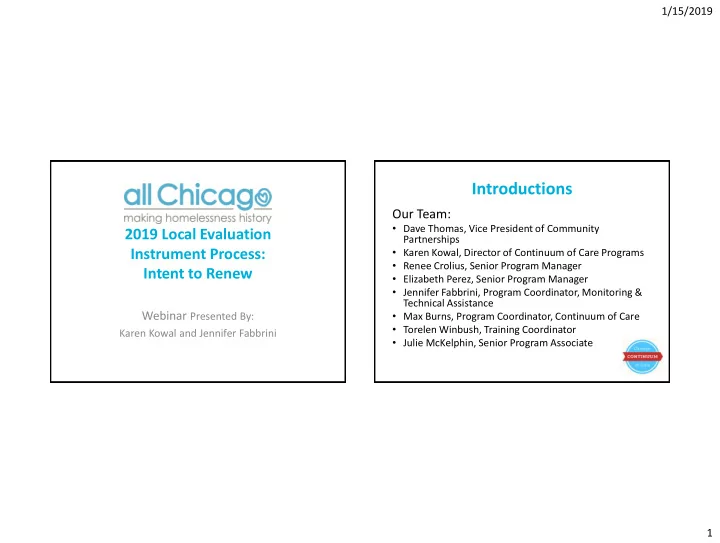
Introductions

Our Team:

  • Dave Thomas, Vice President of Community

Partnerships

  • Karen Kowal, Director of Continuum of Care Programs
  • Renee Crolius, Senior Program Manager
  • Elizabeth Perez, Senior Program Manager
  • Jennifer Fabbrini, Program Coordinator, Monitoring &

Technical Assistance

  • Max Burns, Program Coordinator, Continuum of Care
  • Torelen Winbush, Training Coordinator
  • Julie McKelphin, Senior Program Associate
slide-2
SLIDE 2

1/15/2019 2

The Local Evaluation Instrument (LEI) Process How it may be used to determine funding priorities for Chicago The Intent to Renew and its purpose How to successfully complete and submit the Intent to Renew on time

Training Objectives

To ensure all agencies know and understand:

LOCAL EVALUATION INSTRUMENT PROCESS OVERVIEW

slide-3
SLIDE 3

1/15/2019 3

Local Evaluation Instrument Context

  • The Local Evaluation Instrument Process is

a tool used by the CoC to evaluate project performance, project operations, and general grant management

  • Developed and updated annually by the

Evaluation Tool Committee

  • Administered by the Collaborative

Applicant for the Chicago CoC (All Chicago)

– HUD requires that the CA evaluate and monitor all projects

Local Evaluation Instrument Context

  • Local

– CoC Board of Directors establishes policies and priorities for the CoC and funding process, based on HEARTH Act and Plan 2.0 priorities – Ranking Committee (Project Prioritization Work Group) typically utilizes the results in determining ranking priorities – Determine projects to receive a monitoring review

  • HUD

– CoC Program Competition NOFA released by HUD

  • utlines national priorities and application

requirements – Funds are competitively awarded

slide-4
SLIDE 4

1/15/2019 4

Local Evaluation Instrument Context

  • System performance Measures

– Length of time homeless – Extent those who exit return to homelessness – Thoroughness in reaching those experiencing homelessness – Overall reduction in homelessness – Jobs and income growth – Reducing first-time homelessness

NOFA Cycle

Housing Inventory & Point In Time Count (HIC / PIT) CoC Registration System Performance Measures (SysPM) Grant Inventory Worksheet (GIW) Local Evaluation Process (Renewals) New Projects Process HUD NOFA Competition Release

  • CoC Application Submission
  • Project Applications Submission
  • Ranking and Review (Priority Listing)

Longitudinal Systems Analysis (LSA) [formally AHAR] Jan -March April - June July – Sept Oct – Dec

slide-5
SLIDE 5

1/15/2019 5

Overview of CoC Application Process

Two Part Process:

Local Evaluation Instrument Process (January - April) HUD Application Process (Dependent Upon Release of the NOFA)

Why Change?

  • 1. Chicago’s Local Evaluation Instrument (LEI)

was excessively long

  • 2. Service Providers and All Chicago spent a

significant amount of time on the LEI

  • 3. Challenges in providing time and opportunity

for project to improve

slide-6
SLIDE 6

1/15/2019 6

New Goals

  • Simplify the LEI for agencies and All Chicago;
  • Minimize risk to the Chicago CoC by ensuring

all agencies and projects are in compliance with HUD and meeting local priorities and thresholds both programmatically and fiscally;

  • Create a collaborative process that provides

and emphasizes proactive support and technical assistance to agencies and projects in order to strengthen the Chicago CoC.

2019 Chicago CoC Local Evaluation Instrument

Intent to Renew

❖Certification Checklist ❖Initial Desk Audit

Local Evaluation

❖Project Performance Report ❖Housing First Assessment ❖Consumer Engagement Assessment ✓ Pass ✓ Pass with Findings ✓ Scored

slide-7
SLIDE 7

1/15/2019 7

2019 Local Evaluation Timeline - DRAFT

8 6 4 2

12/6/2018 1/7/2019 4/1/2019 4/29/2019 7/8/2019 2/4/2019 4/26/2019 5/17/2019

Intent to Renew is released to the community. Intent to Renew is due February 4th, 2019

Intent to Renew Released

Local Evaluation released to the community. Agencies review and update HMIS data and prepare Local Evaluation Components.

Local Evaluation Released

All Chicago begins reviewing and scoring Evaluation Instrument submissions for all projects. Initial scorecards are developed.

Evaluation Instrument Review

Final Score cards released to agencies for all projects

Final Scorecards

All Chicago releases guidance on the Initial Desk Audit so agencies can review project policies and procedures before release of the Intent to Renew.

Initial Desk Audit Guidance Released

All Chicago reviews and “grades” Intent to Renew submissions. Scores provided to agencies by February 22nd, 2019 All Chicago provides TA to agencies through March 31, 2019

Intent to Renew Review & TA

Final day for agencies to update data for Project Performance report and to submit Local Evaluation Component

Evaluation Instrument Deadline

Initial scorecards are sent to agencies. Agencies can submit appeals for their projects.

Initial Scorecards & Appeals Process

INTENT TO RENEW

slide-8
SLIDE 8

1/15/2019 8

Who is Required to Submit?

  • Agencies with a CoC-funded project operating between

January 1, 2018 and December 31, 2018, in order to be eligible to apply for renewal in FY19

– Includes all LTRA projects, regardless of renewal status – New Projects awarded in FY2017 and started in 2018 – HMIS and CE-SSO projects do NOT need to complete at this time.

  • Any agency not interested in renewing a CoC grant for FY19

must contact All Chicago ASAP

  • Agencies do not need to submit an Intent to Renew for

projects not funded in FY18

  • If you are unsure if a project needs to submit an Intent to

Renew, contact CoCPrograms@allchicago.org. Exempt projects have already been notified.

Submission Information

One survey per agency

  • The survey is designed for the agency to input information

about all of its projects within one survey submission.

  • Agencies do not have to submit a separate survey for each

project.

  • Each checklist question is formatted to ask you to identify if

there is a different response for a project or set of projects

  • Each file upload question allows you to upload multiple sets of

files - different files for different projects. Please use a cover page to clearly identify which files relate to which projects.

slide-9
SLIDE 9

1/15/2019 9

Submission Information

  • To access the Intent to Renew Form click on the following

link: https://bit.ly/2RfM6gO

  • The first time you enter the survey, login with username

& password sent to you by All Chicago:

Note: There is one username/password per agency

Submission Information

Browser Compatibility:

  • We recommend using Firefox or Google Chrome as your browser when

working with SurveyGizmo. Please see the following from the Survey Gizmo site: “SurveyGizmo tests and supports use of our application in all major browsers including Google Chrome, Firefox, Safari, and Internet Explorer 8, 9, 10 and 11. We recommend always keeping your browser up to date with the most current version to ensure continued compatibility. Older versions of supported browsers might present quirks or inconsistencies when compared to their up-to-date counterparts. IE users using high security settings (generally between medium-high to high depending on the version) might run into issues when using the SurveyGizmo

  • application. High security settings may block JavaScript which SurveyGizmo

uses to make the application interactive. ”

slide-10
SLIDE 10

1/15/2019 10

SurveyGizmo Basics

Navigating through a survey: Required Questions:

  • In order to make it easy to navigate forward and backward within

the survey, none of the questions have been marked as required. However, this is only for ease of navigation.

  • All questions must be answered.

SurveyGizmo Basics – Save and Continue

  • Click to Save and Continue
  • Enter your email address

twice ✓Check to be sure you have received the email before navigating away from the survey!

slide-11
SLIDE 11

1/15/2019 11

SurveyGizmo Basics – Save and Continue

  • Save and Continue
  • You will receive an email from noreply@surveygizmo.com that

looks like the one below.

  • There is sometimes a delay, so if you don’t receive the email

right away, check again in a few hours. Also check your junk mail box.

  • Save the email.

SurveyGizmo Basics – Save and Continue

  • When you want to stop working on the survey and return to it

later, go to the email you received from noreply@surveygizmo.com and click on the link.

  • When you utilize the “Save and Continue” link, you do not

need to login again with your agency’s given username/password. If you login with the username/password, you won’t see your saved work. To pick up where you left off, you must utilize the link that you receive via email after clicking on “Save and Continue.”

slide-12
SLIDE 12

1/15/2019 12

SurveyGizmo Basics – Save and Continue

  • You must complete the page you are working on and click on

“next” at the bottom of the page in order for the work done to be saved.

  • Partially completed pages will not be saved.

SurveyGizmo Basics – Types of Questions

– Add another

If you need to indicate that a “No” response applies to more than one project, click here to submit another project name and explanation.

slide-13
SLIDE 13

1/15/2019 13

2019 Intent to Renew Overview

  • 1. Cover Page
  • 2. Certification Checklist

a) Fiscal Criteria b) Programmatic Criteria c) HMIS Data Quality d) HEARTH Act Compliance

  • 3. Initial Desk Audit

Cover Page

  • Agency Information
  • Contact Person for Questions about the ITR
  • Executive Director Name
  • Project Information

– # of Projects – Complete Information about EACH project

  • Typical Project Information
  • Consolidation
  • Major Changes
  • Intent to Renew Certification for Projects
slide-14
SLIDE 14

1/15/2019 14

Cover Page – Contact Information

New Feature

Cover Page – Project Information

  • Project Name
  • HMIS ID
  • Address
  • HUD Program Type
  • Chicago Model Type
  • # Units/Beds
  • Grant Amount
  • Grant Start/End Date

A section with these fields will appear in the form for each of the agency’s projects Let us know if a project is missing

slide-15
SLIDE 15

1/15/2019 15

Cover Page – Project Information

Intent to Renew

Signature

slide-16
SLIDE 16

1/15/2019 16

Certification Checklist: Fiscal Criteria

HUD Monitoring Findings

Yes No

  • 1. Were any of the agency’s projects monitored by HUD in calendar year 2017
  • r 2018?

☐ ☐

  • 2. For any of the projects monitored in calendar year 2017 or 2018, were there

any HUD findings?

☐ ☐

  • 3. Have all the HUD findings from 2017 or 2018 been resolved?

☐ ☐

If the answer to #1 is “No,” questions 2-3 will be skipped. Attachment A: HUD Monitoring Documentation (if applicable) Attach:

 HUD Monitoring Letter (indicating findings or lack thereof)  If there were any findings that were resolved, attach the HUD close out letter (indicating resolution of

findings)

 If there are any unresolved findings, attach the correspondence submitted to HUD to attempt to resolve

the finding(s) as well as any additional response(s) from HUD If the answer to #3 is “No,” explain in a narrative why the finding(s) remain unresolved.

Certification Checklist: Fiscal Criteria

Fiscal Year

  • 4. What is your agency’s fiscal year?

Recent Financial Statement Yes No

  • 5. Does the agency have an annual financial statements audit completed within 9

months of the end of the fiscal year? ☐ ☐ If the answer to #5 is “No,” explain why a financial statements audit has not been completed within 9

  • months. Indicate when the financial statements audit is expected.

Attachment B: Annual Financial Statement Audit Attach:

 Most recently completed audited financial statement (complete package)

slide-17
SLIDE 17

1/15/2019 17

Certification Checklist: Fiscal Criteria

Single Audit Yes No

  • 6. For the most recently completed audit year, was the organization required to

undergo a single (Uniform Guidance) audit? See instruction manual for additional information. ☐ ☐ Attachment C: Single Audit Report or Management Letter Attach:

 Single audit report (complete package)

OR

 If not required to undergo a single (uniform guidance audit), submit one of the following:

  • Auditor’s management letter (if issued by your auditor)
  • Auditor’s Communication With Those Charged With Governance, referred to as an AU 260 letter (this communication is

required to be issued in connection with an audit)

  • A “Communicating Internal Control Related Matters Identified in an Audit“ letter, referred to as an AU 265 letter (if issued by

your auditor)

  • I. Fiscal Criteria

If more than one project was monitored, click here to list each one

slide-18
SLIDE 18

1/15/2019 18

  • I. Fiscal Criteria
  • I. Fiscal Criteria

Findings not resolved: Findings resolved:

  • r
slide-19
SLIDE 19

1/15/2019 19

  • I. Fiscal Criteria

Certification Checklist: Fiscal Criteria

Match Yes No

  • 7. Will your agency be able to provide the match requirement for all of your

renewal projects? ☐ ☐ Match must equal 25 percent of the total grant request including admin costs but excluding leasing costs (i.e., any funds identified for Leased Units and Leased Structures). Match contributions can be cash, in-kind, or a combination of the two; and, match must be used for an eligible cost as set forth in Subpart D of CoC Program interim rule. For an in-kind match, the recipient may use the value of property, equipment, goods, or services contributed to the project, provided that, if the recipient or sub recipient had to pay for such items with grant funds, the costs would have been eligible. If third party services are to be used as match, the third party service provider that will deliver the services must enter into a memorandum of understanding (MOU) before the grant is executed documenting that the third part will provide such services and value towards the project.

slide-20
SLIDE 20

1/15/2019 20

  • I. Fiscal Criteria

If you selected No, list each project that has a “No” response. Any projects not listed will be considered a “Yes”

Certification Checklist: Programmatic Criteria

Coordinated Entry System (CES) Yes No N/A

  • 8. Do all of the agency’s projects participate in the CES for individuals,

families or youth? ☐ ☐ ☐ If the answer to #8 is N/A, please explain why this question does not apply to the project. Annual Performance Report (APR) Yes No N/A

  • 9. Was the last APR submitted on time for each project?

☐ ☐ ☐

  • 10. Has the last APR been accepted by HUD for each project?

☐ ☐ ☐

  • 11. Due date of last APR for each project:

If the answer to #9 or #10 is N/A, please explain.

slide-21
SLIDE 21

1/15/2019 21

  • II. Programmatic Criteria

If Yes, move on to next question. If No, identify the projects and explain.

  • II. Programmatic Criteria
slide-22
SLIDE 22

1/15/2019 22

Certification Checklist: Programmatic Criteria

Housing First Approach

Housing First Supporting Documents Please provide the following supporting documents to verify the project’s Housing First approach and adherence to HUD regulations. The documents will be reviewed for consistency with housing first practices such as 1) not screening out participants based on factors such as income, substance use, criminal record, and experience with domestic violence and 2) not terminating participants based on factors such as failure to participate in supportive services, failure to make progress on a service plan, substance use, loss of income or failure to improve income, being a victim of domestic violence, and any other activity not typically found in Chicago lease agreements. The purpose of this review is to minimize risk and proactively support agencies and programs in this area due to the priority and importance that HUD places on the Housing First approach. Additional guidance for these attachments is included in the Initial Desk Audit Guidance.

 Attachment D: Intake Procedure and Packet – Attach a written process for filling vacancies, a description of the intake procedure,

and a list of the forms/handouts used during intake.

 Attachment E: Eligibility Criteria – Attach written eligibility criteria in alignment with housing first  Attachment F: Discharge/Termination Policy – Attach discharge/termination policy and forms, grievance policy/procedure and

forms

 Attachment G: Service Plan – Attach a service plan template and a written procedure that includes expectations of how and when

to complete a service plan

 AttachmentH: Participant Handbook and Rights – Attach the participant handbook, orientation materials, postings, or any other

documents, and describe how/when the information is provided to participants

 Attachment I: Lease & Occupancy Agreements – Describe the leasing/rental assistance set up for the project, attach as

applicablethe lease, sublease, occupancyagreement, or checklistused to evaluateparticipant-heldleases

  • II. Programmatic Criteria

Housing First Approach Attachment D: Intake Procedure and Packet

  • Attach the following: A written process that explains how the program fills vacancies.
  • Describe the process used during program intake. What steps are taken prior to determining if participants are

eligible or ineligible? At what point are eligible participants enrolled into the program? Clearly specify any documentation that is requested from participants, and whether it is required to move forward with program enrollment.

  • A list of all forms and handouts used during intake, including but not limited to the initial assessment of the

participant, participant agreement, consent for data sharing, written eligibility criteria, discharge policy, grievance process, consumer handbook/orientation, and other policies, procedures, and regulations.

Remember to utilize the Checklist for Attachments to ensure you have fulfilled all parts
  • f the question!
slide-23
SLIDE 23

1/15/2019 23

Using a Cover Page for File Uploads

Labeling Attachments

  • File Naming Rules: Attachment Letter_Agency Name (or

acronym)_HMIS ID(s) or Project Name(s)

  • For agencies with multiple projects, clearly identify which

documents are associated with which projects

slide-24
SLIDE 24

1/15/2019 24

Resource: Checklist for Attachments

  • II. Programmatic Criteria

Please complete this chart once per project. Click “Add Another” to add the next project.

slide-25
SLIDE 25

1/15/2019 25

  • II. Programmatic Criteria

If the agency doesn’t have any projects with a leasing budget line item, select N/A.

If you selected that one or more projects utilizes either 1. Leasing Budget Line Item (project-based) or 2. Leasing Budget Line Item (scattered site), please verify that leasing funds are not used to lease units or structures

  • wned by the recipient, subrecipient, their parent, subsidiary, or affiliated
  • rganization, unless granted an exception by HUD.

Certification Checklist: HMIS Data Quality

HMISImplementation Yes No N/A

DV Exclusive

  • 12. Do all of the agency’s projects have an HMIS ID created in ServicePoint?

☐ ☐ ☐

  • 13. Do all of the agency’s projects enter data into HMIS?

☐ ☐ ☐

Only victim service agencies serving survivorsof domestic violence and legal service agencies are exempt from participation in HMIS (select N/A).

slide-26
SLIDE 26

1/15/2019 26

Certification Checklist: HMIS Data Quality

  • 14. Have all of the agency’s projects submitted reports to the HMIS team for the

following four Quarterly Data Quality Assessment periods? Yes No N/A

  • January 2018

☐ ☐ ☐

  • April 2018

☐ ☐ ☐

  • July 2018

☐ ☐ ☐

  • October 2018

☐ ☐ ☐

  • 15. If your agency participated in the Quarterly Data Quality Assessment in the

most recent period (October 2018), did all of the agency’s projects receive indications that they met each of the following expectations of the review?

  • Assessment data fields with missing rates below five percent

☐ ☐ ☐

  • No erroneous Child Only Entries

☐ ☐ ☐

  • Entries entered within two days of event

☐ ☐

  • Bed/unit utilization within expected range:

▪ Emergency Shelters: 80%-105% ▪ Interim Housing: 80% - 105% ▪ Transitional Housing: 80% - 105% ▪ Permanent Supportive Housing: 85% - 105% ▪ Safe Haven: 85% - 105% ☐ ☐ ☐

  • III. HMIS Data Quality
slide-27
SLIDE 27

1/15/2019 27

Certification Checklist: HEARTH Compliance

Policies & Procedures Does the project have the following HEARTH required policies and procedures in place? Confidentiality Yes No

  • 16. The agency agrees to maintain the confidentiality of non-HMIS records pertaining to any

individual or family who receives family violence prevention or treatment services with HUD CoC funding. ☐ ☐

  • 17. The agency and listed project(s) take measures to ensure that the address or location of any

family violence shelter project in the Chicago CoC, which is assisted with HUD CoC funds, will not be made public, except with written authorization of the person responsible for the operation of such project. ☐ ☐ Person of Lived Experience Participation Yes No

  • 18. The agency provides the opportunity for participation of at least one homeless or formerly

homeless individual on the board of directors or other equivalent policymaking entity. ☐ ☐

  • 19. Does the agency currently have on its board of directors or other equivalent policymaking

entity a participant who has experienced homelessness? ☐ ☐

  • 20. Has the homeless or formerly homeless individual been homeless or a resident of an agency

project in that last 10 years? ☐ ☐

  • 21. Is the homeless individual currently experiencing homelessness or a current program

participant? ☐ ☐

  • 22. Please provide the name (first name, initial of last name) or HMIS ID of the homeless or

formerly homeless individual.

  • IV. HEARTH Act Compliance

Questions 20-22 appear if the answer to #19 is “Yes.”

slide-28
SLIDE 28

1/15/2019 28

Certification Checklist: HEARTH Compliance

Family Projects Where There is at Least One Parent & One Child Yes No

In any project, does the agency serve at least one household that consists of one parent and one or more children 18 and under? If no, the following questions will be skipped. ☐ ☐

  • 23. Does the agency and applicable project(s) accept all families with children 18 and under without regard to the age
  • r gender of any child?

☐ ☐

  • 24. Does the agency and applicable project(s) ensure that a staff person has designated responsibility for ensuring that

children are enrolled in school and connected to appropriate services in the community? ☐ ☐

  • 25. Are the agency and applicable project(s)’ policies and practices consistent with the laws related to providing

education services to individuals and families? ☐ ☐

  • 26. Does the case management model include developmentally appropriate intake and service planning for each

member of the family as an individual (including bio psychosocial or other appropriate assessment)? ☐ ☐

  • 27. Are services delivered where the child is living or does the project provide a space for home based, early childhood

services? ☐ ☐

  • 28. Does the agency and applicable project(s) facilitate on-site development screening for all children that enter the

program? ☐ ☐

  • 29. Does the agency and applicable project(s) actively assist the families in accessing child care?

☐ ☐

  • 30. Does the agency and applicable project(s) have written procedures that require agency workers to provide guidance

and support around enrolling children in pre-school or school? ☐ ☐

  • 31. Does the agency and applicable project(s) connect families to Chicago Public School’s Students in Temporary Living

Situations (STLS) liaisons and/or inform families of their homeless student rights (this applies to all program model types EXCEPT Permanent Supportive Housing and Rapid Rehousing, whose participants do not qualify for the STLS Program)? ☐ ☐

  • 32. Does the agency and applicable project(s) assess, track and monitor the health of children in the program, including

providing assistance with connecting to health care provider(s)? ☐ ☐

  • 33. Do the program’s administrative, service-delivery, and living facilities utilize space and materials to promote healthy

parent-child engagement that fosters healthier relationships? ☐ ☐

  • IV. HEARTH Act Compliance

Questions 23-33 appear if the answer is “Yes.”

slide-29
SLIDE 29

1/15/2019 29

Certification Checklist: HEARTH Compliance

Yes No

  • 34. Are all of your agency’s your projects required to calculate rent reasonableness?

☐ ☐

  • 35. If the answer to #34 is yes, please verify that the project(s) ensure funds spent
  • n leasing or rental assistance are for reasonable rental amounts.

☐ ☐ Rent Reasonableness All housing leased with CoC funds or where rental assistance payments are made with CoC funds must have rental amounts that are reasonable in relation to rents being charged for comparable unassisted units.

If the answer to #34 is no, please explain.

Attachment J: Rent Reasonableness Form & Procedure Attach:

 All programs that utilize CoC funds to pay the rent for units or structures must submit a written procedure

explaining the method used to determine rent reasonableness and the frequency with which it is conducted.

 Also submit a copy of the form(s) used by the program in this process.

Additional guidance for this attachment is included in the Initial Desk Audit Guidance.

  • IV. HEARTH Act Compliance

All housing leased with CoC funds or where rental assistance payments are made with CoC funds must have rental amounts that are reasonable in relation to rents being charged for comparable unassisted units.

Rent Reasonableness

  • 35. Please verify that, for all of the

agency's projects that are required to calculate rent reasonableness, the projects ensure that the funds spent

  • n leasing or rental assistance are

for reasonable rental amounts.

slide-30
SLIDE 30

1/15/2019 30

Certification Checklist: HEARTH Compliance

Yes No

  • 36. Are all of your agency’s projects required to meet Housing Quality

Standards?

N/A for projects without a CoC-funded housing component

☐ ☐

  • 37. If the answer to #36 is yes, please verify that the project(s) meet

applicable Housing Quality Standards. ☐ ☐

Housing Quality Standards All housing leased with CoC funds or where rental assistance payments are made with CoC funds must meet applicable Housing Quality Standards (HQS). If the answer to #36 is no, please explain. Attachment K: Housing Quality Standard Form Attach:

 The policy or procedure that outlines the frequency and other expectations of HQS inspections.

Note: In general, all programs that provide housing that is supported with leasing or rental assistance funds under the CoC program must conduct HQS inspections for units.

 The form used to complete Housing Quality Standards inspections.

Additional guidance for this attachment is included in the Initial Desk Audit Guidance.

Initial Desk Audit Document List

  • Attachment A: HUD Finding Documentation
  • Attachment B: Annual Audit
  • Attachment C: Single Audit (if applicable)
  • Attachment D: Intake Procedure and Packet
  • Attachment E: Eligibility Criteria
  • Attachment F: Discharge Policy
  • Attachment G: Service Plan
  • Attachment H: Participant Involvement and Feedback
  • Attachment I: Lease & Occupancy Agreements
  • Attachment J: Rent Reasonableness Form & Procedure
  • Attachment K: Housing Quality Standards
slide-31
SLIDE 31

1/15/2019 31

Submission Information

Final Review

– Click link to download PDF of response – Ensure all responses are correct (including attachments) – If submitted prior to deadline and need to make correction: may need to re-submit entire Intent to Renew

Review Before Submitting

At the very bottom is the link to download

Ensure all questions have been fully answered. All Chicago did not activate the “required question” feature so it is up to each agency to ensure a complete submission.

Tip: The formatting is easier to read in the PDF version

slide-32
SLIDE 32

1/15/2019 32

Submission Information

Final Submission

– Confirmation Email sent to address listed under Primary Contact and Executive Director – Save this confirmation email for your records – May take several minutes to arrive after submission. – Check your Spam or Junk folder. If you do not receive it after 30 minutes, contact CoCprograms@allchicago.org to have the email re- sent

Reminder!

  • Intent to Renews are due via online submission

no later than: 4:00pm (CST) on February 4, 2019

  • Late submissions will not be accepted
slide-33
SLIDE 33

1/15/2019 33

Submission Information

  • Tips

– All agencies are encouraged to submit early, if possible, to avoid issues with meeting the deadline – Only one staff person at a time should access survey and it may be best to designate one person responsible for entering all information – Review and utilize Instruction Manual when completing the Intent to Renew – Contact All Chicago staff if needed, with questions not answered in the FAQs or Instructions

SurveyGizmo Troubleshooting

My document will not upload. What should I do?

  • Check the file size limits – Reduce size of file
slide-34
SLIDE 34

1/15/2019 34

SurveyGizmo Troubleshooting

How do I reduce the size of my file?

  • Is your file saved as an image file, or a text file?
  • If your file is too large to upload, you may want to

compress the file or save it to your computer in a different format:

  • Use online compression tools, like

http://smallpdf.com/compress-pdf

  • When scanning, choose in the settings on your

copier/printer COMPACT PDF

SurveyGizmo Troubleshooting

I completed Submission, but I did not receive the confirmation email. What should I do?

  • Check your SPAM or JUNK folder
  • There can sometimes be a delay from Surveygizmo. Wait at

least 30 minutes and see if the email comes through.

  • Did you enter your full email address in the Contact Information

section?

  • If you continue to have difficulty, contact

CoCPrograms@allchicago.org. All Chicago is able to re-fire the confirmation email or confirm submission was received.

slide-35
SLIDE 35

1/15/2019 35

SurveyGizmo Tips and Tricks

  • Utilize the Instruction Manual and FAQs for additional

details or assistance

  • Have your responses prepared before going into

Surveygizmo to complete the survey

  • Do not wait until the last minute! Allow enough time

for troubleshooting or technical difficulties

  • If you’re having trouble, try using a different browser
  • r restarting your computer.

Review Information

  • All Chicago staff will review over 40 submissions
  • f the Intent to Renew and an unknown number
  • f Initial Desk Audit documents.
  • All Chicago will reach out to agencies if a

document is missing or to clarify if the document is correct. Please respond as quickly as possible.

  • “Report cards” will tentatively be issued by

February 22nd

slide-36
SLIDE 36

1/15/2019 36

“Report Cards”

Pass

  • Document meets

expectations

  • Agency does not need to

make any changes

  • Project moves forward to

submit the Local Evaluation Pass with Findings

  • Document does NOT meet

expectations

  • Agency will need to make

changes and resubmit the document.

  • Documents will be reviewed

and reassessed

  • Agency will receive

technical assistance

Technical Assistance

  • All Chicago will provide Technical Assistance to

any agency that has a “Pass with Findings”

  • Technical assistance could be individualized or

in a cohort

  • What is a “Pass” cannot be achieved before

the release of the Local Evaluation in April?

– Receive further targeted technical assistance and, if necessary, a corrective action plan

slide-37
SLIDE 37

1/15/2019 37

Appeals Process

  • Because this is a collaborative process, there

should be no need for appeals for the Intent to Renew

  • If an agency chooses to appeal, they may follow

the appeals process as outlined in the Chicago CoC Charter

Monitoring Process

  • Agencies may be chosen for monitoring based on

their Intent to Renew

  • The Monitoring Work Group is finalizing the 2019

Monitoring Process and selection criteria.

  • The 2019 Monitoring Process will NOT require

agencies to resubmit documents from the Initial Desk Audit

slide-38
SLIDE 38

1/15/2019 38

Local Evaluation Instrument

  • Released in April 2019
  • Scored Portion
  • Components:

❖Project Performance Report ❖Housing First Assessment ❖Consumer Engagement Assessment

Training Materials

  • All materials are now posted in the Online Training Portal

and on the All Chicago website:

https://allchicago.org/COC/COCProgramCompetition

  • Intent to Renew PDF
  • Evaluation Instrument Online Submission Links
  • Instructions and Other Resources
slide-39
SLIDE 39

1/15/2019 39

Contact Information

  • CoCprograms@allchicago.org (preferred)
  • Phone: 312-379-0301

➢Karen Kowal – Extension 143 ➢Jennifer Fabbrini – Extension 130

  • Business hours are from 9am to 5pm Monday

through Friday. Please allow 24-48 hours for a response

Thank you!

REMINDER: Intents to Renew are due via online submission no later than:

4:00pm on February 4, 2019