Introduction to Agile Software Development Word Association Write - - PDF document

introduction to agile software development word
SMART_READER_LITE
LIVE PREVIEW

Introduction to Agile Software Development Word Association Write - - PDF document

Introduction to Agile Software Development Word Association Write down the first word or phrase that pops in your head when you hear: Extreme Programming (XP) Team (or Personal) Software Process (TSP/PSP) Plan-driven software


slide-1
SLIDE 1

1

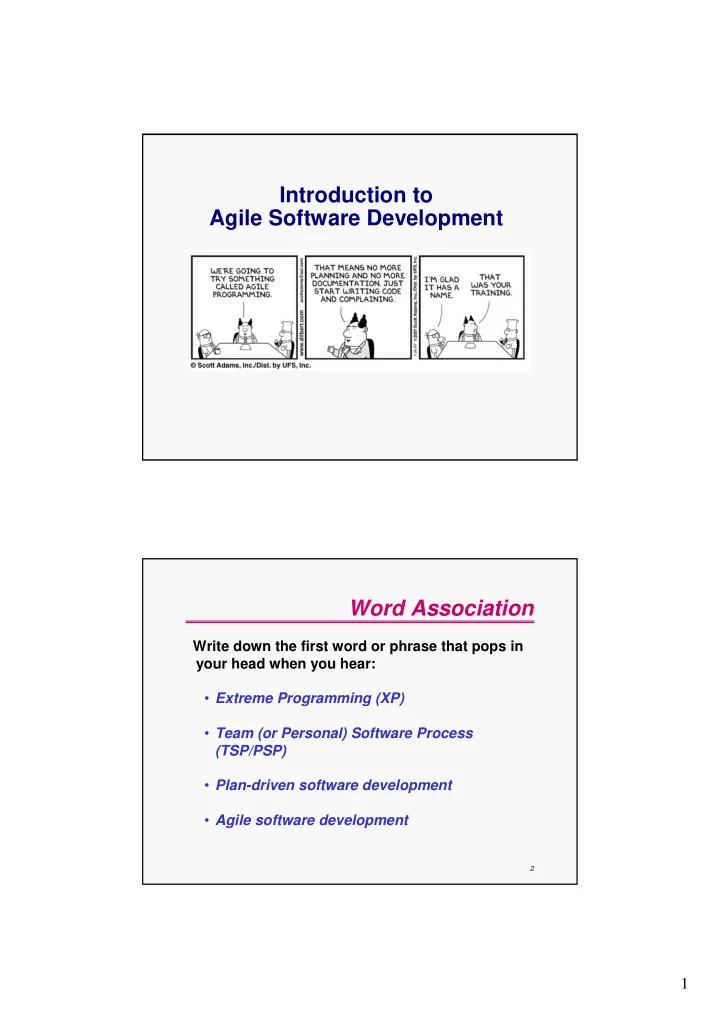
Introduction to Agile Software Development

2

Word Association

Write down the first word or phrase that pops in your head when you hear:

  • Extreme Programming (XP)
  • Team (or Personal) Software Process

(TSP/PSP)

  • Plan-driven software development
  • Agile software development
slide-2
SLIDE 2

2

3

Process Methodology Myths

Agile Methods

  • cowboys and hackers
  • undisciplined
  • low quality

Plan Driven Methods

  • process worship
  • document laden
  • excessive discipline

It’s not that black and white. The process spectrum spans a range of gray.

4

Important Concepts

Plan-Driven

  • Process Improvement
  • Process Capability
  • Organizational Maturity
  • Process Group
  • Risk Management
  • Verification (building

the product right)

  • Validation (building the

right product)

  • System Architecture

Agile

  • Embrace Change
  • Frequent Delivery
  • Simple Design
  • Refactoring
  • Pair Programming
  • Retrospective
  • Tacit Knowledge
  • Test-Driven

Development (TDD)

slide-3
SLIDE 3

3

5

Plan-Driven Approach

Characteristics

  • Systematic engineering approach
  • Completeness of documentation
  • Thorough verification - traceability
  • Traditionally waterfall, but more incremental

and evolutionary processes are the norm. Examples

  • Cleanroom (mathematically driven)
  • PSP/TSP (Humphrey, SEI)
  • SW-CMM (process improvement framework)

6

Agile Approach

Characteristics

  • Short, iterative cycles
  • Incremental delivery
  • Evolutionary work artifacts (test,design,code)
  • Active customer involvement
  • Dynamic application domains (requirements)

Examples

  • eXtreme Programming (XP) – (Beck)
  • Crystal family (Cockburn)
  • Scrum (Schwaber)
  • Feature-Driven Development (Coad)
slide-4
SLIDE 4

4

7

The Process Methodology Spectrum

Hackers Inch- Pebble XP Agile Methodologies Plan Driven Methodologies Scrum DSDM Crystal Lean Feature Driven Design RUP SW- CMM PSP Cleanroom TSP from “Balancing Agility & Discipline” (Boehm & Turner) Less Agile More Agile

8

What Is Agile Software Development?

In the late 1990's several methodologies began to get increasing public attention. All emphasized:

  • close collaboration between the programmer team and

business experts

  • face-to-face communication (as more efficient than written

documentation)

  • frequent delivery of new deployable business value
  • tight, self-organizing teams
  • ways to craft the code and the team such that the

inevitable requirements churn was not a crisis. 2001 : Workshop in Snowbird, Utah, Practitioners of these methodologies met to figure out just what it was they had in

  • common. They picked the word "agile" for an umbrella term

and crafted the

  • Manifesto for Agile Software Development,
slide-5
SLIDE 5

5

9

Manifesto for Agile Software Development

Statement of shared development values: Individuals and Interactions – over process and tools Working software - over comprehensive documentation Customer collaboration - over contract negotiation Responding to change - over following a plan “That is, while there is value in the items on the right, we value the items on the left more. “

10

What traditional developers heard

Statement of shared development values: Individuals and Interactions = NO process Working software = NO documentation Customer collaboration = NO contracts Responding to change = NOT following a plan

slide-6
SLIDE 6

6

11

Principles behind the Agile Manifesto

We follow these principles: Our highest priority is to satisfy the customer through early and continuous delivery of valuable software. Welcome changing requirements, even late in development. Agile processes harness change for the customer's competitive advantage. Deliver working software frequently, from a couple of weeks to a couple of months, with a preference to the shorter timescale. Business people and developers must work together daily throughout the project. Build projects around motivated individuals. Give them the environment and support they need, and trust them to get the job done. The most efficient and effective method of conveying information to and within a development team is face-to-face conversation.

12

Principles behind the Agile Manifesto

We follow these principles (continued): Working software is the primary measure of progress. Agile processes promote sustainable development. The sponsors, developers, and users should be able to maintain a constant pace indefinitely. Continuous attention to technical excellence and good design enhances agility. Simplicity--the art of maximizing the amount of work not done--is essential. The best architectures, requirements, and designs emerge from self-organizing teams. At regular intervals, the team reflects on how to become more effective, then tunes and adjusts its behavior accordingly.
slide-7
SLIDE 7

7

13

Traditional Approach

Project follows a waterfall process (plan driven) Teams produce artifacts at each phase of the life-cycle in a sequential manner. Significant upfront design effort Implementation delayed until later stages of the project Testing deferred until coding complete Teams make final presentation to the customer Teams participate in postmortem session

14

Traditional Project Approach

Start End

Requirements Planning Analysis/Design Implementation Test Demo

Project Plan Estimates Schedule Risk Mgmt Require Doc Design Document Use Case Diagrams Interaction Diagrams Class Diagrams GUI Prototypes

Code!

Inspections Test Plan Test Results Post Mortem

Code!

slide-8
SLIDE 8

8

15

Traditional Challenges

Lightweight application/heavyweight process Document intensive (perceived) Less flexible design Big bang approach to coding/integration Testing short-shifted One-shot presentation opportunity Lack of opportunity for process improvement Prone to “Analysis-Paralaysis”

  • “Ready, Aim, Aim, Aim, …”

16

Four Project Variables

Time – duration of the project Quality – the requirements for ‘correctness’ Resources – personnel, equipment, etc. Scope – what is to be done; the features to be implemented Pick three, any three . . .

slide-9
SLIDE 9

9

17

Planning

“The plan is nothing; the planning is everything” Dwight Eisenhower Allied supreme commander during World War II 34th President of United States (1953-61)

18

Where are the risks?

“Getting Readu for Agile Methods With Care”, Barry Boehm – IEEE Computer, 2002

slide-10
SLIDE 10

10

19

Agile RE Profile

“Getting Readu for Agile Methods With Care”, Barry Boehm – IEEE Computer, 2002 20

Plan-Driven RE Profile

“Getting Readu for Agile Methods With Care”, Barry Boehm – IEEE Computer, 2002

slide-11
SLIDE 11

11

21

Agile Characteristics

Incremental development – several releases Planning based on user stories Each iteration touches all life-cycle activities Testing – unit testing for deliverables Testing – acceptance tests for each release Flexible Design – evolution vs. big upfront effort Reflection after each release cycle Several technical and customer focused presentation opportunities

22

Key Agile Contributions

Team Skills

  • Collaborative Development
  • Reflections (process improvement)

User Stories

  • Requirements elicitation
  • Planning – scope & composition

Evolutionary Design

  • Opportunity to make mistakes

Continuous Integration

  • Code (small booms vs big bang)

Testing

  • Dispels notion of testing as an end of cycle activity

Communication

  • Interacting with customer / team members
slide-12
SLIDE 12

12

23

Agile Software Development

Agile Themes:

  • Lightweight disciplined processes
  • Feature / Customer Focused
  • Small teams
  • Short delivery cycles

Popular Agile Methodologies:

  • XP (eXtreme Programming)
  • Crystal Family
  • Adaptive Software Process
  • Scrum

24

Characteristics of Agile Methodologies

Deliver working software frequently Incremental development cycles – release plan based on user stories. Evolutionary approach to design – design what you need for this release cycle Test – Test – Test (Unit & Acceptance) Customer participation Lightweight documentation Reflect at regular intervals – tune and adjust

slide-13
SLIDE 13

13

25

Agile Benefits

User stories drive planning and requirements in a manageable work units

  • Customer perspective
  • Risk management

Frequent delivery of working software

  • Process reflection opportunities
  • Implementation refactoring
  • Positive feedback to team

Testing Focus

  • Test early and often
  • Change in attitude towards testing

26

Transitioning to Agile

Agile is not a “Silver Bullet” that will cure all your development woes. It will however brightly illuminate your

  • pportunities.

Where are the opportunities for improvement in our current process? How does Agile address those issues? Trust, Transparency, Patience Individual Opportunity - “Generalizing Specialists” The adoption of Agile is neither completely top-down or bottom-up. It must be a balance of both with a strong level

  • f trust and commitment between all levels of the
  • rganization
slide-14
SLIDE 14

14

27

Common Issues

Typical issues/obstacles that arise include:

  • Lack of business ownership and the inability

to make decisions

  • Limited business buy-in into the concept of

Agile

  • Team communication, individual skills, and

team fit

  • Lack of trust in the team by the business
  • Focus only on Agile development practices

Agile permeates all levels of the organization

28

slide-15
SLIDE 15

15

29

Methodology Distribution

30

Resources

  • Agile Software Development Portal:

agile.csc.ncsu.edu/

  • Agile Alliance – www.agilealliance.com
  • www.extremeprogramming.org/
  • Laurie Williams – North Carolina State:

collaboration.csc.ncsu.edu/laurie/index.html