
SLIDE 1
Introducing NERUPI
Friday 14 June 2019 Annette Hayton, NERUPI Convenor
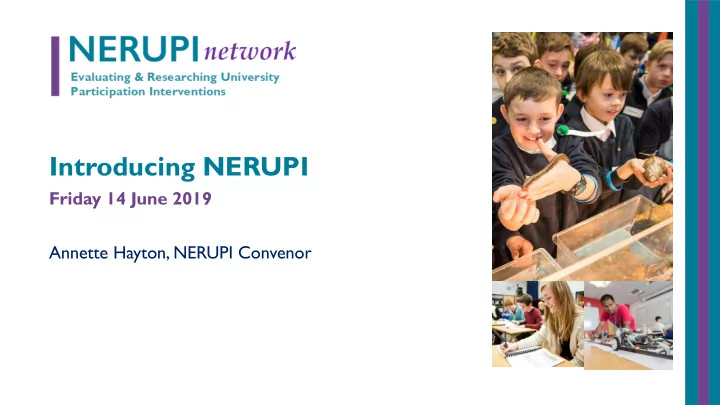
Introducing NERUPI Friday 14 June 2019 Annette Hayton, NERUPI - - PowerPoint PPT Presentation
Introducing NERUPI Friday 14 June 2019 Annette Hayton, NERUPI Convenor Accountability, context & impact Academic research has increased understanding of reasons for low participation and attainment of under-represented groups but:
Friday 14 June 2019 Annette Hayton, NERUPI Convenor
BUT efforts for accountability, ‘rigour’ & comparability OFTEN result in simplistic approaches to evaluation based on medical models LOSE SIGHT of underlying reasons for inequalities OF CONTEXT & complexity of successful interventions
Did they have a good time? Were they safe? Can organisation be improved? Did they like the lunch? Was the session engaging? How was it for the staff and ambassadors?
Bath admitted 600 students who participated in outreach with
T wice as many participants from low progression areas went on to university compared with the average for LPN students in the counties surrounding the university. Participants in Bath outreach activities were much more likely to go to a high tariff university than disadvantaged students nationally Participants in Bath outreach activities were awarded an average of two grades higher in their GCSEs than students in the same schools who had the same attainment at KS2 who had not taken part.
Monitoring Process Evaluation Progression
? Impact of activities
OFS Access and Participation standards of evidence (Page 7) (Exeter University for OfS 2019)
‘It is often useful to employ mixed- methods research (i.e. using different techniques) in order to take account of different perspectives on the outcomes’
SOCIAL AND ACADEMIC CAPITAL HABITUS SKILLS CAPITAL INTELLECTUAL & SUBJECT CAPITAL
PROGRESSION CURRICULUM STUDENT IDENTITIES SKILLS CURRICULUM KNOWLEDGE CURRICULUM KNOW CHOOSE BECOME PRACTISE
UNDERSTAND Develop students' knowledge and awareness of the benefits of higher education Develop students' capacity to navigate Higher Education sector and make informed choices Develop students' confidence and resilience to negotiate the challenges of university life Develop students' study skills and capacity for academic attainment Develop students' understanding by contextualising subject knowledge
Aim 1 Develop students' knowledge and awareness of the benefits of higher education and graduate employment Level 2 (age 14–16) Top-level objective Explore academic, social, economic and personal benefits of progressing to higher education Objectives or learning outcomes Understand economic benefits of higher education and career opportunities for graduates Explore benefits of higher education in terms of personal development and cultural enrichment Discover study and research opportunities at the (University of Bath)
The Evaluation of the Impact of Outreach (OFFA 2017)
‘Evaluation …means assessing the impact of the activity on its participants, measured against its intended objectives.’
Footnote iv The NERUPI framework provides a very rigorous theoretically-informed methodology for linking WP aims and
(Exeter University for OfS 2019)
NERUPI (glossary definition) Framework developed by the University
evaluation.
Dimension 2: Designing your programmes
Are your programmes underpinned by clear objectives for what you want to achieve? The NERUPI Framework sets out clear Aims and Objectives/Learning Outcomes that provide the basis for additional learning outcomes tailored to specific interventions while retaining overall programme coherence. Is your programme design informed by evidence? The theoretically grounded, context specific aims and
foundation for programme design. Is evaluation specified at the planning stage of your interventions? The NERUPI Framework underpins the design of activities and the identification of appropriate data collection and
aims - targeting - interventions - evaluation strategy- logistics
Deliver interventions & undertake evaluation
Monitoring – tracking – related stats – process - impact
interventions
(OfS Regulatory Notice 1: Access and
evaluation approaches and methods
Past Members Events
The Capability Approach: Beyond the Deficit Model for Student Success 11 March 2019 Geographies of Widening Participation and Insights from NCOP 5 April 2019 Widening Participation and Graduate Progression 15 May 2019
NERUPI Annual
Convention Making Spaces in HE: Exploring Possible Selves 2 July 2019
Alex Wardrop Julian Crockford Jacqueline Stevenson Andrew Bengry
19 September 2019 Developing and Implementing your Evaluation Strategy Dr Andrew Bengry, Bath Spa University, Annette Hayton, NERUPI Convenor. Dr Anna Anthony, Data Analyst, HEAT, 14 November 2019 Knowledge, Learning and Attainment Professor Paul Ashwin, University of Lancaster, 14 January 2020 Admissions, Choice and Student Diversity Professor Vikki Boliver, University of Durham 11 March 2020 Exploring and Enhancing the impact of Student Ambassadors and Mentors Dr Clare Gartland, University of Suffolk 21 May 2020 Reducing the BAME Attainment Gap Nona McDuff OBE, Kingston University, 19 June 2020 Collaborative Outreach: Extending the Partnership Approach