
SLIDE 1
Pierre Bourdieu: Cultural & Symbolic Capital
EDUC 800 Presentation
Breana Bayraktar, Kelly Graham, Selila Honig
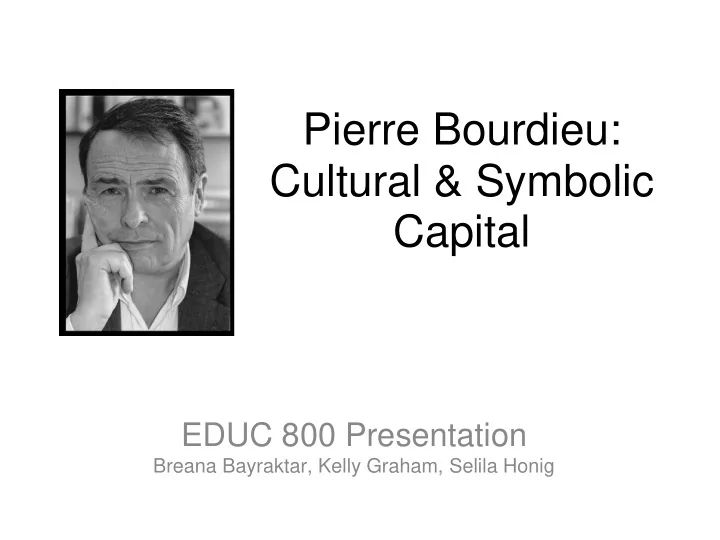
Pierre Bourdieu: Cultural & Symbolic Capital EDUC 800 - - PowerPoint PPT Presentation
Pierre Bourdieu: Cultural & Symbolic Capital EDUC 800 Presentation Breana Bayraktar, Kelly Graham, Selila Honig Agenda Week One: Biography of Pierre Bourdieu Key Ideas: Habitus, Field & Doxa; Social, Linguistic & Cultural
Breana Bayraktar, Kelly Graham, Selila Honig
Week One:
Cultural Capital
Week Two:
Week Three:
1930: Born in Denguin, Pyrénées- Atlantiques circa 1944-48: Studied at a lycée in Pau before switching to Lycée Louis-le-Grand in Paris 1948-55: Studied philosophy in Paris at the École Normale Supérieure with classmates Michel Foucault and Jacques Derrida
1955: Became agrégé (tenured secondary teacher) in Philosophy.
1958-60: Drafted into army; served in Algeria during the French-Algerian war. Lectured at the University
Berber culture (Studied kinship, ritual and pre- capitalist economy of the Kabyle peoples of Northern Algeria). 1975: Launched the interdisciplinary journal Actes de la recherche en sciences sociales, “devoted to deconsecrating the mechanism by which cultural production helps sustain the dominant structure of society” 1964: Became Director of Studies at the École Pratique des Hautes Études in Paris; 1968: Took over the Centre de Sociologie Européenne, the sociological research center, which he directed until his death. 1960: Returned to France; taught at University of Paris (1960-62) and University
Algeria
Habitus = dispositions; lasting, acquired schemes of perception, thought and action Doxa = “true beliefs” that we take to be "self- evident universals” (e.g., belief in God) Habitus manifests the structures of the field, and the field mediates between habitus and practice = The formation and expression of self around an internalized and usually accurate sense of social destiny. Field = a social arena in which people maneuver and struggle in pursuit of desirable resources
Il y a de pauvres bourgeoises qui, en prenant nos chapeaux, espèrent avoir nos manières = Some poor commoners think they can acquire our manners by putting on our hats
– She’s charming, said Eugene after having looked at Mme de Nucingen. – She has white eyebrows. – Yes, but she is wonderfully slim! – She has big hands. –But she has beautiful eyes! –Her face is too long. – But the long shape is a mark of distinction. – It’s good for her that she has that. Look how she takes and drops her lorgnette! The Goriot betrays in all her movements said the viscountess to Eugene’s great surprise.
another key Bourdieusian concept--that middle-class kids get from their families. One could extend that insight to the American context and argue that depriving working-class kids of the ‘frills’--art, music, trips--in the name of ‘the basics’ is not just stingy or philistine, it's a way of maintaining class privilege” (Subject to Debate, article in The Nation, 2002).
would like to see choice and free will. The habitus is that unchosen principle of so many choices that drives our humanists to such despair“ (In Other Words, p. 14).
– The amount and distribution of capital determines
– Within each field, one tries to augment and profit from capital – Types of capital
– Bourdieu and the use of economic terms
capital that determines one’s position in social space
converted into another
“knowledge, skills and other cultural acquisitions, as exemplified
by educational or technical qualifications” (Language and Symbolic Power, 1991, pg. 14). Three forms of cultural capital 1. Embodied – inherited and acquired (but not genetic), usually through family socialization
2. Objectified – objects owned / cultural articles 3. Institutionalized – institutional recognition of cultural capital
certificates
YouTube - Elements of Bourdieu: Social Capital in the Funny Pages
– Social capital can influence power and profit from economic and cultural capital – Social capital is symbolic – exists through people recognizing and accepting differences and seeing them as naturally occurring
The value of linguistic products and the power/resources one has to be recognized as a producer and user of a language in certain fields
– It can be a cultural obstacle in education systems – Social position limits or give access to the language of a group/field
heard
impose a vision of the world
allowable form and content of expression
– “Among the most effective and best concealed censorships are all those which consist in excluding certain agents from communication by excluding them from the groups which speak or the places which allow
Vote with the Right Vote with the Left
Large-scale farmer Director/CEO of a large commercial/industrial venture Artists Small business owners Artisans
University Profs Secondary Teachers Private Sector Engineers Medical/social services Mid-level commerce Primary Teachers Office Workers Shopkeepers Journeyman/Craftsman Semi-Skilled Laborers Unskilled laborers Freelance Professionals Hiking Swimming Mineral Water Bocci (lawn bowling) Home-made liquor (Pastis/Ouzo) Fishing Red Wine Cards (Hearts) Soccer Hunting Dressage Chess Beer
CULTURAL CAPITAL ECONOMIC CAPITAL