Interpolated sequences and critical L -values of modular forms - - PowerPoint PPT Presentation

interpolated sequences and critical l values of modular
SMART_READER_LITE
LIVE PREVIEW

Interpolated sequences and critical L -values of modular forms - - PowerPoint PPT Presentation

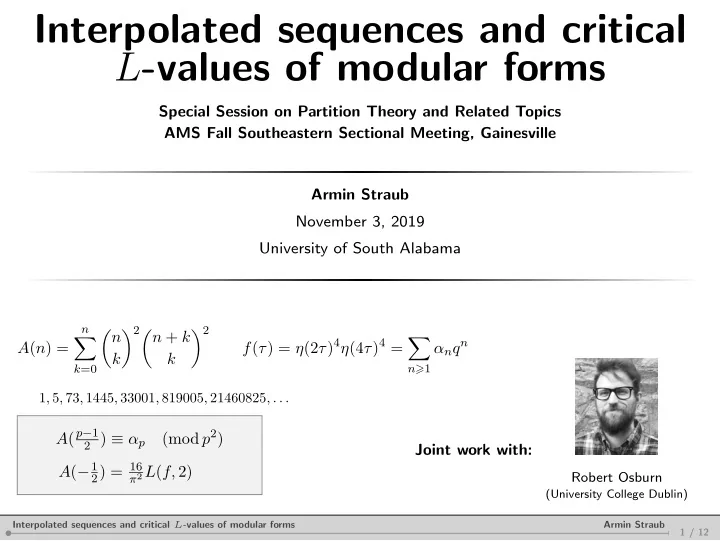
Interpolated sequences and critical L -values of modular forms Special Session on Partition Theory and Related Topics AMS Fall Southeastern Sectional Meeting, Gainesville Armin Straub November 3, 2019 University of South Alabama n 2 n


slide-1
SLIDE 1

Interpolated sequences and critical L-values of modular forms

Special Session on Partition Theory and Related Topics AMS Fall Southeastern Sectional Meeting, Gainesville Armin Straub November 3, 2019 University of South Alabama A(n) =

n

  • k=0

n k 2n + k k 2 f(τ) = η(2τ)4η(4τ)4 =

  • n1

αnqn

1, 5, 73, 1445, 33001, 819005, 21460825, . . .

A( p−1

2 ) ≡ αp

(mod p2) A(− 1

2) = 16 π2 L(f, 2)

Joint work with:

Robert Osburn

(University College Dublin)

Interpolated sequences and critical L-values of modular forms Armin Straub 1 / 12

slide-2
SLIDE 2

Ap´ ery numbers and the irrationality of ζ(3)

  • The Ap´

ery numbers

1, 5, 73, 1445, . . .

A(n) =

n

  • k=0

n k 2n + k k 2 satisfy (n + 1)3un+1 = (2n + 1)(17n2 + 17n + 5)un − n3un−1. ζ(3) =

  • n1

1 n3 is irrational.

THM

Ap´ ery ’78

Interpolated sequences and critical L-values of modular forms Armin Straub 2 / 12

slide-3
SLIDE 3

Ap´ ery numbers and the irrationality of ζ(3)

  • The Ap´

ery numbers

1, 5, 73, 1445, . . .

A(n) =

n

  • k=0

n k 2n + k k 2 satisfy (n + 1)3un+1 = (2n + 1)(17n2 + 17n + 5)un − n3un−1. ζ(3) =

  • n1

1 n3 is irrational.

THM

Ap´ ery ’78

The same recurrence is satisfied by the “near”-integers B(n) =

n

  • k=0

n k 2n + k k 2  

n

  • j=1

1 j3 +

k

  • m=1

(−1)m−1 2m3n

m

n+m

m

 . Then, B(n)

A(n) → ζ(3). But too fast for ζ(3) to be rational.

proof

Interpolated sequences and critical L-values of modular forms Armin Straub 2 / 12

slide-4
SLIDE 4

Zagier’s search and Ap´ ery-like numbers

  • The Ap´

ery numbers B(n) =

n

  • k=0

n k 2n + k k

  • for ζ(2) satisfy

(n + 1)2un+1 = (an2 + an + b)un − cn2un−1, (a, b, c) = (11, 3, −1).

Are there other tuples (a, b, c) for which the solution defined by u−1 = 0, u0 = 1 is integral?

Q

Beukers

Interpolated sequences and critical L-values of modular forms Armin Straub 3 / 12

slide-5
SLIDE 5

Zagier’s search and Ap´ ery-like numbers

  • The Ap´

ery numbers B(n) =

n

  • k=0

n k 2n + k k

  • for ζ(2) satisfy

(n + 1)2un+1 = (an2 + an + b)un − cn2un−1, (a, b, c) = (11, 3, −1).

Are there other tuples (a, b, c) for which the solution defined by u−1 = 0, u0 = 1 is integral?

Q

Beukers

  • Apart from degenerate cases, Zagier found 6 sporadic integer solutions:

* C∗(n) A

n

  • k=0

n k 3

B

⌊n/3⌋

  • k=0

(−1)k3n−3k n 3k (3k)! k!3

C

n

  • k=0

n k 22k k

  • *

C∗(n) D

n

  • k=0

n k 2n + k n

  • E

n

  • k=0

n k 2k k 2(n − k) n − k

  • F

n

  • k=0

(−1)k8n−k n k

  • CA(k)

Interpolated sequences and critical L-values of modular forms Armin Straub 3 / 12

slide-6
SLIDE 6

Modularity of Ap´ ery-like numbers

  • The Ap´

ery numbers

1, 5, 73, 1145, . . .

A(n) =

n

  • k=0

n k 2n + k k 2 satisfy η7(2τ)η7(3τ) η5(τ)η5(6τ)

1 + 5q + 13q2 + 23q3 + O(q4)

modular form

=

  • n0

A(n) η12(τ)η12(6τ) η12(2τ)η12(3τ) n

q − 12q2 + 66q3 + O(q4)

modular function

.

Interpolated sequences and critical L-values of modular forms Armin Straub 4 / 12

slide-7
SLIDE 7

Modularity of Ap´ ery-like numbers

  • The Ap´

ery numbers

1, 5, 73, 1145, . . .

A(n) =

n

  • k=0

n k 2n + k k 2 satisfy η7(2τ)η7(3τ) η5(τ)η5(6τ)

1 + 5q + 13q2 + 23q3 + O(q4)

modular form

=

  • n0

A(n) η12(τ)η12(6τ) η12(2τ)η12(3τ) n

q − 12q2 + 66q3 + O(q4)

modular function

. Not at all evidently, such a modular parametrization exists for all known Ap´ ery-like numbers!

FACT

  • Context:

f(τ) modular form of weight k x(τ) modular function y(x) such that y(x(τ)) = f(τ) Then y(x) satisfies a linear differential equation of order k + 1.

Interpolated sequences and critical L-values of modular forms Armin Straub 4 / 12

slide-8
SLIDE 8

L-value interpolations

For primes p > 2, the Ap´ ery numbers for ζ(3) satisfy A( p−1

2 ) ≡ af(p)

(mod p2), with f(τ) = η(2τ)4η(4τ)4 =

  • n1

af(n)qn ∈ S4(Γ0(8)).

THM

Ahlgren– Ono 2000 conjectured (and proved modulo p) by Beukers ’87

Interpolated sequences and critical L-values of modular forms Armin Straub 5 / 12

slide-9
SLIDE 9

L-value interpolations

For primes p > 2, the Ap´ ery numbers for ζ(3) satisfy A( p−1

2 ) ≡ af(p)

(mod p2), with f(τ) = η(2τ)4η(4τ)4 =

  • n1

af(n)qn ∈ S4(Γ0(8)).

THM

Ahlgren– Ono 2000 conjectured (and proved modulo p) by Beukers ’87

A(− 1

2) = 16 π2 L(f, 2)

THM

Zagier 2016

  • Here, A(x) =

  • k=0

x k 2x + k k 2

is absolutely convergent for x ∈ C.

  • Predicted by Golyshev based on motivic considerations,

the connection of the Ap´ ery numbers with the double covering

  • f a family of K3 surfaces, and the Tate conjecture.
  • D. Zagier

Arithmetic and topology of differential equations Proceedings of the 2016 ECM, 2017

Interpolated sequences and critical L-values of modular forms Armin Straub 5 / 12

slide-10
SLIDE 10

L-value interpolations, cont’d

  • Zagier found 6 sporadic integer solutions C∗(n) to:

∗ one of A-F

(n + 1)2un+1 = (an2 + an + b)un − cn2un−1

u−1 = 0, u0 = 1

There exists a weight 3 newform f∗(τ) =

n1 γn,∗qn, so that

C∗( p−1

2 ) ≡ γp,∗

(mod p).

THM

1985

  • 2019

Interpolated sequences and critical L-values of modular forms Armin Straub 6 / 12

slide-11
SLIDE 11

L-value interpolations, cont’d

  • Zagier found 6 sporadic integer solutions C∗(n) to:

∗ one of A-F

(n + 1)2un+1 = (an2 + an + b)un − cn2un−1

u−1 = 0, u0 = 1

There exists a weight 3 newform f∗(τ) =

n1 γn,∗qn, so that

C∗( p−1

2 ) ≡ γp,∗

(mod p).

THM

1985

  • 2019
  • C, D proved by Beukers–Stienstra (’85); A follows from their work
  • E proved using a result Verrill (’10); B through p-adic analysis
  • F conjectured by Osburn–S and proved by Kazalicki (’19) using

Atkin–Swinnerton-Dyer congruences for non-congruence cusp forms

Interpolated sequences and critical L-values of modular forms Armin Straub 6 / 12

slide-12
SLIDE 12

L-value interpolations, cont’d

  • Zagier found 6 sporadic integer solutions C∗(n) to:

∗ one of A-F

(n + 1)2un+1 = (an2 + an + b)un − cn2un−1

u−1 = 0, u0 = 1

There exists a weight 3 newform f∗(τ) =

n1 γn,∗qn, so that

C∗( p−1

2 ) ≡ γp,∗

(mod p).

THM

1985

  • 2019
  • C, D proved by Beukers–Stienstra (’85); A follows from their work
  • E proved using a result Verrill (’10); B through p-adic analysis
  • F conjectured by Osburn–S and proved by Kazalicki (’19) using

Atkin–Swinnerton-Dyer congruences for non-congruence cusp forms

For ∗ one of A-F , except E, there is α∗ ∈ Z such that C∗(− 1

2) = α∗

π2 L(f∗, 2).

THM

Osburn S ’18

Interpolated sequences and critical L-values of modular forms Armin Straub 6 / 12

slide-13
SLIDE 13

L-value interpolations, cont’d

  • Zagier found 6 sporadic integer solutions C∗(n) to:

∗ one of A-F

(n + 1)2un+1 = (an2 + an + b)un − cn2un−1

u−1 = 0, u0 = 1

There exists a weight 3 newform f∗(τ) =

n1 γn,∗qn, so that

C∗( p−1

2 ) ≡ γp,∗

(mod p).

THM

1985

  • 2019
  • C, D proved by Beukers–Stienstra (’85); A follows from their work
  • E proved using a result Verrill (’10); B through p-adic analysis
  • F conjectured by Osburn–S and proved by Kazalicki (’19) using

Atkin–Swinnerton-Dyer congruences for non-congruence cusp forms

For ∗ one of A-F , except E, there is α∗ ∈ Z such that C∗(− 1

2) = α∗

π2 L(f∗, 2). For sequence E, res

x=−1/2CE(x) = 6

π2 L(fE, 1).

THM

Osburn S ’18

Interpolated sequences and critical L-values of modular forms Armin Straub 6 / 12

slide-14
SLIDE 14

L-value interpolations, cont’d

* C∗(n) f∗(τ) N∗ CM α∗ A

n

  • k=0

n k 3

η(4τ)5η(8τ)5 η(2τ)2η(16τ)2

32

Q( √ −2)

8 B

⌊n/3⌋

  • k=0

(−1)k3n−3k n 3k (3k)! k!3

η(4τ)6

16

Q( √ −1)

8 C

n

  • k=0

n k 22k k

  • η(2τ)3η(6τ)3

12

Q( √ −3)

12 D

n

  • k=0

n k 2n + k n

  • η(4τ)6

16

Q( √ −1)

16 E

n

  • k=0

n k 2k k 2(n − k) n − k

  • η(τ)2η(2τ)η(4τ)η(8τ)2

8

Q( √ −2)

6 F

n

  • k=0

(−1)k8n−k n k

  • CA(k)

q − 2q2 + 3q3 + . . .

24

Q( √ −6)

6

C∗(− 1

2) = α∗

π2 L(f∗, 2)

Interpolated sequences and critical L-values of modular forms Armin Straub 7 / 12

slide-15
SLIDE 15

Interpolating sequences

What is the proper way of defining C(− 1

2)?

Q

a(n) = n! is interpolated by a(x) = Γ(x + 1) = ∞ txe−t dt.

EG

Interpolated sequences and critical L-values of modular forms Armin Straub 8 / 12

slide-16
SLIDE 16

Interpolating sequences

What is the proper way of defining C(− 1

2)?

Q

a(n) = n! is interpolated by a(x) = Γ(x + 1) = ∞ txe−t dt.

EG

  • a(0) − a(1)x2 + a(2)x4 − . . .
  • dx = π

2 a(− 1

2)

THM

Glaisher 1874

Interpolated sequences and critical L-values of modular forms Armin Straub 8 / 12

slide-17
SLIDE 17

Interpolating sequences

What is the proper way of defining C(− 1

2)?

Q

a(n) = n! is interpolated by a(x) = Γ(x + 1) = ∞ txe−t dt.

EG

  • a(0) − a(1)x2 + a(2)x4 − . . .
  • dx = π

2 a(− 1

2)

THM

Glaisher 1874

∞ 1 1 + x2S · a(0) dx = π 2 S−1/2 · a(0)

“poof”

(Glaisher’s formal proof, simplified by O’Kinealy)

Here, S is the shift operator: S · b(n) = b(n + 1)

Interpolated sequences and critical L-values of modular forms Armin Straub 8 / 12

slide-18
SLIDE 18

Interpolating sequences: Ramanujan’s master theorem

∞ xs−1 a(0) − xa(1) + x2a(2) − . . .

  • dx =

π sin sπa(−s)

THM

Ramanujan Hardy Interpolated sequences and critical L-values of modular forms Armin Straub 9 / 12

slide-19
SLIDE 19

Interpolating sequences: Ramanujan’s master theorem

∞ xs−1 a(0) − xa(1) + x2a(2) − . . .

  • dx =

π sin sπa(−s) for 0 < Re s < δ, provided that

  • a is analytic on H(δ) = {z ∈ C : Re u −δ},
  • |a(x + iy)| < Ceα|x|+β|y| for some β < π.

THM

Ramanujan Hardy Interpolated sequences and critical L-values of modular forms Armin Straub 9 / 12

slide-20
SLIDE 20

Interpolating sequences: Ramanujan’s master theorem

∞ xs−1 a(0) − xa(1) + x2a(2) − . . .

  • dx =

π sin sπa(−s) for 0 < Re s < δ, provided that

  • a is analytic on H(δ) = {z ∈ C : Re u −δ},
  • |a(x + iy)| < Ceα|x|+β|y| for some β < π.

THM

Ramanujan Hardy

Suppose a satisfies the conditions for RMT. If a(0) = 0, a(1) = 0, a(2) = 0, . . . , then a(z) = 0 identically.

COR

Carlson 1914

  • However, we will see that our interpolations do not arise in this way.

Interpolated sequences and critical L-values of modular forms Armin Straub 9 / 12

slide-21
SLIDE 21

Interpolating sequences

What is the proper way of defining C(− 1

2)?

Q

  • For Ap´

ery numbers A(n), Zagier used A(x) =

  • k=0

x k 2x + k k 2

.

Interpolated sequences and critical L-values of modular forms Armin Straub 10 / 12

slide-22
SLIDE 22

Interpolating sequences

What is the proper way of defining C(− 1

2)?

Q

  • For Ap´

ery numbers A(n), Zagier used A(x) =

  • k=0

x k 2x + k k 2

. (x + 2)3A(x + 2) − (2x + 3)(17x2 + 51x + 39)A(x + 1) + (x + 1)3A(x) = 0 for all x ∈ Z0

EG

Zagier

Interpolated sequences and critical L-values of modular forms Armin Straub 10 / 12

slide-23
SLIDE 23

Interpolating sequences

What is the proper way of defining C(− 1

2)?

Q

  • For Ap´

ery numbers A(n), Zagier used A(x) =

  • k=0

x k 2x + k k 2

. (x + 2)3A(x + 2) − (2x + 3)(17x2 + 51x + 39)A(x + 1) + (x + 1)3A(x) = 8 π2 (2x + 3) sin2(πx)

In particular, A(x) does not satisfy the (vertical) growth conditions of RMT.

EG

Zagier

Interpolated sequences and critical L-values of modular forms Armin Straub 10 / 12

slide-24
SLIDE 24

Interpolating sequences

What is the proper way of defining C(− 1

2)?

Q

  • For Ap´

ery numbers A(n), Zagier used A(x) =

  • k=0

x k 2x + k k 2

. (x + 2)3A(x + 2) − (2x + 3)(17x2 + 51x + 39)A(x + 1) + (x + 1)3A(x) = 8 π2 (2x + 3) sin2(πx)

In particular, A(x) does not satisfy the (vertical) growth conditions of RMT.

EG

Zagier

  • For the ζ(2) Ap´

ery numbers B(n), we use B(x) =

  • k=0

x k 2x + k k

  • .

However:

  • The series diverges if Re x < −1.
  • Q(x, Sx)B(x) = 0 where Q(x, Sx) is Ap´

ery’s recurrence operator.

Interpolated sequences and critical L-values of modular forms Armin Straub 10 / 12

slide-25
SLIDE 25

Interpolating sequences

What is the proper way of defining C(− 1

2)?

Q

  • For Ap´

ery numbers A(n), Zagier used A(x) =

  • k=0

x k 2x + k k 2

.

CC(n) =

n

  • k=0

n k 22k k

  • diverges for n ∈ Z0

EG

(C)

Interpolated sequences and critical L-values of modular forms Armin Straub 10 / 12

slide-26
SLIDE 26

Interpolating sequences

What is the proper way of defining C(− 1

2)?

Q

  • For Ap´

ery numbers A(n), Zagier used A(x) =

  • k=0

x k 2x + k k 2

.

CC(n) =

n

  • k=0

n k 22k k

  • diverges for n ∈ Z0

= 3F2 −n, −n, 1

2

1, 1

  • 4
  • EG

(C)

Interpolated sequences and critical L-values of modular forms Armin Straub 10 / 12

slide-27
SLIDE 27

Interpolating sequences

What is the proper way of defining C(− 1

2)?

Q

  • For Ap´

ery numbers A(n), Zagier used A(x) =

  • k=0

x k 2x + k k 2

.

CC(n) =

n

  • k=0

n k 22k k

  • diverges for n ∈ Z0

= 3F2 −n, −n, 1

2

1, 1

  • 4
  • We use the interpolation CC(x) = Re 3F2

−x, −x, 1

2

1, 1

  • 4
  • .

EG

(C)

Interpolated sequences and critical L-values of modular forms Armin Straub 10 / 12

slide-28
SLIDE 28

Interpolating sequences

What is the proper way of defining C(− 1

2)?

Q

  • For Ap´

ery numbers A(n), Zagier used A(x) =

  • k=0

x k 2x + k k 2

.

CC(n) =

n

  • k=0

n k 22k k

  • diverges for n ∈ Z0

= 3F2 −n, −n, 1

2

1, 1

  • 4
  • We use the interpolation CC(x) = Re 3F2

−x, −x, 1

2

1, 1

  • 4
  • .

EG

(C)

CE(n) =

n

  • k=0

n k 2k k 2(n − k) n − k

  • EG

(E)

Interpolated sequences and critical L-values of modular forms Armin Straub 10 / 12

slide-29
SLIDE 29

Interpolating sequences

What is the proper way of defining C(− 1

2)?

Q

  • For Ap´

ery numbers A(n), Zagier used A(x) =

  • k=0

x k 2x + k k 2

.

CC(n) =

n

  • k=0

n k 22k k

  • diverges for n ∈ Z0

= 3F2 −n, −n, 1

2

1, 1

  • 4
  • We use the interpolation CC(x) = Re 3F2

−x, −x, 1

2

1, 1

  • 4
  • .

EG

(C)

CE(n) =

n

  • k=0

n k 2k k 2(n − k) n − k

  • =

2n n

  • 3F2
  • −n, −n, 1

2 1 2 − n, 1

  • −1
  • This has a simple pole at n = − 1

2.

EG

(E)

Interpolated sequences and critical L-values of modular forms Armin Straub 10 / 12

slide-30
SLIDE 30

Interpolating sequences

What is the proper way of defining C(− 1

2)?

Q

  • For Ap´

ery numbers A(n), Zagier used A(x) =

  • k=0

x k 2x + k k 2

.

C(n) =

n

  • k1,k2,k3,k4=0

k1+k2=k3+k4 4

  • i=1

n ki n + ki ki

  • .

How to compute C(− 1

2)?

EG

  • RE: order 4, degree 15
  • DE: order 7, degree 17

(2 analytic solutions)

Interpolated sequences and critical L-values of modular forms Armin Straub 10 / 12

slide-31
SLIDE 31

Interpolating sequences

What is the proper way of defining C(− 1

2)?

Q

  • For Ap´

ery numbers A(n), Zagier used A(x) =

  • k=0

x k 2x + k k 2

.

C(n) =

n

  • k1,k2,k3,k4=0

k1+k2=k3+k4 4

  • i=1

n ki n + ki ki

  • .

How to compute C(− 1

2)?

EG

  • RE: order 4, degree 15
  • DE: order 7, degree 17

(2 analytic solutions)

For any odd prime p, C( p−1

2 ) ≡ γ(p) (mod p2),

η12(2τ) =

  • n1

γ(n)qn ∈ S6(Γ0(4))

THM

McCarthy, Osburn, S 2018

Is there a Zagier-type interpolation?

Q

Interpolated sequences and critical L-values of modular forms Armin Straub 10 / 12

slide-32
SLIDE 32

Conclusions

  • Golyshev and Zagier observed that for

A(n) =

n

  • k=0

n k 2n + k k 2 , f(τ) = η(2τ)4η(4τ)4 =

  • n1

αnqn

the known modular congruences have a continuous analog:

weight 4

A( p−1

2 ) ≡ αp

(mod p2), A(− 1

2) = 16 π2 L(f, 2)

Interpolated sequences and critical L-values of modular forms Armin Straub 11 / 12

slide-33
SLIDE 33

Conclusions

  • Golyshev and Zagier observed that for

A(n) =

n

  • k=0

n k 2n + k k 2 , f(τ) = η(2τ)4η(4τ)4 =

  • n1

αnqn

the known modular congruences have a continuous analog:

weight 4

A( p−1

2 ) ≡ αp

(mod p2), A(− 1

2) = 16 π2 L(f, 2)

  • We proved that the same phenomenon holds for:
  • all six sporadic sequences of Zagier

weight 3

  • an infinite family of leading coefficients of Brown’s cellular integrals
  • dd weight k

Interpolated sequences and critical L-values of modular forms Armin Straub 11 / 12

slide-34
SLIDE 34

Conclusions

  • Golyshev and Zagier observed that for

A(n) =

n

  • k=0

n k 2n + k k 2 , f(τ) = η(2τ)4η(4τ)4 =

  • n1

αnqn

the known modular congruences have a continuous analog:

weight 4

A( p−1

2 ) ≡ αp

(mod p2), A(− 1

2) = 16 π2 L(f, 2)

  • We proved that the same phenomenon holds for:
  • all six sporadic sequences of Zagier

weight 3

  • an infinite family of leading coefficients of Brown’s cellular integrals
  • dd weight k
  • Proofs are computational and not satisfactorily uniform

Do all of these have the same motivic explanation? Can Zagier’s motivic approach (relying on Tate conjecture) be worked out explicitly in these cases?

Interpolated sequences and critical L-values of modular forms Armin Straub 11 / 12

slide-35
SLIDE 35

Conclusions

  • Golyshev and Zagier observed that for

A(n) =

n

  • k=0

n k 2n + k k 2 , f(τ) = η(2τ)4η(4τ)4 =

  • n1

αnqn

the known modular congruences have a continuous analog:

weight 4

A( p−1

2 ) ≡ αp

(mod p2), A(− 1

2) = 16 π2 L(f, 2)

  • We proved that the same phenomenon holds for:
  • all six sporadic sequences of Zagier

weight 3

  • an infinite family of leading coefficients of Brown’s cellular integrals
  • dd weight k
  • Proofs are computational and not satisfactorily uniform

Do all of these have the same motivic explanation? Can Zagier’s motivic approach (relying on Tate conjecture) be worked out explicitly in these cases?

  • Further examples exist. What is the natural framework?

Ap´ ery-like sequences, CM modular forms, hypergeometric series, . . .

  • How to characterize the analytic interpolations abstractly?

We used suitable binomial sums. But the interpolations are not unique! (Some grow like sin(πx) as x → i∞.)

  • Polynomial analogs?

Interpolated sequences and critical L-values of modular forms Armin Straub 11 / 12

slide-36
SLIDE 36

THANK YOU!

Slides for this talk will be available from my website: http://arminstraub.com/talks

  • D. McCarthy, R. Osburn, A. Straub

Sequences, modular forms and cellular integrals Mathematical Proceedings of the Cambridge Philosophical Society, 2018

  • R. Osburn, A. Straub

Interpolated sequences and critical L-values of modular forms Chapter 14 of the book: Elliptic Integrals, Elliptic Functions and Modular Forms in Quantum Field Theory Editors: J. Bl¨ umlein, P. Paule and C. Schneider; Springer, 2019, p. 327-349

  • R. Osburn, A. Straub, W. Zudilin

A modular supercongruence for 6F5: An Ap´ ery-like story Annales de l’Institut Fourier, Vol. 68, Nr. 5, 2018, p. 1987-2004

  • D. Zagier

Arithmetic and topology of differential equations Proceedings of the 2016 ECM, 2017

Interpolated sequences and critical L-values of modular forms Armin Straub 12 / 12

slide-37
SLIDE 37

Beukers’ proof of the irrationality of ζ(3)

In = (−1)n 1 1 xn(1 − x)nyn(1 − y)n (1 − xy)n+1 dxdy Jn = 1 2 1 1 1 xn(1 − x)nyn(1 − y)nwn(1 − w)n (1 − (1 − xy)w)n+1 dxdydw

  • Beukers showed that

In = a(n)ζ(2) + ˜ a(n), Jn = b(n)ζ(3) + ˜ b(n)

Interpolated sequences and critical L-values of modular forms Armin Straub 13 / 20

slide-38
SLIDE 38

Beukers’ proof of the irrationality of ζ(3)

In = (−1)n 1 1 xn(1 − x)nyn(1 − y)n (1 − xy)n+1 dxdy Jn = 1 2 1 1 1 xn(1 − x)nyn(1 − y)nwn(1 − w)n (1 − (1 − xy)w)n+1 dxdydw

  • Beukers showed that

In = a(n)ζ(2) + ˜ a(n), Jn = b(n)ζ(3) + ˜ b(n) where ˜ a(n),˜ b(n) ∈ Q and a(n) =

n

  • k=0

n k 2n + k k

  • ,

b(n) =

n

  • k=0

n k 2n + k k 2 .

Interpolated sequences and critical L-values of modular forms Armin Straub 13 / 20

slide-39
SLIDE 39

Beukers’ proof of the irrationality of ζ(3)

In = (−1)n 1 1 xn(1 − x)nyn(1 − y)n (1 − xy)n+1 dxdy Jn = 1 2 1 1 1 xn(1 − x)nyn(1 − y)nwn(1 − w)n (1 − (1 − xy)w)n+1 dxdydw

  • Beukers showed that

In = a(n)ζ(2) + ˜ a(n), Jn = b(n)ζ(3) + ˜ b(n) where ˜ a(n),˜ b(n) ∈ Q and a(n) =

n

  • k=0

n k 2n + k k

  • ,

b(n) =

n

  • k=0

n k 2n + k k 2 .

  • Brown realizes these as period integrals, for N = 5, 6, on the moduli

space M0,N of curves of genus 0 with N marked points.

Interpolated sequences and critical L-values of modular forms Armin Straub 13 / 20

slide-40
SLIDE 40

Brown’s cellular integrals

Period integrals on M0,N are Q-linear combinations of multiple zeta values (MZVs).

(conjectured by Goncharov–Manin, 2004)

THM

Brown 2009

  • Examples of such integrals can be written as:

(ai, bj, cij ∈ Z)

  • 0<t1<...<tN−3<1
  • tai

i (1 − tj)bj(ti − tj)cijdt1 . . . dtN−3

  • Typically involve MZVs of all weights N − 3.

Interpolated sequences and critical L-values of modular forms Armin Straub 14 / 20

slide-41
SLIDE 41

Brown’s cellular integrals

Period integrals on M0,N are Q-linear combinations of multiple zeta values (MZVs).

(conjectured by Goncharov–Manin, 2004)

THM

Brown 2009

  • Examples of such integrals can be written as:

(ai, bj, cij ∈ Z)

  • 0<t1<...<tN−3<1
  • tai

i (1 − tj)bj(ti − tj)cijdt1 . . . dtN−3

  • Typically involve MZVs of all weights N − 3.
  • Brown constructs families of integrals Iσ(n), for which MZVs of

submaximal weight vanish.

Here, σ are certain (“convergent”) permutations in SN.

N 5 6 7 8 9 10 11 # of σ 1 1 5 17 105 771 7028

Interpolated sequences and critical L-values of modular forms Armin Straub 14 / 20

slide-42
SLIDE 42

One of Brown’s cellular integrals

  • One of the 17 permutations for N = 8 is σ = (8, 3, 6, 1, 4, 7, 2, 5).
  • Cellular integral Iσ(n) =
  • ∆ fn

σ ωσ where

∆ : 0 < t2 < . . . < t6 < 1

fσ = (−t2)(t2 − t3)(t3 − t4)(t4 − t5)(t5 − t6)(t6 − 1) (t3 − t6)(t6)(−t4)(t4 − 1)(1 − t2)(t2 − t5) , ωσ = dt2dt3dt4dt5dt6 (t3 − t6)(t6)(−t4)(t4 − 1)(1 − t2)(t2 − t5).

Interpolated sequences and critical L-values of modular forms Armin Straub 15 / 20

slide-43
SLIDE 43

One of Brown’s cellular integrals

  • One of the 17 permutations for N = 8 is σ = (8, 3, 6, 1, 4, 7, 2, 5).
  • Cellular integral Iσ(n) =
  • ∆ fn

σ ωσ where

∆ : 0 < t2 < . . . < t6 < 1

fσ = (−t2)(t2 − t3)(t3 − t4)(t4 − t5)(t5 − t6)(t6 − 1) (t3 − t6)(t6)(−t4)(t4 − 1)(1 − t2)(t2 − t5) , ωσ = dt2dt3dt4dt5dt6 (t3 − t6)(t6)(−t4)(t4 − 1)(1 − t2)(t2 − t5).

Iσ(0) = 16ζ(5) − 8ζ(3)ζ(2) Iσ(1) = 33Iσ(0) − 432ζ(3) + 316ζ(2) − 26 Iσ(2) = 8929Iσ(0) − 117500ζ(3) + 515189

6

ζ(2) − 331063

48

EG

Panzer: HyperInt

Interpolated sequences and critical L-values of modular forms Armin Straub 15 / 20

slide-44
SLIDE 44

One of Brown’s cellular integrals

  • One of the 17 permutations for N = 8 is σ = (8, 3, 6, 1, 4, 7, 2, 5).
  • Cellular integral Iσ(n) =
  • ∆ fn

σ ωσ where

∆ : 0 < t2 < . . . < t6 < 1

fσ = (−t2)(t2 − t3)(t3 − t4)(t4 − t5)(t5 − t6)(t6 − 1) (t3 − t6)(t6)(−t4)(t4 − 1)(1 − t2)(t2 − t5) , ωσ = dt2dt3dt4dt5dt6 (t3 − t6)(t6)(−t4)(t4 − 1)(1 − t2)(t2 − t5).

Iσ(0) = 16ζ(5) − 8ζ(3)ζ(2) Iσ(1) = 33Iσ(0) − 432ζ(3) + 316ζ(2) − 26 Iσ(2) = 8929Iσ(0) − 117500ζ(3) + 515189

6

ζ(2) − 331063

48

EG

Panzer: HyperInt

  • OGF of Iσ(n) satisfies a Picard–Fuchs DE of order 7 (Lairez).

With 2-dimensional space of analytic solutions at 0.

Interpolated sequences and critical L-values of modular forms Armin Straub 15 / 20

slide-45
SLIDE 45

One of Brown’s cellular integrals

  • One of the 17 permutations for N = 8 is σ = (8, 3, 6, 1, 4, 7, 2, 5).
  • Cellular integral Iσ(n) =
  • ∆ fn

σ ωσ where

∆ : 0 < t2 < . . . < t6 < 1

fσ = (−t2)(t2 − t3)(t3 − t4)(t4 − t5)(t5 − t6)(t6 − 1) (t3 − t6)(t6)(−t4)(t4 − 1)(1 − t2)(t2 − t5) , ωσ = dt2dt3dt4dt5dt6 (t3 − t6)(t6)(−t4)(t4 − 1)(1 − t2)(t2 − t5).

Iσ(0) = 16ζ(5) − 8ζ(3)ζ(2) Iσ(1) = 33Iσ(0) − 432ζ(3) + 316ζ(2) − 26 Iσ(2) = 8929Iσ(0) − 117500ζ(3) + 515189

6

ζ(2) − 331063

48

EG

Panzer: HyperInt

  • OGF of Iσ(n) satisfies a Picard–Fuchs DE of order 7 (Lairez).

With 2-dimensional space of analytic solutions at 0.

  • The leading coefficients of Iσ(n) are:

1, 33, 8929, 4124193, 2435948001, 1657775448033, . . .

Interpolated sequences and critical L-values of modular forms Armin Straub 15 / 20

slide-46
SLIDE 46

One of Brown’s cellular integrals, cont’d

  • One of the 17 permutations for N = 8 is σ = (8, 3, 6, 1, 4, 7, 2, 5).
  • Cellular integral Iσ(n) =
  • ∆ fn

σ ωσ where

  • The leading coefficients Aσ(n) of Iσ(n) are:

1, 33, 8929, 4124193, 2435948001, 1657775448033, . . . Aσ(n) =

n

  • k1,k2,k3,k4=0

k1+k2=k3+k4 4

  • i=1

n ki n + ki ki

  • LEM

McCarthy, Osburn, S 2018

Interpolated sequences and critical L-values of modular forms Armin Straub 16 / 20

slide-47
SLIDE 47

One of Brown’s cellular integrals, cont’d

  • One of the 17 permutations for N = 8 is σ = (8, 3, 6, 1, 4, 7, 2, 5).
  • Cellular integral Iσ(n) =
  • ∆ fn

σ ωσ where

  • The leading coefficients Aσ(n) of Iσ(n) are:

1, 33, 8929, 4124193, 2435948001, 1657775448033, . . . Aσ(n) =

n

  • k1,k2,k3,k4=0

k1+k2=k3+k4 4

  • i=1

n ki n + ki ki

  • LEM

McCarthy, Osburn, S 2018

For each N 5 and convergent σN, the leading coefficients AσN (n) satisfy

(p 5)

AσN (mpr) ≡ AσN (mpr−1) (mod p3r).

CONJ

McCarthy, Osburn, S 2018

For N = 5, 6 these are the supercongruences proved by Beukers and Coster.

Interpolated sequences and critical L-values of modular forms Armin Straub 16 / 20

slide-48
SLIDE 48

One of Brown’s cellular integrals, cont’d

  • One of the 17 permutations for N = 8 is σ = (8, 3, 6, 1, 4, 7, 2, 5).
  • Cellular integral Iσ(n) =
  • ∆ fn

σ ωσ where

  • The leading coefficients Aσ(n) of Iσ(n) are:

1, 33, 8929, 4124193, 2435948001, 1657775448033, . . . Aσ(n) =

n

  • k1,k2,k3,k4=0

k1+k2=k3+k4 4

  • i=1

n ki n + ki ki

  • LEM

McCarthy, Osburn, S 2018

For any odd prime p, Aσ p − 1 2

  • ≡ γ(p) (mod p2).

where η12(2τ) =

  • n1

γ(n)qn is the unique newform in S6(Γ0(4)).

THM

McCarthy, Osburn, S 2018

Interpolated sequences and critical L-values of modular forms Armin Straub 16 / 20

slide-49
SLIDE 49

The Ahlgren–Ono supercongruences

For any odd prime p, the Ap´ ery numbers for ζ(3) satisfy A p − 1 2

  • ≡ α(p)

(mod p2), with η(2τ)4η(4τ)4 =

  • n1

α(n)qn the unique newform in S4(Γ0(8)).

THM

Ahlgren– Ono ’00

For any prime p 5, the Ap´ ery numbers for ζ(2) satisfy B p − 1 2

  • ≡ β(p)

(mod p2), with η(4τ)6 =

  • n1

β(n)qn the unique newform in S3(Γ0(16), ( −4

· )).

THM

Ahlgren ’01

  • conjectured (and proved modulo p) by Beukers ’87

Interpolated sequences and critical L-values of modular forms Armin Straub 17 / 20

slide-50
SLIDE 50

Congruences and interpolations for cellular integrals

  • For an explicit family σN of convergent configurations,

AσN (n) = CD(n)(N−3)/2.

Interpolated sequences and critical L-values of modular forms Armin Straub 18 / 20

slide-51
SLIDE 51

Congruences and interpolations for cellular integrals

  • For an explicit family σN of convergent configurations,

AσN (n) = CD(n)(N−3)/2.

  • For odd k 3, consider the weight k binary theta series

fk(τ) = 1 4

  • (n,m)∈Z2

(−1)m(k−1)/2(n − im)k−1qn2+m2 =:

  • n1

γk(n)qn.

Interpolated sequences and critical L-values of modular forms Armin Straub 18 / 20

slide-52
SLIDE 52

Congruences and interpolations for cellular integrals

  • For an explicit family σN of convergent configurations,

AσN (n) = CD(n)(N−3)/2.

  • For odd k 3, consider the weight k binary theta series

fk(τ) = 1 4

  • (n,m)∈Z2

(−1)m(k−1)/2(n − im)k−1qn2+m2 =:

  • n1

γk(n)qn.

Let N 5 be odd and k = N − 2. Then, for all primes p 5, AσN ( p−1

2 ) ≡ γk(p)

(mod p2).

THM

McCarthy, OS ’18

Interpolated sequences and critical L-values of modular forms Armin Straub 18 / 20

slide-53
SLIDE 53

Congruences and interpolations for cellular integrals

  • For an explicit family σN of convergent configurations,

AσN (n) = CD(n)(N−3)/2.

  • For odd k 3, consider the weight k binary theta series

fk(τ) = 1 4

  • (n,m)∈Z2

(−1)m(k−1)/2(n − im)k−1qn2+m2 =:

  • n1

γk(n)qn.

Let N 5 be odd and k = N − 2. Then, for all primes p 5, AσN ( p−1

2 ) ≡ γk(p)

(mod p2).

THM

McCarthy, OS ’18

Let N 5 be odd and k = N − 2. Then, AσN (− 1

2) =

αk πk−1 L(fk, k − 1), where αk are explicit rational numbers, defined recursively.

THM

OS ’18

Interpolated sequences and critical L-values of modular forms Armin Straub 18 / 20

slide-54
SLIDE 54

THANK YOU!

Slides for this talk will be available from my website: http://arminstraub.com/talks

  • D. McCarthy, R. Osburn, A. Straub

Sequences, modular forms and cellular integrals Mathematical Proceedings of the Cambridge Philosophical Society, 2018

  • R. Osburn, A. Straub

Interpolated sequences and critical L-values of modular forms Chapter 14 of the book: Elliptic Integrals, Elliptic Functions and Modular Forms in Quantum Field Theory Editors: J. Bl¨ umlein, P. Paule and C. Schneider; Springer, 2019, p. 327-349

  • R. Osburn, A. Straub, W. Zudilin

A modular supercongruence for 6F5: An Ap´ ery-like story Annales de l’Institut Fourier, Vol. 68, Nr. 5, 2018, p. 1987-2004

  • D. Zagier

Arithmetic and topology of differential equations Proceedings of the 2016 ECM, 2017

Interpolated sequences and critical L-values of modular forms Armin Straub 19 / 20

slide-55
SLIDE 55

THANK YOU!

Slides for this talk will be available from my website: http://arminstraub.com/talks

  • D. McCarthy, R. Osburn, A. Straub

Sequences, modular forms and cellular integrals Mathematical Proceedings of the Cambridge Philosophical Society, 2018

  • R. Osburn, A. Straub

Interpolated sequences and critical L-values of modular forms Chapter 14 of the book: Elliptic Integrals, Elliptic Functions and Modular Forms in Quantum Field Theory Editors: J. Bl¨ umlein, P. Paule and C. Schneider; Springer, 2019, p. 327-349

  • R. Osburn, A. Straub, W. Zudilin

A modular supercongruence for 6F5: An Ap´ ery-like story Annales de l’Institut Fourier, Vol. 68, Nr. 5, 2018, p. 1987-2004

  • D. Zagier

Arithmetic and topology of differential equations Proceedings of the 2016 ECM, 2017

Interpolated sequences and critical L-values of modular forms Armin Straub 20 / 20