Interpolated sequences and critical L -values of modular forms - - PowerPoint PPT Presentation

interpolated sequences and critical l values of modular
SMART_READER_LITE
LIVE PREVIEW

Interpolated sequences and critical L -values of modular forms - - PowerPoint PPT Presentation

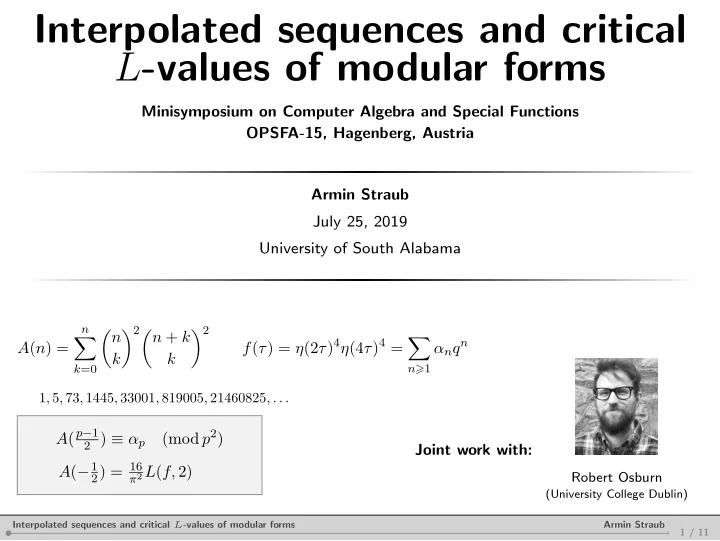
Interpolated sequences and critical L -values of modular forms Minisymposium on Computer Algebra and Special Functions OPSFA-15, Hagenberg, Austria Armin Straub July 25, 2019 University of South Alabama n 2 n + k 2 n f ( ) =


slide-1
SLIDE 1

Interpolated sequences and critical L-values of modular forms

Minisymposium on Computer Algebra and Special Functions OPSFA-15, Hagenberg, Austria Armin Straub July 25, 2019 University of South Alabama A(n) =

n
  • k=0

n k 2n + k k 2 f(τ) = η(2τ)4η(4τ)4 =

  • n1

αnqn

1, 5, 73, 1445, 33001, 819005, 21460825, . . .

A( p−1

2 ) ≡ αp

(mod p2) A(− 1

2) = 16 π2 L(f, 2)

Joint work with:

Robert Osburn

(University College Dublin)

Interpolated sequences and critical L-values of modular forms Armin Straub 1 / 11
slide-2
SLIDE 2

A victory for the French peasant. . . ∗

  • The Ap´

ery numbers

1, 5, 73, 1445, . . .

A(n) =

n

  • k=0

n k 2n + k k 2 satisfy (n + 1)3un+1 = (2n + 1)(17n2 + 17n + 5)un − n3un−1.

ζ(3) = ∞

n=1 1 n3 is irrational.

THM

Ap´ ery ’78

∗ Someone’s “sour comment” after Henri Cohen’s report on Ap´

ery’s proof at the ’78 ICM in Helsinki.

Interpolated sequences and critical L-values of modular forms Armin Straub 2 / 11
slide-3
SLIDE 3

A victory for the French peasant. . . ∗

  • The Ap´

ery numbers

1, 5, 73, 1445, . . .

A(n) =

n

  • k=0

n k 2n + k k 2 satisfy (n + 1)3un+1 = (2n + 1)(17n2 + 17n + 5)un − n3un−1.

ζ(3) = ∞

n=1 1 n3 is irrational.

THM

Ap´ ery ’78

The same recurrence is satisfied by the “near”-integers B(n) =

n

  • k=0

n k 2n + k k 2  

n

  • j=1

1 j3 +

k

  • m=1

(−1)m−1 2m3n

m

n+m

m

 . Then, B(n)

A(n) → ζ(3). But too fast for ζ(3) to be rational.

proof

∗ Someone’s “sour comment” after Henri Cohen’s report on Ap´

ery’s proof at the ’78 ICM in Helsinki.

Interpolated sequences and critical L-values of modular forms Armin Straub 2 / 11
slide-4
SLIDE 4

A victory for the French peasant. . . ∗

  • The Ap´

ery numbers

1, 5, 73, 1445, . . .

A(n) =

n

  • k=0

n k 2n + k k 2 satisfy (n + 1)3un+1 = (2n + 1)(17n2 + 17n + 5)un − n3un−1.

ζ(3) = ∞

n=1 1 n3 is irrational.

THM

Ap´ ery ’78

After a few days of fruitless effort the specific problem was mentioned to Don Zagier (Bonn), and with irritating speed he showed that indeed the sequence satisfies the recurrence.

Alfred van der Poorten — A proof that Euler missed. . . (1979) ”

∗ Someone’s “sour comment” after Henri Cohen’s report on Ap´

ery’s proof at the ’78 ICM in Helsinki.

Interpolated sequences and critical L-values of modular forms Armin Straub 2 / 11
slide-5
SLIDE 5

A victory for the French peasant. . . ∗

  • The Ap´

ery numbers

1, 5, 73, 1445, . . .

A(n) =

n

  • k=0

n k 2n + k k 2 satisfy (n + 1)3un+1 = (2n + 1)(17n2 + 17n + 5)un − n3un−1.

ζ(3) = ∞

n=1 1 n3 is irrational.

THM

Ap´ ery ’78

After a few days of fruitless effort the specific problem was mentioned to Don Zagier (Bonn), and with irritating speed he showed that indeed the sequence satisfies the recurrence.

Alfred van der Poorten — A proof that Euler missed. . . (1979) ”

Nowadays, there are excellent implementations of this creative telescoping, including:

  • HolonomicFunctions by Koutschan (Mathematica)
  • Sigma by Schneider (Mathematica)
  • ore algebra by Kauers, Jaroschek, Johansson, Mezzarobba (Sage)

(These are just the ones I use on a regular basis. . . )

∗ Someone’s “sour comment” after Henri Cohen’s report on Ap´

ery’s proof at the ’78 ICM in Helsinki.

Interpolated sequences and critical L-values of modular forms Armin Straub 2 / 11
slide-6
SLIDE 6

Zagier’s search and Ap´ ery-like numbers

  • The Ap´

ery numbers B(n) =

n

  • k=0

n k 2n + k k

  • for ζ(2) satisfy

(n + 1)2un+1 = (an2 + an + b)un − cn2un−1, (a, b, c) = (11, 3, −1).

Are there other tuples (a, b, c) for which the solution defined by u−1 = 0, u0 = 1 is integral?

Q

Beukers

Interpolated sequences and critical L-values of modular forms Armin Straub 3 / 11
slide-7
SLIDE 7

Zagier’s search and Ap´ ery-like numbers

  • The Ap´

ery numbers B(n) =

n

  • k=0

n k 2n + k k

  • for ζ(2) satisfy

(n + 1)2un+1 = (an2 + an + b)un − cn2un−1, (a, b, c) = (11, 3, −1).

Are there other tuples (a, b, c) for which the solution defined by u−1 = 0, u0 = 1 is integral?

Q

Beukers

  • Apart from degenerate cases, Zagier found 6 sporadic integer solutions:

* C∗(n) A

n
  • k=0

n k 3

B

⌊n/3⌋
  • k=0

(−1)k3n−3k n 3k (3k)! k!3

C

n
  • k=0

n k 22k k

  • *

C∗(n) D

n
  • k=0

n k 2n + k n

  • E
n
  • k=0

n k 2k k 2(n − k) n − k

  • F
n
  • k=0

(−1)k8n−k n k

  • CA(k)
Interpolated sequences and critical L-values of modular forms Armin Straub 3 / 11
slide-8
SLIDE 8

L-value interpolations

For primes p > 2, the Ap´ ery numbers for ζ(3) satisfy A( p−1

2 ) ≡ af(p)

(mod p2), with f(τ) = η(2τ)4η(4τ)4 =

  • n1

af(n)qn ∈ S4(Γ0(8)).

THM

Ahlgren– Ono 2000 conjectured (and proved modulo p) by Beukers ’87

Interpolated sequences and critical L-values of modular forms Armin Straub 4 / 11
slide-9
SLIDE 9

L-value interpolations

For primes p > 2, the Ap´ ery numbers for ζ(3) satisfy A( p−1

2 ) ≡ af(p)

(mod p2), with f(τ) = η(2τ)4η(4τ)4 =

  • n1

af(n)qn ∈ S4(Γ0(8)).

THM

Ahlgren– Ono 2000 conjectured (and proved modulo p) by Beukers ’87

A(− 1

2) = 16 π2 L(f, 2)

THM

Zagier 2016

  • Here, A(x) =
  • k=0

x k 2x + k k 2

is absolutely convergent for x ∈ C.

  • Predicted by Golyshev based on motivic considerations,

the connection of the Ap´ ery numbers with the double covering

  • f a family of K3 surfaces, and the Tate conjecture.
  • D. Zagier

Arithmetic and topology of differential equations Proceedings of the 2016 ECM, 2017

Interpolated sequences and critical L-values of modular forms Armin Straub 4 / 11
slide-10
SLIDE 10

L-value interpolations, cont’d

  • Zagier found 6 sporadic integer solutions C∗(n) to:

∗ one of A-F

(n + 1)2un+1 = (an2 + an + b)un − cn2un−1

u−1 = 0, u0 = 1

There exists a weight 3 newform f∗(τ) =

n1 γn,∗qn, so that

C∗( p−1

2 ) ≡ γp,∗

(mod p).

THM

1985

  • 2019
Interpolated sequences and critical L-values of modular forms Armin Straub 5 / 11
slide-11
SLIDE 11

L-value interpolations, cont’d

  • Zagier found 6 sporadic integer solutions C∗(n) to:

∗ one of A-F

(n + 1)2un+1 = (an2 + an + b)un − cn2un−1

u−1 = 0, u0 = 1

There exists a weight 3 newform f∗(τ) =

n1 γn,∗qn, so that

C∗( p−1

2 ) ≡ γp,∗

(mod p).

THM

1985

  • 2019
  • C, D proved by Beukers–Stienstra (’85); A follows from their work
  • E proved using a result Verrill (’10); B through p-adic analysis
  • F conjectured by Osburn–S and proved by Kazalicki (’19) using

Atkin–Swinnerton-Dyer congruences for non-congruence cusp forms

Interpolated sequences and critical L-values of modular forms Armin Straub 5 / 11
slide-12
SLIDE 12

L-value interpolations, cont’d

  • Zagier found 6 sporadic integer solutions C∗(n) to:

∗ one of A-F

(n + 1)2un+1 = (an2 + an + b)un − cn2un−1

u−1 = 0, u0 = 1

There exists a weight 3 newform f∗(τ) =

n1 γn,∗qn, so that

C∗( p−1

2 ) ≡ γp,∗

(mod p).

THM

1985

  • 2019
  • C, D proved by Beukers–Stienstra (’85); A follows from their work
  • E proved using a result Verrill (’10); B through p-adic analysis
  • F conjectured by Osburn–S and proved by Kazalicki (’19) using

Atkin–Swinnerton-Dyer congruences for non-congruence cusp forms

For ∗ one of A-F , except E, there is α∗ ∈ Z such that C∗(− 1

2) = α∗

π2 L(f∗, 2).

THM

Osburn S ’18

Interpolated sequences and critical L-values of modular forms Armin Straub 5 / 11
slide-13
SLIDE 13

L-value interpolations, cont’d

  • Zagier found 6 sporadic integer solutions C∗(n) to:

∗ one of A-F

(n + 1)2un+1 = (an2 + an + b)un − cn2un−1

u−1 = 0, u0 = 1

There exists a weight 3 newform f∗(τ) =

n1 γn,∗qn, so that

C∗( p−1

2 ) ≡ γp,∗

(mod p).

THM

1985

  • 2019
  • C, D proved by Beukers–Stienstra (’85); A follows from their work
  • E proved using a result Verrill (’10); B through p-adic analysis
  • F conjectured by Osburn–S and proved by Kazalicki (’19) using

Atkin–Swinnerton-Dyer congruences for non-congruence cusp forms

For ∗ one of A-F , except E, there is α∗ ∈ Z such that C∗(− 1

2) = α∗

π2 L(f∗, 2). For sequence E, res

x=−1/2CE(x) = 6

π2 L(fE, 1).

THM

Osburn S ’18

Interpolated sequences and critical L-values of modular forms Armin Straub 5 / 11
slide-14
SLIDE 14

L-value interpolations, cont’d

* C∗(n) f∗(τ) N∗ CM α∗ A

n
  • k=0

n k 3

η(4τ)5η(8τ)5 η(2τ)2η(16τ)2

32

Q( √ −2)

8 B

⌊n/3⌋
  • k=0

(−1)k3n−3k n 3k (3k)! k!3

η(4τ)6

16

Q( √ −1)

8 C

n
  • k=0

n k 22k k

  • η(2τ)3η(6τ)3

12

Q( √ −3)

12 D

n
  • k=0

n k 2n + k n

  • η(4τ)6

16

Q( √ −1)

16 E

n
  • k=0

n k 2k k 2(n − k) n − k

  • η(τ)2η(2τ)η(4τ)η(8τ)2

8

Q( √ −2)

6 F

n
  • k=0

(−1)k8n−k n k

  • CA(k)

q − 2q2 + 3q3 + . . .

24

Q( √ −6)

6

C∗(− 1

2) = α∗

π2 L(f∗, 2)

Interpolated sequences and critical L-values of modular forms Armin Straub 6 / 11
slide-15
SLIDE 15

Challenge: A ≡ B

Can we extend the tools for A = B to A ≡ B?

Q

Interpolated sequences and critical L-values of modular forms Armin Straub 7 / 11
slide-16
SLIDE 16

Challenge: A ≡ B

Can we extend the tools for A = B to A ≡ B?

Q

For primes p > 2 and n = p−1

2 , ⌊n/3⌋

  • k=0

(−1)k3n−3k n 3k (3k)! k!3

CB(n)

n

  • k=0

n k 2n + k k

  • CD(n)

(mod p). EG

Osburn-S 2018

Interpolated sequences and critical L-values of modular forms Armin Straub 7 / 11
slide-17
SLIDE 17

Challenge: A ≡ B

Can we extend the tools for A = B to A ≡ B?

Q

For primes p > 2 and n = p−1

2 , ⌊n/3⌋

  • k=0

(−1)k3n−3k n 3k (3k)! k!3

CB(n)

n

  • k=0

n k 2n + k k

  • CD(n)

(mod p). EG

Osburn-S 2018

For primes p > 2 and n = p−1

2 , n

  • k=0

n k 2n + k k 2 ≡ (−1)n

n

  • k=0

n k 2n + k k 2k n

  • (mod p2).

EG

Osburn- S-Zudilin 2018

Interpolated sequences and critical L-values of modular forms Armin Straub 7 / 11
slide-18
SLIDE 18

Challenge: A ≡ B

Can we extend the tools for A = B to A ≡ B?

Q

For primes p > 2 and n = p−1

2 , ⌊n/3⌋

  • k=0

(−1)k3n−3k n 3k (3k)! k!3

CB(n)

n

  • k=0

n k 2n + k k

  • CD(n)

(mod p). EG

Osburn-S 2018

For primes p > 2 and n = p−1

2 , n

  • k=0

n k 2n + k k 2 ≡ (−1)n

n

  • k=0

n k 2n + k k 2k n

  • (mod p2).

EG

Osburn- S-Zudilin 2018

  • Our proof of this congruence relies on finding (?!) the identity

RHS =

n

  • k=0

(−1)k 3n + 1 n − k n + k k 3 .

Interpolated sequences and critical L-values of modular forms Armin Straub 7 / 11
slide-19
SLIDE 19

Challenge: A ≡ B

Can we extend the tools for A = B to A ≡ B?

Q

For primes p > 2 and n = p−1

2 , n

  • k=0

(−1)k n + k k 3n k 3 1 − 3k(2Hk − Hn+k − Hn−k)

n

  • k=0

n + k k 2n k 2 (mod p2).

LEM

Osburn- S-Zudilin 2018

Interpolated sequences and critical L-values of modular forms Armin Straub 7 / 11
slide-20
SLIDE 20

Challenge: A ≡ B

Can we extend the tools for A = B to A ≡ B?

Q

For primes p > 2 and n = p−1

2 , n

  • k=0

(−1)k n + k k 3n k 3 1 − 3k(2Hk − Hn+k − Hn−k)

n

  • k=0

n + k k 2n k 2 (mod p2).

LEM

Osburn- S-Zudilin 2018

  • Our proof of this congruence relies on finding the identity

RHS = (−1)n 2

n

  • k=0

n + k n 2n − k n n k 4 ×

  • 2 + (n − 2k)(5Hk − 5Hn−k − Hn+k + H2n−k)
  • .
Interpolated sequences and critical L-values of modular forms Armin Straub 7 / 11
slide-21
SLIDE 21

Creative telescoping

Goal: a recurrence for

n

  • k=0

n k 2n + k k 2 =:

n

  • k=0

A(n, k)

Let Sn be such that Snf(n, k) = f(n + 1, k).

Marko Petkovsek, Herbert S. Wilf and Doron Zeilberger

A = B

  • A. K. Peters, Ltd., 1st edition, 1996
Interpolated sequences and critical L-values of modular forms Armin Straub 8 / 11
slide-22
SLIDE 22

Creative telescoping

Goal: a recurrence for

n

  • k=0

n k 2n + k k 2 =:

n

  • k=0

A(n, k)

Let Sn be such that Snf(n, k) = f(n + 1, k).

  • Suppose we have P(n, Sn) ∈ Q[n, Sn] and R(n, k) ∈ Q(n, k) so that

P(n, Sn)A(n, k) = (Sk − 1)R(n, k)A(n, k).

Marko Petkovsek, Herbert S. Wilf and Doron Zeilberger

A = B

  • A. K. Peters, Ltd., 1st edition, 1996
Interpolated sequences and critical L-values of modular forms Armin Straub 8 / 11
slide-23
SLIDE 23

Creative telescoping

Goal: a recurrence for

n

  • k=0

n k 2n + k k 2 =:

n

  • k=0

A(n, k)

Let Sn be such that Snf(n, k) = f(n + 1, k).

  • Suppose we have P(n, Sn) ∈ Q[n, Sn] and R(n, k) ∈ Q(n, k) so that

P(n, Sn)A(n, k) = (Sk − 1)R(n, k)A(n, k).

  • Then:

P(n, Sn)

  • k∈Z

A(n, k) = 0

Marko Petkovsek, Herbert S. Wilf and Doron Zeilberger

A = B

  • A. K. Peters, Ltd., 1st edition, 1996
Interpolated sequences and critical L-values of modular forms Armin Straub 8 / 11
slide-24
SLIDE 24

Creative telescoping

Goal: a recurrence for

n

  • k=0

n k 2n + k k 2 =:

n

  • k=0

A(n, k)

Let Sn be such that Snf(n, k) = f(n + 1, k).

  • Suppose we have P(n, Sn) ∈ Q[n, Sn] and R(n, k) ∈ Q(n, k) so that

P(n, Sn)A(n, k) = (Sk − 1)R(n, k)A(n, k).

  • Then:

P(n, Sn)

  • k∈Z

A(n, k) = 0 P(n, Sn) = (n + 2)3S2

n − (2n + 3)(17n2 + 51n + 39)Sn + (n + 1)3

R(n, k) = 4k4(2n + 3)(4n2 − 2k2 + 12n + 3k + 8) (n − k + 1)2(n − k + 2)2

EG

Automatically obtained using Koutschan’s excellent HolonomicFunctions package for Mathematica.

Marko Petkovsek, Herbert S. Wilf and Doron Zeilberger

A = B

  • A. K. Peters, Ltd., 1st edition, 1996
Interpolated sequences and critical L-values of modular forms Armin Straub 8 / 11
slide-25
SLIDE 25

Challenge: Interpolating sequences

What is the proper way of defining C(− 1

2)?

Q

  • For Ap´

ery numbers A(n), Zagier used A(x) =

  • k=0

x k 2x + k k 2

.

Interpolated sequences and critical L-values of modular forms Armin Straub 9 / 11
slide-26
SLIDE 26

Challenge: Interpolating sequences

What is the proper way of defining C(− 1

2)?

Q

  • For Ap´

ery numbers A(n), Zagier used A(x) =

  • k=0

x k 2x + k k 2

. P(x, Sx)A(x) = 8 π2 (2x + 3) sin2(πx) for all complex x, where P(x, Sx) is Ap´ ery’s recurrence operator.

EG

Interpolated sequences and critical L-values of modular forms Armin Straub 9 / 11
slide-27
SLIDE 27

Challenge: Interpolating sequences

What is the proper way of defining C(− 1

2)?

Q

  • For Ap´

ery numbers A(n), Zagier used A(x) =

  • k=0

x k 2x + k k 2

. P(x, Sx)A(x) = 8 π2 (2x + 3) sin2(πx) for all complex x, where P(x, Sx) is Ap´ ery’s recurrence operator.

EG

  • Creative telescoping: P(x, Sx)A(x, k) = (Sk − 1)R(x, k)A(x, k)

P(x, Sx)

K−1

  • k=0

A(x, k) = R(x, K)A(x, K) − R(x, 0)A(x, 0) = R(x, K)A(x, K)

Interpolated sequences and critical L-values of modular forms Armin Straub 9 / 11
slide-28
SLIDE 28

Challenge: Interpolating sequences

What is the proper way of defining C(− 1

2)?

Q

  • For Ap´

ery numbers A(n), Zagier used A(x) =

  • k=0

x k 2x + k k 2

. P(x, Sx)A(x) = 8 π2 (2x + 3) sin2(πx) for all complex x, where P(x, Sx) is Ap´ ery’s recurrence operator.

EG

  • Creative telescoping: P(x, Sx)A(x, k) = (Sk − 1)R(x, k)A(x, k)

P(x, Sx)

K−1

  • k=0

A(x, k) = R(x, K)A(x, K) − R(x, 0)A(x, 0) = R(x, K)A(x, K) =

  • −8(2x + 3)K2 + O(K)

sin2(πx) π2K2 + O 1 K3

  • Interpolated sequences and critical L-values of modular forms
Armin Straub 9 / 11
slide-29
SLIDE 29

Challenge: Interpolating sequences

What is the proper way of defining C(− 1

2)?

Q

  • For Ap´

ery numbers A(n), Zagier used A(x) =

  • k=0

x k 2x + k k 2

. P(x, Sx)A(x) = 8 π2 (2x + 3) sin2(πx) for all complex x, where P(x, Sx) is Ap´ ery’s recurrence operator.

EG

  • For the ζ(2) Ap´

ery numbers B(n), we use B(x) =

  • k=0

x k 2x + k k

  • .

However:

  • The series diverges if Re x < −1.
  • Q(x, Sx)B(x) = 0 where Q(x, Sx) is Ap´

ery’s recurrence operator.

Interpolated sequences and critical L-values of modular forms Armin Straub 9 / 11
slide-30
SLIDE 30

Challenge: Interpolating sequences

What is the proper way of defining C(− 1

2)?

Q

  • For Ap´

ery numbers A(n), Zagier used A(x) =

  • k=0

x k 2x + k k 2

.

CC(n) =

n

  • k=0

n k 22k k

  • diverges for n ∈ Z0

EG

(C)

Interpolated sequences and critical L-values of modular forms Armin Straub 9 / 11
slide-31
SLIDE 31

Challenge: Interpolating sequences

What is the proper way of defining C(− 1

2)?

Q

  • For Ap´

ery numbers A(n), Zagier used A(x) =

  • k=0

x k 2x + k k 2

.

CC(n) =

n

  • k=0

n k 22k k

  • diverges for n ∈ Z0

= 3F2 −n, −n, 1

2

1, 1

  • 4
  • EG

(C)

Interpolated sequences and critical L-values of modular forms Armin Straub 9 / 11
slide-32
SLIDE 32

Challenge: Interpolating sequences

What is the proper way of defining C(− 1

2)?

Q

  • For Ap´

ery numbers A(n), Zagier used A(x) =

  • k=0

x k 2x + k k 2

.

CC(n) =

n

  • k=0

n k 22k k

  • diverges for n ∈ Z0

= 3F2 −n, −n, 1

2

1, 1

  • 4
  • We use the interpolation CC(x) = Re 3F2

−x, −x, 1

2

1, 1

  • 4
  • .

EG

(C)

Interpolated sequences and critical L-values of modular forms Armin Straub 9 / 11
slide-33
SLIDE 33

Challenge: Interpolating sequences

What is the proper way of defining C(− 1

2)?

Q

  • For Ap´

ery numbers A(n), Zagier used A(x) =

  • k=0

x k 2x + k k 2

.

CC(n) =

n

  • k=0

n k 22k k

  • diverges for n ∈ Z0

= 3F2 −n, −n, 1

2

1, 1

  • 4
  • We use the interpolation CC(x) = Re 3F2

−x, −x, 1

2

1, 1

  • 4
  • .

EG

(C)

CE(n) =

n

  • k=0

n k 2k k 2(n − k) n − k

  • EG

(E)

Interpolated sequences and critical L-values of modular forms Armin Straub 9 / 11
slide-34
SLIDE 34

Challenge: Interpolating sequences

What is the proper way of defining C(− 1

2)?

Q

  • For Ap´

ery numbers A(n), Zagier used A(x) =

  • k=0

x k 2x + k k 2

.

CC(n) =

n

  • k=0

n k 22k k

  • diverges for n ∈ Z0

= 3F2 −n, −n, 1

2

1, 1

  • 4
  • We use the interpolation CC(x) = Re 3F2

−x, −x, 1

2

1, 1

  • 4
  • .

EG

(C)

CE(n) =

n

  • k=0

n k 2k k 2(n − k) n − k

  • =

2n n

  • 3F2
  • −n, −n, 1

2 1 2 − n, 1

  • −1
  • This has a simple pole at n = − 1

2.

EG

(E)

Interpolated sequences and critical L-values of modular forms Armin Straub 9 / 11
slide-35
SLIDE 35

Challenge: Interpolating sequences

What is the proper way of defining C(− 1

2)?

Q

  • For Ap´

ery numbers A(n), Zagier used A(x) =

  • k=0

x k 2x + k k 2

.

C(n) =

n

  • k1,k2,k3,k4=0

k1+k2=k3+k4 4

  • i=1

n ki n + ki ki

  • .

How to compute C(− 1

2)?

EG

  • RE: order 4, degree 15
  • DE: order 7, degree 17

(2 analytic solutions)

Interpolated sequences and critical L-values of modular forms Armin Straub 9 / 11
slide-36
SLIDE 36

Challenge: Interpolating sequences

What is the proper way of defining C(− 1

2)?

Q

  • For Ap´

ery numbers A(n), Zagier used A(x) =

  • k=0

x k 2x + k k 2

.

C(n) =

n

  • k1,k2,k3,k4=0

k1+k2=k3+k4 4

  • i=1

n ki n + ki ki

  • .

How to compute C(− 1

2)?

EG

  • RE: order 4, degree 15
  • DE: order 7, degree 17

(2 analytic solutions)

For any odd prime p, C( p−1

2 ) ≡ γ(p) (mod p2),

η12(2τ) =

  • n1

γ(n)qn ∈ S6(Γ0(4))

THM

McCarthy, Osburn, S 2018

Is there a Zagier-type interpolation?

Q

Interpolated sequences and critical L-values of modular forms Armin Straub 9 / 11
slide-37
SLIDE 37

Challenge: computing values of η(τ) at CM points

How to efficiently compute η(τ) for quadratic irrationalities τ?

Q Lots of papers would benefit from a CAS implementation!

  • Dedekind eta function:

the prototypical modular form of weight 1

2

η(τ) = eπiτ/12

n1

(1 − e2πinτ).

Interpolated sequences and critical L-values of modular forms Armin Straub 10 / 11
slide-38
SLIDE 38

Challenge: computing values of η(τ) at CM points

How to efficiently compute η(τ) for quadratic irrationalities τ?

Q Lots of papers would benefit from a CAS implementation!

  • Dedekind eta function:

the prototypical modular form of weight 1

2

η(τ) = eπiτ/12

n1

(1 − e2πinτ). η(i) = 1 2π3/4 Γ( 1

4)

θ3(i) = 1 √ 2π3/4 Γ( 1

4) θ3(τ) =

  • n∈Z

qn2/2 = η(τ)5 η(τ/2)2η(2τ)2

θ3(1 + i √ 2)4 = Γ2( 1

8)Γ2( 3 8)

8 √ 2π3 θ3

  • − 1−i

√ 3 2

4 =

  • 3 − i

√ 3

  • Γ6( 1

3)

211/3π4 .

EG

Interpolated sequences and critical L-values of modular forms Armin Straub 10 / 11
slide-39
SLIDE 39

Challenge: computing values of η(τ) at CM points

How to efficiently compute η(τ) for quadratic irrationalities τ?

Q Lots of papers would benefit from a CAS implementation!

h

  • j=1

a−6

j |η(τj)|24 =

1 (2πd)6h

  • d
  • k=1

Γ k

d

( −d

k ) 3w

where the product is over reduced binary quadratic forms [aj, bj, cj] of discriminant −d < 0.

τj =

−bj+√−d 2aj

THM

Chowla– Selberg 1967 here, −d is a fundamental discriminant; w is number of roots of unity in Q(√−d)

Interpolated sequences and critical L-values of modular forms Armin Straub 10 / 11
slide-40
SLIDE 40

Challenge: computing values of η(τ) at CM points

How to efficiently compute η(τ) for quadratic irrationalities τ?

Q Lots of papers would benefit from a CAS implementation!

h

  • j=1

a−6

j |η(τj)|24 =

1 (2πd)6h

  • d
  • k=1

Γ k

d

( −d

k ) 3w

where the product is over reduced binary quadratic forms [aj, bj, cj] of discriminant −d < 0.

τj =

−bj+√−d 2aj

THM

Chowla– Selberg 1967 here, −d is a fundamental discriminant; w is number of roots of unity in Q(√−d)

  • The |η(τj)| only differ by an algebraic factor:
  • τ2 = M · τ1 for some M ∈ GL2(Z).
  • f(τ) =

η(τ) η(M · τ) is a modular function with f(τ1) = η(τ1) η(τ2).

Interpolated sequences and critical L-values of modular forms Armin Straub 10 / 11
slide-41
SLIDE 41

Challenge: computing values of η(τ) at CM points

How to efficiently compute η(τ) for quadratic irrationalities τ?

Q Lots of papers would benefit from a CAS implementation!

f a modular function, τ0 a quadratic irrationality = ⇒ f(τ0) is an algebraic number.

FACT

Interpolated sequences and critical L-values of modular forms Armin Straub 10 / 11
slide-42
SLIDE 42

Challenge: computing values of η(τ) at CM points

How to efficiently compute η(τ) for quadratic irrationalities τ?

Q Lots of papers would benefit from a CAS implementation!

f a modular function, τ0 a quadratic irrationality = ⇒ f(τ0) is an algebraic number.

FACT

  • A · τ0 = τ0 for some A ∈ GL2(Z)
  • Two modular functions are related by a modular equation:

P(f(A · τ), f(τ)) = 0

  • Hence: f(τ0) is a root of P(x, x) = 0.

Complexity of modular equations increases very quickly.

BUT

Interpolated sequences and critical L-values of modular forms Armin Straub 10 / 11
slide-43
SLIDE 43

Challenge: computing values of η(τ) at CM points

How to efficiently compute η(τ) for quadratic irrationalities τ?

Q Lots of papers would benefit from a CAS implementation!

f a modular function, τ0 a quadratic irrationality = ⇒ f(τ0) is an algebraic number.

FACT

  • j(τ) = q−1 + 744 + 196884q + 21493760q2 + · · ·

q = e2πiτ

  • Modular polynomial ΦN ∈ Z[x, y] such that ΦN(j(Nτ), j(τ)) = 0.

Φ2(x, y) = x3 + y3 − x2y2 + 24 · 3 · 31(x2 + xy2) − 24 · 34 · 53(x2 + y2) + 34 · 53 · 4027xy + 28 · 37 · 56(x + y) − 212 · 39 · 59

EG

Interpolated sequences and critical L-values of modular forms Armin Straub 10 / 11
slide-44
SLIDE 44

Challenge: computing values of η(τ) at CM points

How to efficiently compute η(τ) for quadratic irrationalities τ?

Q Lots of papers would benefit from a CAS implementation!

f a modular function, τ0 a quadratic irrationality = ⇒ f(τ0) is an algebraic number.

FACT

  • j(τ) = q−1 + 744 + 196884q + 21493760q2 + · · ·

q = e2πiτ

  • Modular polynomial ΦN ∈ Z[x, y] such that ΦN(j(Nτ), j(τ)) = 0.

Φ2(x, y) = x3 + y3 − x2y2 + 24 · 3 · 31(x2 + xy2) − 24 · 34 · 53(x2 + y2) + 34 · 53 · 4027xy + 28 · 37 · 56(x + y) − 212 · 39 · 59 Φ11(x, y) = x12 + y12 − x11y11 + 8184x11y10 − 28278756x11y9 + . . . several pages . . . + + 392423345094527654908696 . . . 100 digits . . . 000

EG

ΦN is O(N3 log N) bits Φ11(x, y) due to Kaltofen–Yui (1984)

Interpolated sequences and critical L-values of modular forms Armin Straub 10 / 11
slide-45
SLIDE 45

Challenge: computing values of η(τ) at CM points

How to efficiently compute η(τ) for quadratic irrationalities τ?

Q Lots of papers would benefit from a CAS implementation!

f a modular function, τ0 a quadratic irrationality = ⇒ f(τ0) is an algebraic number.

FACT

Other options for evaluating f(τ0):

  • via PSLQ/LLL and rigorous bounds
  • via class field theory (Shimura reciprocity)

To evaluate j( 1+√−23

2

) , we determine its Galois conjugates :

EG

class field theory

Interpolated sequences and critical L-values of modular forms Armin Straub 10 / 11
slide-46
SLIDE 46

Challenge: computing values of η(τ) at CM points

How to efficiently compute η(τ) for quadratic irrationalities τ?

Q Lots of papers would benefit from a CAS implementation!

f a modular function, τ0 a quadratic irrationality = ⇒ f(τ0) is an algebraic number.

FACT

Other options for evaluating f(τ0):

  • via PSLQ/LLL and rigorous bounds
  • via class field theory (Shimura reciprocity)

To evaluate j( 1+√−23

2

) , we determine its Galois conjugates :

  • x − j( 1+√−23

2

) x − j( 1+√−23

4

) x − j( −1+√−23

4

)

  • = x3 + 3491750x2 − 5151296875x + 12771880859375

EG

class field theory

Interpolated sequences and critical L-values of modular forms Armin Straub 10 / 11
slide-47
SLIDE 47

THANK YOU!

Slides for this talk will be available from my website: http://arminstraub.com/talks

  • D. McCarthy, R. Osburn, A. Straub

Sequences, modular forms and cellular integrals Mathematical Proceedings of the Cambridge Philosophical Society, 2018

  • R. Osburn, A. Straub

Interpolated sequences and critical L-values of modular forms Chapter 14 of the book: Elliptic Integrals, Elliptic Functions and Modular Forms in Quantum Field Theory Editors: J. Bl¨ umlein, P. Paule and C. Schneider; Springer, 2019, p. 327-349

  • R. Osburn, A. Straub, W. Zudilin

A modular supercongruence for 6F5: An Ap´ ery-like story Annales de l’Institut Fourier, Vol. 68, Nr. 5, 2018, p. 1987-2004

  • D. Zagier

Arithmetic and topology of differential equations Proceedings of the 2016 ECM, 2017

Interpolated sequences and critical L-values of modular forms Armin Straub 11 / 11