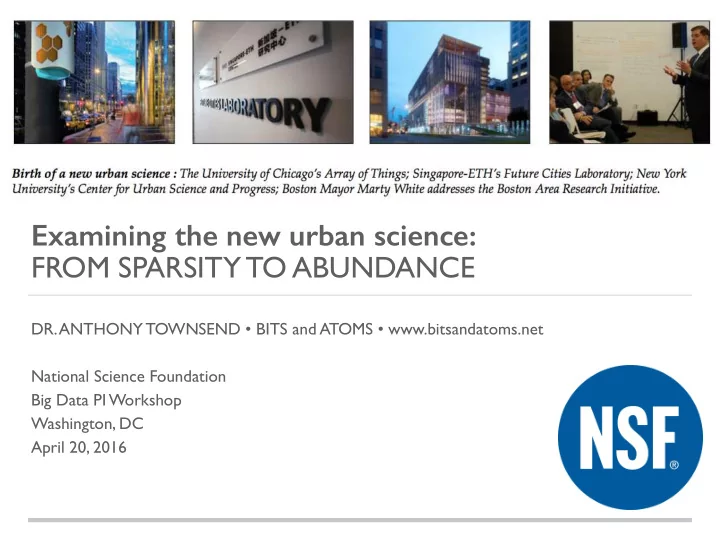
Examining the new urban science: FROM SPARSITY TO ABUNDANCE DR. - PowerPoint PPT Presentation
Examining the new urban science: FROM SPARSITY TO ABUNDANCE DR. ANTHONY TOWNSEND BITS and ATOMS www.bitsandatoms.net National Science Foundation Big Data PI Workshop Washington, DC April 20, 2016 big urban data is neither new
Examining the new urban science: FROM SPARSITY TO ABUNDANCE DR. ANTHONY TOWNSEND • BITS and ATOMS • www.bitsandatoms.net National Science Foundation Big Data PI Workshop Washington, DC April 20, 2016
big urban data is neither new… The Tabularium, Rome 2
one beginning of big data was to measure cities! IBM and the 1890 U.S. Census 3
…nor truly big So big you need me! Too big for me! The Goldilocks Zone (and most big urban data we work with every day) 4
this really is big urban data Living PlanIT (circa 2030): 200,000 people 255 petabytes / year (98 percent is video) LHC (today): peak 10 Gb/sec ~30 petabytes/year
cities of data project: examining the new urban science 2014-2015 at NYU Rudin Center • Support from Data and Society Research Institute, MacArthur Foundation, and Knight Foundation • who? what? where? why? when? how? of data-intensive urban research • special focus on new groups formed outside traditional urban studies, geography, and planning • schools and programs www.citiesofdata.org •
living labs, applied science, and the huge expectations around big urban data research
emerging frontiers • verification of long-standing urban heuristics (e.g. Jane Jacobs was right!) • tiers of sensing: • retail - ‘pedestrian’ sensing (Placemeter + Paris, LinkNYC, Array of Things) • application-specific (e.g. NYC taxi GPS logs) • ‘synoptic’ sensing (Koonin, NYU CUSP) - urban-scale, long-duration, multi-spectral instrumentation • industry-led data mining - (e.g. Sidewalk Labs’ Flow and Google HULK, Foursquare, Facebook migration study • citizen science…
why citizen science? BETTER SCIENCE MORE TRUST IN RESULTS STRONGER PARTNERS FOR APPLICATION
Citizen Urban Science Array of Things
Citizen Urban Science: New Models
The Future of Urban Science — Alternative Scenarios Bubble Integration Enigma Overrun Urban science overshoots Urban science helps engineer Urban science uncovers Urban science does what demand for students, applied a smooth paradigm shift in more questions than it economics did to, well, research, and institutional urban studies and planning, answers by mapping a everything. support - and probably validating and updating old vast unknown territory already has. theories and models. in short order. www.citiesofdata.org
implications and impacts • This is scientifically AND socially important in a way that few research topics are: • Cities are civilization - over the next century global urban population is moving from 3.5 to as much as 8 billion, 50 to 90 percent of total • Perhaps the most important subject of research - we know so little about underlying dynamics, and the lock-in of bad decisions now will be very long as network structures are determined. • Even the most cursory application of models from other fields is yielding huge new insights, and providing formal basis for old intuition • The institutional landscape is forming: • UK Future Cities Catapult - modeled after Germany’s Fraunhofer Institute • Formation of MetroLab in 2015 by White House OSTP Smart Cities Initiative - meeting in 2 weeks in San Diego (metrolab.heinz.cmu.edu) • The U.S. needs to spend $2-3 trillion to maintain infrastructure over the next decade. • Assuming we can apply the resulting knowledge - and that is a big IF based on current work - even just a tiny improvement in the effectiveness of that spending, could be very highly levered investment.
resources www.citiesofdata.org www.datasociety.net metrolab.heinz.cmu.edu www.smartcitiesbook.com slides - https://perma.cc/N938-VPN6
Recommend
More recommend
Explore More Topics
Stay informed with curated content and fresh updates.