
SLIDE 1
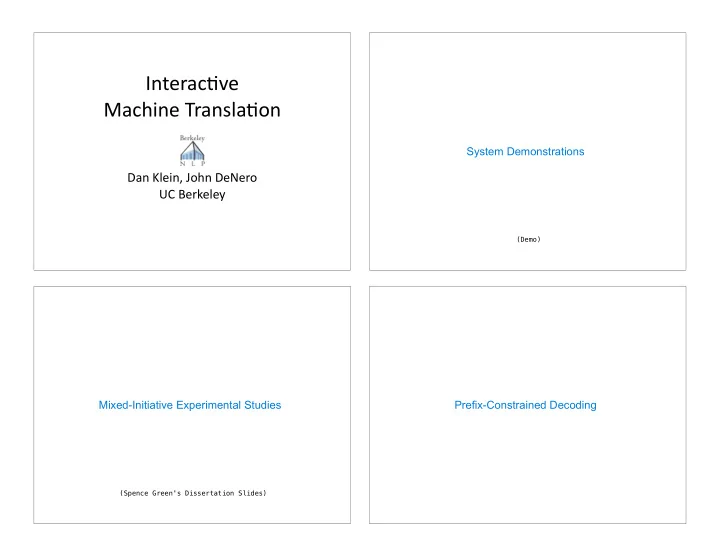
Interac(ve Machine Transla(on
Dan Klein, John DeNero UC Berkeley
System Demonstrations
(Demo)
Mixed-Initiative Experimental Studies
(Spence Green's Dissertation Slides)
Interac(ve Machine Transla(on System Demonstrations Dan Klein, - - PowerPoint PPT Presentation
Interac(ve Machine Transla(on System Demonstrations Dan Klein, John DeNero UC Berkeley (Demo) Mixed-Initiative Experimental Studies Prefix-Constrained Decoding (Spence Green's Dissertation Slides) Prefix Decoding Phrase-Based
(Demo)
(Spence Green's Dissertation Slides)
Prefix Decoding
A user enters a prefix of the translation; the MT system predicts the rest. Yemeni media report that there is traffic chaos in the capital. Once the user has typed: Jemenitische Medien berichten von einem Verkehrschaos The system suggests: in der Hauptstadt. Suggestion is useful when:
Phrase-Based Prefix-Constrained Decoding
Early work [Barrachina et al. 2008; Ortiz-Martínez et al. 2009]: Standard phrase-based beam search, but discard hypotheses that don't match the prefix. Better version [Wuebker et al. 2016]: While aligning the prefix to the source, use one beam per target cardinality. While generating the suffix of the translation, use one beam per source cardinality. Also added:
and suffix (lexical features are more relevant for alignment).
Neural Prefix-Constrained Decoding
State-of-the-art neural MT model from 2015 [Luong et al., 2015]:
trained with SGD.
translation, knowledge distillation, Transformer architecture, subwords, or label smoothing.
(the constrained word).
Prefix Decoding: Phrase-Based vs Neural
En-De autodesk newstest2015 BLEU Next word accuracy BLEU Next word accuracy Phrasal baseline 44.5 37.8 22.4 28.5 Phrasal improved 44.5 46.0 22.4 41.2 NMT 40.6 52.3 23.2 50.4 NMT ensemble 44.3 54.9 26.3 53.0
Wuebker et al., 2016, "Models and Inference for Prefix-Constrained Machine Translation"
Online Fine-Tuning for Model Personalization
After sentence i is translated, take a stochastic gradient descent step with batch size 1 on (xi, yi) [Turchi et al., 2017]. Evaluation via simulated post-editing [Hardt and Elming, 2010]:
E.g., Autodesk corpus results using a small Transformer:
Recall of observed words goes up, but unobserved words goes down [Simianer et al., 2019]:
that also appear in the corresponding hypothesis: 44.9% -> 55.0%
that also appear in the corresponding hypothesis: 39.3% -> 35.8%
Turchi et al., 2017, "Continuous learning from human post-edits for neural machine translation." Simianer et al., 2019, "Measuring Immediate Adaptation Performance for Neural Machine Translation"
Space-Efficient Model Adaptation
Inference for "personalized" (user-adapted) models:
Example production constraint: latency budget of 300ms ⇒ maximum of ~10M parameters for a personalized model Full (small transformer) model in 2019: ~36M parameters Solution:
batch adaptation
# params baseline 33.7 36.2M full model 41.7 39.0 25.8M
38.6 37.9 2.2M inner layers 38.8 37.8 2.7M
36.3 35.7 5.0M
34.2 34.3 5.5M
38.7 37.5 5.5M
Eine Glühstiftkerze (1) dient ...
Embedding lookup Encoder Decoder
<s> A sheathed-element glow plug …
Filter Self-attention Filter Self-attention Filter Self-attention
... ...
4×
10.3M (5.0M) 526K Embedding lookup
Filter Encoder attention Self-attention Filter Encoder attention Self-attention Filter Encoder attention Self-attention
Output projection
A sheathed-element glow plug ...
10.3M (5.5M) 10.3M (5.5M) 788K
# parameters
inner layers
Group Lasso Regularization for Sparse Adaptation
Simultaneous regularization and tensor selection Regularize offsets Wu, define each tensor as one group g for L1/ L2 regularization Total loss: Cut off all tensors g with: Define a group for each hidden layer and each embedding column
en>fr fr>en en>ru ru>en en>zh zh>en Baseline 28.8 35.8 10.7 29.7 19.9 18.9 Full Adaptation 36.6 49.6 21.0 42.1 40.6 46.6 Sparse Adapt. (# params) 36.2 (16.5%) 49.2 (15.9%) 21.2 (16.1%) 42.2 (15.8%) 42.0 (15.6%) 46.5 (15.2%)
Wuebker et al., 2018, "Compact Personalized Models for Neural Machine Translation"
Bottleneck Adapter Modules
Adapter modules:
by a combination of new adapter layers and residual connections.
weights near zero.
all model parameters except the adapter layers.
BERT GLUE
Houlsby et al., 2019, "Parameter-Efficient Transfer Learning for NLP" Bapna & Firat, 2019. "Simple, Scalable Adaptation for Neural Machine Translation"
Word Alignment Applications
Simple terminology-constrained inference:
target translation.
target term to the translation hypothesis. Tag projection:
From Wikipedia: <span><b>Translation</b> is the communication
means of an <a3>equivalent</a3> <a4>target-language</a4> text.<sup><a5>[1]</a5></sup></span> Google Translate: <span><b>Übersetzung</b> ist die Übermittlung der <a1>Bedeutung</a1> eines <a2>quellsprachlichen</a2> Textes mittels eines <a3>äquivalenten</a3> <a4>zielsprachlichen</a4> Textes.<sup><a5>[1]</a5></sup></span>
Alignment by Attention in a Transformer
Encoder Decoder Input Emb. Output Emb. Linear Softmax Word Softmax Linear Linear Linear Attention Linear Word K V Q +
Training/ Testing Training
Frozen Weights
Train alignment attention to predict the next word. Inference: find attention activations that maximize the likelihood of the
Retrain: toward a self- supervised loss that maximizes the likelihood
alignments Ensemble: inference under a bidirectional objective Bias alignment configurations to have adjacent source words aligned to adjacent target words
Zenkel et al., 2020. "End-to-End Neural Word Alignment Outperforms GIZA++"
Insertion Transformer p(c, `|x, ˆ yt) = InsertionTransformer(x, ˆ yt) c ∈ C :a word to be inserted ` ∈ [0, |ˆ yt|] :an insertion location x :Input sequence ˆ yt :A sequence of output words inserted so far
<latexit sha1_base64="QtPfl9T/WoqxENEjExhMezSgh0=">ADHicbVLbhMxFPUMrxJeKSzZXDWiClIVzVRICSkQjd0V6SmrZSJIo9zp7HqsQfbA4km8wFs+BU2LECILR/Ajr/BnoQobFk6ejec46Pr50WghsbRX+C8Nr1Gzdvbdxu3bl7/6D9ubDY6NKzbDPlFD6NKUGBZfYt9wKPC0jwVeJKe7/v+yQfUhit5ZGcFDnN6JnGbWuNoMtou24EhYA5TMHBCbXVrB7Zp7D9ChKLU2tdSANai850lSaTOkcd2dXqAnSYtBwiUkObUTRkW1X7/cXlQ+Kj0GKyCFIE3fjiuvao53QsH0Q7MV47z4bpaLjUuAwi1yN+op2usA1mUFgy+L1EyXJj/s1ujvV5RQGWgSutVPp1ZBQOjIKPaW4zanagXNQugngJOmS5Dkft38lYsTJHaZmgxgziqLDirwTGDdSkqDBWXn9AwHDkqaoxlWzWPW8MRVxuAm7La0FTXFRXNjZnlqWP6MZvLPV/8X29Q2uzFsOJ+Qu7mi4OyUvgH8T8Dxlwjs2LmAGWau6zAJlRTZt3/abkhxJevfBUc7/biqBe/e9bZe7McxwZ5TLZIl8TkOdkjb8kh6RMWfAq+BN+C7+Hn8Gv4I/y5oIbBUvOIXFjhr7/SKPer</latexit><latexit sha1_base64="QtPfl9T/WoqxENEjExhMezSgh0=">ADHicbVLbhMxFPUMrxJeKSzZXDWiClIVzVRICSkQjd0V6SmrZSJIo9zp7HqsQfbA4km8wFs+BU2LECILR/Ajr/BnoQobFk6ejec46Pr50WghsbRX+C8Nr1Gzdvbdxu3bl7/6D9ubDY6NKzbDPlFD6NKUGBZfYt9wKPC0jwVeJKe7/v+yQfUhit5ZGcFDnN6JnGbWuNoMtou24EhYA5TMHBCbXVrB7Zp7D9ChKLU2tdSANai850lSaTOkcd2dXqAnSYtBwiUkObUTRkW1X7/cXlQ+Kj0GKyCFIE3fjiuvao53QsH0Q7MV47z4bpaLjUuAwi1yN+op2usA1mUFgy+L1EyXJj/s1ujvV5RQGWgSutVPp1ZBQOjIKPaW4zanagXNQugngJOmS5Dkft38lYsTJHaZmgxgziqLDirwTGDdSkqDBWXn9AwHDkqaoxlWzWPW8MRVxuAm7La0FTXFRXNjZnlqWP6MZvLPV/8X29Q2uzFsOJ+Qu7mi4OyUvgH8T8Dxlwjs2LmAGWau6zAJlRTZt3/abkhxJevfBUc7/biqBe/e9bZe7McxwZ5TLZIl8TkOdkjb8kh6RMWfAq+BN+C7+Hn8Gv4I/y5oIbBUvOIXFjhr7/SKPer</latexit><latexit sha1_base64="QtPfl9T/WoqxENEjExhMezSgh0=">ADHicbVLbhMxFPUMrxJeKSzZXDWiClIVzVRICSkQjd0V6SmrZSJIo9zp7HqsQfbA4km8wFs+BU2LECILR/Ajr/BnoQobFk6ejec46Pr50WghsbRX+C8Nr1Gzdvbdxu3bl7/6D9ubDY6NKzbDPlFD6NKUGBZfYt9wKPC0jwVeJKe7/v+yQfUhit5ZGcFDnN6JnGbWuNoMtou24EhYA5TMHBCbXVrB7Zp7D9ChKLU2tdSANai850lSaTOkcd2dXqAnSYtBwiUkObUTRkW1X7/cXlQ+Kj0GKyCFIE3fjiuvao53QsH0Q7MV47z4bpaLjUuAwi1yN+op2usA1mUFgy+L1EyXJj/s1ujvV5RQGWgSutVPp1ZBQOjIKPaW4zanagXNQugngJOmS5Dkft38lYsTJHaZmgxgziqLDirwTGDdSkqDBWXn9AwHDkqaoxlWzWPW8MRVxuAm7La0FTXFRXNjZnlqWP6MZvLPV/8X29Q2uzFsOJ+Qu7mi4OyUvgH8T8Dxlwjs2LmAGWau6zAJlRTZt3/abkhxJevfBUc7/biqBe/e9bZe7McxwZ5TLZIl8TkOdkjb8kh6RMWfAq+BN+C7+Hn8Gv4I/y5oIbBUvOIXFjhr7/SKPer</latexit><latexit sha1_base64="QtPfl9T/WoqxENEjExhMezSgh0=">ADHicbVLbhMxFPUMrxJeKSzZXDWiClIVzVRICSkQjd0V6SmrZSJIo9zp7HqsQfbA4km8wFs+BU2LECILR/Ajr/BnoQobFk6ejec46Pr50WghsbRX+C8Nr1Gzdvbdxu3bl7/6D9ubDY6NKzbDPlFD6NKUGBZfYt9wKPC0jwVeJKe7/v+yQfUhit5ZGcFDnN6JnGbWuNoMtou24EhYA5TMHBCbXVrB7Zp7D9ChKLU2tdSANai850lSaTOkcd2dXqAnSYtBwiUkObUTRkW1X7/cXlQ+Kj0GKyCFIE3fjiuvao53QsH0Q7MV47z4bpaLjUuAwi1yN+op2usA1mUFgy+L1EyXJj/s1ujvV5RQGWgSutVPp1ZBQOjIKPaW4zanagXNQugngJOmS5Dkft38lYsTJHaZmgxgziqLDirwTGDdSkqDBWXn9AwHDkqaoxlWzWPW8MRVxuAm7La0FTXFRXNjZnlqWP6MZvLPV/8X29Q2uzFsOJ+Qu7mi4OyUvgH8T8Dxlwjs2LmAGWau6zAJlRTZt3/abkhxJevfBUc7/biqBe/e9bZe7McxwZ5TLZIl8TkOdkjb8kh6RMWfAq+BN+C7+Hn8Gv4I/y5oIbBUvOIXFjhr7/SKPer</latexit>How can a translation model make suggestions about mid-sentence edits?
Stern et al., 2019. "Insertion Transformer: Flexible Sequence Generation via Insertion Operations"
Reformer
Should document context be incorporated through learning or inference? With some optimizations, a 64k-length sequence can be encoded on a GPU.
Kitaev et al., 2020. "Reformer: The Efficient Transformer"