
SLIDE 1
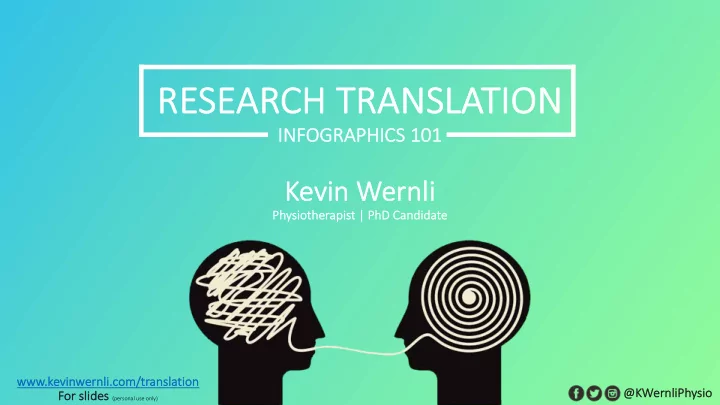
RESEARCH TRANSLA LATION
Ke Kevin Wernli
Ph Physiother erapist | Ph PhD Candidate @K @KWernliPhysio www www.kevinwern rnli.com/translation Fo For slides (personal use only)
RESEARCH TRANSLA LATION INFOGRAPHIC IN HICS 101 101 Kevin - - PowerPoint PPT Presentation
RESEARCH TRANSLA LATION INFOGRAPHIC IN HICS 101 101 Kevin Wernli Ke Physiother Ph erapist | Ph PhD Candidate www www.kevinwern rnli.com/translation @K @KWernliPhysio Fo For slides (personal use only) WHY HOW OUTLINE SUMMARY
Ph Physiother erapist | Ph PhD Candidate @K @KWernliPhysio www www.kevinwern rnli.com/translation Fo For slides (personal use only)
Why do you want to translate research?
(Jacobs et al. 2017)
Tweets with a visual abstract
(Morris et al. 2011)(Ibrahim et al. 2017)
TEXT ONLY = ~10% retention TEXT + IMAGE =
retention
BARRIERS
KNOWLEDGE
(17 years behind research)
EASY FREE LESS CONTROL HARD $$$ FULL CONTROL
(Arcia et al. 2015)
Identify key message(s) Draft outline on paper Use graphics software (e.g. PowerPoint) Colour scheme https://coolors.co SHAPES REMOVE BACKGROUND/ CROP ICONS EXPORT IMAGE SOURCES 30mins
Colour scheme https://coolors.co SHAPES REMOVE BACKGROUND/ CROP ICONS EXPORT IMAGE SOURCES
ALIGN and DISTRUBUTE (shape format>align) Keyboard shortcuts: CMD (CTRL) + alt CMD (CTRL) + alt + shift Content amount: Minimal à More detailed “Copy Image” Quicker than save and insert Reference study “Summary Only” statement Destination (FB, IG, Twitter etc) preferred dimensions
We should adapt to current trends to put health information where people seek it Infographics lead to more engagement
>?more citations/grants/traditional media stories
Consumers prefer infographics to traditional text
(Buljan et al. 2018)
It’s easier than you may think (and fun) We are already seeing an increased request for infographics/graphical abstracts
tiny.cc/KWtranslation
Or go to: (case sensitive) Complete the ~1min feedback to get access to slides
Use phone camera to scan
REFERENCES
Wura Jacobs, Ann O. Amuta & Kwon Chan Jeon | Claudia Alvares (Reviewing Editor) (2017) Health information seeking in the digital age: An analysis of health information seeking behavior among US adults, Cogent Social Sciences, 3:1, DOI: 10.1080/23311886.2017.1302785 Morris, Z. S., Wooding, S., & Grant, J. (2011). The answer is 17 years, what is the question: understanding time lags in translational research. Journal of the Royal Society of Medicine, 104(12), 510-520. doi:10.1258/jrsm.2011.110180 Ibrahim, A. M., Lillemoe, K. D., Klingensmith, M. E., & Dimick, J. B. (2017). Visual Abstracts to Disseminate Research on Social Media: A Prospective, Case- control Crossover Study. Annals of Surgery, 266(6), e46-e48. doi:10.1097/sla.0000000000002277 Arcia, A., Suero-Tejeda, N., Bales, M. E., Merrill, J. A., Yoon, S., Woollen, J., & Bakken, S. (2015). Sometimes more is more: iterative participatory design of infographics for engagement of community members with varying levels of health literacy. Journal of the American Medical Informatics Association, 23(1), 174-183. doi:10.1093/jamia/ocv079 Buljan, I., Malički, M., Wager, E., Puljak, L., Hren, D., Kellie, F., . . . Marušić, A. (2018). No difference in knowledge obtained from infographic or plain language summary of a Cochrane systematic review: three randomized controlled trials. Journal of Clinical Epidemiology, 97, 86-94. doi:10.1016/j.jclinepi.2017.12.003