Interac(onal Competence in Local and Global Contexts - - PDF document

interac onal competence in local and global contexts
SMART_READER_LITE
LIVE PREVIEW

Interac(onal Competence in Local and Global Contexts - - PDF document

CULI Na(onal Seminar 2012 November 19-20, 2012 Interac(onal Competence in Local and Global Contexts Richard F. Young Interac(onal Competence in Language


slide-1
SLIDE 1

CULI ¡Na(onal ¡Seminar ¡2012 ¡ November ¡19-­‑20, ¡2012 ¡ 1 ¡

Interac(onal ¡Competence ¡ in ¡Local ¡and ¡Global ¡Contexts ¡

Richard ¡F. ¡Young ¡

WHAT ¡IS ¡INTERACTIONAL ¡ COMPETENCE? ¡

Interac(onal ¡Competence ¡in ¡Language ¡Learning ¡and ¡Teaching ¡

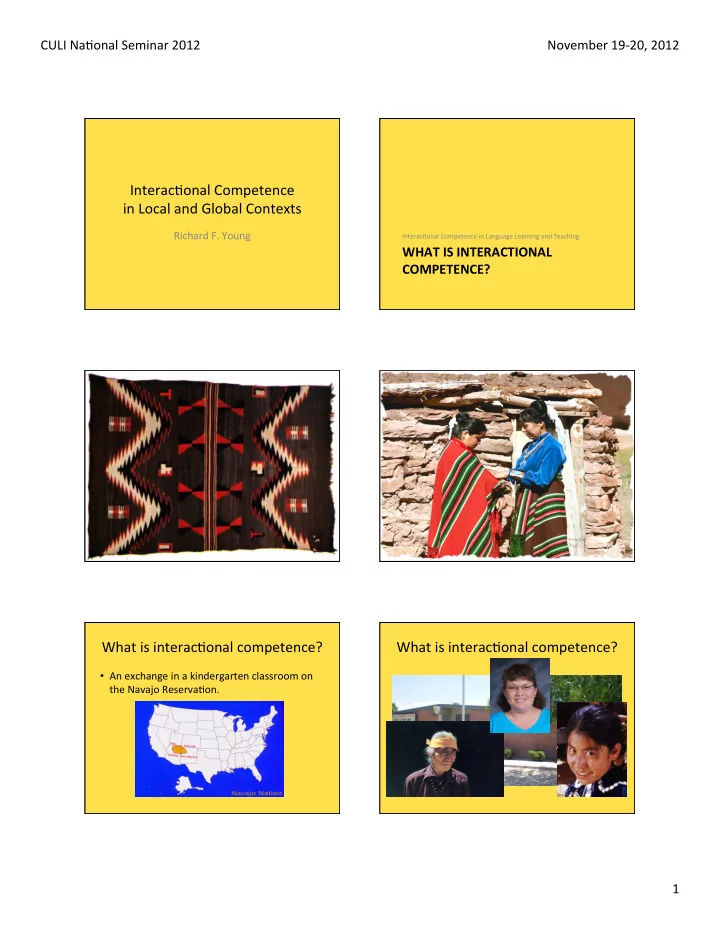
What ¡is ¡interac(onal ¡competence? ¡

  • An ¡exchange ¡in ¡a ¡kindergarten ¡classroom ¡on ¡

the ¡Navajo ¡Reserva(on. ¡

What ¡is ¡interac(onal ¡competence? ¡

slide-2
SLIDE 2

CULI ¡Na(onal ¡Seminar ¡2012 ¡ November ¡19-­‑20, ¡2012 ¡ 2 ¡

What ¡is ¡interac(onal ¡competence? ¡

  • A ¡Navajo ¡man ¡opened ¡the ¡door ¡to ¡the ¡

classroom ¡and ¡stood ¡silently, ¡looking ¡at ¡the ¡

  • floor. ¡The ¡Anglo-­‑American ¡teacher ¡said ¡‘Good ¡

morning’ ¡and ¡waited ¡expectantly, ¡but ¡the ¡man ¡ did ¡not ¡respond. ¡The ¡teacher ¡then ¡said ¡‘My ¡ name ¡is ¡Mrs. ¡Jones’, ¡and ¡again ¡waited ¡for ¡a ¡

  • response. ¡There ¡was ¡none. ¡

What ¡is ¡interac(onal ¡competence? ¡

  • In ¡the ¡mean(me, ¡a ¡child ¡in ¡the ¡room ¡put ¡away ¡

his ¡crayons ¡and ¡got ¡his ¡coat ¡from ¡the ¡rack. ¡The ¡ teacher, ¡no(ng ¡this, ¡said ¡to ¡the ¡man, ¡‘Oh, ¡are ¡ you ¡taking ¡Billy ¡now?’ ¡He ¡said, ¡‘Yes.’ ¡

What ¡is ¡interac(onal ¡competence? ¡

  • The ¡teacher ¡con(nued ¡to ¡talk ¡to ¡the ¡man ¡

while ¡Billy ¡got ¡ready ¡to ¡leave, ¡saying ¡‘Billy ¡is ¡ such ¡a ¡good ¡boy’, ¡‘I’m ¡so ¡happy ¡to ¡have ¡him ¡in ¡ class’, ¡etc. ¡

What ¡is ¡interac(onal ¡competence? ¡

  • Billy ¡walked ¡towards ¡the ¡man ¡(his ¡father), ¡

stopping ¡to ¡turn ¡around ¡and ¡wave ¡at ¡the ¡ teacher ¡on ¡his ¡way ¡out ¡and ¡saying, ¡‘Bye-­‑bye.’ ¡ The ¡teacher ¡responded, ¡‘Bye-­‑bye.’ ¡The ¡man ¡ remained ¡silent ¡as ¡he ¡leZ. ¡

WHAT ¡IS ¡‘COMPETENCE’? ¡

Interac(onal ¡Competence ¡in ¡Language ¡Learning ¡and ¡Teaching ¡

What ¡is ¡‘competence’? ¡

  • Noam ¡Chomsky ¡

dis(nguished ¡between ¡a ¡ speaker’s ¡knowledge ¡of ¡ language ¡in ¡the ¡abstract ¡ (competence) ¡and ¡the ¡ way ¡in ¡which ¡that ¡ knowledge ¡is ¡realized ¡in ¡ the ¡produc(on ¡and ¡ interpreta(on ¡of ¡actual ¡ u\erances ¡ (performance). ¡

slide-3
SLIDE 3

CULI ¡Na(onal ¡Seminar ¡2012 ¡ November ¡19-­‑20, ¡2012 ¡ 3 ¡

What ¡is ¡‘competence’? ¡

  • Dell ¡Hymes ¡rejected ¡

Chomsky’s ¡dichotomy ¡ between ¡competence ¡and ¡

  • performance. ¡He ¡argued ¡

that ¡using ¡language ¡in ¡ social ¡situa(ons ¡required ¡ as ¡much ¡knowledge ¡and ¡ skill ¡as ¡knowledge ¡of ¡ language ¡as ¡an ¡idealized ¡ system: ¡“There ¡are ¡rules ¡

  • f ¡use ¡without ¡which ¡the ¡

rules ¡of ¡grammar ¡are ¡ useless.” ¡

What ¡is ¡‘competence’? ¡

  • In ¡an ¡individual’s ¡communicaGve ¡

competence, ¡Michael ¡Canale ¡and ¡Merrill ¡ Swain ¡included ¡… ¡ – Linguis(c ¡competence ¡ – Discourse ¡competence ¡ – Pragma(c ¡competence ¡ – Strategic ¡competence ¡

What ¡is ¡interac(onal ¡competence? ¡

  • Seven ¡resources ¡that ¡par(cipants ¡bring ¡to ¡

interac(on ¡… ¡

– Par(cipa(on ¡framework ¡ – Register ¡ – Modes ¡of ¡meaning ¡ – Speech ¡acts ¡ – Turn-­‑taking ¡ – Repair ¡ – Boundaries ¡

Par(cipa(on ¡framework ¡

  • The ¡iden((es ¡of ¡all ¡par(cipants ¡in ¡an ¡

interac(on, ¡present ¡or ¡not, ¡official ¡or ¡ unofficial, ¡ra(fied ¡or ¡unra(fied, ¡and ¡their ¡ foo(ng ¡or ¡iden((es ¡in ¡the ¡interac(on ¡

Register ¡

  • The ¡features ¡of ¡pronuncia(on, ¡vocabulary, ¡

and ¡grammar ¡that ¡typify ¡a ¡prac(ce ¡

Modes ¡of ¡meaning ¡

  • The ¡ways ¡in ¡which ¡par(cipants ¡construct ¡

interpersonal, ¡experien(al, ¡and ¡textual ¡ meanings ¡in ¡a ¡prac(ce ¡ ¡

slide-4
SLIDE 4

CULI ¡Na(onal ¡Seminar ¡2012 ¡ November ¡19-­‑20, ¡2012 ¡ 4 ¡

Speech ¡acts ¡

  • The ¡selec(on ¡of ¡acts ¡in ¡a ¡prac(ce ¡and ¡their ¡

sequen(al ¡organiza(on ¡

Turn-­‑taking ¡

  • How ¡par(cipants ¡select ¡the ¡next ¡speaker ¡and ¡

how ¡par(cipants ¡know ¡when ¡to ¡end ¡one ¡turn ¡ and ¡when ¡to ¡begin ¡the ¡next ¡

Repair ¡

  • The ¡ways ¡in ¡which ¡par(cipants ¡respond ¡to ¡

interac(onal ¡trouble ¡in ¡a ¡given ¡prac(ce ¡

Boundaries ¡

  • The ¡opening ¡and ¡closing ¡acts ¡of ¡a ¡prac(ce ¡that ¡

serve ¡to ¡dis(nguish ¡a ¡given ¡prac(ce ¡from ¡ adjacent ¡talk ¡

INTERSUBJECTIVITY ¡

Interac(onal ¡Competence ¡in ¡Language ¡Learning ¡and ¡Teaching ¡

Intersubjec(vity ¡

  • Claire ¡Kramsch ¡

recognized ¡that ¡ interac(onal ¡competence ¡ presupposes ¡“a ¡shared ¡ internal ¡context ¡or ¡ ‘sphere ¡of ¡inter-­‑ subjecGvity’” ¡and ¡this ¡ view ¡is ¡what ¡most ¡clearly ¡ dis(nguishes ¡IC ¡from ¡ previous ¡theories ¡of ¡

  • competence. ¡
slide-5
SLIDE 5

CULI ¡Na(onal ¡Seminar ¡2012 ¡ November ¡19-­‑20, ¡2012 ¡ 5 ¡

Intersubjec(vity ¡

  • Intersubjec(vity ¡in ¡communica(on ¡requires ¡

that ¡… ¡

– The ¡receiver ¡should ¡come ¡to ¡a\end ¡to ¡the ¡ situa(on ¡as ¡intended ¡by ¡the ¡sender. ¡ – The ¡sender ¡should ¡know ¡that ¡the ¡receiver ¡is ¡so ¡

  • doing. ¡

– The ¡receiver ¡should ¡know ¡that ¡the ¡sender ¡knows ¡ that ¡this ¡is ¡the ¡case. ¡

Intersubjec(vity ¡

THE ¡DEVELOPMENT ¡OF ¡ INTERACTIONAL ¡COMPETENCE ¡

Interac(onal ¡Competence ¡in ¡Language ¡Learning ¡and ¡Teaching ¡

Studies ¡of ¡the ¡development ¡of ¡ interac(onal ¡competence ¡through ¡… ¡

  • Co-­‑construc(on ¡of ¡a ¡repe((ve ¡prac(ce ¡
  • Study ¡abroad ¡
  • Mul(-­‑party ¡interac(on ¡at ¡school ¡
  • Co-­‑construc(on ¡of ¡social ¡iden(ty ¡by ¡novice ¡

pharmacists ¡

Co-­‑construc(on ¡of ¡a ¡repe((ve ¡ prac(ce ¡

Study ¡abroad ¡

slide-6
SLIDE 6

CULI ¡Na(onal ¡Seminar ¡2012 ¡ November ¡19-­‑20, ¡2012 ¡ 6 ¡

Mul(-­‑party ¡interac(on ¡at ¡school ¡

Co-­‑construc(on ¡of ¡social ¡iden(ty ¡by ¡ novice ¡pharmacists ¡ TEACHING ¡ INTERACTIONAL ¡COMPETENCE ¡

Interac(onal ¡Competence ¡in ¡Language ¡Learning ¡and ¡Teaching ¡

Teaching ¡interac(onal ¡competence ¡

By ¡standing ¡outside ¡of ¡interac(ve ¡ prac(ces ¡that ¡are ¡of ¡significance ¡to ¡ the ¡group(s) ¡whose ¡language ¡is ¡being ¡ learned, ¡and ¡analyzing ¡the ¡ conven(onal ¡ways ¡that ¡verbal ¡ resources ¡get ¡used, ¡the ¡movement ¡ that ¡occurs ¡between ¡their ¡ conven(onal ¡meanings ¡and ¡their ¡ individual ¡uses, ¡and ¡the ¡ consequences ¡that ¡are ¡engendered ¡ by ¡the ¡various ¡uses, ¡we ¡can ¡develop ¡ a ¡far ¡greater ¡understanding ¡both ¡of ¡

  • urselves ¡and ¡of ¡those ¡in ¡whose ¡

prac(ces ¡we ¡aspire ¡to ¡become ¡ par(cipants. ¡

Joan ¡Kelly ¡Hall ¡

For ¡developing ¡interac(onal ¡ competence, ¡spending ¡(me ¡in ¡ the ¡target ¡community ¡is ¡no ¡ panacea, ¡length ¡of ¡residence ¡is ¡ not ¡a ¡reliable ¡predictor, ¡and ¡L2 ¡ classrooms ¡can ¡be ¡a ¡produc(ve ¡ social ¡context. ¡In ¡other ¡words, ¡ exposure ¡alone ¡to ¡discursive ¡ prac(ce ¡in ¡a ¡second ¡language ¡ community ¡is ¡not ¡an ¡efficient ¡ instruc(onal ¡strategy, ¡no ¡ma\er ¡ how ¡long ¡or ¡how ¡intense ¡the ¡

  • exposure. ¡

Teaching ¡interac(onal ¡competence ¡

Gabriele ¡Kasper ¡ Kenneth ¡Rose ¡

Teaching ¡interac(onal ¡competence ¡

Students ¡acquire ¡a ¡general ¡method ¡ to ¡construct ¡a ¡concrete ¡orienta(on ¡ basis ¡to ¡solve ¡any ¡specific ¡problem ¡in ¡ a ¡given ¡subject ¡domain. ¡Such ¡a ¡ general ¡method ¡involves ¡a ¡ theore(cal ¡analysis ¡of ¡objects, ¡ phenomena, ¡or ¡events ¡in ¡various ¡ subject ¡domains. ¡The ¡main ¡feature ¡of ¡ the ¡analysis ¡is ¡that ¡it ¡reveals ¡the ¡ ‘genesis’ ¡and ¡the ¡general ¡structure ¡of ¡

  • bjects ¡or ¡phenomena ¡(the ¡general ¡

make-­‑up ¡of ¡things). ¡In ¡such ¡analysis, ¡ students ¡learn ¡to ¡dis(nguish ¡ essen(al ¡characteris(cs ¡of ¡different ¡

  • bjects ¡and ¡phenomena, ¡to ¡form ¡

theore(cal ¡concepts ¡on ¡this ¡basis, ¡ and ¡use ¡them ¡as ¡cogni(ve ¡tools ¡in ¡ further ¡problem ¡solving. ¡

Гальперин ¡П.Я. ¡
slide-7
SLIDE 7

CULI ¡Na(onal ¡Seminar ¡2012 ¡ November ¡19-­‑20, ¡2012 ¡ 7 ¡ WHAT ¡IS ¡INTERACTIONAL ¡ COMPETENCE? ¡

Interac(onal ¡Competence ¡in ¡Language ¡Learning ¡and ¡Teaching ¡

What ¡is ¡interac(onal ¡competence? ¡

  • 1. Interac(onal ¡competence ¡has ¡been ¡studied ¡in ¡spoken ¡

interac(on, ¡although ¡nonverbal ¡aspects ¡of ¡spoken ¡ interac(on ¡are ¡seen ¡as ¡important. ¡

  • 2. The ¡pragma(cs ¡of ¡interac(on—the ¡rela(onships ¡between ¡

the ¡forms ¡of ¡talk ¡chosen ¡by ¡par(cipants ¡and ¡the ¡social ¡ contexts ¡in ¡which ¡they ¡are ¡used—are ¡fundamental ¡to ¡ interac(onal ¡competence. ¡

  • 3. Interac(onal ¡competence ¡is ¡the ¡construc(on ¡of ¡a ¡shared ¡

mental ¡context ¡through ¡the ¡collabora(on ¡of ¡all ¡ interac(onal ¡partners. ¡

  • 4. The ¡context ¡of ¡an ¡interac(on ¡includes ¡the ¡social, ¡

ins(tu(onal, ¡poli(cal, ¡and ¡historical ¡circumstances ¡that ¡ extend ¡beyond ¡the ¡horizon ¡of ¡a ¡single ¡interac(on. ¡

What ¡is ¡interac(onal ¡competence? ¡ Read ¡all ¡about ¡it! ¡

  • Young, ¡R. ¡F. ¡(2011). ¡

Interac(onal ¡ competence ¡in ¡ language ¡learning, ¡ teaching, ¡and ¡tes(ng. ¡In ¡

  • E. ¡Hinkel ¡(Ed.), ¡

Handbook ¡of ¡research ¡in ¡ second ¡language ¡ teaching ¡and ¡learning ¡ (2nd ¡ed.). ¡London ¡& ¡ New ¡York: ¡Routledge. ¡

Thank ¡you ¡