
SLIDE 1
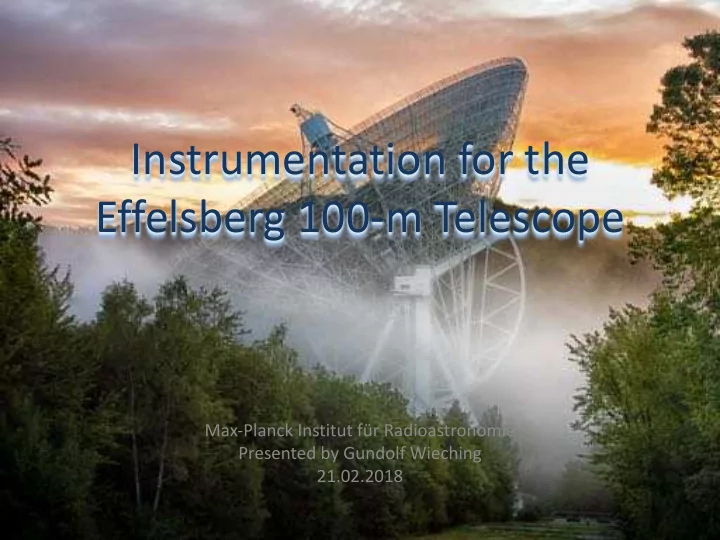
Instrumentation for the Effelsberg 100-m Telescope
Max-Planck Institut für Radioastronomie Presented by Gundolf Wieching 21.02.2018
Instrumentation for the Effelsberg 100-m Telescope Max-Planck - - PowerPoint PPT Presentation
Instrumentation for the Effelsberg 100-m Telescope Max-Planck Institut fr Radioastronomie Presented by Gundolf Wieching 21.02.2018 100 m Effelsberg Telescope Inauguration: May 12, 1971 Regular operations started on August 1, 1972
Max-Planck Institut für Radioastronomie Presented by Gundolf Wieching 21.02.2018
– Regular operations started on August 1, 1972
– 9’ @ 1.4 GHz – 10” @ 86 GHz, pointing accuracy ~2-3”
– continuum, – spectroscopy, – pulsars & transients, – VLBI (European, global, mm)
06.09.2016 TVN 2016
Receiver Abbr. RF start GHz RF stop GHz RF-BW GHz IF-BW GHz Channels
beams Installation date
50cm P500 0,3 0,9 0,6 0,6 LCP/RCP 1 2011 PAF 0,7 1,7 0,4 0,3 H/V 37 2017 30cm (UHF) P300 0,8 1,3 0,5 0,1 LCP/RCP 1 1999 L-Band 7 Beam P217 1,3 1,6 0,3 0,3 LCP/RCP 7 2005 18/21cm P200 1,3 1,8 0,5 0,1 LCP/RCP 7 2006 UBB P170 0,6 3 2,4 2,4 H/V 1 2012 13cm S130 2,2 2,3 0,1 0,1 LCP 1 2004 11cm S110 2,6 2,7 0,1 0,1 LCP/RCP 1 2002 9cm P90 2,9 3,6 0,7 0,1 LCP 1 1985 6cm S60 4,6 5,1 0,5 0,5 LCP/RCP 2 1995 5cm P50 5,8 6,8 1 0,5 LCP/RCP 1 2003 C+-Band S45 4 9,3 7,3 4 H/V 1 (2*) 2014 3.6cm S36 8 9,2 1,2 0,5 LCP/RCP 1 2004 2.8cm S28 10,3 10,6 0,3 0,1 LCP/RCP 2 1980 2.2cm P22 12,1 13,6 1,5 0,1 LCP/RCP 1 1990 Ku-Band* 12 18 6 6 LCP/RCP 2 2017* 2cm S20 14 16 2 0,5 LCP/RCP 1 1998 1.9cm P19 13,5 18,7 5,2 0,5 H 1 2000 K-Band S14 18 26,5 8,5 8,5 H/V 2 2013 1cm P10 27 38,7 11,7 2 H 1 1996 9mm S9 30 34 4 LCP/RCP/H/V 7 2008 Q-Band* 33 50 17 4 LCP/RCP 2017* 7mm S7 41,6 44,4 2,8 0,5 RCP 1 1998 3mm P3 84 96 12 2 LCP/RCP 1 1999
0,1 1 10 100
50cm PAF* 30cm (UHF) L-Band 7 Beam 18/21cm UBB 13cm 11cm 9cm 6cm 5cm C+-Band 3.6cm 2.8cm 2.2cm Ku-Band* 2cm 1.9cm K-Band 1cm 9mm Q-Band* 7mm 3mm
RF Frequency in GHz
Primary Focus
Designed for Pulsar observations
600 800 1000 1200 1400 1600 0.4 0.6 0.8 1 1.2 1.4 1.6 1.8 2 frequency (MHz) time (sec) L-BAND L-BAND
PSR$B1933+16$
credit to Paulo Freire
– Mode I: LCP, RCP at two feeds 8 x 2.5GHz res: 45KHz – Mode II: LCP at one feed 28 x 300 MHz, res: 5.4 kHz – 4 GHz VLBI IF
K-Band IF modules K-Band synthesizer
Sensitivity: Trec < 20K TSys < 55K (weather dominated)
Design Specifications RF frequency range 4.0 - 8.0 GHz 5.3 - 9.3 GHz number of feeds 1 (final implementation: 2) polarization linear polarisation, cross-polar. < -20 dB system sensitivity Trec: <20 K full band IFspectroscopic 4 x 2.5 GHz, res: 44.3 kHz (1.6 km/s @ 8 GHz) zoom IFspectroscopic 4 x 300 GHz, res: 5.3 kHz (0.29 km/s @ 8 GHz) IFgeneric/VLBI 2 x 0 – 4.0 GHz calibration source noise source, line source
Design Specifications RF frequency range 38 - 50 GHz feeds Dual cryogenic horn Polarization Circual polarisation cross-polar. < -20 dB System sensitivity Trec: < 45 K Full band IFspectroscopic 8 x 2.5 GHz, res: 44.3 kHz IFgeneric/VLBI 4 x 4.0 GH Calibration source noise source, line source
, instantaneous bandwidth 4x 4GHz ( 4 channels ) spectrometers possible
Design Specifications RF frequency range 12.0 - 18.0 GHz number of feeds 2 corrugates horns polarization 2 x circular polarized (cross-pol. <-20dB) system sensitivity Trec: 20K full band IFspectroscopic 12 x 2.5GHz, res: 44.3kHz IFgeneric/VLBI 2 x 4.0GHz calibration source noise source, line source
(94 per polarization)
Xinping Deng et. al. IAU 2017
Band ASKAP (MHz) MPIfR (MHz 1 700-1200 700-1200 2 840-1440 1200-1480 3 1400-1800 1340-1740 4 600-700 600-700
beams
– increases the survey capability of big single dish telescopes such as Effelsberg
– accessing “lost” frequencies
– increasing the survey capabilities – reducing the impact of the increased RFI emission – introducing new generic design for various RF frequencies
Project B2: Development of cryogenic PAFs
– direct sampling, low power ADCs – development of cryoPAF design – assessment and implementation of requirements as variations for individual the telescopes e.g. for Effelsberg, FAST, QTT – design of low-loss transitions between antenna and LNAs – design, fabrication and measurements of a small-scale prototype of the integrated passive front-end unit – multifunctional cryogenic On-Chip Integration of e.g. LNA, RF-switches, broadband amplifier, phase shifter – ryogenic cooling and mounting concept for e.g. of Antennas, LNAs, Windows, IR filters etc. – digital beam forming concepts, simulation and implementations – evaluation on efficient RFI mitigation algorithms
– receiver control and monitor system – time distribution – RF over fibre system – IF switching system – Total Power Backend
: InteRCoM 19‘‘
Receiver OMT ADC0 ADC1 FPGA Stokes Parameter computation 10GbE Server IF channel IF channel I,Q,U,V I,Q,U,V
Specpol
Blank/Sync signal
Ea Eb
Fits writer Server
!"#$% ⟸ '( ) + '+ ) ⟹ !"-$.- /"#$% ⟸ '( ) − '+ ) ⟹ 1
"-$.-
2"#$% ⟸ 245 '('+
∗
⟹ /"-$.- 1
"#$%
⟸ −2!7 '('+
∗
⟹ 2"-$.-
– increase of sensitivity – increase stability – increase number of pixels/FOV coverage – increase bandwidth(?)
– increase of dynamic range – RFI mitigation technics
– reduction of receiver system – use of COTS components, e.g. networking, computing
OMT Hybrid Dewar IF Processor Optical Transmitter Optial Receiver IF Processor
Pulsar (incl. ADC) VLBI (incl. ADC) Polarimetry Frontend IF System Backend
OMT Hybrid Dewar IF Processor Optical Transmitter Optial Receiver IF Processor
Pulsar (incl. ADC) VLBI (incl. ADC) Polarimetry Frontend IF System Backend
OMT Dewar ADC Ethernet Switch Spec. Pulsar VLBI Polarimetry Frontend Digitizer Backend FPGA IF Converter
Ø reduced analogue parts Ø digital interfaces Ø higher () stability Ø expandable Ø industrial standard Ø reduced cost (capital and operational) Ø increased flexibility
11.01.2017 Lunch Talk MPIfR
Frontend Specifications Number of Rx 2 prototypes (spare) 64 production Rx Bandwidth 1.75 - 3.50 GHz Digitizer Bandwidth 1.75 - 3.50 GHz (12 bit) Backend Interface 40 GB Ethernet, SPEAD protocol Sensitivity Tsys < 25 K Stability spectroscopic Allan time(1 MHz Bandwidth) > 1000 sec. Polarisation H and V polarisation, cross coupling < 20 dB System Setup cryogenic Dipole and LNA @ 15 Kelvin GM cooler baseband digitizing @ receiver Additional Requirements highly reliability maintainability weight limit 65kg integration in MeerKAT infrastructure and maintenance plan Operating temperature 0 - 40DegC full-fill MeerKAT RFI requirements
Beamformer 32-nodes 2x Titan X (pascal) 2x 40 GbE NIC 512 GB RAM
Antenna data
FRB Search 66-nodes 2x Titan X (pascal) Pulsar Search 50-nodes 2x Titan X (pascal) 2.2 PB storage
credit E. Barr
– Q-Band Receiver (33-50GHz) – Ku-Band Receiver (12-18 GHz) – UBB Upgrade (1.3-2.6 GHz) – Ka-Band Receiver (26.5-40GHz) – BRoad-bAND EVN (Brand) Receiver (1.5-15 GHz) – Cryogenic PAF (high S-Band? tbc) – Generic Backend incl. direct digitization
– workshop "Science with the MPIfR-MT SKA Prototype Telescope“, 16th of April 2018