with the Effelsberg telescope Elly M. Berkhuijsen & Rainer Beck - - PowerPoint PPT Presentation

with the effelsberg telescope
SMART_READER_LITE
LIVE PREVIEW

with the Effelsberg telescope Elly M. Berkhuijsen & Rainer Beck - - PowerPoint PPT Presentation

45.5 years of M31 observations with the Effelsberg telescope Elly M. Berkhuijsen & Rainer Beck Philip Hoernes, Christoph Nieten, Rene Giebel, David Mulcahy (former PhD students) Andrew Fletcher (University of Newcastle) M31 HI


slide-1
SLIDE 1

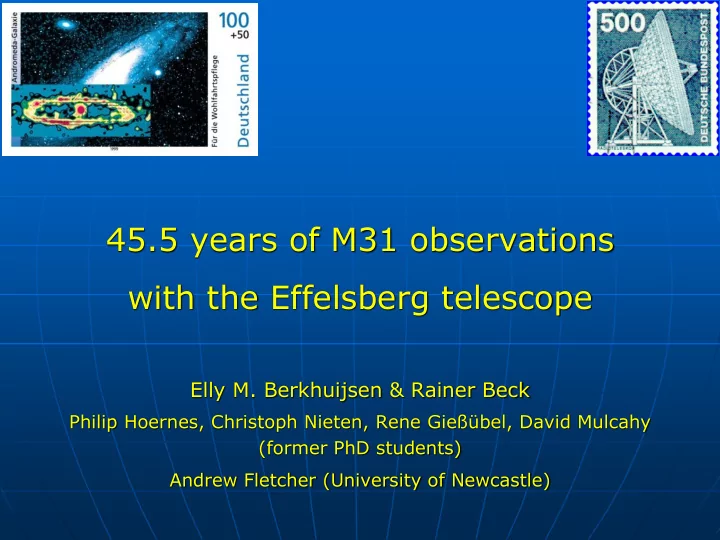
45.5 years of M31 observations with the Effelsberg telescope

Elly M. Berkhuijsen & Rainer Beck

Philip Hoernes, Christoph Nieten, Rene Gießübel, David Mulcahy (former PhD students) Andrew Fletcher (University of Newcastle)
slide-2
SLIDE 2

M31

HI

Westerbork

Braun et al. 2009

slide-3
SLIDE 3

Why M31?

Largest spiral galaxy on sky (2o – 6o)

Good spatial resolution achievable with the Effelsberg 100-m telescope

High declination allows long observation sessions

Best-studied spiral galaxy

Exceptionally regular magnetic field structure

Prototype of a dynamo-generated magnetic field

M31 will determine the fate of the Milky Way

slide-4
SLIDE 4

First radio "image" of M31

158.5 MHz Jodrell Bank

(Hanbury Brown & Hazard 1951)

slide-5
SLIDE 5

Most radio continuum surveys of M31 were made with the Effelsberg 100-m telescope

slide-6
SLIDE 6

First scan measurements in Effelsberg at 11.1 cm

(Berkhuijsen & Wielebinski 1973)

slide-7
SLIDE 7

First radio maps from Effelsberg at 11.1 cm and 6.2 cm

(Berkhuijsen et al. 1977 & 1983)

Background sources subtracted

slide-8
SLIDE 8

IAU Symposium No.77

1977 Aug. 22-26 Bad Münstereifel

slide-9
SLIDE 9

First detection of polarized radio emission in M31

Effelsberg 11.1 cm (4.5’ or 1.0 kpc resolution)

Rainer Beck, PhD Thesis 1979 Up to 45% polarized

slide-10
SLIDE 10

First detection of polarized radio emission in M31

Effelsberg 11.1 cm

Beck et al. 1978, 1980

slide-11
SLIDE 11

First painting M31 in colour

at Landesmuseum Bonn

slide-12
SLIDE 12

Public attraction

Sky & Telescope

slide-13
SLIDE 13

The whole galaxy in one run: New broad-band receiver at 6.2 cm

Total intensity + B-vectors

(corrected for Faraday rotation in the Milky Way foreground) Philip Hoernes, PhD 1996

Background sources subtracted

slide-14
SLIDE 14
slide-15
SLIDE 15

Circulation: 6.15 million !

slide-16
SLIDE 16

Combined efforts: VLA + Effelsberg 20.1 cm

(resolution 45" or 170 pc)

Beck et al. 1998

Background sources subtracted

slide-17
SLIDE 17

VLA + Effelsberg 20.1 cm Thermal + Nonthermal

(resolution 45" or 170 pc)

Tabatabaei et al. 2013 Nonthermal emission is much smoother

slide-18
SLIDE 18

VLA + Effelsberg 20.1 cm Thermal + Nonthermal

Berkhuijsen et al. 2013 Synchrotron–FIR correlation is much flatter than thermal–FIR correlation

→ Cosmic rays diffuse over lengths of 1-2 kpc

slide-19
SLIDE 19

Three recent Effelsberg surveys:

2645 MHz (11.1 cm) 4850 MHz (6.2 cm) 8350 MHz (3.6 cm)

slide-20
SLIDE 20

Enlarged field: Effelsberg 8-channel system at 11.1 cm

Total intensity + E+90° vectors (5' or 1.1 kpc resolution)

David Mulcahy, Master Thesis 2011 Strong Faraday rotation

Background sources subtracted

slide-21
SLIDE 21

Effelsberg broad-band receiver at 6.2 cm

Total intensity + E+90° vectors (3' or 680 pc resolution)

Rene Gießübel, PhD Thesis 2012 Faraday rotation still significant

slide-22
SLIDE 22

Polarized intensity at 6.2 cm + E+90° vectors

Effelsberg

Rene Gießübel, PhD Thesis 2012 Extent of the ordered field out to ≈20 kpc

slide-23
SLIDE 23

High frequency: Effelsberg broad-band single-horn receiver at 3.6 cm

Total intensity + E+90° vectors (1.5' or 340 pc resolution)

Rene Gießübel, PhD Thesis 2012 Small Faraday rotation

slide-24
SLIDE 24

Radio emission components and scale lengths at 6.2 cm

(3' resolution)

Berkhuijsen & Beck, in prep. Large scale lengths: Evidence of cosmic-ray diffusion

slide-25
SLIDE 25

Equipartition magnetic field strengths

Berkhuijsen & Beck, in prep.

  • Total magnetic field strength: 4-8 μG
  • Magnetic energy density similar to that of the kinetic

turbulent motions, larger than the thermal energy density

  • Ordered field has the largest scale length
slide-26
SLIDE 26

Spectral index 20.1/3.6 cm

VLA/Effelsberg (90" or 340 pc resolution)

Berkhuijsen & Beck, in prep. Flat spectral index in star-forming "ring" due to thermal emission

slide-27
SLIDE 27

Synchrotron spectral index 20.1/3.6 cm

(90" resolution)

Berkhuijsen & Beck, in prep. Cosmic-ray electrons in the "ring" are younger (flatter energy spectrum)

slide-28
SLIDE 28

Axisymmetric spiral field generated by a mean-field dynamo

Old Faraday rotation measures 6.2/11.1 cm

Effelsberg (5' or 1.1 kpc resolution)

Berkhuijsen et al. 2003, Fletcher et al. 2004

slide-29
SLIDE 29

New Faraday rotation measures 6.2/11.1 cm

Effelsberg (5' or 1.1 kpc resolution)

Berkhuijsen & Beck, in prep. Axisymmetric spiral field confirmed

rad/m2

slide-30
SLIDE 30

Polarized intensity 11.1 cm

+ B-vectors (corrected for Faraday rotation) Effelsberg (5' or 1.1 kpc resolution)

Berkhuijsen & Beck, in prep. Magnetic field NOT perfectly aligned along the "ring"

slide-31
SLIDE 31

New Faraday rotation measures 3.6/6.2 cm

Effelsberg (2.6' or 590 pc resolution)

Berkhuijsen & Beck, in prep.

rad/m2

Similar RM pattern, but larger RM values

slide-32
SLIDE 32

New Faraday rotation measures 3.6/6.2 cm along the "ring"

(Berkhuijsen & Beck, in prep.)

slide-33
SLIDE 33

Polarized intensity 6.2 cm

+ B-vectors (corrected for Faraday rotation) Effelsberg (2.6' or 590 pc resolution)

Berkhuijsen & Beck, in prep. Magnetic field NOT perfectly aligned along the "ring"

slide-34
SLIDE 34

M31 at 130 MHz

LOFAR HBA (200" or 760 pc resolution)

Horneffer & Beck, in prep.

slide-35
SLIDE 35
slide-36
SLIDE 36

The power of the Effelsberg 100-m telescope for continuum mapping

Flexible scanning modes

No missing large-scale structures

Excellent sensitivity to detect weak diffuse emission

Large objects can be mapped

Excellent performance for linear polarization

Best performance between 5 and 15 GHz

Receiving systems have excellent stability

Multi-horn systems reduce weather effects

Advanced processing software (NOD3)

slide-37
SLIDE 37

Wishlist

Digital polarimeter for continuum mapping (in test phase) (for wide-band polarimetry and RM Synthesis)

More horns for X band (8-9 GHz) and/or C/X-band (4-9 GHz) (to reduce weather effects)

New multi-horn broadband system for Ku band (12-18 GHz) (to obtain high-resolution maps of galaxies with high surface brightness)

slide-38
SLIDE 38

Crash in about 5 billion years