
SLIDE 1
Inhomogeneous Continuity Equation With Application to Hamiltonian ODE Helen K. Lei December 7, 2009
This talk represents joint work with L. Chayes (UCLA) and W. Gangbo (Georgia Tech). We are mainly interested in Hamiltonian dynamics where mass may go to infinity in finite time. We will start with some preliminaries which explains the situation for the mass conserved case. Then we will present some work on one particular inhomogeneous continuity equation.
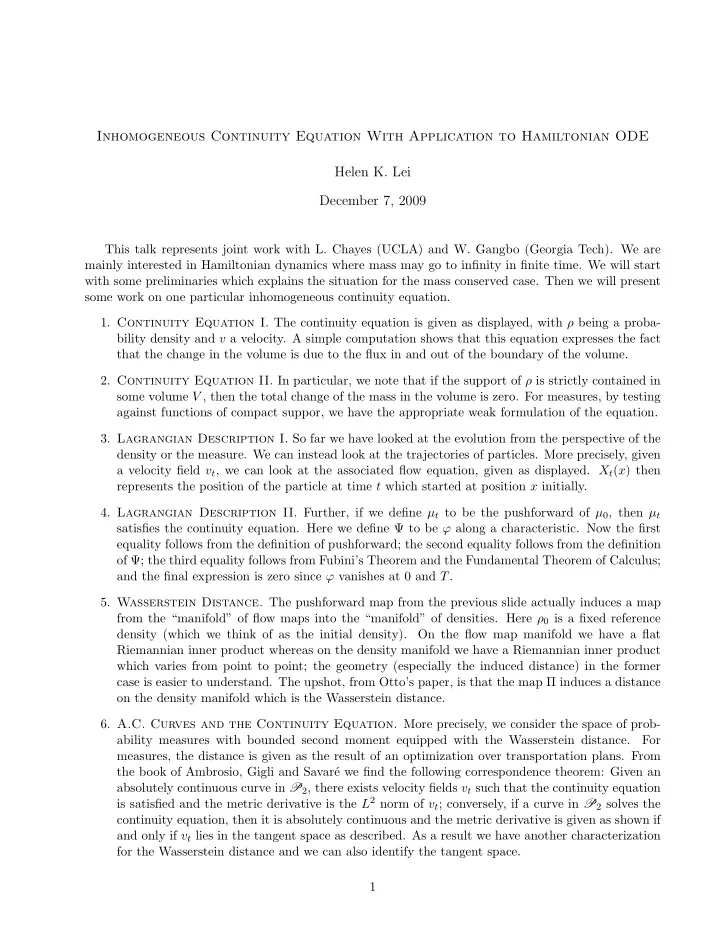
- 1. Continuity Equation I. The continuity equation is given as displayed, with ρ being a proba-
bility density and v a velocity. A simple computation shows that this equation expresses the fact that the change in the volume is due to the flux in and out of the boundary of the volume.
- 2. Continuity Equation II. In particular, we note that if the support of ρ is strictly contained in
some volume V , then the total change of the mass in the volume is zero. For measures, by testing against functions of compact suppor, we have the appropriate weak formulation of the equation.
- 3. Lagrangian Description I. So far we have looked at the evolution from the perspective of the
density or the measure. We can instead look at the trajectories of particles. More precisely, given a velocity field vt, we can look at the associated flow equation, given as displayed. Xt(x) then represents the position of the particle at time t which started at position x initially.
- 4. Lagrangian Description II. Further, if we define µt to be the pushforward of µ0, then µt
satisfies the continuity equation. Here we define Ψ to be ϕ along a characteristic. Now the first equality follows from the definition of pushforward; the second equality follows from the definition
- f Ψ; the third equality follows from Fubini’s Theorem and the Fundamental Theorem of Calculus;
and the final expression is zero since ϕ vanishes at 0 and T.
- 5. Wasserstein Distance. The pushforward map from the previous slide actually induces a map
from the “manifold” of flow maps into the “manifold” of densities. Here ρ0 is a fixed reference density (which we think of as the initial density). On the flow map manifold we have a flat Riemannian inner product whereas on the density manifold we have a Riemannian inner product which varies from point to point; the geometry (especially the induced distance) in the former case is easier to understand. The upshot, from Otto’s paper, is that the map Π induces a distance
- n the density manifold which is the Wasserstein distance.
- 6. A.C. Curves and the Continuity Equation. More precisely, we consider the space of prob-