QCD Symmetries in eta and etaprime mesic nuclei Steven Bass Chiral - - PowerPoint PPT Presentation

qcd symmetries in eta and etaprime mesic nuclei
SMART_READER_LITE
LIVE PREVIEW

QCD Symmetries in eta and etaprime mesic nuclei Steven Bass Chiral - - PowerPoint PPT Presentation

QCD Symmetries in eta and etaprime mesic nuclei Steven Bass Chiral symmetry, eta and eta physics: the masses of these mesons are 300-400 MeV too big for them to be pure Goldstone bosons Famous axial U(1) problem of QCD Additional mass is


slide-1
SLIDE 1

1

QCD Symmetries in eta and etaprime mesic nuclei

Steven Bass

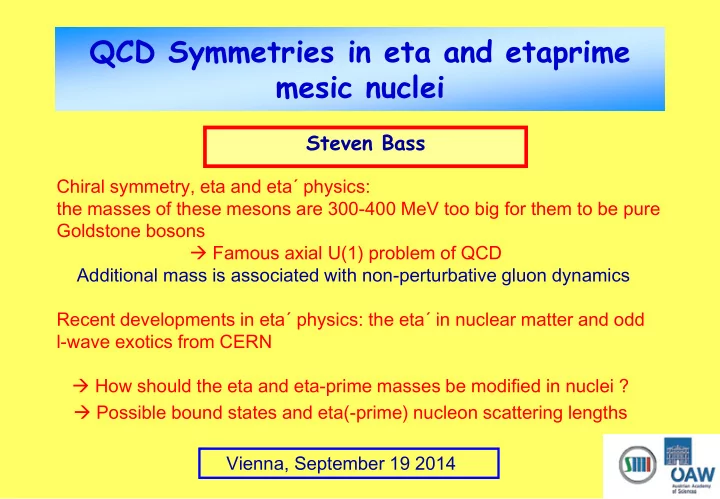
Vienna, September 19 2014 Chiral symmetry, eta and eta´ physics: the masses of these mesons are 300-400 MeV too big for them to be pure Goldstone bosons  Famous axial U(1) problem of QCD Additional mass is associated with non-perturbative gluon dynamics Recent developments in eta´ physics: the eta´ in nuclear matter and odd l-wave exotics from CERN  How should the eta and eta-prime masses be modified in nuclei ?  Possible bound states and eta(-prime) nucleon scattering lengths

slide-2
SLIDE 2

2

From Quarks to Hadrons

  • Confinement
  • Dynamical chiral symmetry breaking:

» Chiral condensate, pions, kaons, ... Goldstone bosons

  • Axial U(1) Symmetry breaking ... Big masses for eta and etaprime
  • Using nuclei to probe symmetries and possible restoration (both quark

and gluonic effects)

slide-3
SLIDE 3
  • QCD Lagrangian with massless quarks exhibits chiral symmetry
  • Noether currents
  • No parity doublets in hadron spectrum  Spontaneous Chiral symmetry

breaking: non zero condensate spontaneously breaks the symmetry  Nonet of near massless Goldstone bosons with JP = 0-

  • Identify with pion, kaon, eta with meson mass squared proportional to mq

… where is the singlet boson ?

3

Chiral symmetry

slide-4
SLIDE 4

4

Eta and Etaprime masses

  • Mass matrix
  • Diagonalize
  • Eigenvalues
  • With no glue:

chiral symmetry „predicts“ eigenstates with masses 300 MeV „too small“ » „eta“ degenerate with the pion » „etaprime“ with mass

slide-5
SLIDE 5

5

Chirality and anomalous glue

  • Perturbative QCD conserves chirality for massless quarks
  • Confinement and vacuum tunneling processes (instantons, …) connect left

and right handed quarks

slide-6
SLIDE 6

6

Confinement and chiral symmetry

  • Scalar confinement dynamically breaks chiral symmetry

– E.g. In Bag model confinement the Bag wall connects left and right handed quarks – Quark – pion coupling and the pion cloud of the nucleon

  • Pions, kaons, eta ... as Goldstone bosons
  • OGE as residual vector (colour hyperfine) interaction
slide-7
SLIDE 7

7

Axial U(1) symmetry

  • Extra gluonic mass term is associated with the QCD axial anomaly
  • plus gluon topology

(note the difference with „perturbative glue“)

  • ´t Hooft, Veneziano, Witten, Crewther, …

– possible connection to confinement (Kogut and Susskind) Can we observe physical manifestation of this anomalous glue in low-energy physical processes involving eta and eta´mesons ?

slide-8
SLIDE 8

8

Glue in etaprime physics

  • Glue enters through the anomaly equation …
  • Three important places it can contribute

» Gluonic potential associated with QCD vacuum gives the etaprime a big mass » The etaprime has a large singlet component  coupling to gluonic intermediate states (OZI violation) » Gluonic Fock components in the etaprime wavefunction

slide-9
SLIDE 9

9

U(1) extended chiral Lagrangian

  • Low energy effective Lagrangian

– constructed to reproduce the axial anomaly in the anomalous divergence equation and the gluonic mass term for the singlet boson

  • Q is the topological charge density and the gluonic potential yields the

gluonic contribution to the etaprime mass term

  • Couple to sigma mean field and repeat …
slide-10
SLIDE 10

New Compass results

  • Iterate in Bethe Salpeter equation

dynamicaly generates 1-+ exotic resonance with mass ~ 1400 MeV [SDB and E Marco, PRD 65 (2002) 057503] Compass, hep-ex 1408.4286

10

slide-11
SLIDE 11

11

Eta(prime) bound states in nuclei

[SDB + AW Thomas, Phys Lett B634 (2006) 368, Acta Phys Pol B 45 (2014) 627]

  • New experiments + big effort ...
  • Binding energies and effective masses in nuclei are sensitive to

– Coupling to scalar sigma field in the nuclei in mean field approx. – Nucleon-nucleon and nucleon-hole excitations in the medium

  • TH: Solve for the meson self-energy in the medium

– Where a is the „eta(prime)-nucleon scattering length“

slide-12
SLIDE 12

12

Eta bound-states in nuclei

  • Sigma mean field couples to light quarks and not to strange quarks

 Flavour-singlet component is important ! The bigger the eta-eta´mixing angle, the bigger the singlet component in the eta  greater the attraction  more binding  bigger eta-N scattering length Likewise, more mixing gives smaller singlet component in the eta‘  reduced binding and smaller eta‘N scattering length Without QCD axial anomaly, eta‘ a strange state and no mass shift

QCD arguments  gluonic mass term is suppressed in the medium but theory technology to calculate the size of the effect direct from QCD still some time away  look at QCD inspired models

slide-13
SLIDE 13

QCD and models

  • Include key aspects of QCD as input motivation

» Confinement » Chiral symmetry » Eta-etaprime mixing

  • Quark-meson coupling, chiral coupled channels, NJL, linear sigma model...

include different aspects of QCD input with very different predictions

  • Suppose we see a bound state or mass shift 

» What do we learn about QCD ?

13

slide-14
SLIDE 14

14

QCD Inspired Models

  • Quark Meson Coupling Model:

– Can vary the mixing angle ! – Use large eta and eta´masses to treat the eta and eta´as MIT Bags embedded in the medium with coupling between the light-quarks and the sigma mean field Solve for in-medium mass and binding energy  Extract an „effective“ scattering length for the model  Increases with increasing singlet component in the eta !

  • Hints from CBELSA/TAPS for etaprime [Nanova et al, 2013]
slide-15
SLIDE 15

COSY 11

  • E. Czerwinski et al (2014),

COSY 11 Collaboration, Phys. Rev. Lett. 113 (2014) 062004

15

slide-16
SLIDE 16

Eta-etaprime mixing and mass shift

  • Phenomenology and EP data

» On-shell Re[a_eta] ~ 0.9 fm [Green + Wycech, Arndt et al] » COSY-11 ~ 0.7 fm from FSI in pp  pp eta » COSY-11 a_eta‘ new [previous slide]

  • Chiral coupled channels treating the eta as a pure octet state

» Small mass shift and small Re[a_eta] ~ 0.2 fm » For etaprime: including axial U(1) degrees of freedom gives considerable expansion in number of potentials

  • N*(1535)

– 3 quark state (1s)2(1p) in Quark model and lattice calculations

  • r

K-Sigma quasi-bound state from Chiral coupled channels in octet approx. – In data and in both QMC and chiral coupled channels models, negligible shift in excitation energy in nuclei

16

slide-17
SLIDE 17

Comparison with NJL

  • NJL model using density dependent instanton interaction

– QCD input: chiral symmetry, no confinement, medium a Fermi gas of quarks instead of nucleons, mass shift for the eta´up to ~ 150 MeV » Phys Rev C74 (2006) 045203

  • Suppose eta-eta´ mass splitting comes just from anomaly, proportional to

quark condensate  80-100 MeV mass shift » Phys Rev C85 (2012) 032201, Phys. Rev. C88 (2013) 064906

17

slide-18
SLIDE 18

18

Outlook and Conclusions

  • Eta and etaprime physics probes the role of long range gluonic

dynamics

  • Etas and etaprimes in nuclei:

– Aspects of Confinement, chiral symmetry and their interplay, range of masses for pseudoscalars to be treated as Goldstone states in the models – Binding energies and scattering lengths sensitive to the flavour- singlet component in the eta and eta´ – Without QCD anomaly, no effect in the eta´ – QMC model: » Factor of 2 increase in the eta-nucleon scattering length and binding energy in nuclei with eta-etaprime mixing cf. Theory prediction with a pure octet eta » Good agreement with CBELSA/TAPS for the eta´ ... Awaits experimental input! ... ELSA (BOG-OD), GSI (etaprime), COSY (eta).

slide-19
SLIDE 19

CBELSA/TAPS: Transparency Ratios

  • Medium is reasonably transparent to eta´propagation

19

slide-20
SLIDE 20

Theoretical development

20

slide-21
SLIDE 21

For extra reading

21