SLIDE 1 1 Curve sketching — Symmetries, envelopes and square roots
1.5 Comments on symmetries.
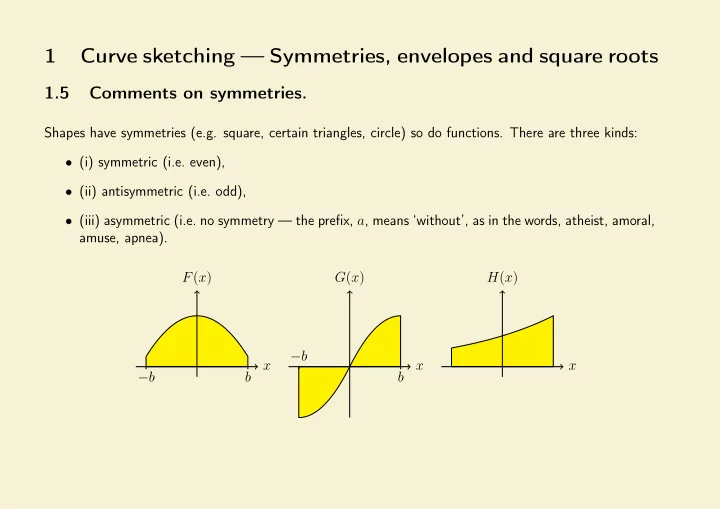
Shapes have symmetries (e.g. square, certain triangles, circle) so do functions. There are three kinds:
- (i) symmetric (i.e. even),
- (ii) antisymmetric (i.e. odd),
- (iii) asymmetric (i.e. no symmetry — the prefix, a, means ‘without’, as in the words, atheist, amoral,
amuse, apnea). −b b x F(x) −b b x G(x) x H(x)
SLIDE 2 −b b x F(x) −b b x G(x) x H(x) Examples of even functions: x2, x4, cos x, e−x2, sin2 x, x3 sin x, cosh x, f(x) + f(−x). Examples of odd functions: x, x3, sin x, xe−x2, x cos x, sinh x, f(x) − f(−x). Examples of asymmetric functions: ex, sin(x + 1
4π),
x + |x|. Note: We have the following “multiplication tables” for symmetries: even × even = even
even × odd = odd This is just like the addition of even and odd numbers....
SLIDE 3 1.6 Envelopes.
This involves the product of two functions, one of which oscillates. We will look in detail at the functions, x cos x, x sin x, (cos x)/x and e−|x| sin 100x.
- Black disks mark where sin x = 0, i.e. where x = nπ.
- Here f(x) is positive, and since −1 ≤ sin x ≤ 1, then,
−f(x) ≤ f(x) sin x ≤ f(x).
- It’s a little more complicated when f(x) has zeroes.
General strategy:
- Check for symmetries.
- Draw both f(x) and −f(x) first.
- Mark where the sinusoid is zero. Likewise for f(x),
- Finally attempt to sketch the curve.
SLIDE 4 x x cos x Figure 1.26
- We first mark in the functions x and −x as the dashed lines, and therefore we know that x cos x
must lie between these two extremes.
- The zeros of cos x are at x = ±π/2, ±3π/2 and so on, so these are marked by black disks on the
x-axis.
- Another zero arises at x = 0 due to the factor, x, in x cos x.
- Finally, we note that the function is odd (odd×even). (Useful to state if your diagram doesn’t make
it obvious!)
SLIDE 5 Figure 1.27 x x sin x
- This example is very similar to that shown in Figute 1.26. But it has a sine rather than a cosine.
- The function is even because x sin x is odd×odd.
- sin x has single zeros at 0, ±π, ±2π, ±3π and so on.
- There is a second zero at x = 0 because both the factors in x sin x have simple zeros.
- Therefore there is a double zero at x = 0 and the curve will look like a parabola near there.
SLIDE 6 Figure 1.28 x (cos x)/x
- We first mark in the functions 1/x and −1/x.
- These tend to ±∞ as x → 0.
- Note that both cos x and x are positive when x is slightly greater than zero.
- An odd function. The zeros of cos x are at odd multiples of 1
2π.
SLIDE 7 Figure 1.29 x e−|x| sin 100x
- The function e−|x| decays exponentially as x → ±∞. It is even.
- The envelope, ±e−|x|, has been sketched.
- The odd function sin 100x oscillates very quickly (the period is π/50).
- e−|x| sin 100x is an odd function.
- This is an example of an AM (Amplitude Modulation) radio signal: the carrier wave (sin 100x) has
its amplitude modulated by the signal, e−|x|.
SLIDE 8 1.7 Square roots of functions.
- A little bit of care needs to be taken whenever one needs to sketch the square root of a function.
- Both roots? Often resolved when considering the application.
- But what happens when one takes the square root of a function which has a single zero?
Figure 1.30 Yes — a vertical tangent!
SLIDE 9
x y = √ 1 − x2 Figure 1.31. x y where y2 = 1 − x2 I am simply making the distinction between writing y = √ 1 − x2 explicitly, and writing y2 = 1 − x2 in terms of what one plots. In the right hand graph the negative values of y are allowed, whereas they are not allowed on the left. Clearly this is a circle since x2 + y2 = 1. But what is happening near x = 1 in this case?
SLIDE 10 x y where y2 = 1 − x2 Clearly there is a vertical tangent at x = 1, but is it the square root of a linear factor? Just consider the positive root: y = √ 1 − x2 ⇒ y =
When x 1 then (1 + x) ≃ 2 and therefore the equation becomes y =
- (1 + x)(1 − x) ≃
- 2(1 − x).
This is the square root of a linear factor, just as in Figure 1.30.
SLIDE 11 x y = (x − 2)(x − 1)(x + 1)(x + 2) Figure 1.9 Figure 1.32 x y =
- (x − 2)(x − 1)(x + 1)(x + 2)
- We have y = (x − 2)(x − 1)(x + 1)(x + 2) on the left and y =
- (x − 2)(x − 1)(x + 1)(x + 2) on
the right.
- The dotted lines on the right denote the extra curves for y2 = (x − 2)(x − 1)(x + 1)(x + 2), i.e. for
y = ±
- (x − 2)(x − 1)(x + 1)(x + 2).
- At the roots, x = ±1, ±2 we have vertical tangents.
SLIDE 12 1.8 Ratios of polynomials.
Sounds scary but it’s systematic. An example: y = (x − 1)2(x + 2) x(x − 3)2 . First we collect basic information of the following kind:
- the locations of all zeros and their multiplicity (i.e. single, double and so on);
- the locations of all poles (i.e. infinities) which are the zeros of the denominator, and we also need
their multiplicity;
For the above example we have the following: Zeros at x = 1, 1, −2 i.e. x = 1 twice and x = −2 once, Infinities at x = 0, 3, 3 i.e. x = 3 twice and x = 0 once, y → 1 as x → ±∞. When x ≫ 1 then y ≃ x3 x3 = 1.
SLIDE 13
A straightforward case of a pole at x = 0. As x increases past x = 0, the sign of y changes, but y will have descended down to −∞ before re-emerging at +∞. This infinite discontinuity always happens at a single pole. Figure 1.33. x y = 1/x As Figure 1.33 but the pole is now at x = 1. Figure 1.34. x y = 1/(x − 1)
SLIDE 14 This is a double pole at x = 1. I have indicated the location of the double pole by a pair of dashed lines. As x increases through x = 1, then (x − 1)2 doesn’t change sign. Hence the curve ascends to +∞ and then returns from +∞. Figure 1.35. x y = 1/(x − 1)2 This is a triple pole at x = 1, the pres- ence of which is indicated by three dashed
- lines. The fact that it is a cube means
that there will be a sign change as x in- creases past x = 1. So this looks very similar to the single pole case. Figure 1.36. x y = 1/(x − 1)3
SLIDE 15 x Figure 1.37 y = 1 x2 − 1
- There are no zeros.
- Poles at x = −1 and x = 1 because x2 − 1 = (x − 1)(x + 1).
- When x → ±∞ then y → 0+.
Refer to full notes for the details of the joining of the dots! All of our examples will follow a similar logic. The behaviour of the curve will then depend on the multiplicity of the zeros and poles.
SLIDE 16 x y = x x2 − 1 Figure 1.38
- Zero at x = 0.
- Poles at x = −1 and x = 1.
- When x → ∞ then y → 0+.
- When x → −∞ then y → 0−.
It is worth comparing Figures 1.37 and 1.38 to see the difference caused by the addition of a zero.
SLIDE 17
y = x(x − 1) (x + 1)(x − 2). Zeros at x = 0, 1. Poles at x = −1, 2. When x → ±∞ then y → 1. Similar logic to the previous example. Figure 1.39. x y y = x(x − 1)2 (x + 1)2(x − 2). Zeros at x = 0, 1, 1. Poles at x = −1, −1, 2. When x → ±∞ then y → 1. Figure 1.40. x y
SLIDE 18
y = x(x − 1)2 (x + 1)(x − 2) Zeros at x = 0, 1, 1. Poles at x = −1, 2. When x → ±∞ then y ∼ x. Figure 1.41. x y A slightly modified version of both Figures 1.39 and 1.40. Note the different large-x behaviour here. Final note: it is possible to go a little further with the large-|x| behaviour and find that, y = x(x − 1)2 (x + 1)(x − 2) = x − 1 + 2x − 2 x2 − x − 2, but I shall not be covering this extra analysis.