
SLIDE 1
NYCDEP CAT-252 – Replacement of Esopus Creek and Rte. 28A Railroad Bridges October 27, 2015
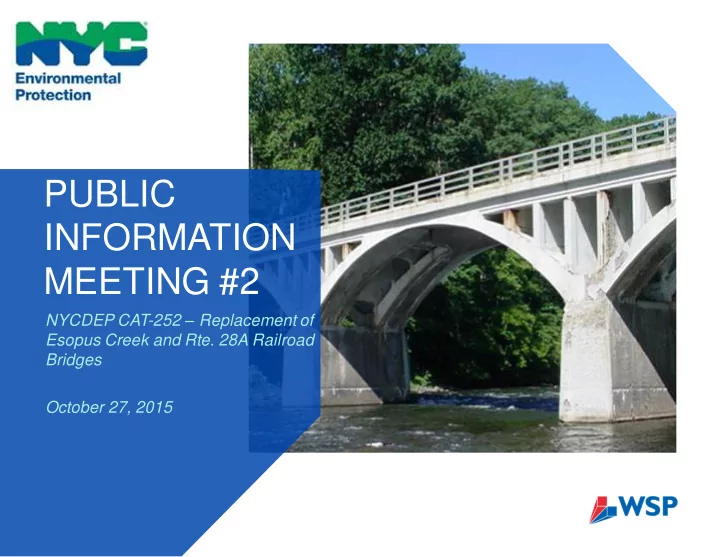
INFORMATION MEETING #2 NYCDEP CAT-252 Replacement of Esopus Creek - - PowerPoint PPT Presentation
PUBLIC INFORMATION MEETING #2 NYCDEP CAT-252 Replacement of Esopus Creek and Rte. 28A Railroad Bridges October 27, 2015 QUESTIONS? PRESENTATION OUTLINE Introductions Project History Existing Conditions Work Completed to
NYCDEP CAT-252 – Replacement of Esopus Creek and Rte. 28A Railroad Bridges October 27, 2015
4
Project Location
5
Bridges were constructed in the early 1900’s Bridges are inspected every two years by NYSDOT Bridges are considered at the end
NYCDEP addressed Yellow Flag condition on the Esopus Creek Bridge in 2013
Span 5 floorbeam NYCDEP initiated design of replacement project in July 2014
Claverack Creek
Esopus Creek Bridge Railroad Bridge S-Curve
7
Built in 1913 454’ long, 5-span concrete
Bridge roadway width = 22’ Carries two 11’ travel lanes and no shoulders The condition of the bridge is beyond its useful life
Esopus Creek Bridge
8
Spalling with exposed rebar throughout Cracking with efflorescence City performed repairs including joint replacement and Class A concrete repairs Posted no ‘R’ Permit Vehicles (no vehicles above legal weights permitted)
9
Built in 1913 39’ long, single span concrete thru- girder/floorbeam bridge Bridge roadway width = 22’ Carries two 11’ travel lanes and no shoulders The bridge is beyond its useful life
10
Spalling with exposed rebar on primary members Underside of deck and abutments exhibit spalled and loose concrete No flag conditions
11
Non-standard vertical sight distance Non-standard bridge and shoulder width
12
Non-standard horizontal S-curve Non-standard Y-type intersection
13
Engineering for Flood Study
borings) - permitting
14
Project Objective #1 – Provide a new structure based on current NYSDOT standards with a service life of 75-years Project Objective #2 - Improve bridge, approach roadway and intersection geometry Project Objective #3 – Address / improve hydraulic performance in coordination with Town of Olive’s Flood Mitigation Study Project Objective #4 – Provide for future bicycle / pedestrian accommodation per the Ulster County Inter-governmental Agreement
15
Natural Resource Management
Sustainable Land Use
Waste Reduction/ Resource Conservation
Energy conservation/ Reduction in Greenhouse Gas Emissions
Goal to achieve a gold or higher sustainability rating
16
No Build Option
Bridge Rehabilitation Option
Bridge Replacement Option
new bridges on a parallel alignment
17
ESOPUS CREEK BRIDGE: Complete removal and replacement of the existing structure Construct a new bridge on an off-line, parallel alignment to the south of the existing bridge to avoid lengthy detour route New bridge will consist of a multi-girder precast concrete bridge on precast concrete piers and abutments
Project Objective #1 - Provide a new structure based on current NYSDOT standards with a service life of 75-years
18
Esopus Creek Bridge Existing Alignment Proposed Alignment
19 Alternative 1 - $41 million (bridge only) Alternative 2 - $48 million (bridge only) Existing
454’
382’-6”
454’
536’-6”
20
21
RAILROAD BRIDGE: Complete removal and replacement of the existing structure Construct a new bridge on an off-line, parallel alignment to the south of the existing bridge New bridge will consist of a precast concrete components precast or cast-in-place concrete abutments
schedule
22
Railroad Bridge
23
24
Provide standard width travel lanes and shoulders within project limits Correct non-standard sight distances caused by crest vertical curve Improve horizontal alignment at ‘S-curve’ Provide new intersection with Rte. 28/28A based on current design standards Install NYSDOT standard approach guide rail transitions and end assemblies
Project Objective #2 - Improve bridge, approach roadway and intersection geometry
25
Project Objective #2 - Improve approach roadway and intersection geometry and safety features
26
S-Curve Correction
Existing Alignment Proposed Alignment
27
Route 28A / 28 Intersection Non-conforming NYSDOT intersection geometry for the existing roadway Safety deficiencies Acute angle inhibits line
Lack of turn lanes Accidents are higher than statewide average NYSDOT conventional T- type intersection with dedicated turn lanes Stop sign control, signal not warranted
28
Project Objective #3 - Address / improve hydraulic performance in coordination with Town of Olive’s Flood Mitigation Study Coordination on-going with flood study Improvements to hydraulic performance at Esopus Creek Bridge includes: Reduce number of piers in the waterway Potential increase in bridge length (facilitate future floodplain improvement on east side)
29
HYDRAULIC INFORMATION FROM WOIDT
Project Objective #4 - Provide for future bicycle / pedestrian accommodation per the Ulster County Inter-governmental Agreement
Dedicated bike / ped trail on north side
30
Drive thru Video
31
– August 2016
2023
32
Public Design Commission (PDC)
NYSDOT
Quality Review (SEQR)