
SLIDE 1
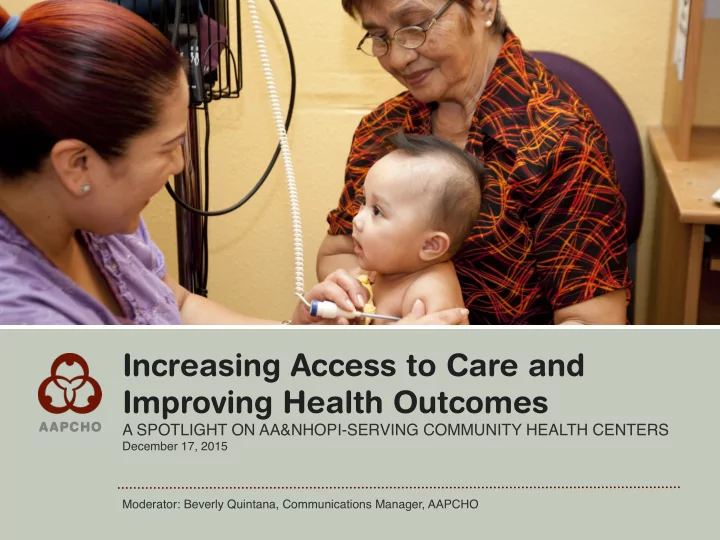
Increasing Access to Care and Improving Health Outcomes
A SPOTLIGHT ON AA&NHOPI-SERVING COMMUNITY HEALTH CENTERS
December 17, 2015 Moderator: Beverly Quintana, Communications Manager, AAPCHO
Increasing Access to Care and Improving Health Outcomes A SPOTLIGHT - - PowerPoint PPT Presentation
Increasing Access to Care and Improving Health Outcomes A SPOTLIGHT ON AA&NHOPI-SERVING COMMUNITY HEALTH CENTERS December 17, 2015 Moderator: Beverly Quintana, Communications Manager, AAPCHO ABOUT THE ASSOCIATION OF ASIAN PACIFIC COMMUNITY
A SPOTLIGHT ON AA&NHOPI-SERVING COMMUNITY HEALTH CENTERS
December 17, 2015 Moderator: Beverly Quintana, Communications Manager, AAPCHO
| 2 Increasing Access to Care and Improving Health Outcomes: A Spotlight on AA&NHOPI-serving Community Health Centers
| ¡3 ¡ Increasing Access to Care and Improving Health Outcomes: A Spotlight on AA&NHOPI-serving Community Health Centers
| ¡4 ¡ Increasing Access to Care and Improving Health Outcomes: A Spotlight on AA&NHOPI-serving Community Health Centers
| ¡5 ¡ Increasing Access to Care and Improving Health Outcomes: A Spotlight on AA&NHOPI-serving Community Health Centers
Program Manager, AAPCHO
Director of Research, AAPCHO
Director of Policy and Advocacy, AAPCHO
Director of Community Services & Partnerships, AAPCHO
| ¡6 ¡ Increasing Access to Care and Improving Health Outcomes: A Spotlight on AA&NHOPI-serving Community Health Centers
| ¡7 ¡ Increasing Access to Care and Improving Health Outcomes: A Spotlight on AA&NHOPI-serving Community Health Centers
| ¡8 ¡ PACIFIC ¡ISLANDERS ¡ % ¡ Guamanian/Chamorro ¡ ¡ 0.10% ¡ Micronesian ¡ ¡ 0.60% ¡ Other ¡Pacific ¡Islanders ¡ ¡ 1.20% ¡ Samoan ¡ ¡ 2.10% ¡ Tongan ¡ ¡ 0.20% ¡ NATIVE ¡HAWAIIANS ¡ 14.60% ¡ ASIAN ¡GROUPS ¡ % ¡ Cambodian ¡ ¡ 0.70% ¡ Chinese ¡ ¡ 50.30% ¡ Filipino ¡ ¡ 5.00% ¡ Japanese ¡ ¡ 0.90% ¡ Korean ¡ ¡ 0.80% ¡ LaoNan ¡ ¡ 0.20% ¡ Mien ¡ ¡ 0.20% ¡ Mixed ¡AA&NHOPI ¡ ¡ 0.60% ¡ Other ¡Asian ¡ ¡ 4.50% ¡ Thai ¡ ¡ 0.10% ¡ Vietnamese ¡ ¡ 2.40% ¡
*AAPCHO has 29 AA&NHOPI-serving FQHCs
Increasing Access to Care and Improving Health Outcomes: A Spotlight on AA&NHOPI-serving Community Health Centers
member FQHC patients were best served in a language other than English
members, LEP patients represented up to 99%
populations
| ¡9 ¡
53.2%& 57.2%& 60.4%& 59.0%& 60.4%& 60.2%& 58.7%& 52.9%& 51.4%& 51.2%& 50.3%& 51.5%& 49.3%&49.9%& 0%& 10%& 20%& 30%& 40%& 50%& 60%& 70%& 2000&2001&2002&2003&2004&2005&2006&2007&2008&2009&2010&2011&2012&2013& Percent&LEP&pa8ents& Year&
*AAPCHO has 24 AA&NHOPI-serving FQHCs English ¡ 39.5% ¡ Cantonese ¡ 23.2% ¡ Mandarin ¡ 20.9% ¡ Unknown ¡ 5.4% ¡ Chinese ¡ 4.0% ¡ Vietnamese ¡ 2.4% ¡ Other ¡ 1.8% ¡ Korean ¡ 0.9% ¡ Cambodian ¡ 0.5% ¡ Spanish ¡ 0.5% ¡ Tagalog ¡ ¡ 0.2% ¡ Samoan ¡ 0.2% ¡ Burmese ¡ 0.1% ¡ Hakka ¡ 0.1% ¡ Japanese ¡ 0.1% ¡ Karen ¡ 0.1% ¡ Mien ¡ 0.1% ¡ LaoNan ¡ 0.1% ¡ Chuukese ¡ ¡ <.10% ¡ Indonesian ¡ <.10% ¡ Malay ¡ <.10% ¡ Thai ¡ <.10% ¡ Tongan ¡ <.10% ¡
Increasing Access to Care and Improving Health Outcomes: A Spotlight on AA&NHOPI-serving Community Health Centers
118% increase between 2005-2014
| ¡10 ¡
448659 ¡ 976422 ¡ 0 ¡ 200000 ¡ 400000 ¡ 600000 ¡ 800000 ¡ 1000000 ¡ 2005 ¡ 2006 ¡ 2007 ¡ 2008 ¡ 2009 ¡ 2010 ¡ 2011 ¡ 2012 ¡ 2013 ¡ 2014 ¡
Growth ¡in ¡AA&NHOPIs ¡seen ¡at ¡FQHCs ¡
NaNonal ¡AA&NHOPIs ¡
Increasing Access to Care and Improving Health Outcomes: A Spotlight on AA&NHOPI-serving Community Health Centers
Tuyen Tran, MPH, Program Manager, AAPCHO
| ¡12 ¡ Increasing Access to Care and Improving Health Outcomes: A Spotlight on AA&NHOPI-serving Community Health Centers
| ¡13 ¡ Increasing Access to Care and Improving Health Outcomes: A Spotlight on AA&NHOPI-serving Community Health Centers
| ¡14 ¡
TOTAL ¡AA&NHOPI ¡ SERVED ¡ STATE/TERRITORY ¡ TOTAL ¡FQHCS ¡ 162,219 ¡ CA ¡ 30 ¡ 89,390 ¡ HI ¡ 14 ¡ 63,566 ¡ NY ¡ 7 ¡ 58,322 ¡ MA ¡ 10 ¡ 46,658 ¡ WA ¡ 7 ¡
Increasing Access to Care and Improving Health Outcomes: A Spotlight on AA&NHOPI-serving Community Health Centers
| ¡15 ¡
AA&NHOPI-‑SERVING ¡ FQHCs ¡(AVERAGES; ¡ %) ¡ NaGonal ¡FQHCs ¡ (AVERAGES; ¡%) ¡ Average ¡total ¡ paNents/FQHC ¡ 24,323 ¡ 18,106 ¡ Average ¡total ¡ AA&NHOPIs ¡ 5,299 ¡ 750 ¡ %AA&NHOPI ¡ 22% ¡ 4% ¡ % ¡paNents ¡best ¡ served ¡in ¡a ¡language ¡
33% ¡ 23% ¡
Increasing Access to Care and Improving Health Outcomes: A Spotlight on AA&NHOPI-serving Community Health Centers
| ¡16 ¡
AA&NHOPI-‑SERVING ¡ FQHCs ¡(%) ¡ NaGonal ¡FQHCs ¡(%) ¡ % ¡≤ ¡200% ¡poverty ¡ 93.01% ¡ 92.78% ¡ % ¡Medicaid ¡ 46% ¡ 41% ¡ % ¡Uninsured ¡ 34% ¡ 35% ¡
Increasing Access to Care and Improving Health Outcomes: A Spotlight on AA&NHOPI-serving Community Health Centers
| ¡17 ¡
AA&NHOPI-‑SERVING ¡ FQHCs ¡( ¡%) ¡ NaGonal ¡FQHCs ¡( ¡%) ¡ % ¡Prenatal ¡paNents ¡ 2.5% ¡ 2.3% ¡ % ¡HepaNNs ¡B ¡ 0.54% ¡ 0.13% ¡ % ¡HepaNNs ¡C ¡ 0.90% ¡ 0.78% ¡ % ¡TB ¡ 0.08% ¡ 0.05% ¡ % ¡Asthma ¡ 6.30% ¡ 5.88% ¡ % ¡Abnormal ¡breast ¡ findings ¡ 0.61% ¡ 0.52% ¡ % ¡Abnormal ¡cervical ¡ findings ¡ 0.98% ¡ 0.91% ¡
Increasing Access to Care and Improving Health Outcomes: A Spotlight on AA&NHOPI-serving Community Health Centers
| ¡18 ¡
AA&NHOPI-‑SERVING ¡ FQHCs ¡(AVERAGES) ¡ NaGonal ¡FQHCs ¡ (AVERAGES) ¡ Average ¡total ¡ encounters ¡ 103,112 ¡ 71,309 ¡ Average ¡total ¡ES ¡ encounters ¡ 7,679 ¡ 4,953 ¡ Average ¡total ¡ES ¡costs ¡ 1,823,109 ¡ 958,052 ¡ Average ¡ES ¡cost/ Encounter ¡ 237.41 ¡ 193.42 ¡
Increasing Access to Care and Improving Health Outcomes: A Spotlight on AA&NHOPI-serving Community Health Centers
| ¡19 ¡ Increasing Access to Care and Improving Health Outcomes: A Spotlight on AA&NHOPI-serving Community Health Centers
| ¡20 ¡ Increasing Access to Care and Improving Health Outcomes: A Spotlight on AA&NHOPI-serving Community Health Centers
AA&NHOPI-‑SERVING ¡ FQHCs ¡( ¡%) ¡ NaGonal ¡FQHCs ¡(%) ¡ Cervical ¡cancer ¡ screening ¡ 62.3% ¡ 57.8% ¡ PaNents ¡with ¡ controlled ¡ hypertension ¡ 63.9% ¡ 63.6% ¡ DiabeNc ¡paNents ¡with ¡ HbA1c ¡> ¡9 ¡ 29.7% ¡ 31.1% ¡
| ¡21 ¡
Increasing Access to Care and Improving Health Outcomes: A Spotlight on AA&NHOPI-serving Community Health Centers
Rosy Chang Weir, PhD, Director of Research, AAPCHO
– Patient-level data (vs. CHC level data in UDS) – Disaggregated AA&NHOPI data (vs. AA, NH, PI only in
– Analysis with Enabling Services and Social Determinants of
| ¡23 ¡ Increasing Access to Care and Improving Health Outcomes: A Spotlight on AA&NHOPI-serving Community Health Centers
| ¡24 ¡
¡ Cultural ¡and ¡ linguistically ¡ appropriate ¡ services ¡(CLAS) ¡ ¡
Increasing Access to Care and Improving Health Outcomes: A Spotlight on AA&NHOPI-serving Community Health Centers
*Draft in Review
| ¡25 ¡ Increased ¡ demand ¡ from ¡high-‑ ¡ risk ¡patients ¡ AA&NHOPI-‑ serving ¡CHCs ¡ provide ¡CLAS/ ¡ Enabling ¡ Services ¡(ES) ¡ Greater ¡ workforce ¡ demands ¡to ¡ provide ¡ CLAS/ ¡ES ¡ Higher ¡ enabling ¡ service ¡FTEs ¡ [UDS] ¡ Higher ¡quality ¡of ¡ care ¡ ¡& ¡value ¡ contributing ¡to ¡ Health ¡Equity ¡& ¡ Triple ¡Aim ¡ ¡ (e.g. ¡patients ¡ with ¡LEP, ¡ poverty, ¡ Medicaid, ¡Hep ¡B, ¡ comorbidities) ¡ ¡
Increased ¡
# ¡of ¡ patients ¡ (e.g. ¡ multilingual/ ¡ multicultural ¡ staff) ¡ ¡ (e.g., ¡ ¡longer ¡ encounters ¡for ¡ LEP ¡patients) ¡ ¡ (e.g. ¡cervical ¡ cancer, ¡ hypertension, ¡ diabetes ¡-‑ ¡UDS) ¡ (e.g., ¡access ¡ to ¡preventive ¡ care ¡resulting ¡ in ¡lower ¡ costs) ¡ AA&NHOPI ¡ CHCs ¡ ¡ Achieving ¡the ¡ Triple ¡Aim ¡ through ¡CLAS ¡ ¡
Pop ¡Health ¡
Increasing Access to Care and Improving Health Outcomes: A Spotlight on AA&NHOPI-serving Community Health Centers
*Draft in Review
| ¡26 ¡
High-‑risk ¡ patients ¡visit ¡ CHCs ¡for ¡ preventive ¡ services ¡ AA&NHOPI-‑ serving ¡CHCs ¡ provide ¡CLAS/ ¡ Enabling ¡ Services ¡(ES) ¡ Greater ¡ workforce ¡ demands ¡to ¡ provide ¡ CLAS/ ¡ES ¡ Higher ¡ enabling ¡ service ¡FTEs ¡ [UDS] ¡ Higher ¡quality ¡of ¡ care ¡ ¡& ¡value ¡ contributing ¡to ¡ Health ¡Equity ¡& ¡ Triple ¡Aim ¡ ¡
AA&NHOPI ¡ CHCs ¡ ¡ Achieving ¡the ¡ Triple ¡Aim ¡ through ¡CLAS ¡ ¡
Pop ¡Health ¡
*Draft in Review
Increasing Access to Care and Improving Health Outcomes: A Spotlight on AA&NHOPI-serving Community Health Centers
| ¡27 ¡
Disaggregated ¡ AA&NHOPI ¡ ethniciNes ¡and ¡ languages ¡
AA&NHOPI ¡ categories ¡ Social ¡ determinants ¡
(Protocol ¡for ¡ Responding ¡to ¡ and ¡Assessing ¡ PaNent ¡Assets, ¡ Risks, ¡and ¡ Experiences) ¡
Enabling ¡ services ¡ ¡
(Enabling ¡ Services ¡ Account-‑ ability ¡ Project) ¡ PaNent-‑ level ¡data ¡
Data ¡ Warehouse ¡
Increasing Access to Care and Improving Health Outcomes: A Spotlight on AA&NHOPI-serving Community Health Centers
| ¡28 ¡ Increasing Access to Care and Improving Health Outcomes: A Spotlight on AA&NHOPI-serving Community Health Centers
Isha Weerasinghe, MSc, Director of Policy and Advocacy, AAPCHO
| ¡30 ¡ Increasing Access to Care and Improving Health Outcomes: A Spotlight on AA&NHOPI-serving Community Health Centers
| ¡31 ¡ Increasing Access to Care and Improving Health Outcomes: A Spotlight on AA&NHOPI-serving Community Health Centers
– Integration of CLAS standards
| ¡32 ¡ Increasing Access to Care and Improving Health Outcomes: A Spotlight on AA&NHOPI-serving Community Health Centers
– Particularly for payers that aren’t properly reimbursing FQHCs
| ¡33 ¡ Increasing Access to Care and Improving Health Outcomes: A Spotlight on AA&NHOPI-serving Community Health Centers
| ¡34 ¡ Increasing Access to Care and Improving Health Outcomes: A Spotlight on AA&NHOPI-serving Community Health Centers
| ¡35 ¡ Increasing Access to Care and Improving Health Outcomes: A Spotlight on AA&NHOPI-serving Community Health Centers
Jen Lee, MPH, Director of Community Services & Partnerships, AAPCHO
| ¡37 ¡
| ¡38 ¡
| ¡39 ¡
| ¡40 ¡
| ¡41 ¡ Increasing Access to Care and Improving Health Outcomes: A Spotlight on AA&NHOPI-serving Community Health Centers
| ¡42 ¡