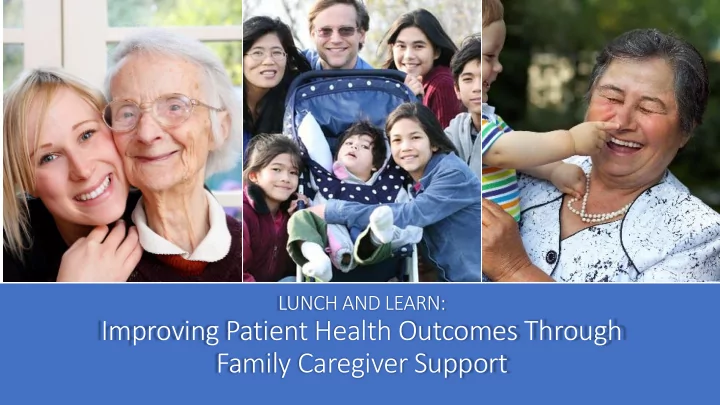
SLIDE 1
LUNCH AND LEARN:
Improving Patient Health Outcomes Through Family Caregiver Support
SLIDE 2
IM IMPROVING PATIENT HEALTH OUTCOMES THROUGH FAMILY CAREGIVER SUPPORT
FACILITATOR:
Marilyn Sword, Frontier Group LLC, Caregiver Integration Project Consultant Frontiergroupidaho@gmail.com, 208-344-8585
PRESENTERS:
Amy Mart, Director, Community Partnerships of Idaho Care Plus amart@mycpicp.org, 208-639-1484 Pam Oliason, Program Specialist, Idaho Commission on Aging (Lifespan Respite, Family Caregiver Support) Pam.oliason@aging.Idaho.gov, 208-577-2852 Kathy Skogsberg, Family Caregiver kathy@idahoada.org, 208-546-2033 Sarah Toevs Ph.D.Director, Center for the Study of Aging, Boise State University stoevs@boisestate.edu, 208-426-2452
SLIDE 3 WHAT IS IS THE CAREGIVER IN INTEGRATION PROJE JECT?
Caregiver Integration Workgroup
Workgroup formed to outline and develop a way to provide caregiver resources to local clinics and CHEMS agencies
Caregiver Training
Training developed and delivered to CHEMS and PCMHs in Ada, Elmore and Valley counties via webinars in June and August, 2017; follow-up in-person training in early December
Screening and Referrals
CarePlus assesses, refers caregivers to supports and provides follow up
Evaluation
Caregivers are surveyed for their utilization and effectiveness of referral and supports; that data provided to PCMHs and CHEMS
SLIDE 4 WHO ARE FAMILY CAREGIVERS?
An attorney in Boise whose
- therwise healthy wife had
a stroke and is being discharged from a rehabilitation facility A young couple in Mountain Home with two small children; the father is currently deployed overseas and they have a new baby with significant disabilities A mother who lives in Eagle who works full-time and whose 10-year-old adopted daughter struggles with critical behaviors due to reactive attachment disorder A long haul trucker from Kuna who learns that his 73-year-old mother in Salmon was found wandering in the street unaware of where she was A 69-year-old widow in Idaho City who just learned that her daughter has been seriously injured in an auto accident; the widow is the only family member who can care for her three grandchildren, ages 2, 5, and 7 A school teacher in McCall who is trying to help her teenage son with disabilities find a job after high school while also supporting her 85-year-
- ld grandmother who has Parkinson’s disease,
diabetes and a heart condition
SLIDE 5
WHAT DO FAMILY CAREGIVERS PROVIDE?
Emotional and spiritual support Medical equipment operation Interpreting medical directions Health insurance advocacy Transportation Complex medication management Care coordination Wound care Mental health planning & supervision Personal care Financial management
SLIDE 6 WHY SHOULD YOU BE CONCERNED ABOUT CAREGIVERS?
- 300,000 family caregivers in Idaho
- 201 million hours of uncompensated care annually
- 70% of family caregivers are employed full or part-time
- Looming crisis
- 2010: 6:1 ratio working-aged to older adults
- 2020: 3:1
:1 rati tio
- Idaho is ranked 42nd in providing support for family caregivers
- Ranked 49th for high levels of worry, stress, and exhaustion
experienced by caregivers
SLIDE 7
VALUE OF FAMILY CAREGIVERS
▪ Provide $2 $2 bill illion of unpaid care each year in Idaho ▪ Delay need for costly institutional care ▪ 48% ($2.7 million) of Idaho’s Medicaid budget allocated to care in nursing homes and intermediate care facilities (2014) ▪ Reduce hospital admissions/re-admissions ▪ Reduce utilization of emergency rooms for crisis care ▪ Enable care recipients and families to thrive
SLIDE 8
WHAT IS IS HAPPENING IN IN ID IDAHO TO HELP FAMILY CAREGIVERS?
SLIDE 9
IDAHO’S LIFESPAN FAMILY CAREGIVER ACTION PLAN
SLIDE 10
CAREGIVERS IN IN ID IDAHO:
Have little access to respite (a break) Don’t know where to go for help Are not recognized as partners in care Perform medical tasks without training Risk family stability Risk losing employment and income Neglect their own health
SLIDE 11
WHAT DO CAREGIVERS NEED TO MEET THEIR CAREGIVING RESPONSIBILITIES?
Recognition of their contribution to their family member’s care (partners with you) ✓An occasional (or even regular) break from caregiving Information specific to their loved one’s medical condition/disability and needs Self-care information and strategies (for themselves) Support from others/support groups Training to provide complex care Financial information and/or support Information about eligibility for services or supports (eg. Medicaid) Flexibility in their workplace (for those who are working)
SLIDE 12 A CAREGIVER’S STORY
Hear from a local caregiver about her caregiving experience, including obstacles and difficulties and what worked well.
SLIDE 13 A A CAREGIVER’S WORLD
This Care Map for caregiver Kathy Skogsberg illustrates the complexity of caregiving in her life.
Caregivers can use this exercise to illustrate their
environment, who it includes, and where the gaps are.
SLIDE 14 TOOL KIT IT OF CAREGIVER RESOURCES
Through this project, you will receive some resources that will help you provide information to the caregivers of your patients. This Tool Kit includes:
▪ Caregiver self-identification flyer to help caregivers connect to supports ▪ Information on how to draw a Care Map and how it can be used ▪ An AARP Resource and Referral Guide full of information for caregivers ▪ An article “Helping Those Who Help Others”, including the Modified Caregiver Strain Index, a tool to help caregivers identify their level of stress and needs ▪ Infographic on Powerful Tools for Caregivers, a 6-part course providing caregivers with strategies for resilience ▪ An article on What Not to Say to Caregivers (from AARP) ▪ Assistance from CarePlus to connect the caregivers of your patients to the resources they need to meet their caregiving responsibilities ▪ A copy of this Lunch and Learn presentation ▪ Follow up in-person training in December, 2017 that will include information on community resources that will help you sustain support for caregivers
SLIDE 15
WITHOUT THE HELP AND SUPPORT THAT FAMILY CAREGIVERS PROVIDE, THERE WOULD BE INCREASED COST AND PRESSURE ON THE HEALTHCARE SYSTEM.
SLIDE 16
How can you help caregivers to: maintain their caregiving responsibilities hold down costs delay more expensive care (ER visits, nursing home placements) avoid/postpone needing care themselves
SLIDE 17
RECOGNIZE CAREGIVERS AS KEY PARTNERS IN IN YOUR PATIENT’S CARE
While your organization probably already understands this, there are steps you can take to enhance this practice or help new staff see the importance of caregivers as part of the team: ▪ When elderly or frail patients come in for appointments, does someone come with them? Is there an opportunity at check in or during the patient’s appointment for you to talk with the caregiver to ask them about how they are doing or share information about caregiving? ▪ Many caregivers do not recognize themselves as such. Would you be willing to share information that would help them self identify to get them thinking about themselves as caregivers in order to seek help or resources? ▪ For EMS personnel, when you respond to an emergency, what is your protocol to help caregivers in situations that appear unsafe or challenged?
SLIDE 18
CAREGIVER SELF-IDENTIFICATION FLYER
CLI LINICS: Place this flyer in your waiting room EMS PERSONNEL: Provide a copy when you are called to an emergency in a home or elsewhere
SLIDE 19 REFER TO RESOURCES AND SUPPORTS
▪ The self-identification flyer is a great conversation starter for helping a caregiver recognize themselves in a caregiver role, but it also can open the door for you to
▪ Even when it is obvious that a caregiver could use some information and support, you may not know what help is available or not have the time to research options for the caregiver ▪ That is where Care Plus steps in
SLIDE 20
CARE PLUS
Community Partnerships of Idaho Care Plus is a care coordination, resource and referral agency that has contracted with Central Health Collaborative to support PCMHs and CHEMs agencies and others to connect caregivers with the information and resources they may need. They have experience coordinating services for Idahoans who are dually eligible for Medicare and Medicaid, many of whom have chronic health conditions and complex needs. Care Plus can assist you by: ▪ Accepting a referral from you of a caregiver who you believe could benefit from some information and support. ▪ Telephonically assessing supports needed and providing referral and support to access available resources. ▪ Following up with the caregiver to determine if the referral was completed and the extent to which it was helpful. ▪ Providing information to you as the health care provider to facilitate your patient’s care.
SLIDE 21 HERE’S HOW THIS COULD WORK
CHEMS or CLINICS: Doorway to caregivers Distribute Caregiver Self-Identification Flyer Assist caregiver to connect with Care Plus Care Plus assesses for supports/resources needed Care Plus refers to appropriate supports and/or resources Care Plus follows up with caregiver about use and/or effectiveness of resources Information on caregiver use of resources provided to each CHEMS or CLINICS CHEMS or CLINICS incorporate that information into patient’s file as needed
SLIDE 22 REFERRAL IN INFORMATION
To reach the Information and Referral specialist at Care Plus, call 208-629-3610 8 am – 5 pm (Mountain Time), Monday-Friday
- r email questions or requests to
caregiver@mycpicp.com
SLIDE 23 TOOL KIT IT TO SUPPORT CAREGIVERS
▪ Caregiver Self Identification Flyer – helps caregivers see their caregiving role and connects them with supports ▪ Modified Caregiver Strain Index – a one-page tool listing issues that caregivers have found to be difficult. ▪ Care Map – an exercise that caregivers can do to draw out their caregiving situation; the map can provide an illustration to the caregiver, the family, friends, the medical professionals, and others of where there may be gaps in caregiver support or opportunities that have not been utilized. ▪ Referral Assistance – Community Partnerships of Idaho Care Plus, a care coordination and resource agency is prepared to assist with assessing caregivers and connect them with community resources. ▪ A Resource Guide for Idaho Family Caregivers – developed by AARP with the Idaho Caregiver Alliance, this booklet provides user-friendly information for caregivers across the lifespan; http://states.aarp.org/resource-guide-idaho- family-caregivers/ ▪ What Not to Say to Caregivers – list of recommendations for having conversations with people about their caregiving experience; https://aging.idaho.gov/caregiver/Eleven%20Things%20You%20Should%20Never%20Say%20to%20a%20Caregiver.pdf ▪ Powerful Tools for Caregivers - information for caregivers on strategies for self-care through a 6-session course offered across Idaho ▪ A copy of this Lunch and Learn presentation and Follow up Training for PCMH and CHEMS staff will be provided in early December in Boise.
SLIDE 24 QUESTIONS?
In addition to the Tool Kit information, all webinar participants will receive an evaluation of this
- training. You can complete and submit the
evaluation electronically. It will provide valuable feedback for future trainings. Thank you.
SLIDE 25 Idaho Caregiver Alliance https://hs.boisestate.edu/csa/idaho- caregiver-alliance/ Central Health Collaborative www.cdhd.Idaho.gov Community Partnerships of Idaho Care Plus www.cpicareplus.com
CAREGIV IVER IN INTEGRATION PROJECT
For referrals to resources and supports: caregiver@mycpicp.com 208-629-3610
(Support through this project available through January 31, 2018)