Improving Improving Outcomes in Major Depression: Outcomes in Major - - PowerPoint PPT Presentation

improving improving outcomes in major depression outcomes
SMART_READER_LITE
LIVE PREVIEW

Improving Improving Outcomes in Major Depression: Outcomes in Major - - PowerPoint PPT Presentation

Improving Improving Outcomes in Major Depression: Outcomes in Major Depression: The The Impact of Cognitive Dysfunction The The Impact of Cognitive Dysfunction mpact of Cognitive Dysfunction mpact of Cognitive Dysfunction Major


slide-1
SLIDE 1

Improving Improving Outcomes in Major Depression: Outcomes in Major Depression: The The Impact of Cognitive Dysfunction mpact of Cognitive Dysfunction The The Impact of Cognitive Dysfunction mpact of Cognitive Dysfunction

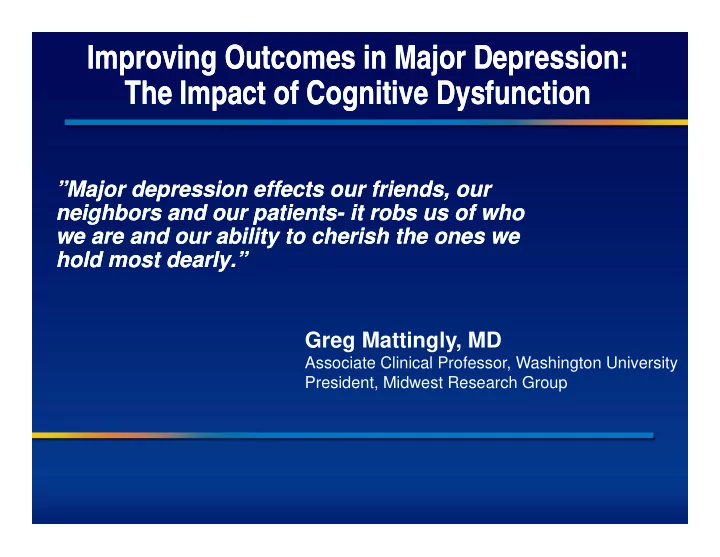
”Major depression effects our friends, our ”Major depression effects our friends, our neighbors and our patients neighbors and our patients-

  • it robs us of who

it robs us of who we are and our ability to cherish the ones we we are and our ability to cherish the ones we we are and our ability to cherish the ones we we are and our ability to cherish the ones we hold most dearly hold most dearly.” .” Greg Mattingly, MD

Associate Clinical Professor, Washington University President Midwest Research Group President, Midwest Research Group

slide-2
SLIDE 2

Top 3: Sleep, mood and concentration Top 3: Sleep, mood and concentration Prevalence of Symptoms During MDD Episodes Prevalence of Symptoms During MDD Episodes Prevalence of Symptoms During MDD Episodes Prevalence of Symptoms During MDD Episodes

100% 20% 0% 80% 60% 40% Depressed mood Sleep problems Appetite problems Sleep problems Trouble thinking Thoughts of death

  • 13-year NIMH Study of

1,920 Individuals in the Baltimore Epidemiologic

Tiredness Lost interest Worthlessness Thoughts of death

Baltimore Epidemiologic Catchment Area

Slowness/restlessness Worthlessness Chen LS, et al. Am J Psychiatry. 2000;157(4):573-580.

slide-3
SLIDE 3

Sadness, Depression and Recovery: Reciprocal Limbic-Cortical Function and Mood

Mayberg HS et. al. Am J Psychiatry 156: 675-682, 1999.

slide-4
SLIDE 4

Most Patients Fail to Achieve Remission Most Patients Fail to Achieve Remission Most Patients Fail to Achieve Remission Most Patients Fail to Achieve Remission

Sequenced Treatment Alternatives to Relieve Depression Sequenced Treatment Alternatives to Relieve Depression (STAR*D) STAR*D)

 2,876 patients with MDD treated in primary care and psychiatric 2,876 patients with MDD treated in primary care and psychiatric settings settings

– 80% of patients had chronic or recurrent depression 80% of patients had chronic or recurrent depression

 First First-line treatment line treatment  First First-line treatment line treatment

– Flexible dose of citalopram for up to 14 weeks (mean dose 42 mg/day) Flexible dose of citalopram for up to 14 weeks (mean dose 42 mg/day)

Remission rate

28%

Response rate

47%

STAR*D, Sequenced Treatment Alternatives to Relieve Depression; STAR*D, Sequenced Treatment Alternatives to Relieve Depression; MDD, major depressive disorder; SSRI, selective serotonin reuptake MDD, major depressive disorder; SSRI, selective serotonin reuptake T i di MH t l T i di MH t l A J P hi t A J P hi t 2006 163 28 2006 163 28 40 40 inhibitor. inhibitor. Trivedi MH, et al. Trivedi MH, et al. Am J Psychiatry. Am J Psychiatry. 2006;163:28 2006;163:28-40. 40.

slide-5
SLIDE 5

Depressive symptoms persist during periods of remission and Depressive symptoms persist during periods of remission and subsequent depressive episodes subsequent depressive episodes subsequent depressive episodes subsequent depressive episodes

Mean proportion of time DSM-IV symptoms are present during 3-year follow-up period (n=267)

Lack of energy Worthlessness/guilt Eating problems Psychomotor problems Cognitive problems

1.00

  • IV

Core symptoms: depressed mood/diminished interest

follow-up period (n=267)

Sleeping problems Death ideations

0.80 0.60 n of Time DSM- ster Is Present 0.40 0.20 Mean Proportion Symptom Clu 0 00 M 0.00 Weeks of Follow-up

DSM-IV, Diagnostic and Statistical Manual of Mental Disorders, 4th edition

Conradi HJ, et al. Psychol Med. 2011;41:1165-1174.

slide-6
SLIDE 6

Cognitive dysfunction of depression impacts on Cognitive dysfunction of depression impacts on functionality functionality1-

  • 3

3

functionality functionality

In MDD, cognitive impairments in information processing, memory, and verbal fluency may impact upon educational, occupational, and daily e ba ue cy ay pact upo educat o a , occupat o a , a d da y functioning1

Workplace functionality Workplace functionality

  • Government-commissioned research in 2010 found that

people unable to work because of depression lose £8.97 billi f t ti l i i E l d2 billion of potential earnings per year in England2

  • In the United States, the costs related to both

absenteeism from work and presenteeism due to $ 1

3

  • 1. Hammar A, Ardal G. Front Hum Neurosci. 2009;3:26;
  • 2. All-Party Parliamentary Group on Wellbeing Economics:

Cost of depression in England, 2010. Available at:

untreated depression are over $51 billion per year3

Cost of depression in England, 2010. Available at: http://wellbeingeconomics.files.wordpress.com/2012/02/costo fdepressionstats2010.pdf. Accessed September 2014;

  • 3. Greenberg PE, et al. J Clin Psychiatry. 2003;64(12):1465-1475.

MDD, major depressive disorder.

slide-7
SLIDE 7

Cognitive Cognitive S Symptoms in Depression Are ymptoms in Depression Are H Highly ighly Prevalent and Persistent, Even revalent and Persistent, Even After fter Treatment reatment Prevalent and Persistent, Even revalent and Persistent, Even After fter Treatment reatment

44% 94 % 44% %

REMISSION

ACUTE

REMISSION

Even in patients thought to be in remission, cognitive symptoms were shown to be present in depressed patients for an average of 44% of th ti d i i d f i i

CU

In one study, cognitive problems dominated the course of depression and were present for up to 94% of the time during depressive episodes

Conra Conradi i HJ e HJ et al.

  • al. Psy

Psycho hol Med l Med. 20 . 2011;4 ;41:1 1:1165–1 65–1174. 4.

the time during periods of remission

slide-8
SLIDE 8

Evaluating Evaluating Cognitive Performance Cognitive Performance

Di it S b l S b tit ti T t ( Di it S b l S b tit ti T t (DSST) DSST) Digit Symbol Substitution Test ( Digit Symbol Substitution Test (DSST) DSST)

DSST3 DSST

  • Measure of processing speed,

working memory and attention working memory and attention

  • The number of correct

symbols substituted for digits during a test period is measured

  • Timed- Processing Speed
  • Involves the substitution of

simple symbols for digits-

Working Memory

  • 1. Rey. L’Examen Clinique en Psychologie. 1964.
  • 2. Lezak. Neuropsychological Assessment. 1983.
  • 3. Wechsler. Wechsler Adult Intelligence Scale. 1997.
slide-9
SLIDE 9

Digit Symbol Substitution Test (DSST) Digit Symbol Substitution Test (DSST) Digit Symbol Substitution Test (DSST) Digit Symbol Substitution Test (DSST)

  • 1. Wechsler. Wechsler Adult Intelligence Scale. 1997.
slide-10
SLIDE 10

Remission Status of MDD Patients Has Remission Status of MDD Patients Has Significant Effects on Family Members Significant Effects on Family Members Significant Effects on Family Members Significant Effects on Family Members

60

Decrease in Problem Behaviors and Symptoms for Children of Depressed Mothers, by Maternal Remission Status (N=80)a

54 56 58 60

p , y ( )

Early-remitting mothers Late-remitting mothers Nonremitting mothers 48 50 52 54 42 44 46 48

  • Children of early- and late-remitting mothers significantly improved compared with those
  • f nonremitting mothers (early vs nonremitting: P=0.005; late vs nonremitting: P=0.002)b

40

Baseline 3 months 6 months 9 months

aOnly

Only data for the 9 months following remission is shown, due to high dropout rate among non data for the 9 months following remission is shown, due to high dropout rate among non-

  • remitters prior to month 12.

remitters prior to month 12.

bChild

Child Behavior Checklist was used; higher scores = greater number or severity of symptoms. Behavior Checklist was used; higher scores = greater number or severity of symptoms. 1.

  • 1. Wickramaratne

Wickramaratne P, et al. P, et al. Am J Psychiatry Am J Psychiatry. 2011;168:593 . 2011;168:593-

  • 602.

602.

g ( y g ; g )