The Rise in Depressive Disorder The Costs of Depression Rates of - - PowerPoint PPT Presentation

the rise in depressive disorder the costs of depression
SMART_READER_LITE
LIVE PREVIEW

The Rise in Depressive Disorder The Costs of Depression Rates of - - PowerPoint PPT Presentation

Out of the Blue: Challenging Myths Myths about depression: Six non-medication ways to Cause is known (biochemical and genetic) Despite the ads one sees on TV, the cause of depression is not known and has not been established as


slide-1
SLIDE 1

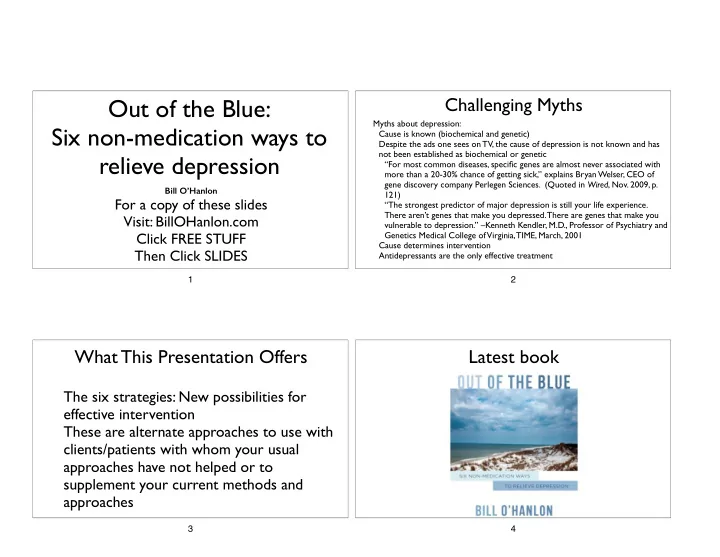
Out of the Blue: Six non-medication ways to relieve depression

Bill O’Hanlon

For a copy of these slides Visit: BillOHanlon.com Click FREE STUFF Then Click SLIDES

1

Challenging Myths

  • Myths about depression:
  • Cause is known (biochemical and genetic)
  • Despite the ads one sees on TV, the cause of depression is not known and has

not been established as biochemical or genetic

  • “For most common diseases, specific genes are almost never associated with

more than a 20-30% chance of getting sick,” explains Bryan Welser, CEO of gene discovery company Perlegen Sciences. (Quoted in Wired, Nov. 2009, p. 121)

  • “The strongest predictor of major depression is still your life experience.

There aren’t genes that make you depressed. There are genes that make you vulnerable to depression.” –Kenneth Kendler, M.D., Professor of Psychiatry and Genetics Medical College of Virginia, TIME, March, 2001

  • Cause determines intervention
  • Antidepressants are the only effective treatment

2

What This Presentation Offers

  • The six strategies: New possibilities for

effective intervention

  • These are alternate approaches to use with

clients/patients with whom your usual approaches have not helped or to supplement your current methods and approaches

3

Latest book

4

slide-2
SLIDE 2

The Rise in Depressive Disorder

  • Rates of depression have radically increased in recent years.
  • Treatment for depression has increased by 300% between 1987 and 1997; by

1997, 40% of psychotherapy patients, double the percentage of a decade before, had a diagnosis of a mood disorder.

  • The percentage of the population for depression grew from 2.1% in the early 80s

to 3.7% in the early 2000s, an increase of 76%.

  • Use of antidepressants nearly tripled from 1988 to 2000.
  • Immigrants tend to have the same rates of depression as their adopted culture/

country rather than the rates of the place from which they came

Wega, W. and Rimbaut, R. (1991). “Ethnic minorities and mental health,” Annual Review of Sociology, 7:351-383.

5

The Costs of Depression

  • WHO estimates that

depression is the leading cause of disability for 15- to 44-year-olds

  • In the US, economists

estimate that depression is responsible for $43 billion in costs every year 6

Depression can be devastating

Andrew Solomon (author of “The NoonDay Demon”) 7

Emily Dickinson I felt a funeral in my brain

I felt a funeral in my brain and mourners to and fro

Kept treading, treading 'til I thought that sense was breaking through And when they all were seated, a service like a drum Kept beating, beating 'til I thought my mind was going numb And then I heard them lift a box and creak across my soul With those same boots of lead again then space began to toll As if the heavens were a bell and being were an ear And I and silence, some strange race wrecked solitary here Just then a plank in reason broke and I fell down and down and hit a world at every plunge and finished knowing then

8

slide-3
SLIDE 3

Lincoln’s description of depression

“I am now the most miserable man living. If what I feel were equally distributed to the whole human family, there would not be one cheerful face on the earth. Whether I shall ever be better I cannot tell; I awfully forbode I shall

  • not. To remain as I am is impossible; I must die
  • r be better, it appears to me.”

9

Depression as multi-factored

  • Biochemistry is only part of the story

10

The Six Strategies

#1 Marbling #2 Undoing depression #3 Shifting relationship with depression #4 Challenging isolation/restoring and strengthening connections #5 A future with possibilities #6 Re-starting brain growth 11

#1 Marbling

Mapping depresso-land and non-depresso-land

  • Investigate times and aspects of non-depression while

finding out about depressive experience

12

slide-4
SLIDE 4

Focus mainly on depression could add to the problem

  • A recent study shows that extensive discussions of

problems and encouragement of ‘‘problem talk,’’ rehashing the details of problems, speculating about problems, and dwelling on negative affect in particular, leads to a significant increase in the stress hormone cortisol, which predicts increased depression and anxiety

  • ver time.

Byrd-Craven, J., Geary, D. C., Rose, A. J., & Ponzi, D. (2008). “Co- ruminating increase stress hormone levels in women,” Hormones and Behavior, 53, 489–492.

13

Therapy often focuses on what is wrong

14

Challenging pessimism and building

  • ptimism
  • One study found that even naturally pessimistic people who spent one week doing exercises in which

they identified and wrote down times in the past in which they were at their best, their personal strengths, expressing gratitude to someone they have never properly thanked, and writing down three good things that happened were happier when their happiness levels were measured six months later.

Seligman, M., Stern, T., Park, N & Peterson, C. (2005) “Positive Psychology progress: Empirical validation of interventions,” American Psychologist, 60: 410-421.

  • Seligman reports a study done by himself and Jeff Levy with people who scored as severely depressed

in a depression inventory. Participants were instructed to recall and write down three good things that happened each day for 15 days. 94% of them went from severely depressed to mildly to moderately depressed during that time.

Cited in Authentic Happiness, Seligman, Martin E. P ., 2002, NY: Free Press.

15

Positive Psychology can help alleviate depression

  • A meta-analysis of 51 positive psychology interventions with 4,266 individuals
  • The results revealed that positive psychology interventions do indeed significantly

enhance well-being (mean r 5.29) and decrease depressive symptoms (mean r 5.31). Sin, Nancy and Lyubomyski, Sonya. (2009). “Enhancing Well-Being and Alleviating Depression with Positive Psychology Interventions: A practice-friendly meta- analysis,” 2008). Journal of Clinical Psychology, In Session 65: 467–487. 16

slide-5
SLIDE 5

Acknowledgment and Possibility

  • An alternative is to move back and forth between discussions of

depression and non-depressive moments and experiences.

  • This not only respectfully acknowledges the person’s painful and

discouraging experiences, but gives them a reminder they aren’t and haven’t always been depressed.

  • It can also illuminate and give hints to skills, abilities and connections

that can potentially lead out of depression or at least reduce depression levels. 17

Letter from Abraham Lincoln to Fanny McCullough after she was distraught over the loss of her father in the Civil War

Dear Fanny It is with deep grief that I learn of the death of your kind and brave Father; and, especially, that it is affecting your young heart beyond what is common in such cases. In this sad world of ours, sorrow comes to all; and, to the young, it comes with bitterest agony, because it takes them unawares. The older have learned to ever expect it. I am anxious to afford some alleviation of your present distress. Perfect relief is not possible, except with time. You can not now realize that you will ever feel better. Is this not so? And yet it is a mistake. You are sure to be happy again. To know this, which is certainly true, will make you some less miserable now. I have had experience enough to know what I say; and you need only believe it to feel better at once. 18

Make maps of depresso-land and non-depresso-land

  • Compare and contrast and build maps of feelings, actions, thoughts,

focus of attention, interactions and contexts associated with both depressive experience and non-depressive experience 19

Elaine’s maps

Confident/Competent-land Depresso-land

Stays in bed until noon Stays alone; talks

  • nly to depressed

friend or therapist Gets out of bed by 9 a.m. Contacts friends Plays music Focuses on good things she has accomplished in the past Eats breakfast foods all day Doesn’t have a job

  • r quits job

Focuses on bad things happening in the future Goes to lunch alone Has a job; Goes to work Spends time with women friends

20

slide-6
SLIDE 6

Inclusion

  • Permission
  • To and not to
  • “It’s okay to feel depressed.”
  • “You don’t have to have hope right now.”
  • Inclusion of opposites
  • “You can be hopeless and have hope at the same time.”
  • Exceptions
  • “You feel hopeless except when you don’t.”

21

Discover exceptions, resources and solutions

  • Find out about moments of non-depression
  • Find out about what happens when the depression starts to lift

differently than during it

  • Ask why the problem isn’t worse
  • Import strengths and abilities from contexts of competence

22

#2 Undoing depression

  • Pattern intervention
  • Discover repeating patterns involved with and associated iwth

depressive experience and help the person change those patterns in small or big ways

  • Patterns of doing, viewing and context
  • Highlight any places around depression that the person has

moments of choice

23

Depression as a bad trance

  • Symptom trance vs. coming out of bad trance
  • Repetition as trance induction
  • “Your nostrils are closing; your nostrils are closing.”

24

slide-7
SLIDE 7

Undoing depression: Case example

  • Erickson sends a depressed person to the library

25

How to do a good depression

  • Stay still, don’t do anything that makes you breathe fast or hard
  • Stay in bed if you can; if not, sit in the same chair or lay on the couch
  • Isolate; avoid other people
  • If you can’t avoid other people, try to talk to the same person or few people
  • Talk to them about the same topic, usually how depressed/unhappy you/they are
  • Sleep during the day and have insomnia at night
  • Brood on the past, fears, faults and resentments
  • Imagine the future will be the same or worse than the past or present
  • Eat terribly; overeat or undereat (whichever one you specialize in), eat junk foods,

sugar, fat

  • Don’t pursue hobbies, passions or spiritual interests
  • Drink alcohol, smoke cigarettes, and/or use other drugs
  • Don’t ask for help

26

Undoing depression: Identifying patterns

  • Location/places
  • Activities
  • Timing/Duration
  • Sequences
  • People

27

#3: Shifting relationship to depression

28

slide-8
SLIDE 8

#3: Shifting relationship to depression

  • Mindfulness: Noticing without judging and noticing variations

in sensations, feelings, thoughts and experiences around depression

  • Externalizing: From domination and intrusion to taking back

power from depression

  • Valuing depression: Stop resisting depression to reduce the

suffering

  • Follow your wound: Making meaning and finding direction

from the crisis and pain of depression

29

Mindfulness

  • Noticing without judging
  • Noticing variations in sensations, feelings, thoughts and

experiences around depression

  • Witnessing rather than getting caught up in; being with
  • Get curious
  • Teasdale JD, et al. (2000). “Prevention of relapse/recurrence in major depression by mindfulness-

based cognitive therapy,” Journal of Consulting and Clinical Psychology, 68(4):615–623.

  • Teasdale JD, et al. (2002) “Metacognitive awareness and prevention of relapse in depression:

empirical evidence,” Journal of Consulting and Clinical Psychology, 70(2):275–287.

  • Williams, M.; Teasdale, J.; Segal, Z.; and Kabat-Zinn, J. (2007). The Mindful Way Through

Depression: Freeing yourself from chronic unhappiness. NY: Guilford.

  • Teasdale, J.D., Segal, Z.V., Williams, J.M.G., Ridgeway,

V., Lau, M., & Soulsby, J. (2000). “Reducing risk of recurrence of major depression using Mindfulness-based Cognitive Therapy,” Journal of Consulting and Clinical Psychology, 68, 615-23.

30

Mindfulness Based Cognitive Therapy (MBCT)

  • MBCT proved as effective as maintenance anti-depressants in preventing a relapse and

more effective in enhancing peoples' quality of life. The study also showed MBCT to be as cost-effective as prescription drugs in helping people with a history of depression stay well in the longer-term.

  • Over the 15 months after the trial, 47% of the group following the MBCT course

experienced a relapse compared with 60% of those continuing their normal treatment, including anti-depressant drugs. In addition, the group on the MBCT programme reported a higher quality of life, in terms of their overall enjoyment of daily living and physical well-being. Kuyken, Willem, et. al. (2008). “Mindfulness-Based Cognitive Therapy to Prevent Relapse in Recurrent Depression,” Journal of Consulting and Clinical Psychology, December; 76,(6): 966-978.

31

Mindfulness Based Cognitive Therapy (MBCT)

Other studies:

  • Bedard, M., et. al (2008). “Mindfulness-based cognitive therapy reduces depression

symptoms in people with a traumatic brain injury: Results from a pilot study,” European Psychiatry, Volume 23, Supplement 2, April, Page S243.

  • Bondolfi, Guido; et. al (2010). “Depression relapse prophylaxis with Mindfulness-Based

Cognitive Therapy: Replication and extension in the Swiss health care system,” Journal of Affective Disorders, 122(3), May:224-231.

  • Barnhofer, T., & Crane, C. (2008). “Mindfulness-based cognitive therapy for depression

and suicidality.” In Didonna (Ed.) Clinical Handbook of Mindfulness. New York. Springer.

  • Barnhofer et al. (2009). “Mindfulness-based cognitive therapy as a treatment for chronic

depression: A preliminary study,” Behaviour Research and Therapy, May(47)5:366-373.

  • Bertschy, G.B. et. al. (2008), “Mindfulness based cognitive therapy: A randomized

controlled study on its efficiency to reduce depressive relapse/recurrence,” Journal of Affective Disorders, Volume 107, Supplement 1, March 2008, Pages S59-S60.

32

slide-9
SLIDE 9

Externalizing

  • Help people separate depression from their identity
  • Speak about depression as an undermining influence
  • Investigate times when depression has dominated
  • Investigate times when they have escaped from or stood up to depression
  • Build on those exceptions to uncover personal qualities and identity stories that

show the person to be a hero and competent

  • Spread the story socially and extend it into the past and the future

33

Valuing depression

  • Stop resisting depression to reduce the suffering

34

Depression can help focus attention and reduce distractibility

  • Substantial evidence indicates that depression focuses attention on the problems

that caused the episode.

  • Depression promotes analysis and problem-solving by focusing attention on the

problem and reducing distractibility.

References: Andrews, P . et. al (2007). “The functional design of depression’s influence on attention: A preliminary test of alternative control-process mechanisms,” Evolutionary Psychology, 5(3): 584-604. Yost, J. H., and Weary, G. (1996). “Depression and the correspondent inference bias: Evidence for more effortful cognitive processing,” Personality and Social Psychology Bulletin, 22, 192-200.

35

Depression can help social cooperation and decision making

  • Happy or secure participants showed shorter decision times and

imitated others' behavior, whereas sad or insecure participants exhibited more systematic and rational behavior.

Reference: Hertel G.; Neuhof J.; Theuer T.; Kerr N. L. (2000). “Mood effects on cooperation in small groups: Does positive mood simply lead to more cooperation?” Cognition and Emotion, 14(4), July, pp. 441-472.

36

slide-10
SLIDE 10

Follow Your Wound

  • Depression can be a spur to a new life direction

37

Pissed and Dissed as Life Energies and Guides to Life Directions

  • Pissed as a clue for what to do with the rest of your

life

  • Dissed as a clue for what to do with the rest of

your life

  • Follow your blisters rather than your bliss

38

Disrepected: Wounded/Cursed

  • r

Dissatisfied: Righteously Indignant/Dissatisfied

39

Transforming the “negative” energy of anger and hurts into positive energy

40

slide-11
SLIDE 11

Patsy Rodenberg

Voice coach for actors and public speakers 41

Leonard Cohen: There’s a crack in everything. That’s how the light gets in.

42

Daughter who died of leukemia at 5. Rice wrote a novel that featured a 5-year-old who could never die. (Interview with a Vampire)

Ann Rice - A wound transformed

43

We all leave childhood with wounds. In time we may transform our liabilities into gifts. The faults that pockmark the psyche may become the source of a man or a woman’s beauty. The injuries we have suffered invite us to assume the most human of all vocations—to heal ourselves and others. –Sam Keen

Sam Keen - Wounds as invitations to healing self and others 44

slide-12
SLIDE 12

Peter Gabriel - Witness 45 I thank God for my handicaps, for through them I have found myself, my work and my God. - Helen Keller Real suffering burns clean; neurotic suffering creates more and more soot. - Marion Woodman 46

  • Where have you been wounded?
  • Where or about what have you been cursed?
  • What would you like to change about the world or other people?
  • What would you talk about if given an hour of prime time television to

influence the nation or the world?

  • How can you turn this wound or disrespect or curse into a blessing or

contribution?

Assessment of the wound

47

Post-depression thriving

  • The 3 Cs
  • Connection
  • Compassion
  • Contribution

48

slide-13
SLIDE 13

#4 Challenging isolation

  • Depression invites

people to isolation and disconnection

  • Connections as

essential healing and preventive factors

49

An example of re-connection and depression recovery from Cambodia

50

Social Isolation is Becoming More Common

Social connections are at risk in modern societies

  • Shared family dinners and family vacations are down over a third in the last 25 years
  • Having friends over to the house is down by 45% over the last 25 years
  • Participation in clubs and civic organizations is down by over 50% in the last 25 years
  • Church attendance is down by about a third since the 1960s
  • The average number of people we consider close confidants dropped nearly one-third, from

2.94 in 1985 to 2.09 in 2004

  • The average American has only two close friends
  • 1 in 4 Americans (25%) report that they have no one to confide in
  • Average household size has decreased by about 10% during the past twenty years, to 2.5

people

  • In 1990, more than 1 in 5 households were headed by a single parent; currently it is 1 in 3
  • 6.27 million people in the U.S. live alone and that is expected to increase to 29 million by

2010

  • People with five or more close friends (excluding family members) are 50 percent more likely

to describe themselves as "very happy" than respondents with fewer.

51

Connection - Parker Palmer

52

slide-14
SLIDE 14

Seven pathways to connection

  • Inner self; deep self; heart; soul; intuition
  • Body; physical self and sensations
  • Another being
  • Others; group; community
  • Art
  • Nature
  • Bigger meaning/purpose; God/higher power

53

Connection to nature

54

#5 A Future With Possibilities

  • Connecting to a future with

meaning and hope

  • Often in depression, there

is a collapse of future- mindedness and hope

  • We can help reconnect the

person with future possibilities 55

Future Pull

  • Victor Frankl
  • The farmhouse

in my future 56

slide-15
SLIDE 15

Future Pull

  • Problems into preferences
  • Positive expectancy language
  • Letter from one’s future
  • Starting therapy from post-depression

perspective

57

#6 Restarting brain growth

  • The neurogenic/neuroatrophy hypothesis and how to use it in

treatment 58

The New Brain Science

  • Old view: Brain had fixed structure and set number of brain cells, which

declined over the aging process and with damage from trauma

  • New view: Brain plasticity
  • Brain can grow new cells and make new connections throughout life
  • Brain and body experience alters the structure and connections in the

brain, strengthening, growing or weakening them and changing structure 59 60

slide-16
SLIDE 16

Neurogenic/Neuroatrophy Hypothesis

So far, the evidence for the theory is

  • sketchy. Recent findings show a

pattern that fits with the theory, though.

61

Neurogenic/Neuroatrophy Hypothesis

Stress, which plays a key role in triggering depression, suppresses neurogenesis in the hippocampus.

62

Neurogenic/Neuroatrophy Hypothesis

Scientists have also found evidence that the hippocampus shrinks in people who have had long-standing depression.

63

Neurogenic/Neuroatrophy Hypothesis

Antidepressants, on the other hand, encourage the birth of new brain cells.

64

slide-17
SLIDE 17

Neurogenic/Neuroatrophy Hypothesis

Animals must take antidepressants for two or three weeks before they bump up the birth rate of brain cells, and the cells take maybe another two weeks to start functioning. That's consistent with the lag time antidepressants show before they lift mood in people.

65

Neurogenic/Neuroatrophy Hypothesis

If an antidepressant is given during a period of chronic stress, it prevents the decline in neurogenesis that normally

  • ccurs.

66

Neurogenic/Neuroatrophy Hypothesis

People with head injuries in early adulthood experience higher rates of depression over their lifetimes.

67

Neurogenic/Neuroatrophy Hypothesis

Exercise, which combats depression in people, also promotes neurogenesis in the hippocampus.

68

slide-18
SLIDE 18

Neurogenic/Neuroatrophy Hypothesis

So does electroconvulsive therapy, popularly known as shock treatment, which works in human cases of severe depression.

69

Neurogenic/Neuroatrophy Hypothesis

Altair, C.A. et al. (2003). “Effects of electroconvulsive seizures and antidepressant drugs on brain-derived neurotrophic factor protein in rat brain,” Biological Psychiatry, 54(7):703-709. Ruso-Neustadt, A.A. et al. (2004). “Hippocampal brain-derived neurotrophic factor expression following treatment with reboxetine, citalopram, and physical exercise,” Neuropsychopharmacology, 29(12):2189-2199. 70

Neurogenesis/Neuroatrophy Hypothesis

  • Postmortem studies have shown that depressed patients had

decreased hippocampal and cortical BDNF levels

  • Several studies have shown increased BDNF when people are

treated with anti-depressants for some time

Altair, C.A. (1999). “Neurotrophins and depression,” Trends in Pharmacological Science, 20(2):59-61. Karege, F. et al. (2002). “Decreased serum brain-dreived neurotrophic factor levels in major depressed patients,” Psychiatry Research, 109(2):143-148. Sen, S. et al. (2008). “Serum brain-derived neurotrophic factor, depression, and anti-depressant medications: meta-analyses and implications,” Biological Psychiatry, 64:527-532.

71

Neurogenesis/Neuroatrophy Hypothesis

  • 27 depressed patients and 19 control participants were presented with visual images

intended to evoke either a positive or a negative emotional response. While viewing these images, participants were instructed to use cognitive strategies to increase, decrease or maintain their emotional responses to the images by imagining themselves in similar scenarios.

  • Experimenters used functional magnetic resonance imaging (fMRI) to measure brain activity

in the target areas. The scientists examined the extent to which activation in the brain's reward centers to positive pictures was sustained over time.

  • The experiment found that depressed patients showed normal levels of sustained activity in

the reward centers early on in the experiment. However, towards the end of the experiment, those levels of activity dropped off precipitously.

Heller, A. et. al. (2009). “Reduced capacity to sustain positive emotion in major depression reflects diminished maintenance of fronto-striatal brain activation,” Proceedings of the National Academy of Sciences, doi: 10.1073/pnas.0910651106.

72

slide-19
SLIDE 19

The mechanisms for brain cell growth (neurogenesis)

  • IGF-1 (insulin-like growth factor)
  • VEGF (vascular endothial growth factor)
  • BDNF (brain-derived neurotrophic factor)

“Miracle Grow for the brain”

73

  • Dr. R. Douglas Fields, NIH

neuroscientist and researcher

  • From the neurotransmitter theory to brain connectivity and plasticity
  • The brain becomes less plastic, less able to adapt and learn when the person

becomes seriously depressed

  • Brain atrophy/damage can take place with the stress of longer-term depression

that is untreated

  • Exercise can increase levels of BDNF and other factors that can oppose that

atrophy and damage

Smita Thakker-V aria, Jennifer Jernstedt Krol, Jacob Nettleton, Parizad M. Bilimoria, Debra A. Bangasser, T racey J. Shors, Ira B. Black, and Janet Alder, The Neuropeptide VGF Produces Antidepressant-Like Behavioral Effects and Enhances Proliferation in the Hippocampus, J. Neurosci., Nov 2007; 27: 12156 - 12167. Holsinger, T racey; et. al (2002). “Head Injury in Early Adulthood and the Lieftime Risk of Depression,” Archive of General Psychiatry, 59:17-22.

74

What affects brain growth and connection?

  • Learning new things that stretch your abilities (not too much) and repeating those

things through deliberate practice

  • Top things
  • New language
  • Music

Among expert musicians, certain areas of the cortex are up to 5% larger than in people with little or no musical training, recent research shows. In musicians who started their training in early childhood, the neural bridge that links the brain's hemispheres, called the corpus callosum, is up to 15% larger. A professional musician's auditory cortex – the part of the brain associated with hearing – contains 130% more gray matter than that of non-musicians.

  • New physical abilities (juggling, typing, and so on)
  • Exercise (vigorous aerobic)

75

  • Dr. Dean Ornish on exercise,

nutrition and brain growth

76

slide-20
SLIDE 20

77

Exercise and brain blood vessel growth

In people ages 60-80, those who aerobically exercised 3+ hours a week over the course of 10 years showed:

  • An increase in the number of large blood vessels in the cerebral region of the brain
  • An increase in blood flow in the 3 major cerebral arteries
  • The cerebral area controls consciousness, memory, initiation of activity, emotional response, language and

word associations

  • Narrowing and loss of blood vessels may be associated with cognitive decline

Rahman, Feraz, et. al (2008). Study presented at Radiological Society of North America; UNC Chapel Hill researchers.

78

Exercise and Mood Disorders

  • Growing evidence of strong and lasting effects of exercise
  • n depression and anxiety, as well as anger
  • Beats medications in some trials for lingering positive

effects

  • Has been shown to work on people who are not

responding to medications 79 80

slide-21
SLIDE 21

SMILE

(Standard Medical Intervention and Long Term Exercise)

  • 156 adults, diagnosed w/Major Depression
  • Randomly assigned to 3 treatment groups

1) Exercise treatment

  • Exercise consisted of brisk walking, jogging or stationary bicycle riding 3x/week
  • 10 min. warm-up; 30-min. exercise; 5-minute cool down

2) Zoloft treatment 3) Combined treatment

“Exercise and Pharmacotherapy in the Treatment of Major Depressive Disorder,” James A. Blumenthal, PhD et. al, Psychosomatic Medicine, 69:587-596 (2007).

81

SMILE

(Standard Medical Intervention and Long Term Exercise)

  • At the end of 4 months, 60-70% of the participants were “vastly

improved” or “symptom-free” in all 3 conditions

  • On 10-month follow-up:
  • 38% of Zoloft condition subjects had recurrence
  • 31% of the combined condition had recurrence
  • 8% of the exercise only had recurrence (and people who continued

to exercise were less likely as a group to have recurrence) Hypothesis: Self-efficacy; brain growth 82

SMILE

(Standard Medical Intervention and Long Term Exercise)

How much exercise matters: Every 50 minutes of exercise per week correlated with a 50% drop in depression levels

“Exercise and Pharmacotherapy in the Treatment of Major Depressive Disorder,” James A. Blumenthal, PhD et. al, Psychosomatic Medicine, 69:587-596 (2007).

83

Exercise and Mood: Depression research

Two studies found:

  • People who participated in moderately intense aerobics, such as exercising on

a treadmill or stationary bicycle - whether it was for three or five days per week - experienced a decline in depressive symptoms by an average of 47% after 12 weeks

  • Those in the low-intensity exercise groups showed a 30% reduction in

symptoms

  • Exercise also helped people who were unresponsive to medications

Trivedi, M.H., Greer, T.L., Grannemann, B.D., Chambliss, H.O., Jordan, A.N, “Exercise as an Augmentation Strategy for Treatment of Major Depression.” Journal of Psychiatric Practice, 12(4):205-13, 2006 Andrea L. Dunn, Madhukar H. Trivedi, James B. Kampert, Camillia G. Clark and Heather O. Chambliss, “Exercise treatment for depression: Efficacy and dose response,” American Journal of Preventive Medicine, Volume 28, Issue 1, January 2005, Pages 1-8

84

slide-22
SLIDE 22

Exercise and Mood: Depression research

A Purdue University study found: Middle-aged runners who had been running 3-5 times/week for 3-10 years were markedly less depressed than a matched comparison group.

  • D. Lobstein et al., “Depression as a Powerful Discriminator Between Physically Active and Sedentary Middle-Aged Men,” Journal
  • f Psychosomatic Medicine, 27 (1983):69-76.

85

ACTIVE (Advanced Cognitive Training for

Independent and Vital Elderly) Study

  • Cognitive/brain training that increased speed of processing in the

elderly decreased the likeilhood of developing depression (compared with a control group) by 38% as measured one year out.

Fredric D. Wolinsky et. al. (2009). “The ACTIVE Cognitive Training Interventions and the Onset of and Recovery from Suspected Clinical Depression,” The Journals of Gerontology Series B: Psychological Sciences and Social Sciences, 64B(5):577-585

86

Exercise improves mood in elderly

  • Seniors who had never exercised before experienced a mood-lifting

effect (less depression and anxiety and better reported quality of life) from regular aerobic exercise (3X/week on alternate days for 6 months)

Antunes, H.K. et. al. (2005). “Depression, anxiety, and quality of life scores in seniors after an endurance exercise program,” Brasileira de Psiquiatria, 27(4):266-271.

87

Exercise improves mood in elderly

  • Exercise worked as well as an antidepressant medication in relieving

minor depression in seniors, and had the added effect of improving physical functioning (such as walking more briskly)

Brenes, G.A. et. al. (2007). “Treatment of minor depression in older adults: A pilot study comparing sertraline and exercise,” Aging and Mental Health, 11(1):61-68.

88

slide-23
SLIDE 23

Exercise and Mood: Depression research

A University of Virginia study found:

  • Exercise had the most profound mood-lifting effect on

people who were depressed

  • The effect increased with the amount of exercise
  • The study also found reductions in anger and anxiety through

exercise

  • R. Brown et. al (1978). “The Prescription of Exercise for Depression,” Physician and Sportsmedicine, 6:34-49.

89

Exercise and Moods: Depression research

Beware of “overtraining,” or exercising too much (as in anorexia and

  • ther compulsive problems)
  • The evidence shows that over-exercising (exercising several

times a day at training levels that are at or near maximal) is correlated with depressed moods

  • W. Morgan et. al (1991). “Psychological Monitoring of Overtraining and Staleness,” British Journal of Sports Medicine, 12:146-59.

90

  • Dr. John Ratey on exercise and

mood disorders

  • Serotonin, dopamine, norepinephrine levels and regulation affected by

exercise 91 92

slide-24
SLIDE 24
  • Consider doing “walking sessions”
  • Encourage clients/patients to move as much as they are able

How to translate this in clinical work

93

Getting people to exercise

  • Walking sessions
  • Baby steps
  • The solution-oriented method
  • The buddy system
  • Linking to motivation
  • Away from/toward

94

  • For anxiety, maybe as little as 10-15 mins. can reduce anxiety
  • 3x/week for at least 20 mins. aerobic exercise at 50-70% of maximum heart

rate for relief of depression

  • For maximum brain growth and learning: 6x/week for 50 minutes at 50-70%
  • f maximum heart rate
  • And then learn something new in the next 24 hours
  • Stretch yourself by doing/learning something slightly beyond your comfort

Recommendations for amount of exercise

95

THANK YOU

96