Inaugural Meeting of the International Think Tank for LLDCs - - PowerPoint PPT Presentation

inaugural meeting of the international think tank for
SMART_READER_LITE
LIVE PREVIEW

Inaugural Meeting of the International Think Tank for LLDCs - - PowerPoint PPT Presentation

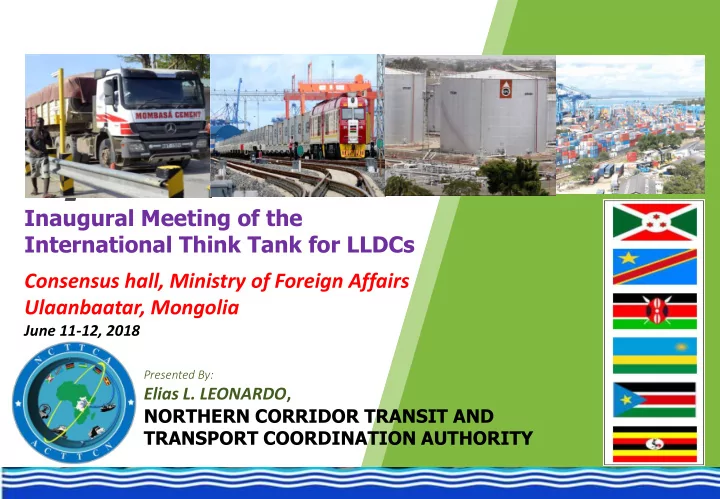
Inaugural Meeting of the International Think Tank for LLDCs Consensus hall, Ministry of Foreign Affairs Ulaanbaatar, Mongolia June 11-12, 2018 Presented By: Elias L. LEONARDO , NORTHERN CORRIDOR TRANSIT AND TRANSPORT COORDINATION AUTHORITY

slide-1
SLIDE 1

Inaugural Meeting of the International Think Tank for LLDCs Consensus hall, Ministry of Foreign Affairs Ulaanbaatar, Mongolia

June 11-12, 2018

Presented By:

Elias L. LEONARDO, NORTHERN CORRIDOR TRANSIT AND TRANSPORT COORDINATION AUTHORITY

slide-2
SLIDE 2

PRESENTATION OUTLINE

NORTHERN CORRIDOR TRANSIT AND TRANSPORT COORDINATION AUTHORITY

  • A. Transport Corridors in Africa
  • B. The Northern Corridor
  • C. Northern Corridor Transport Observatory
  • D. Key Initiatives & Success Stories
  • E. Bottlenecks & Challenges
  • F. Recommendations
slide-3
SLIDE 3
  • A. TRANSPORT CORRIDORS IN AFRICA

NORTHERN CORRIDOR TRANSIT AND TRANSPORT COORDINATION AUTHORITY

  • Africa has a number of Transport Corridors.
  • The Corridors mainly link Landlocked countries (LLCs)

to various Maritime Ports around the continent.

  • Transport Corridors facilitate Trade and boost regional

integration.

  • Most African Corridors have management and/or

coordination Authorities to promote efficiency.

  • However, there are still some challenges facing the

African Corridors.

slide-4
SLIDE 4
slide-5
SLIDE 5
  • A. TRANSPORT CORRIDORS IN AFRICA

NORTHERN CORRIDOR TRANSIT AND TRANSPORT COORDINATION AUTHORITY

Transport Corridors play three major roles:

  • A. INFRASTRUCTURE

Transport Corridors provide the infrastructure and capacity to undertake trade (both import and export); and are therefore crucial prerequisite for trade facilitation in the LLCs.

  • B. INTEGRATION

Cross-border trade flows and cooperation, like those taking place in the East African Region often foster integration and faster economic transformations.

  • C. MARKET

Transport Corridors are market development tool, either

  • n the maritime foreland or on the hinterland.
slide-6
SLIDE 6
  • B. THE NORTHERN CORRIDOR

NORTHERN CORRIDOR TRANSIT AND TRANSPORT COORDINATION AUTHORITY

  • The Northern Corridor is a Transport Corridor linking

the Great Lakes countries of Burundi, DR Congo, Rwanda, South Sudan and Uganda to the Kenyan seaport of Mombasa.

  • The Corridor also serves Tanzania, Ethiopia and

Somalia.

  • It is a multi-modal Corridor encompassing: Road,

Rail, Pipeline and Inland Waterways.

  • The Corridor is the busiest route in the whole of the

East and Central Africa.

slide-7
SLIDE 7
slide-8
SLIDE 8
  • B. THE NORTHERN CORRIDOR SECRETARIAT

NORTHERN CORRIDOR TRANSIT AND TRANSPORT COORDINATION AUTHORITY

  • The Northern Corridor Secretariat was established through a

Treaty known as the Northern Corridor Transit and Transport Agreement signed in 1985 and revised in 2007.

  • The Agreement has 11 Protocols on (maritime port, routes,

customs control and operations, documentation & procedures, rail transport, waterways transport, pipeline, multimodal transport, handling of dangerous goods, facilitation of transit and corridor development) ; all aiming at transforming the Corridor into an economic development Corridor.

  • The Legal Framework took into account the three pillars of

Sustainable Transport (i.e. Social, Economic and Environmental).

  • The highest policy making organs are the Council of Ministers

and the Executive Committee.

slide-9
SLIDE 9

NORTHERN CORRIDOR TRANSIT AND TRANSPORT COORDINATION AUTHORITY

  • C. THE NORTHERN CORRIDOR TRANSPORT OBSEVATORY

The Northern Corridor Transport Observatory is a monitoring tool that assesses and measures performance of the Northern Corridor and has an online platform to track and disseminate information on various key performance indicators. Main Purpose:

  • Identification of areas for improvement in relation to targets.
  • Provision of a set of tools for diagnosing problems on the corridor.
  • Measuring the evolution of the Corridor

to gauge efficiency and bottlenecks.

  • Provision of reliable information for policy and decision making.

The Observatory Track 35 Performance Indicators on:

  • 1. Volume and Capacity
  • 2. Transport cost and rates
  • 3. Productivity and efficiency
  • 4. Transit time and delays
  • 5. Intra-Regional Trade
  • 6. Green Freight Program
slide-10
SLIDE 10
  • Harmonization and simplification of Customs processes and

procedures.

  • The Web-based Northern Corridor Transport Observatory and

the GIS component (www.ttcanc.org or http://top.ttcanc.org and

www.Kandalakaskazi.or.ke).

  • The Single Customs Territory (SCT) and the Regional Electronic

Cargo Tracking System (RECTs).

  • Regular Northern Corridor Road Surveys and Road Safety

Initiatives.

  • The One Stop Border Post (OSBP) initiatives at major border

crossings between Member States.

  • The self regulatory Vehicles Axle Load Control and adoption of

High Speed Weighing in Motion.

  • The Road Side Stations (RSS) Initiative .
  • The Northern Corridor Green Freight Transport Program.
  • The Public-Private Stakeholders consultative forum.

NORTHERN CORRIDOR TRANSIT AND TRANSPORT COORDINATION AUTHORITY

  • D. KEY INITIATIVES & SUCCESS STORIES
slide-11
SLIDE 11
  • E. BOTTLENECKS & CHALLENGES

NORTHERN CORRIDOR TRANSIT AND TRANSPORT COORDINATION AUTHORITY

  • Slow domestication of some of the provisions of the Northern

Corridor Agreement and Protocols.

  • Varying National priorities in the Northern Corridor Member

States; especially the LLCs.

  • Poor infrastructure/limited capacity and insufficient financing

for projects in the Member States.

  • Slow economic growth, low productive capacity and general

governance issues.

  • Multiple and overlaping memberships in Regional Economic

Communities (RECs).

  • The issue of state sovereignty and diverging roadmaps to

integration.

  • Inadequate knowledge management on issues of the LLCs and

lack of consistent memory, and reliable records and documentation of issues.

slide-12
SLIDE 12

NORTHERN CORRIDOR TRANSIT AND TRANSPORT COORDINATION AUTHORITY

  • F. RECOMMENDATIONS
  • Enhancing partnerships between Member States in improving

connectivity and infrastructure development.

  • Harmonizing and streamlining of policy , legal framework and

regulations.

  • Maintaining strong M&E mechanisms to assist policy makers on

informed decisions.

  • Encouraging Intra-Regional and strengthening Trade Facilitation

instruments.

  • Enhancing the productive capacity in LLCs and promoting

enabling environment for Private Sector participation.

  • Building capacity at key National, Corridor and Regional levels.
  • Implementing strategies that accelerates economic and social

growth along the Corridor while ensuring environmental sustainability for the populations.

slide-13
SLIDE 13

NORTHERN CORRIDOR TRANSIT AND TRANSPORT COORDINATION AUTHORITY Links Road, Nyali, P O Box 34068, 80118, Mombasa, Kenya Telephone: +254 41 4470734/729 923574/733 532485, Telefax: +254 41 4470735 Email: ttca@ttcanc.org Website: www.ttcanc.org

CONTACT US

slide-14
SLIDE 14

THANK YOU!

MERCI POUR VOTRE AIMABLE ATTENTION eleonardo@ttcanc.org