Ro#erdam m urban hydro- Herman Russchenberg me meteorological - - PowerPoint PPT Presentation

ro erdam m urban hydro
SMART_READER_LITE
LIVE PREVIEW

Ro#erdam m urban hydro- Herman Russchenberg me meteorological - - PowerPoint PPT Presentation

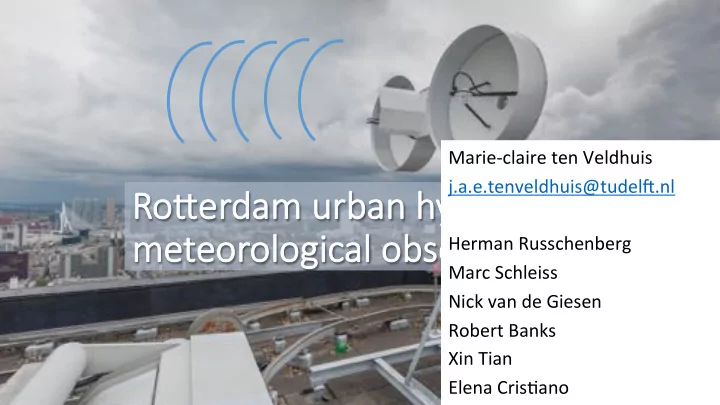
Marie-claire ten Veldhuis j.a.e.tenveldhuis@tudel5.nl Ro#erdam m urban hydro- Herman Russchenberg me meteorological observatory Marc Schleiss Nick van de Giesen Robert Banks Xin Tian Elena CrisEano Andreas Krietemeyer


slide-1
SLIDE 1

Ro#erdam m urban hydro- me meteorological observatory

Marie-claire ten Veldhuis j.a.e.tenveldhuis@tudel5.nl Herman Russchenberg Marc Schleiss Nick van de Giesen Robert Banks Xin Tian Elena CrisEano Andreas Krietemeyer

slide-2
SLIDE 2

2

Hydro-Meteo-observatory Rotterdam

Objec&ves:

  • Measuring small-scale rainfall variability
  • Short-term high resoluEon rainfall forecasEng

(nowcasEng)

  • Numerical weather predicEon and rainfall forecasEng
  • Hydrological response analysis and early-warning

Partners: TU Del5: Deps Watermanagement ; Geosciences&Remote Sensing ; Microelectronics RoTerdam City: Watermanagement ; Climate Resilience Program Industrial partners: SkyEcho, RHDHV

slide-3
SLIDE 3

3

Hydro-Meteo-observatory Rotterdam

EU-funding support and interna&onal collabora&on:

  • MUFFIN (MulE-scale Urban Flood ForecastINg)
  • FLoodCiESense (Early warning service for urban pluvial

floods for and by ciEzens and city authoriEes)

  • BRIGAID (Bridging the Gap for InnovaEons in Disaster

Resilience)

slide-4
SLIDE 4

4

Hydro-meteorological

  • bservaEon network

RoTerdam region 40km – 30 km – 20 km – 10 km – 5km range from radar posiEon (RoTerdam city centre)

slide-5
SLIDE 5

5

Hydro-meteorological

  • bservaEon network

RoTerdam region 40km – 30 km – 20 km – 10 km – 5km range from radar posiEon (RoTerdam city centre)

slide-6
SLIDE 6

6

Hydro-meteorological

  • bservaEon network

RoTerdam region 40km – 30 km – 20 km – 10 km – 5km range from radar posiEon (RoTerdam city centre)

slide-7
SLIDE 7

7

Hydro-meteorological

  • bservaEon network

RoTerdam region 40km – 30 km – 20 km – 10 km – 5km range from radar posiEon (RoTerdam city centre)

slide-8
SLIDE 8

8

Hydro-meteorological

  • bservaEon network

RoTerdam region 40km – 30 km – 20 km – 10 km – 5km range from radar posiEon (RoTerdam city centre)

slide-9
SLIDE 9

9

Available instrumentation

  • Polarimetric Xband radar
  • MRR: verEcal profiling radar
  • Weather staEons: 8 operaEonal (Campbell) + 5 addiEonal to be

installed (Davis)

  • GNSS receivers for water vapour esEmaEon: 4 single frequency,

14 dual frequency (from Nov. 2017)

  • 50-60 Amateur weather staEons (Netatmo, Wunderground)
  • 6 Disdrometers (installed on pumping staEons, status under

invesEgaEon)

  • 20 Water level sensors at overflow weirs
  • 100+ water level/flow sensors at pumping staEons
slide-10
SLIDE 10

10

Polarimetric X-band radar

Some numbers:

  • AlEtude radar: 156 m
  • Blind zone near radar

(min range): 200m

  • 1 full PPI/min

(6 degrees per second)

  • constant elevaEon angle (1.4°)
  • beam width 2.5 degrees
  • FMCW radar: frequency excursions 5-50MHz
  • 20 m range resoluEon ((range 3 - 30m for 50-5MHz)
  • max range: 30 km
  • Data formats: 1 min NetCDF
slide-11
SLIDE 11

11

Pixel surface area: 100 m2 Radar alEtude = 156 m

slide-12
SLIDE 12

12

Polarimetric X-band radar

Rainfall es&ma&on:

  • via specific differenEal phase (KDP)
  • via radar reflecEvity (R)
  • interpolated
slide-13
SLIDE 13

13

Radar PPI ReflecEon HH 18 Aug 2017, 9.39-9.48h

slide-14
SLIDE 14

14

MRR: vertical profiling radar

ObjecEves:

  • Precisely measure

hydrometeors from urban rainfall events with high ver&cal and spa&al resolu&on

  • learn more about the drop size

distribuEon, liquid water content and rain rate for high- impact events

slide-15
SLIDE 15

15

Liquid Water Content (g/m3) VerEcal range (m asl) Ver&cal profile of Liquid Water Content: Product of total volume

  • f all droplets with

density of water, divided by the scaTering volume

  • 0 - 4000 m verEcal

range

  • Over 60 min Eme

Rain rate (mm/h) Rain rate: derived from liquid water content and fall velocity (Doppler spectra)

slide-16
SLIDE 16

16

Network of weather stations

Campbell (HQ) Davis (MQ) Netatmo (LQ) Disdrometers (?)

slide-17
SLIDE 17

17

Network of weather stations

www.weather.tudel5.nl Rainfall: retrieval of Epping Emes Data communica&on: LoRa (Long Range, wireless data communicaEon)

slide-18
SLIDE 18

18

Network of personal weather stations

#Insert 1 or 2 quicklooks from MRR Brief descripEon of parameters measured ObjecEve of instrument?

Ongoing work 2017-2018: Development of data quality algorithm for PWS rainfall data In collaboraEon with:

  • KNMI
  • Wageningen University

Weather amateur networks: personal weather staEon data (PWS)

slide-19
SLIDE 19

19

Hydrological response analysis

  • Water level sensors at CSOs: 21 locaEons,

in 13 sewer districts

  • Flood observaEons by ciEzens

(call centre data)

  • Impact of green-blue soluEons: green roofs,

permeable pavements, bio-retenEon/rain gardens

slide-20
SLIDE 20

20

Water levels at cso-weirs - Response Eme analysis, preliminary conclusions:

  • RT varies between < 1 to > 4 h (25-75%

range)

  • No significant correlaEons with area

size, imp. degree

Figures: Response Eme analysis; water level (blue), rainfall (red) (Example for District 5, 3 events) Courtesy: Mar-jn Mulder, MSc student TU Del8

slide-21
SLIDE 21

21

Crowdsourcing: citizens’ flood

  • bservations

ObjecEve: to idenEfy criEcal thresholds for early warning

Courtesy: Chris-an Bouwens, MSc student TU Del8 Density of flood reports, 2010-2016

slide-22
SLIDE 22

22

Hydrological response analysis : Overflow pumping

ObjecEve: to idenEfy criEcal thresholds for early warning

slide-23
SLIDE 23

23

Rain gauge ater level sensor umping staEon Study area: 1.32 km2

Impact of green-blue solutions

3-month study period: 10 Oct-10 Dec 2016, mild rainfall events (no CSO overflows) Courtesy: Jack Hill, visi-ng student Univ of Melbourne

slide-24
SLIDE 24

24

Impact of green-blue solutions

3-month study period: 10 Oct-10 Dec 2016 % Total implementaEon: area implemented/total area

slide-25
SLIDE 25

25

Impact of green-blue solutions

% Total implementaEon: area implemented/total area Flow variability (expressed as STD) % Peak runoff reducEon: Q_99%-ile (x% impl)/ Q_99%-ile (0% impl)

slide-26
SLIDE 26

26

Impact of green-blue solutions

Some preliminary conclusions:

  • green roofs and permeable pavements more

effecEve than bioretenEon (larger storage capacity)

  • locaEon of implementaEon is important:

larger impact close to system outlet than far from system outlet

1-2-3 June 2018

slide-27
SLIDE 27

27

Hydro-Meteo-observatory Rotterdam

Future work

  • Analysing small-scale rainfall variability, space-Eme

characterisEcs

  • Obtain high accuracy rainfall esEmates
  • Develop early-warning tool to support urban flood

response (low-cost rainfall sensors, ciEzen science project)

  • Hydrological response analysis: predictors for peak flow

variability, runoff raEos, impact of imperviousness and green blue soluEons

  • Short-term high resoluEon rainfall forecasEng (nowcasEng)
  • Numerical weather predicEon: WRF for urban environment
slide-28
SLIDE 28

28

Merci de votre aJen&on Thank you!

Marie-claire ten Veldhuis j.a.e.tenveldhuis@tudel5.nl

Herman Russchenberg, Marc Schleiss, Nick van de Giesen, Robert Banks, Xin Tian, Elena CrisEano, Andreas Krietemeyer

slide-29
SLIDE 29

29

Backup slides

slide-30
SLIDE 30

30

slide-31
SLIDE 31

31

NaEonal Weather Radar Polarimetric X-band radar 1x1 km2, 5-15 min 100x100 km2, 1 min

Courtesy: KNMI Courtesy: H.W.J. Russchenberg

slide-32
SLIDE 32

32

slide-33
SLIDE 33

33

slide-34
SLIDE 34

34

slide-35
SLIDE 35

35

slide-36
SLIDE 36

36

slide-37
SLIDE 37

37