The NLRB's New Prohibition of Class Action Waivers in Arbitration - - PowerPoint PPT Presentation

the nlrb s new prohibition of class action waivers in
SMART_READER_LITE
LIVE PREVIEW

The NLRB's New Prohibition of Class Action Waivers in Arbitration - - PowerPoint PPT Presentation

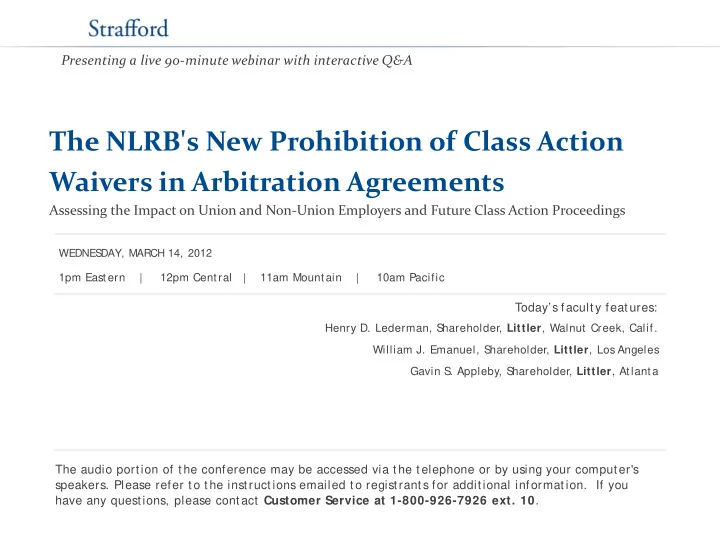
Presenting a live 90-minute webinar with interactive Q&A The NLRB's New Prohibition of Class Action Waivers in Arbitration Agreements Assessing the Impact on Union and Non-Union Employers and Future Class Action Proceedings WEDNES DAY,


slide-1
SLIDE 1

The NLRB's New Prohibition of Class Action Waivers in Arbitration Agreements

Assessing the Impact on Union and Non-Union Employers and Future Class Action Proceedings

Today’s faculty features:

1pm East ern | 12pm Cent ral | 11am Mount ain | 10am Pacific

The audio portion of the conference may be accessed via the telephone or by using your computer's

  • speakers. Please refer to the instructions emailed to registrants for additional information. If you

have any questions, please contact Customer Service at 1-800-926-7926 ext. 10.

WEDNES DAY, MARCH 14, 2012

Presenting a live 90-minute webinar with interactive Q&A

Henry D. Lederman, S hareholder, Littler, Walnut Creek, Calif. William J. Emanuel, S hareholder, Littler, Los Angeles Gavin S . Appleby, S hareholder, Littler, At lant a

slide-2
SLIDE 2

Conference Materials

If you have not printed the conference materials for this program, please complete the following steps:

  • Click on the + sign next to “ Conference Materials” in the middle of the left-

hand column on your screen.

  • Click on the tab labeled “ Handouts” that appears, and there you will see a

PDF of the slides for today's program.

  • Double click on the PDF and a separate page will open.
  • Print the slides by clicking on the printer icon.
slide-3
SLIDE 3

Continuing Education Credits

For CLE purposes, please let us know how many people are listening at your location by completing each of the following steps:

  • Close the notification box
  • In the chat box, type (1) your company name and (2) the number of

attendees at your location

  • Click the S

END button beside the box

FOR LIVE EVENT ONLY

slide-4
SLIDE 4

Tips for Optimal Quality

S

  • und Qualit y

If you are listening via your computer speakers, please note that the quality of your sound will vary depending on the speed and quality of your internet connection. If the sound quality is not satisfactory and you are listening via your computer speakers, you may listen via the phone: dial 1-866-258-2056 and enter your PIN -when prompted. Otherwise, please send us a chat or e-mail sound@ straffordpub.com immediately so we can address the problem. If you dialed in and have any difficulties during the call, press *0 for assistance. Viewing Qualit y To maximize your screen, press the F11 key on your keyboard. To exit full screen, press the F11 key again.

slide-5
SLIDE 5

D.R D.R. . HOR HORTON ON & AR ARBITRAL AL CLAS LASS AC ACTION ON WAI WAIVE VERS

HENRY LEDERMAN/ GAVIN APPLEBY / WILLIAM EMANUEL

5

slide-6
SLIDE 6

Biography

Hen enry D

  • D. Led

eder erman an has devoted his practice almost exclusively to employment law counseling, litigation, and appeals, including those related to the drafting and enforcement of arbitration

  • statutes. Henry recently appeared before the

United States Supreme Court and prevailed on behalf of his client in a matter involving the enforcement of an arbitration agreement.

6

slide-7
SLIDE 7

Biography

Gav avin S

  • S. Appl

ppleby by advises and represents employers in a broad range of employment law matters, from defending single-plaintiff and class action employment cases to offering advice on difficult employment issues and labor relations matters. He also has significant experience with NLRB charges, union campaigns and preventive training related to NLRB issues. In addition,

  • Mr. Appleby is experienced in implementing legal

compliance measures and ADR programs, and has handled more than 300 arbitrations during his career.

7

slide-8
SLIDE 8

Biography

Willi illiam J.

  • J. Ema

manuel has decades of experience representing employers at the NLRB and in related

  • litigation. He is currently writing an amicus brief in the

Fifth Circuit appeal of the NLRB’s D.R. Horton decision

  • n behalf of a trade association. Following the Horton

decision, he has filed briefs on that issue for employers in support of federal court motions to compel arbitration and he is defending Horton-related charges at the NLRB involving arbitration opt-out clauses.

8

slide-9
SLIDE 9

NLRB’s New Role in Mandatory Arbitration—How Did This Happen?

  • NLRB and its historically varying political

views.

  • Current Board’s efforts to expand NLRA to

non-union world.

  • What is “protected concerted activity”?
  • What does this have to do with arbitration

agreements?

9

slide-10
SLIDE 10

The Issue

Employers may – or may not - now be able to eliminate the risk of class, collective and/or representative actions by establishing agreements to arbitrate individual claims only.

10

slide-11
SLIDE 11

The Cases

  • AT&T Mobility LLC v. Concepcion, 131 S.Ct.

1740 (2011)

  • Compucredit Corp. v. Greenwood, 2012 U.S.

Lexis 575 (U.S. Jan. 10, 2012)

  • D.R. Horton, 357 NLRB No. 184

(Jan. 3. 2012)

11

slide-12
SLIDE 12
  • Issue: “Whether the [Federal Arbitration Act]

prohibits States from conditioning the enforceability of certain arbitration agreements on the availability of class-wide arbitration procedures.”

AT&T Mobility v. Concepcion

12

slide-13
SLIDE 13

AT&T Mobility v. Concepcion

  • Holding: California law limiting the enforcement of

class action waivers in arbitration agreements “stands as an obstacle to the accomplishment and execution of the full purposes and objectives of Congress.”

13

slide-14
SLIDE 14

AT&T Mobility v. Concepcion

  • “Principal purpose” of the FAA is to “ensure that

private arbitration agreements are enforced according to their terms.”

  • Parties may agree to limit issues subject to

arbitration.

  • California’s Discover Bank rule improperly targets

adhesion contracts and applies arbitrary rules.

  • FAA preempts contrary state law.

14

slide-15
SLIDE 15

After Concepcion

  • Concepcion has been applied in the

employment context:

– E.g. Green v. Super Shuttle Inc., 2011 U.S. App. LEXIS 18483 (8th Cir.

  • Sept. 6, 2011);
  • Following Concepcion, the U.S. Supreme

Court vacated Sonic Calabasas A, Inc. v. Moreno, 51 Cal. 4th 659 (2011), a case which invalidated an arbitration agreement in the employment context.

15

slide-16
SLIDE 16

Compucredit v. Greenwood

  • Issue: “Whether the Credit Repair Organizations Act

(CROA) precludes enforcement of an arbitration agreement in a lawsuit alleging violations of that Act.”

16

slide-17
SLIDE 17

Compucredit

  • Holding: Because the CROA is silent on whether

claims may proceed to arbitration, the Federal Arbitration Act requires that the arbitration agreement be enforced as written.

17

slide-18
SLIDE 18

Compucredit

  • General language in a statute giving a “right to sue” does not

preclude arbitration.

  • “Had Congress meant to prohibit these very common

provisions [arbitration] in the CROA, it would have done so in a manner less obtuse than what respondents suggest.”

  • Silent statute ≠ Non-enforcement of arbitration agreement
  • Does NLRA specifically address arbitration under FAA

agreements?

18

slide-19
SLIDE 19

NLRB General Counsel Memo GC-10-06

  • Issued on June 16, 2010
  • Applies to non-union employees
  • Recognizes that the United States Supreme Court

“determined that an employer can require an employee, as a condition of employment, to channel his or her individual non-NLRA employment claims into a private arbitral forum.”

  • BUT...

19

slide-20
SLIDE 20
  • In order for a class action waiver to be valid, it

must contain specific language.

  • Employee retains the right to exercise Section 7

rights.

  • Employees will not be retaliated against for

concertedly challenging class action waiver by filing class or collective actions.

  • But, employer may enforce its class action waiver.

NLRB General Counsel Memo GC-10-06

20

slide-21
SLIDE 21

Not So Fast...

D.R. Horton, Inc., 357 NLRB No. 184 (Jan. 3. 2012)

  • National Labor Relations Board: employees have the

right to engage in “concerted, protected activity.”

  • Class actions are such activity.
  • Arbitration agreement requiring an employee “as a

mandatory condition of employment” to waive the right to bring a class action violates the NLRA.

  • GC 10-06 expressly repudiated.

21

slide-22
SLIDE 22

According to the NLRB

  • Employment class actions, as distinguished from

those involving consumers (as in the AT&T Mobility case), are limited in scope, and thus, “class-wide arbitration is . . . far less cumbersome and more akin to an individual arbitration proceeding.”

  • The ruling only applies to “employees” as defined

by the National Labor Relations Act ─ supervisors, for example are not covered by the NLRA.

22

slide-23
SLIDE 23

What’s Next?

  • Decided by a two-member board.

– One member’s appointment may have been expired.

  • An appeal is pending at the 5th Circuit.
  • Courts are already grappling with

application of Horton to pending claims:

– LaVoice v. UBS Financial Services, Inc., Case No. 11 Civ. 2308 (S.D.N.Y.

  • Jan. 13, 2012)

– Johnmohammadi v. Bloomingdale’s Inc., Case No. 11-cv-6434 (C.D.

  • Cal. 2012).

23

slide-24
SLIDE 24

Attacking Horton

  • The NLRA must accommodate the FAA:
  • Southern S.S. Co. v. NLRB, 316 U.S. 31(1942)
  • (“[T]he Board has not been commissioned to effectuate the [NLRA’s]

policies . . . so single-mindedly that it may wholly ignore other and equally important Congressional [objectives].”

  • “Frequently the entire scope of Congressional purpose calls for careful

accommodation of one statutory scheme to another, and it is not too much to demand of [the Board] that it undertake this accommodation . . . .”

  • Hoffman Plastic Compounds, Inc. v. NLRB, 535 U.S. 137, 140 (2002)
  • “Where the Board’s chosen remedy trenches upon a federal statute or

policy outside the Board’s competence to administer, the Board’s remedy may be required to yield.”

24

slide-25
SLIDE 25

Attacking Horton Cont.

  • Reading the NLRA to hold that the class action

procedural device overrides the substantive right to enforce arbitration agreements conflicts with the Rules Enabling Act.

  • Horton ignored the effect on national and even

state-wide class proceedings that involve hundreds or thousands of employees.

  • Wal-Mart Stores, Inc. v. Dukes, involved a

certified class of approximately 1.5 million employees.

25

slide-26
SLIDE 26

Attacking Horton Cont.

  • The practical consequence of requiring

class arbitration would force the abandonment of workplace arbitration and harm both employees and employers.

  • Arbitration is a mutually beneficial

means of dispute resolution.

26

slide-27
SLIDE 27

Attacking Horton Cont.

  • The NLRB’s reliance on the Norris

LaGuardia Act

– NLRB lacks jurisdiction over Norris LaGuardia. – NLRB’s analysis is erroneous.

27

slide-28
SLIDE 28

How is Plaintiffs’ Bar Responding?

  • Horton as defense to motions to compel

arbitration

  • Unfair labor practice charges at the NLRB

28

slide-29
SLIDE 29

Effect of Opt-Out Clause

  • Makes an agreement voluntary.

– Horton only addressed an arbitration agreement that “required” class waiver “as a condition of employment.” – Unfair labor practice under Section 8(a)(1)

  • f the NLRA requires proof that an

employer has “interfere[d] with, restrain[ed], or coerce[ed] employees in the exercise of the rights guaranteed” in Section 7 of the NLRA.

29

slide-30
SLIDE 30

Effect of Opt-Out Clause Cont.

  • Possibly leaves open an avenue for class

litigation.

  • Agreement falls outside of Horton’s

purview and because not mandatory does not violate the NLRA.

30

slide-31
SLIDE 31

Effect of Opt-Out Clause Cont.

  • Makes an agreement consistent with

Section 7 “Right to Refrain”

  • Section 7 of the NLRA provides that

employees “shall have the right to engage in other concerted activities . . . and shall also have the right to refrain from any or all of such activities.”

31

slide-32
SLIDE 32

Elements of a Post-Concepcion Arbitration Agreement

  • FAA governs
  • Coverage

(wage/hour, discrimination)

  • Carve outs

– Administrative (EEOC/NLRB) – Claims (NLRA, Dodd Frank, Franken DoD)

  • Selection of arbitrator (mutual agreement)
  • Arbitrator qualifications (member of local bar,

retired from local judiciary - see 9 U.S.C. 5)

32

slide-33
SLIDE 33
  • Venue (close to where employee

last worked for company)

  • Express class waiver

– Court decides validity – Non-severability – NLRB section 7 disclaimer

  • Remedies (individual only)
  • Opt-out clause?

Elements of a Post-Concepcion Arbitration Agreement

33

slide-34
SLIDE 34

Elements of a Post-Concepcion Arbitration Agreement

  • Know the law on arbitration and monitor

developments in arbitration law

  • Implement an effective arbitration program
  • Identify a workable and effective

implementation policy

  • Enforce the arbitration program

34

slide-35
SLIDE 35

The Rollout

  • Stand-alone agreement with wet signature

(go gold ld standard rd)

  • Stand-alone policy – no signature/electronic

signature or acknowledgment only

  • Policy in handbook (“this is not a contract”)
  • What to do with employees who refuse to

sign...

35

slide-36
SLIDE 36

Unionized Employers?

  • Practical impact of Horton on

Unionized employers?

36

slide-37
SLIDE 37

To Summarize—Key Points re Horton

  • Unprecedented expansion of NLRB’s

jurisdiction.

  • Disregards policy of Federal Arbitration

Act.

  • Attempts to overrule Supreme Court

precedent.

37

slide-38
SLIDE 38

To Summarize—Key Points re Horton

  • Should be contested in multiple forums.
  • Should be distinguished when opt-out

exists.

  • Should be minimized by review/revision of

policies.

38

slide-39
SLIDE 39

Contact Info

Henry Lederman 925-927-4501 HLederman@littler.com Gavin Appleby 404-760-3935 GAppleby@littler.com Bill Emanuel 310-772-7205 WEmanuel@littler.com

39