In each case: fixed firms in the market, then entry/exit Review - - PowerPoint PPT Presentation

in each case fixed firms in the market then entry exit
SMART_READER_LITE
LIVE PREVIEW

In each case: fixed firms in the market, then entry/exit Review - - PowerPoint PPT Presentation

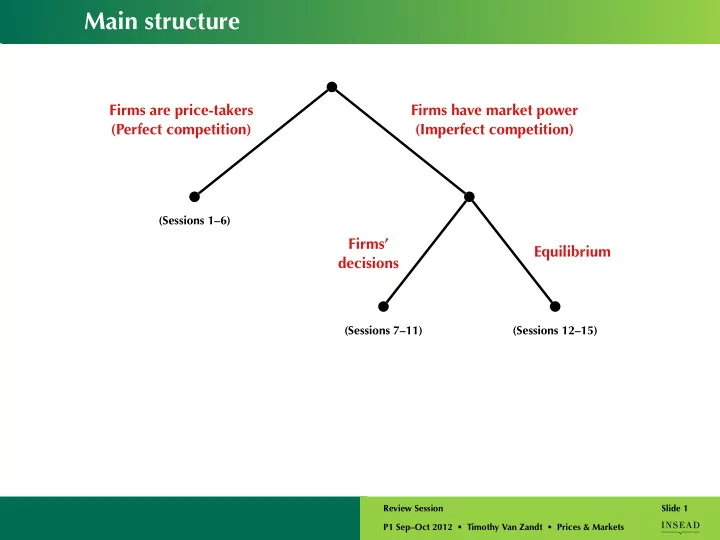
Main structure Firms are price-takers Firms have market power (Perfect competition) (Imperfect competition) (Sessions 16) Firms Equilibrium (Firms decisions decisions & equilibrium) (Sessions 711) (Sessions 1215) In


slide-1
SLIDE 1

Main structure

(Sessions 1–6)

(Firms’ decisions & equilibrium)

Firms are price-takers (Perfect competition) Firms have market power (Imperfect competition)

(Sessions 7–11)

Firms’ decisions

(Sessions 12–15)

Equilibrium

In each case: fixed firms in the market, then entry/exit

P1 Sep–Oct 2012 • Timothy Van Zandt • Prices & Markets Review Session Slide 1

slide-2
SLIDE 2

Key ideas on imperfect competition

Imperfect competition

Fixed firms in market

MC = MR

P, Q Firms’ decisions Nash eqm. Equili- brium

Entry & exit

VΠ > FC? Firms’ decisions

Each active firm has economic profit ≥ 0 . No potential entrant could make economic profit > 0 by entering.

Equilibrium

P1 Sep–Oct 2012 • Timothy Van Zandt • Prices & Markets Review Session Slide 2

slide-3
SLIDE 3

And their analogues for perfect competition

Perfect competition

Fixed firms in market

MC = MR = P

s i (P) Firms’ decisions s(P) = d(P) Equili- brium

Entry & exit

VΠ > FC? P > AC u ? Firms’ decisions

Each active firm has economic profit ≥ 0 . No potential entrant could make economic profit > 0 by entering.

Equilibrium

P1 Sep–Oct 2012 • Timothy Van Zandt • Prices & Markets Review Session Slide 3

slide-4
SLIDE 4

Prices with imperfect competition

5 10 15 20 25 20 40 60 80 100 120 140 160

Q $ d(P) MC Pπ Qπ MR

Pricing reflects both marginal cost and a markup.

P1 Sep–Oct 2012 • Timothy Van Zandt • Prices & Markets Review Session Slide 4

slide-5
SLIDE 5

Advantage of the model of perfect competition?

There are no mark-ups, so we can isolate the effects of cost on prices. … with a remarkably simple 2-dimensional picture: supply=demand.

P1 Sep–Oct 2012 • Timothy Van Zandt • Prices & Markets Review Session Slide 5

slide-6
SLIDE 6

Price after a shift in demand: perfect competition

30 60 90 3000 6000 9000

€ Q d(P) s(P)

  • dnew(P)

P1 Sep–Oct 2012 • Timothy Van Zandt • Prices & Markets Review Session Slide 6

slide-7
SLIDE 7

Reasons for the upward sloping supply curve?

  • 1. Increasing marginal cost of firms in the market.
  • Particularly pronounced in the short-run, hence the lower elasticity
  • f short-run supply and the greater short-run volatility of prices.
  • 2. Increasing minimum average cost of subsequent entrants

(entry by heterogeneous firms).

  • 3. Increasing cost of key inputs

(example: cranberry bogs)

$ Q

Producer surplus Total cost

P∗ Q∗ d(P) s(P)

10 20 30 40 50 60 100 200 300 400 500 600 700 800 900

P1 Sep–Oct 2012 • Timothy Van Zandt • Prices & Markets Review Session Slide 7

slide-8
SLIDE 8

Price after a shift in demand: perfect competition

30 60 90 3000 6000 9000

€ Q d(P) s(P)

  • dnew(P)

Change in price is due entirely to increasing marginal costs (of existing firms, of new entrants, or of scarce inputs).

P1 Sep–Oct 2012 • Timothy Van Zandt • Prices & Markets Review Session Slide 8

slide-9
SLIDE 9

Session 8: Pricing with Market Power

  • 1. The firm’s “pricing” problem: MC = MR .
  • 2. Profit-maximization versus social efficiency.
  • 3. Exit and entry.
  • 4. Social efficiency with a LR fixed cost.

P1 Sep–Oct 2012 • Timothy Van Zandt • Prices & Markets Review Session Slide 9

slide-10
SLIDE 10

Once upon a time, on some exam …

You manage the Zenith, a venue for concerts in Paris. You have signed a contract with a band called “Tool” for a concert on December 10. The contract specifies that the band receives €60,000 plus €12 per ticket sold. Assume that you have additional (constant) marginal costs of €8 per ticket sold and that you are not capacity constrained. The demand curve for the concert is Q = 8,000 − 100P .

  • a. What price should you charge?

P1 Sep–Oct 2012 • Timothy Van Zandt • Prices & Markets Review Session Slide 10

slide-11
SLIDE 11
  • b. Suppose that Trent Reznor, a musician, has offered to join the concert to

perform together with Tool. His presence would cause demand at any price to double. Reznor wants a fixed payment that does not depend on the number of tickets sold. What is the maximum amount you would be willing to pay him?

P1 Sep–Oct 2012 • Timothy Van Zandt • Prices & Markets Review Session Slide 11

slide-12
SLIDE 12

Session 9: How pricing depends on demand

  • 1. Useful formula:

MR = P

  • 1 − 1

E

  • 2. Price-sensitivity effect:

(Assuming constant marginal cost …)

If demand becomes less price sensitive, then the firm should raise its price.

  • 3. Volume effect:

(Keeping price-sensitivity constant …)

If a firm has increasing marginal cost and the volume of demand goes up, then the firm should raise its price.

P1 Sep–Oct 2012 • Timothy Van Zandt • Prices & Markets Review Session Slide 12

slide-13
SLIDE 13

Session 10: Explicit price discrimination

Bottom line:

  • Equate MR across market segments.
  • Charge higher price to segment with less elastic demand.

P1 Sep–Oct 2012 • Timothy Van Zandt • Prices & Markets Review Session Slide 13

slide-14
SLIDE 14

Once upon a time, on some exam …

A pharmaceutical firm sells a patented drug in Hong Kong and Taiwan. It produces the drug with constant marginal cost in a plant in Singapore and transportation costs for delivering the drug to Hong Kong and Taiwan are the same. The drug sells for 30 in Hong Kong and 20 in Taiwan (prices in $US). Recent estimates have shown that the elasticity of demand is 2 for the Hong Kong market and 5 for the Taiwanese market. You are told that the price is set correctly (i.e., maximizes profit) for the Taiwanese market. Show that the price is not correct for the Hong Kong

  • market. In which direction should the firm adjust its price?

P1 Sep–Oct 2012 • Timothy Van Zandt • Prices & Markets Review Session Slide 14

slide-15
SLIDE 15
slide-16
SLIDE 16

Session 11: Implicit price discrimination (Screening)

  • 1. Perfect price discrimination (benchmark)
  • 2. Screening via differentiated products
  • 3. Bundling

P1 Sep–Oct 2012 • Timothy Van Zandt • Prices & Markets Review Session Slide 15

slide-17
SLIDE 17

FPM Ex. 11.8

Zahra sells a good with unit demand. She has constant MC = 5 . Zahra has perfect information about her customers’ valuations. But she is initially prohibited by law from price discrimination. She chooses to charge $10, which results in sales to 10,000

  • customers. She calculates that these customers obtain a total of $50,000 in consumer surplus.

Then the regulation is lifted and she engages in perfect price discrimination. Based on this limited information, what can you say about …

(a) how many customers she will sell to?

>10,000

(all her old customers plus more)

(b) what range of prices she will charge?

5 and up (down to her MC)

(c) how much her profit will go up by?

>50,000

(prior consumer surplus + deadweight loss)

P1 Sep–Oct 2012 • Timothy Van Zandt • Prices & Markets Review Session Slide 16

slide-18
SLIDE 18

Sample Exam 3, Problem 17 (Bundling)

You are a monopolist selling two different types of concert tickets. You have zero marginal cost and hence your objective is to maximize revenue. You face three groups of potential customers, with an equal number of customers in each group. The following table summarizes the valuation of each group for each concert. (Each customer’s valuation of going to both concerts is just the sum of his individual valuations.)

Valuation Type Rock World A 5 60 B 35 65 C 40 70

P1 Sep–Oct 2012 • Timothy Van Zandt • Prices & Markets Review Session Slide 17

slide-19
SLIDE 19

Sample Exam 3, Problem 17 (Bundling)

(Continued)

Valuation Type Rock World

Bundle

A 5 60

65

B 35 65

100

C 40 70

110

(a) Pure bundling: What is the optimal price for the bundle of both tickets? What is your profit?

See valuations of bundle above. Possible price points are 65, 100, and 110, yielding revenue (profit) 195, 200, and 110. So

  • ptimal bundle price is 100 for a profit of 200.

(b) Mixed bundling: Find one mixed bundle pricing strategy that gives you higher profit than your answer with pure bundling.

Offer World ticket alone for 60; sell this to A. Offer bundle for 95; sell this to B and C. (Price has to leave surplus of at least 5 for type B and 10 for type C, so that they do not prefer the single ticket. Total profit is 60 + 2 × 95 = 240 .

P1 Sep–Oct 2012 • Timothy Van Zandt • Prices & Markets Review Session Slide 18

slide-20
SLIDE 20

With 4 sessions on game theory

… Tools/concepts that go beyond our applications to pricing and competition

Session 12: Static Games and NE Basic and universal tools. Session 13: Imperfect Competition Price and quantity competition: static games.

Core session vis-à-vis the framework.

Session 14: Explicit and Implicit Cooperation How—and why—to explicitly or implicitly cooperate. Session 15: Strategic Commitment How timing and commitment matter.

P1 Sep–Oct 2012 • Timothy Van Zandt • Prices & Markets Review Session Slide 19

slide-21
SLIDE 21

Session 12: Static Games and Nash Equilibrium

  • 1. Players, actions, payoffs.
  • 2. Best responses.
  • 3. Dominant strategies.
  • 4. Nash equilibrium.

P1 Sep–Oct 2012 • Timothy Van Zandt • Prices & Markets Review Session Slide 20

slide-22
SLIDE 22

Session 13: Price competition with fixed firms

  • 1. Each firm’s decision is same as pricing with market power: Topics 8&9
  • 2. Goods are substitutes ⇒ prices are strategic complements

(Always with linear demand; almost always in real life.)

  • 3. Interaction captured by Nash equilibrium

Each firm’s price maximizes its own profit given price of the other firm.

P1 Sep–Oct 2012 • Timothy Van Zandt • Prices & Markets Review Session Slide 21

slide-23
SLIDE 23

Scenario

Product category: Passenger jets. Dominated by two firms: Airbus (A) and Boeing (B). (For simplicity, imagine that each firm produces one kind of jet, and these two jets make up the entire product category.) Hypothetical demand functions: QA = 60 − 3PA + 2PB QB = 60 − 3PB + 2PA Constant marginal cost, same for both firms: MCA = MCB = 12 .

P1 Sep–Oct 2012 • Timothy Van Zandt • Prices & Markets Review Session Slide 22

slide-24
SLIDE 24

Now the exercise

QA = 60 − 3PA + 2PB , MCA = 12 QB = 60 − 3PB + 2PA , MCB = 12

I tell you: Nash equilibrium prices are PA = 24 and PB = 24 . Now you tell me: If you calculate Airbus’ marginal revenue at these prices, what value will you find? Now do it, using the formula for MR as function of price and elasticity.

P1 Sep–Oct 2012 • Timothy Van Zandt • Prices & Markets Review Session Slide 23

slide-25
SLIDE 25

Session 13: Imperfect competition with entry/exit

  • 1. Entry has two effects on profit:
  • smaller market shares
  • greater competitive pressure on prices
  • 2. Higher FC ⇒ less entry ⇒ less intense competition ⇒ higher prices

(Even though no firm bases pricing on its fixed cost.)

  • 3. Increase in market volume ⇒ more entry ⇒ lower prices

P1 Sep–Oct 2012 • Timothy Van Zandt • Prices & Markets Review Session Slide 24

slide-26
SLIDE 26

Exercise

Consider the model of imperfect competition with free entry as studied in class (with constant MC). Which of the following statements are valid? (Circle any that apply. Give no explanations.)

  • a. There is no deadweight loss.
  • b. If the fixed cost falls enough, then entry will take place and the price will

fall.

  • c. An increase in market depth (increase in volume) is likely to lead to

entry but overall the price will rise.

  • d. The number of firms in the market is such that no firm makes a loss but if
  • ne more firm entered then it would not earn a profit.

P1 Sep–Oct 2012 • Timothy Van Zandt • Prices & Markets Review Session Slide 25

slide-27
SLIDE 27

Session 14: Explicit and Implicit Cooperation

  • 1. Nash equilibria are typically not efficient.
  • 2. Cooperation (collective action) can be achieved by:
  • Contracts.
  • Repeated interaction.
  • Merger between firms.
  • 3. In price competition with substitute goods, cooperative solution

means raising prices above the NE prices.

  • 4. With complementary goods, the opposite.

P1 Sep–Oct 2012 • Timothy Van Zandt • Prices & Markets Review Session Slide 26

slide-28
SLIDE 28

Go back to our Airbus-Boeing example

Firms’ demand functions: QA

= 60 − 3PA + 2PB

QB

= 60 − 3PB + 2PA

Demand of merged firm: Use hint that prices should be the same: Common value P . Total demand Q = QA + QB as a function of P : Q = 120 − 2P . Elasticity of demand at the NE prices? What does this illustrate?

P1 Sep–Oct 2012 • Timothy Van Zandt • Prices & Markets Review Session Slide 27

slide-29
SLIDE 29

Session 15: Strategic Commitment

  • 1. Sequential games and backward induction.

Life must be understood backward, but … it must be lived forward. – Soren Kierkegaard

  • 2. When you have the chance to commit, think about:
  • In what way you want to influence the other players’ actions.
  • How you can achieve this.

P1 Sep–Oct 2012 • Timothy Van Zandt • Prices & Markets Review Session Slide 28

slide-30
SLIDE 30

Exercise

Consider the game payoffs shown below:

Player B Left Right Up 6 9 4 3 Player A Down 9 7 7 4

  • a. What is the Nash equilibrium of this game? (No explanation is needed.)
  • b. What is the backward-induction solution of the Stackelberg game if

player B moves first? (Show using a game tree.)

P1 Sep–Oct 2012 • Timothy Van Zandt • Prices & Markets Review Session Slide 29