Improving Disaster Recovery Preparedness in Hawai i Brad Romine, - - PowerPoint PPT Presentation

improving disaster recovery preparedness in hawai i
SMART_READER_LITE
LIVE PREVIEW

Improving Disaster Recovery Preparedness in Hawai i Brad Romine, - - PowerPoint PPT Presentation

Improving Disaster Recovery Preparedness in Hawai i Brad Romine, PhD, Hawaii Sea Grant Kitty Courtney, PhD, Tetra Tech, Inc. BUILDING RESILIENCE TO COASTAL HAZARDS AND CLIMATE CHANGE IN HAWAII Three complementary projects building on the


slide-1
SLIDE 1

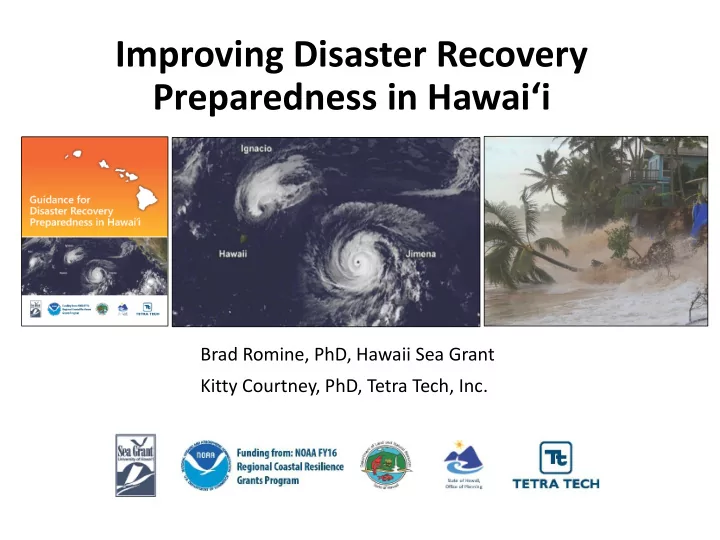
Improving Disaster Recovery Preparedness in Hawaiʻi

Brad Romine, PhD, Hawaii Sea Grant Kitty Courtney, PhD, Tetra Tech, Inc.
slide-2
SLIDE 2

2

State of Hawaii, Office of Planning

Funding from: NOAA FY16 Regional Coastal Resilience Grants Program

Three complementary projects building on the Hawai‘i Sea Level Rise Vulnerability and Adaptation Report and other recent projects and initiatives:

  • Guidance for Disaster Recovery Preparedness in

Hawaiʻi

  • Guidance for Addressing Coastal Hazards and Sea Level

Rise in Community Planning

  • Hawaiʻi Sea Level Rise Viewer

(hawaiisealevelriseviewer.org)

BUILDING RESILIENCE TO COASTAL HAZARDS AND CLIMATE CHANGE IN HAWAI‘I

slide-3
SLIDE 3

Preparing Hawaiʻi for c clim limate change m must also incl clude p preparing f for incr creasing disast ster impact cts

  • Hawaiʻi Sea Level Rise Report: $19 bil. of private land and

structures and $? bil. of public infrastructure vulnerable to chronic flooding and erosion with 3.2 feet of sea level rise

  • Hurricane Maria caused $90 - $100 bil. in damage to Puerto

Rico in one day

  • Hurricane Iniki caused $3.1 bil. in damage, destroyed 1,400

houses, took 7-8 years to recover

slide-4
SLIDE 4

Billi illion-dollar ar disast ster events a are incr creasing

https://www.climate.gov/news-features/blogs/beyond-data/2018s-billion-dollar-disasters-context

slide-5
SLIDE 5

Incr creasing t tropical cy cycl clones n near Hawaii

Observed tropical cyclone formation per year (1979-2003) Projected tropical cyclone formation per year (2075-2099)

Murakami, H., B. Wang, T. Li, and A. Kitoh. 2013. "Projected increase in tropical cyclones near Hawaiʻi." Nature Climate Change 3 (8):749-754. doi: 10.1038/nclimate1890.

slide-6
SLIDE 6

It’s n not if but wh when

1% Annual Chance Coastal Flood Hazard with 3.2 ft of SLR

slide-7
SLIDE 7

Purp rpose of t this G Guidance

  • Improve governance structure for

recovery functions, particularly at the county level.

  • Identify pathways to pursue critical

disaster recovery preparedness activities to support resilient recovery and reconstruction.

  • Encourage integration of disaster

recovery preparedness efforts among related plans and policies.

slide-8
SLIDE 8

Balance ce recovering quick ckly w with b building b back ck safer, s smarter, and more e equitable

slide-9
SLIDE 9

Objec ectives es

  • Defining an organizational structure and

developing capacity before a disaster

  • Establishing protocols to manage the increased

burden on county permitting agencies post- disaster

  • Reinforcing linkages with hazard mitigation

plans, community plans, CIP/functional plans, etc.

  • Balancing expedited reconstruction with

sustainable and more equitable recovery considering public safety, ecosystem health, and changing hazard risks

slide-10
SLIDE 10

Foundation f for Di Disas saster R Recovery P Prepar aredness Gu ss Guidan ance

  • APA Model Recovery Ordinance
  • Recovery preparedness efforts of
  • ther counties in the US
slide-11
SLIDE 11

Emer erging L Lesso essons-Lea earned i d in n Di Disa saster er Recover ery P Prep epared edness ess

  • Disasters provide windows of opportunity for

improving resilience

  • Pre-disaster recovery planning makes a difference in

mitigating risk before and after a disaster

  • Development of disaster recovery scenarios

improves efficiency and quality of post-impact decision-making

slide-12
SLIDE 12

Di Disa saster R Recover ery Prep eparedn dness A ss Activities s to Support P Post-Disaster R Recovery

Adapted from FEMA (2017) "Pre-Disaster Recovery Planning Guide for Local Governments." FEMA Publication FD 008-03

slide-13
SLIDE 13

Disaster Recovery Preparedness Activities (model resources) -

  • 1. Disaster Recovery Ordinance
  • Emergency powers to protect public health and

safety

  • Provides legal authority to expedite recovery
  • Provides for the establishment of a Recovery

Management Organization (RMO)

  • Guides preparation of recovery plans
  • Emergency powers for expediting repairs
  • Emergency powers for addressing areas of

catastrophic damage

slide-14
SLIDE 14

Disaster Recovery Preparedness Activities (model resources) -

  • 2. Disaster Recovery Framework
  • A.k.a., a Pre-Disaster Recovery Plan
  • Guides disaster preparedness and long-term

disaster recovery

  • Pre-defines roles and capabilities, and
  • rganizational frameworks for recovery
  • Aligned with FEMA’s disaster recovery framework
  • Strategies and priorities for governance and

coordination post-disaster

slide-15
SLIDE 15

Disaster Recovery Preparedness Activities (model resources) -

  • 3. Disaster Reconstruction Ordinance
  • Adopted pre-disaster
  • Standard operating procedures for review and

permitting repairs on private property

  • Establishes authority and protocols for:
  • Expedited permitting of minor repairs on private

property

  • Identifying and capturing critical opportunities for

increasing resilience to future disasters while protecting environmental resources

slide-16
SLIDE 16

Rec ecovery P Prep epared edness Ac ss Activities s Integ egrated i in n the R he Rec ecover ery P Planning C Cycle

slide-17
SLIDE 17

A A Pause se t to C Consi sider Pathways s for R Res esilient t Rede edevel elopm pment

(Di Disaster R r Recons nstruc ruction O Ordina nanc nce)

slide-18
SLIDE 18

Disaster Events a as O Opportunities t to Adapt t t to Sea Le Level R Rise

slide-19
SLIDE 19

Ot Other Disast ster Reco cove very Preparedness A Act ctivi vities

  • Communication: Developing a two-way communication and

public messaging strategy

  • Practice: Exercising the disaster recovery framework and
  • rdinances with partners and the public
  • Plan Integration: Updating plans, policies, and ordinances

incorporating information and strategies across related plans to improve overall resilience

  • GIS: Updating and maintaining the county’s geographic

information system database and permitting system with key information needed for disaster recovery

  • County-State Partnerships: Working with state partners to

support county disaster recovery preparedness efforts

slide-20
SLIDE 20

Guidance for Addressing Sea Level Rise in Community Planning in Hawaii

State of Hawaii, Office of Planning

Funding from: NOAA FY16 Regional Coastal Resilience Grants Program Step 1 Where are we now/going? COMMUNITY PROFILE

Describe existing conditions & trends Define key issues, opportunities, & preferences

Step 2 Where do we want to be? COMMUNITY VISIONING Develop vision statements Develop land use and development alternatives Step 3 How do we get there? COMMUNITY OBJECTIVES, POLICIES & ACTIONS

Identify preferred land use & development alterative Develop policies, actions & implementation plan

Step 4 COMMUNITY PLAN REVIEW, REVISION & ADOPTION Step 6 Are we getting there? MONITORING & EVALUATION

Monitor plan implementation Adapt policies to improve effectiveness

Step 5 PLAN IMPLEMENTATION State Priority Guidelines SEA LEVEL RISE CHECKLIST

COMMUNITY PLAN UPDATE

HAWAIʻI SLR VULNERABILITY & ADAPTATION REPORT COUNTY HAZARD MITIGATION PLAN

COUNTY GENERAL PLAN UPDATE

SEA LEVEL RISE VULNERABILITY ASSESSMENT IMPLEMENTATION STRATEGY FOR PRIORITY ADAPTATION POLICIES & ACTIONS SEA LEVEL RISE-INFORMED LAND USE AND DEVELOPMENT ALTERNATIVES COUNTY-WIDE MONITORING, EVALUATION, & LEARNING STRATEGY What changes are needed? ADAPTIVE MANAGEMENT

slide-21
SLIDE 21

Mahalo to:

  • Kauai County Planning Department
  • Honolulu C&C DPP, EMA, and OCCSR
  • Maui Planning and EMA
  • Hawaii County Planning Department
  • Hawaii State EMA
  • National Disaster Preparedness Training Center

(NDPTC)

  • Subject matter experts from around the country
slide-22
SLIDE 22

Rest of the Project Team: Hawaii Sea Grant: Tara Owens, Katy Hintzen, Darren Lerner DLNR-OCCL: Sam Lemmo Office of Planning: Justine Nihipali, Melanie Lander NOAA: Paulo Maurin

State of Hawaii, Office of Planning

Brad Romine romine@hawaii.edu 808-956-3013 Kitty Courtney