Disaster Preparedness: Disaster Preparedness: Baylor Baylor s - - PDF document

disaster preparedness disaster preparedness
SMART_READER_LITE
LIVE PREVIEW

Disaster Preparedness: Disaster Preparedness: Baylor Baylor s - - PDF document

Disaster Preparedness: Disaster Preparedness: Baylor Baylor s experience and Impact on Learners s experience and Impact on Learners Faye Faye Chiou Chiou Tan, MD Tan, MD Professor PMR, Baylor Professor PMR, Baylor Chief PMR, Ben


slide-1
SLIDE 1

1

Disaster Preparedness: Disaster Preparedness:

Baylor Baylor’ ’s experience and Impact on Learners s experience and Impact on Learners

Faye Faye Chiou Chiou Tan, MD Tan, MD Professor PMR, Baylor Professor PMR, Baylor Chief PMR, Ben Chief PMR, Ben Taub Taub/Quentin /Quentin Mease Mease

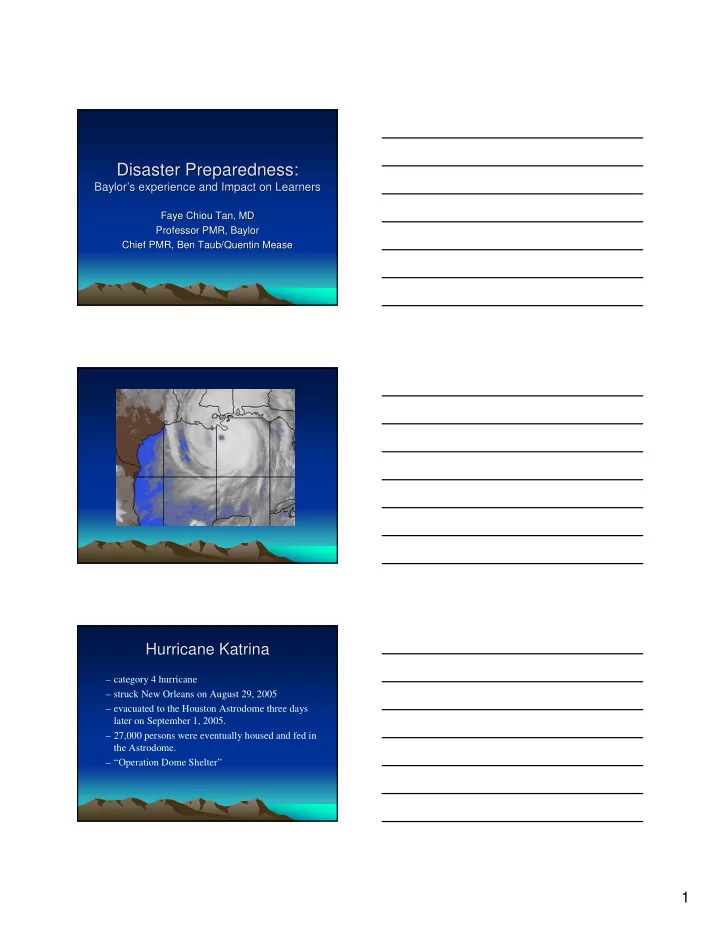
Hurricane Katrina Hurricane Katrina

– category 4 hurricane – struck New Orleans on August 29, 2005 – evacuated to the Houston Astrodome three days later on September 1, 2005. – 27,000 persons were eventually housed and fed in the Astrodome. – “Operation Dome Shelter”

slide-2
SLIDE 2

2

Creation of Astrodome Clinic Creation of Astrodome Clinic

  • The Astrodome Medical Clinic was created with

12 hours notice.

  • The Harris County Hospital District was charged

with the organization and implementation of this clinic.

  • The Harris County Hospital District physicians

and staff were expected to be first line disaster relief personnel in this disaster.

  • 11,245 patients were seen in the Astrodome

Clinic.

– Gavagan, TF, et. al., Southern Med J. 2006: 99(9).

Preparation Preparation

  • Education on disasters –

– Student orientation during Hurricane Season

  • Preparation list for home – supplies, etc.
  • Contact list – phones, pagers, email
  • Hierarchy = Incident Command (IC)
  • Disaster drills – bomb threat, fire drill, code

blue drill

slide-3
SLIDE 3

3

Permission Permission

  • Medical legal insurance coverage for

learners

  • Catching those who circumvent

credentialing

  • Medical students participated as

volunteers in Katrina

  • Medical students participated under faculty

supervision as part of their medical team in Ike

slide-4
SLIDE 4

4

Compel Compel

  • “We cannot compel (learners) to stay in a

disaster – we usually have more doctors than we need” Dr. Ken Mattox

  • Psychiatric and emotional issues
  • Child and elderly care issues

Educational Benefits for Learners Educational Benefits for Learners

  • Allowing learners to participate is disaster

education for future disasters

  • Everyday emergency management (car

accidents, train wrecks, petroleum explosions, etc. ) is good preparation for larger disasters.

  • Logistics management is educational

Specialty Educational Benefits Specialty Educational Benefits

  • How do we fit in with Triage/ Acute

Trauma?

  • What does our specialty contribute to the

disaster?

  • What supplies do we need to let the

administrators know about specific to our field of knowledge?

– Cath kits, mobility devices, dressing, pain pump refill issues

slide-5
SLIDE 5

5

PMR Astrodome Data PMR Astrodome Data

( (Chiou Chiou-

  • Tan, Am J PMR, 2007:86(9)

Tan, Am J PMR, 2007:86(9)

10 20 30 40 50

9 / 1 9 / 2 9 / 3 9 / 4 9 / 5 9 / 6 9 / 7 9 / 8 9 / 9 9 / 1 9 / 1 1 9 / 1 2 9 / 1 3 9 / 1 4 9 / 1 5

Date of Visit Frequency of PMR Conditions

500 1000 1500 2000 2500

Frequency of All Conditions

PMR Clinic Total Astrodome Clinic

Types of PMR Diagnoses Types of PMR Diagnoses

( (Chiou Chiou-

  • Tan, Am J PMR, 2007:86(9)

Tan, Am J PMR, 2007:86(9)

63 50 36 30 16 15 14 13 12 10 8 6 5 4 4 3 10 20 30 40 50 60 70 s w

  • l

l e n f

  • t

/ l e g l e g p a i n / c r a m p s h e a d a c h e n e c k / b a c k p a i n p a i n m e d s / w i t h d r a w a l s k i n u l c e r f r a c t u r e M / S a r m p r

  • b

l e m s n e u r

  • p

a t h i c M / S l e g p r

  • b

l e m s

  • t

h e r M / S p r

  • b

l e m s s t r

  • k

e b u r s i t i s S C I M / S t r u n k p r

  • b

l e m s a m p u t e e Diagnostic Category Number of Patients with Diagnosis

Clinical Preparation Clinical Preparation

  • Chief and Asst. Chief are painfully busy.
  • Transportation of persons with disability out of

harm’s way

– QM closes and moves to Ben Taub – Discharge team (QM) / Receiving team (BT)

  • Resident / Student coverage for disaster

– Set up extra on call beds, cots, rooms – FEMA food, water conservation education, toilets

  • Simultaneous coverage for hospital functions still
  • pen (inpatient, outpatient, clinics, consults)
  • Clinics are filled with patients needing Rx.
slide-6
SLIDE 6

6

The Storm The Storm

  • Safest place to be is in the hospital
  • Hopefully boring –

– Eat like you are on a Cruise Ship – Bring an (educational) book to read

  • Extra students and residents
  • Extra family members and pets

Post Disaster Post Disaster

  • Post disaster is the hardest, longest part
  • Where is everyone? Are they OK?
  • Lights, water, petro gas, airconditioning,

food, medicine

  • Electronic communication devices

– Everyone comes in for comfortable AC and to power their electronic gadgets – Learners competing for the on-call rooms

Post Disaster Post Disaster

  • 25% of disaster relief workers experience

post traumatic stress disorder

  • Debriefing

– What did you learn? – How did that make you feel? Councilors – What can you do to prepare for next time?

slide-7
SLIDE 7

7

Post Disaster Post Disaster

  • Follow through

– Communicate with your chief residents and residency directors on improvements

  • Call schedules
  • Site specific needs
  • Educational aspects

– Study the data scientifically in a paper.

Recognition of Learners Recognition of Learners

  • Recognize exemplary behavior of the

learner and let the residency directors and Chairman know.

  • Write about it in your letter of reference for

the learner.

  • Do something nice for everyone when it’s

all over

– T-shirt, ice-cream social, hero list, etc.

Adoption of Tulane students Adoption of Tulane students

  • Baylor, UTMB, UTHSC, TAMU adopted

620 medical students (310 clinical) and 526 house officers

  • Started Sept 8th, 2005 - 8 months duration

– Searle, Acad. Med. 2007 82(8):733-44.

slide-8
SLIDE 8

8

Adoption of Tulane Students Adoption of Tulane Students

  • Safety – where are the students?
  • IT – Website created by BCM in 4d,

contact lists, links (eg. to FEMA)

  • Lodging –on Website, taking in students

(200 matches in 3 days)

  • Faculty offices in small group teaching

rooms.

  • Student lounge in former cafeteria area-

student lockers, pool table, TV, etc.

Adoption of Tulane Students Adoption of Tulane Students

  • Finances – Tulane acct set up in each

academic department to bill Tulane

  • ID badges – Tulane/Baylor badges made
  • Counseling services – provided by Dept.
  • f Psychiatry – 170 student visits. Tulane

reimbursed Baylor for services.

  • Obtaining flooded records – registrar’s
  • ffice often worked 16hr days.

More Drama More Drama

  • Sept 23, 2005 – Hurricane Rita (last 2000

Astrodome residents moved to Arkansas)

  • Oct 3, 2005 – Start of academic year for Tulane

students at Baylor.

  • Oct 3, 2005 - Baylor Liason Committee for

Medical Education (LCME) site visit.

  • Match Day celebrations – Separate match day

locations for each school

  • Tulane sponsored “Baylor Thank You Day” –

Mardi Gras crawfish boil

slide-9
SLIDE 9

9

Other issues Other issues

  • Recruitment season – full class recruited

at Tulane with similar GPA, MCAT.

  • Donations in support of Tulane students -

$176,045 – used for metro passes, emergency housing, scholarships, lost revenue from foreign students.

  • Tulane faculty/residents received

temporary Texas licenses.

Thank You Thank You

  • I wish to acknowledge:

– All my brave learners, residents and faculty partners – All my brave staff and building support – Incident command leaders who are always brave ☺

  • Dr. Ken Mattox
  • Dr. Thomas Gavagan