Disaster Survivor Assistance Nevada Preparedness Summit June 2015 - - PowerPoint PPT Presentation

disaster survivor assistance
SMART_READER_LITE
LIVE PREVIEW

Disaster Survivor Assistance Nevada Preparedness Summit June 2015 - - PowerPoint PPT Presentation

Disaster Survivor Assistance Nevada Preparedness Summit June 2015 Disaster Survivor Assistance Established In an effort to focus on a survivor-centric approach to providing disaster assistance based on lessons learned in previous disasters,


slide-1
SLIDE 1

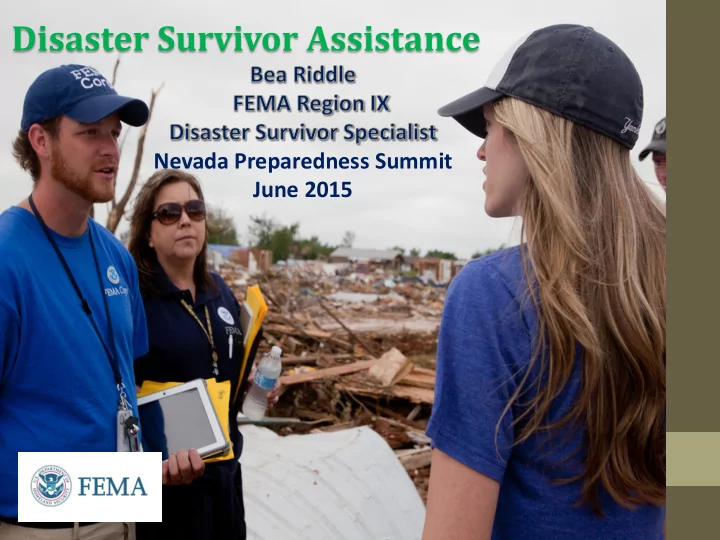
Disaster Survivor Assistance

Nevada Preparedness Summit June 2015
slide-2
SLIDE 2

Disaster Survivor Assistance Established

  • In an effort to focus on a survivor-centric approach to

providing disaster assistance based on lessons learned in previous disasters, FEMA leadership:

  • Transferred the Community Relations program from the

Office of External Affairs (OEA) to the Recovery Directorate, and

  • Changed the name of the cadre to Disaster Survivor

Assistance (DSA)

  • DSA reports directly to Operations Section in the Joint

Field Office (JFO).

2

slide-3
SLIDE 3

DSA Mission

  • Build and sustain an expeditionary

cadre that can address disaster survivor’s immediate needs by:

  • Establishing a timely presence;
  • Providing in-person, tailored

information and services;

  • Providing referrals to Whole

Community partners as needed;

  • Collecting targeted information to

support decision-making; and

  • Identifying public information needs

so critical messaging can be developed and disseminated.

3

slide-4
SLIDE 4

Survivor Centric Focus

  • Register survivors where

they live or work

  • Bring services directly to

those who need them

  • Inclusion of Whole

Community partners for provision of expanded program services

  • Use of technological

tools to enhance mobile capabilities

4

slide-5
SLIDE 5

Value-Added of DSA

  • The DSA Teams are a professional “force

multiplier” that will support State, Local, Tribal, Territorial and Federal requirements in the field by:

  • Quickly deploying in anticipation of (or immediately

following) a disaster declaration;

  • Providing assistance to survivors who need the most

help; and

  • Providing operational awareness of conditions, needs,

and activity in the affected area

5

slide-6
SLIDE 6

Five (5) Essential Functions of DSA

6

AIR

Registration Intake Case Status Inquiries and Updates Survivor Needs Assessment Referrals to Whole Community Partners

slide-7
SLIDE 7

Neighborhoods Local Government Community Groups Private Sector Town Hall Meetings Mobile Disaster Recovery Center Disaster Recovery Center

DSA Essential Functions:

  • 1. Assess, Inform, Report (AIR) Mission
  • 2. Registration Intake
  • 3. Case Status Inquiries & Updates
  • 4. Survivor Needs Assessment
  • 5. Referral to Whole Community Partners

Disaster Survivor Assistance Phased Approach

slide-8
SLIDE 8

DSA Outreach Products and Reports

  • DSA members working in impacted communities

will distribute pre-approved collateral materials to include:

Business Cards Flyers Brochures Fact Sheets Door Hangers Disaster Assistance Publications

  • Spot Report, Daily Summary Report, AIR

Checklist

8

slide-9
SLIDE 9

9

slide-10
SLIDE 10

Technology Requirements

  • The benefits of implementing these operational

requirements allow for a more agile mobile workforce that leverages technology to support survivors who need the most help.

  • The Disaster Survivor Assistance cadre is

designed to function in a 100% mobile environment and the concept of operations requires field teams to provide services directly to disaster survivors on site and in person.

10

slide-11
SLIDE 11

Technology

  • The Disaster Survivor Assistance crews

utilize iPads to register survivors, perform case status inquiries and updates, and provide referrals to resources

slide-12
SLIDE 12

Benefits of DSA

  • A new capability that builds on already existing resources

within FEMA.

  • Meant to complement the already existing operational

structure in the field.

  • Another option for survivors – Tele-registration,

Web/Mobile Registration, Visiting Disaster Recovery Centers.

  • Provides real-time situational awareness of unmet needs,

infrastructure issues, etc.

  • Additional surge staff to support states and local

communities as needed.

  • Another tool in the toolbox.

12

slide-13
SLIDE 13

Next Steps…

  • Develop Work Plan and Strategy

moving forward

  • Coordination with Whole Community Partners

13

slide-14
SLIDE 14

14

Questions???

Bea Riddle, FEMA Region IX Disaster Survivor Specialist Bea.Riddle@fema.dhs.gov 225-910-5156