
SLIDE 1
SBA’s Disaster Assistance Program
Helping Survivors Recover From Disasters
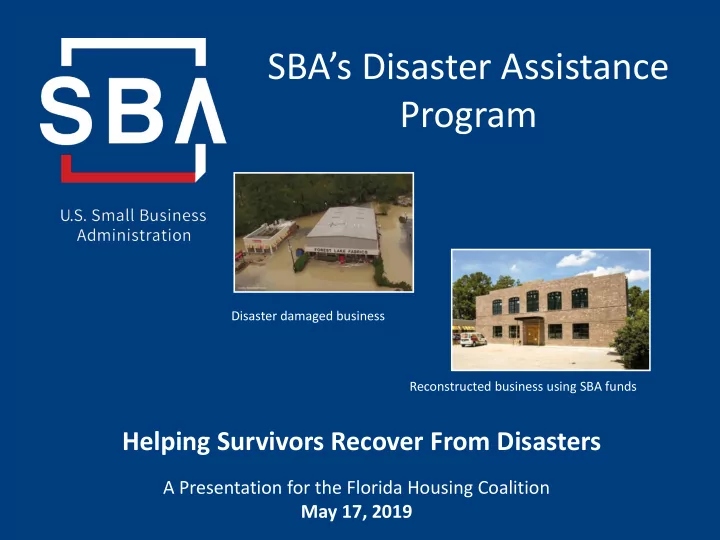
Disaster damaged business Reconstructed business using SBA funds
SBAs Disaster Assistance Program Disaster damaged business - - PowerPoint PPT Presentation
SBAs Disaster Assistance Program Disaster damaged business Reconstructed business using SBA funds Helping Survivors Recover From Disasters A Presentation for the Florida Housing Coalition May 17, 2019 Agenda About SBAs Disaster
Disaster damaged business Reconstructed business using SBA funds
2
To provide low interest disaster loans to businesses of all sizes, private nonprofit
property, machinery & equipment, inventory and business assets that have been damaged or destroyed in a declared disaster.
3
The SBA’s low-interest loan program was designed by Congress to help those affected by unforeseen catastrophic events to recover with as little adverse impact as possible. SBA has been making disaster loans since 1953, and has approved more than $63.9 billion in disaster loans to more than 2.1 million businesses, homeowners, and renters. In fiscal year 2018, SBA approved 140,240 loans for over $6.9 billion in disaster loans for businesses and residents nationwide. For fiscal year 2019 thru April, SBA has approved 37,217 loans for over $1.9 billion.
4
As of the close of business on May 9, 2019 Florida Hurricane Irma Type of Loans Number of Loans Dollar Amount Homes 32,956 $1,116,719,400 Businesses 4,379 $331,924,400 Total 37,335 $1,448,643,800 Florida Hurricane Michael Type of Loans Number of Loans Dollar Amount Homes 11,373 $516,295,300 Businesses 1,220 $120,964,500 Total 12,593 $637,259,800
5
6
AP Photo/US Coast Guard
6
7
The Governor contacts FEMA and/or SBA to request a preliminary damage assessment (PDA) or disaster damage survey. SBA and/or FEMA assesses the damage and reviews the result of disaster damage survey with the State. Based on results Governor may request a presidential
The request for a disaster declaration is either approved or denied.
9
Individual Assistance, SBA’s disaster loan program is automatically activated.
nonprofits of any size, can apply for working capital loans to cover their economic injury losses.
President Donald J. Trump
apply for their uncompensated physical losses.
10
If the President declares a major disaster declaration for Public Assistance, SBA’s disaster loan program is activated only for eligible private, nonprofit organizations for physical damage and economic injury.
Religious Organizations Community Centers Nonprofit Organizations
11
12
When the PDA indicates damages are insufficient for a Presidential declaration, the Governor can request an Administrative (Agency) declaration through the SBA Administrator. Administrative (Agency) Declarations require: At least 25 homes and/or businesses in a county with uninsured losses of 40% or more of their estimated fair market value.
Acting SBA Administrator Chris Pilkerton
13
Indicates that only SBA Disaster Loans for economic injury are available in “Contiguous” Counties. Indicates that SBA Disaster Loans for physical and economic injury losses are available in the “Primary” County. Indicates that SBA Disaster Loans for physical and economic injury losses are available in both the “Primary” County and “Contiguous” Counties.
Presidential declaration (IA) SBA Administrative declaration
14
If a Governor certifies that at least five (5) small businesses in a disaster area have suffered substantial economic injury as a result of the disaster, and need financial assistance not available on reasonable terms, SBA activates its Economic Injury Disaster Loan (EIDL) program only. These working capital loans may be used to pay fixed debts, payroll, accounts payable, and other bills that could have been paid had the disaster not occurred. The loans are not intended to replace lost sales or profits. Note: Physical Disaster Loans are not available in this type of declaration. The filing deadline is 9 months from the date of the declaration.
CBS News
15
If the Secretary of Agriculture designates an area an agricultural disaster, SBA automatically activates its Economic Injury Disaster Loan (EIDL) program. Loans are made available to eligible small businesses, small cooperatives, small aquaculture businesses and most private non-profits of any size that have suffered substantial economic injury as a result of the declared disaster. These working capital loans may be used to pay fixed debts, payroll, accounts payable, and other bills that could have been paid had the disaster not occurred. The loans are not intended to replace lost sales or profits. This declaration is for Economic Injury Disaster Loans (EIDLs)
declaration. Farmers and ranchers are not eligible. However, both farm-related and non-farm related small businesses are eligible to apply.
17
18
18
Types of Loans Borrowers Purpose
Business Loans “Physical” Businesses and private nonprofits Repair or replace real estate, equipment, furniture, etc. $2 million * Economic Injury Loans Small businesses and private nonprofits Economic injury disaster loans or working capital loans $2 million * Home Loans Homeowners Repair or replace real property $200,000 Home Loans Homeowners and renters Repair or replace personal property $40,000 Mitigation Businesses, private nonprofits and homeowners Mitigate / prevent future loss to real property 20% of verified physical damage. Homeowners is limited to $200,000
*The maximum business loan is $2 million, unless the business qualifies as a Major Source of Employment (MSE).
19
20
21
22
22
Low interest rates Cash flow lender No equity required Flexible terms-up to 30 years No prepayment penalty Funds are available prior to an insurance settlement No closing costs May be eligible for refinancing or relocation May apply for mitigation funds to protect against future events First payment deferred Don’t need damage estimate to apply Federal/State assistance may stop Loan can be modified No obligation to take the loan if approved May be eligible for referral to grant program
23
When disaster survivors need to borrow to repair uninsured damages, the low- interest rates and long-terms available from SBA make recovery affordable.
24
25
For homeowners and renters only.
In Presidential declarations, survivors should first register with FEMA at fema.gov, 1-800- 621-3362 or disasterassistance.gov
28
* Damages are initially estimated by desktop loss verification.
STEP 2: Property Verified and Loan Processing Decision Made
29
STEP 3: Loan Closed and Funds Disbursed
30
(SBDCs, WBCs, SCORE, Chambers of Commerce, etc.)
31
32
MYTH: The Small Business Administration (SBA) is part of the Federal Emergency Management Agency (FEMA) and under the Department of Homeland Security (DHS). FACT: SBA is an independent federal agency. MYTH: The Small Business Administration (SBA) only offers disaster loans to businesses. FACT: SBA’s disaster loan program is the only form of SBA assistance not limited to small businesses. SBA offers low-interest loans to businesses of all sizes, nonprofit organizations, homeowners and renters. MYTH: Applicants must go through a bank to apply for an SBA disaster business or and SBA disaster home loan. FACT: Applicants apply directly with SBA for disaster loans. Loan funds are disbursed from the U.S. Treasury.
34
MYTH: SBA’s disaster loans are available any time there is a disaster. FACT: SBA’s disaster loans are only offered when there is a federal disaster declaration. Eligible applicants must be in a declared county/independent city. MYTH: FEMA is the lead agency in all disaster declarations. FACT: SBA can approve a disaster declaration independent of FEMA. A majority of disasters are SBA-only declarations in which SBA’s disaster loans are the only form of recovery other than
MYTH: Disaster survivors can apply once a federal disaster declaration is made. FACT: Disaster survivors should apply BEFORE the filing deadline.
36
37
37
38