Overview Preparedness SHIP Disaster Strategy Local Mitigation - - PDF document

overview
SMART_READER_LITE
LIVE PREVIEW

Overview Preparedness SHIP Disaster Strategy Local Mitigation - - PDF document

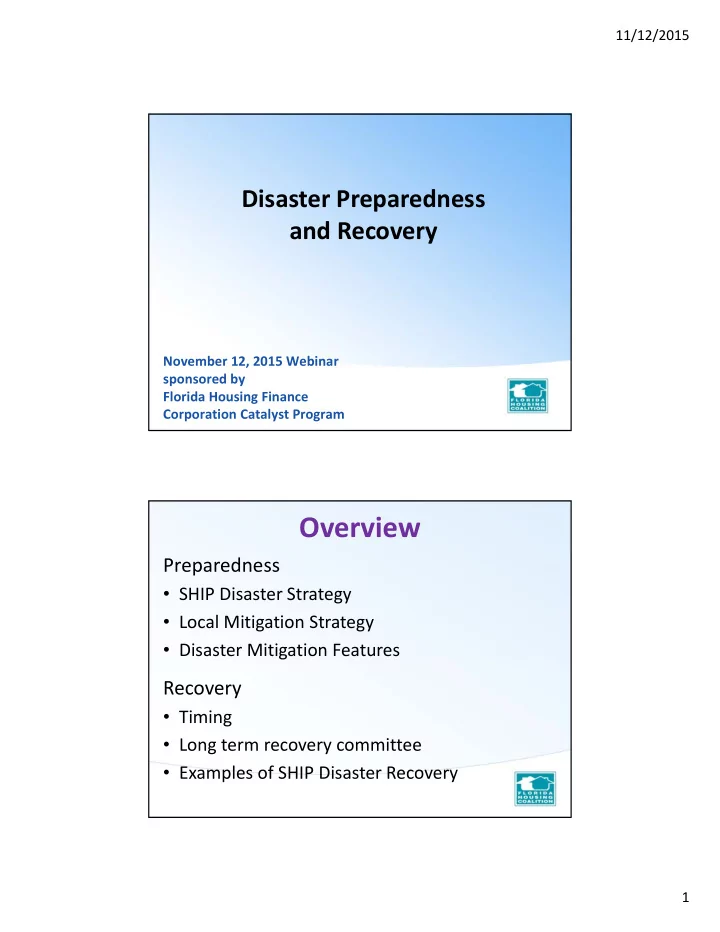
11/12/2015 Disaster Preparedness and Recovery November 12, 2015 Webinar sponsored by Florida Housing Finance Corporation Catalyst Program Overview Preparedness SHIP Disaster Strategy Local Mitigation Strategy Disaster Mitigation


slide-1
SLIDE 1

11/12/2015 1

November 12, 2015 Webinar sponsored by Florida Housing Finance Corporation Catalyst Program

Disaster Preparedness and Recovery

Overview

Preparedness

  • SHIP Disaster Strategy
  • Local Mitigation Strategy
  • Disaster Mitigation Features

Recovery

  • Timing
  • Long term recovery committee
  • Examples of SHIP Disaster Recovery
slide-2
SLIDE 2

11/12/2015 2

Introductions

  • Jamie Leigh Price: Lead Mitigation Planner,

Bureau of Mitigation

  • Meredith Van Valkenburgh: RCMP Program

Manager

  • Danny Hinson: Community Rating System

Coordinator

  • Ken Skalitzky, Emergency Management

Director, Volunteer Florida

  • Evan Rosenberg: Bureau Chief for Recovery
  • George Romagnoli, Pasco County

Community Development Manager

Disaster Preparedness

slide-3
SLIDE 3

11/12/2015 3

SHIP Disaster Strategy

  • For Federally or State declared disasters
  • Provides Temporary Stabilization and the

next wave of Recovery

  • Keep the strategy general
  • Update Strategy and Procedures Manual
  • Advertise now: 30 days before applications

Highlight from SHIP Disaster Strategy

Repairs will be prioritized as follows:

  • Immediate threats to health & life safety in

cases where the home is still habitable.

  • Imminent residual damage to the home

(such as leaking roof) in cases where the home is still habitable.

  • Repairs to make the home habitable.
  • Repairs to mitigate dangerous situations

(exposed wires)

slide-4
SLIDE 4

11/12/2015 4

Procedures for amending the LHAP

  • Initially submit documents electronically in their

current file format (word, excel)

  • Email robert.dearduff@floridahousing.org

Subject Line: LHAP Amendment and the local government name

  • Send main LHAP document and any exhibits

affected

  • State this is a technical revision updating an

existing strategy

  • State SHIP Administrator notifies if approved or

that more information is needed

Disaster Strategy funded from:

  • Unencumbered local SHIP funds
  • Special allocations of funds from Legislature
  • SHIP Disaster annual set‐aside: up to $5

million held back from statewide distribution

– Distributed based on damage data from FEMA and FL Div. of Emergency Management

slide-5
SLIDE 5

11/12/2015 5

Plug Into Existing Efforts

Jamie Leigh Price: Lead Mitigation Planner, Bureau of Mitigation

  • Introduction to Disaster Mitigation
  • Local Hazard Mitigation Plans

The Local Mitigation Strategy

Local Hazard Mitigation Plans are required by DMA 2000 to be eligible for federal hazard mitigation grant funding Purpose

  • Assess vulnerability to natural hazards,
  • Identify mitigation to lessen vulnerability,
  • Rank and implement projects to reduce

risk from natural hazards.

slide-6
SLIDE 6

11/12/2015 6

The Local Mitigation Strategy

  • LMS plans: multi‐hazard, multi‐

jurisdictional plans organized by county

  • Plans expire every 5 years

4 Sections of the LMS Plan:

  • Planning Process,
  • Hazard Identification and Risk Assessment,
  • Mitigation Strategy, and
  • Maintenance.

Poll of Participants

Is SHIP specifically mentioned in your Local Mitigation Strategy?

slide-7
SLIDE 7

11/12/2015 7

Mitigation: Single Family Dwellings VS Multifamily Properties

  • Mitigation for all dwellings
  • Mitigation features for Multifamily

Properties

Residential Construction Mitigation Program (RCMP)

Meredith Van Valkenburgh: RCMP Program Manager

  • RCMP funding from the Florida Hurricane

Catastrophe Trust Fund (ch. 215.559, Florida Statutes)

  • FL Statutes 215.555 & 215.559: $10 million

dollars annually appropriated to provide funding for Wind Mitigation

  • $3.5 million of this for grants to counties, non‐

profits, and/or for profit agencies to assist low to medium income families with Wind Hardening for Single Family homes.

slide-8
SLIDE 8

11/12/2015 8

Residential Construction Mitigation Program (RCMP)

  • RCMP funding from the Florida Hurricane

Catastrophe Trust Fund (ch. 215.559, Florida Statutes)

  • RCMP works well with SHIP and CDBG.

Rehab VS Retrofit Standards

  • Construction standards and mandates

listed in Florida Statute 553.844.

Disaster Mitigation:

Avoiding Damage from Future Disasters

  • FIRST: Monitor SHIP assisted rehabilitation

and new construction for code compliance

  • NEXT: Add mitigation features to your SHIP

Strategies

slide-9
SLIDE 9

11/12/2015 9

Wind Mitigation for New Construction & Rehabilitation

Key components of protecting structural integrity:

  • A continuous load path
  • Roofing protections
  • Protect Openings

Community Rating System

Danny Hinson, CFM, FPEM Florida CRS Initiative

slide-10
SLIDE 10

11/12/2015 10

Florida CRS Initiative

CRS Benefits

  • Florida: $181 million / annual savings

– Only 45% FL communities participating!

  • Nationally: $360 million / annual savings

–Only 6% participating!

Florida CRS Initiative

slide-11
SLIDE 11

11/12/2015 11 A voluntary part of the National Flood Insurance Program (NFIP) Provides reduced flood insurance premiums for better floodplain management!

What is the Community Rating System (CRS)?

NFIP minimum requirements CRS: Everything done above and beyond minimum NFIP requirements

  • Reduce and avoid flood damage to insurable

property

  • Strengthen and support the insurance aspects
  • f the NFIP
  • Foster comprehensive floodplain management

The Florida CRS – CAV Pilot Initiative:

CRS program goals

slide-12
SLIDE 12

11/12/2015 12

Florida CRS Initiative Assist Community CRS participation Conduct workshop(s) for community staff Seek additional credit points Liaison with FEMA Outreach & Planning by State DEM Publicize: Flood Insurance Premium Discount

Florida CRS Initiative

THE FLORIDA DIVISION OF EMERGENCY MANAGEMENT

Florida CRS Initiative

ELE / BFE $ Insurance Rate/$100 Sub‐Total Total / Year +2 60,000 / 140,000 .42 / .08 = 252 / 112 = $364 +1 60,000 / 140,000 .71 / .10 = 426 / 140 = $566* 60,000 / 140,000 1.78 / .13 = 1,068 / 182 = $1,250

Example: $200,000 coverage, at BFE, +1, +2 Freeboard Basic/Additional coverage, no loadings ‐ Federal + Reserve *45% less than premium ‐ annually

slide-13
SLIDE 13

11/12/2015 13

THE FLORIDA DIVISION OF EMERGENCY MANAGEMENT

Florida CRS Initiative

Danny Hinson, CFM, FPEM State CRS Coordinator ‐ 850‐544‐8383 danny.hinson@em.myflorida.com http://www.floridadisaster.org/mitigation/CRS/

More Preparedness: The Role of VOADs and COADs

Ken Skalitzky, Emergency Management Director, Volunteer Florida

  • Voluntary Organizations Active in Disasters
  • Community Organizations Active in Disasters
  • VOAD & COAD Activities
  • How SHIP is involved
  • How to contact your local

VOADs & COADs

slide-14
SLIDE 14

11/12/2015 14

Comprehensive Emergency Management Plan

  • Framework to ensure adequate

preparedness

  • Unifies Efforts: Responsibilities and

Coordination mechanisms

  • Coordinates response and recovery

activities with VOADs & COADs

  • Local Mitigation Strategy is where SHIP is

involved

Recovery Topic

  • Long term Recovery Committee (LTRC)

– Assists survivors over the long‐term with disaster‐related unmet needs that cannot be met through the standard assistance process.

  • True recovery from a disaster takes years
  • LTRC is a network of community agencies:

neighbors helping neighbors

  • Case prioritization based on local criteria
  • How SHIP is involved
slide-15
SLIDE 15

11/12/2015 15

Disaster Recovery

DISASTER PREPAREDNESS & RECOVERY WEBINAR NOVEMBER 12, 2015

DISASTER RECOVERY

slide-16
SLIDE 16

11/12/2015 16

Basics of Disaster Recovery

“Recovery” is a wide ranging concept that can involve several different issues:

  • Historically, a successful recovery was judged on

the speed at which we could rebuild what was destroyed

  • But this ultimately proves to be an unsatisfying

definition once we start looking beyond mere rebuilding…

  • Do we want to rebuild in the same way?
  • What mistakes from the past can we correct?
  • What is the most effective use of limited funds?

It all Starts with Money

Either way that you look at recovery, we need to find a funding source

  • Historically, the federal government would come in and

start infusing money into the impacted area – a top down approach… if your event made enough headlines!

– Very few federal declarations, but when one was granted, the federal checkbook opened up

  • Today, the story is reversed…

– Lots of federal declarations are issued, based off of standards & thresholds which are generally defined in advance, – But now with a declaration comes lots of scrutiny on what resources survivors can bring to the table themselves, before they actually get any disaster relief

slide-17
SLIDE 17

11/12/2015 17

2 Different Sets of Needs

  • There are two ways that you can think of Recovery,

where the difference is in who we are assisting, each with a different set of needs:

– Recovery for impacted survivors (individuals, households & businesses)

  • Repair/replacement of housing & personal goods
  • Fulfillment of social service needs (case management, mental

health, legal help, etc…)

  • Restore commerce and local tax base

– Recovery for impacted governments (governments & some PNP’s)

  • Clean/clear debris
  • Restore capacity to provide services (rebuild damaged facilities

and replace depleted supplies)

Federal Recovery Funding

  • Not surprisingly, federal recovery funding is tightly

aligned with these two different types of needs:

– Funding for Survivors & Businesses

  • FEMA Individual Assistance Grants
  • SBA Disaster Loans
  • Disaster Assistance Programs from other federal agencies (USDA,

HUD, HHS, etc…)

– Funding for Governments

  • FEMA Public Assistance Grants
  • FEMA Hazard Mitigation Grants
  • Disaster Assistance Programs from other federal agencies (USACE,

FHWA, FAA, etc…)

slide-18
SLIDE 18

11/12/2015 18

Individual Assistance Grants (IA)

  • A federal declaration including Individual Assistance

(IA) makes the following programs available to survivors throughout the declared county:

– Assistance to Individuals & Households (IHP)

  • Temporary housing assistance (rental payments)
  • Direct housing assistance

– Repair assistance – Replacement assistance (FEMA modular housing)

  • Other needs assistance (ONA) (medical, dental, funeral, personal

property replacement, etc…)

– Disaster unemployment assistance – Food coupon/commodity distribution – Crisis counseling assistance

IA Grants (ctd.)

  • Please note the following about IA grants:

– While most of IA is without a federal/non federal cost‐ share, the ONA component of IHP does have a 75% federal / 25% non federal cost‐share

  • In Florida, under current policy, the entire 25% non federal share is

paid by the State

– Survivors must first apply for an SBA Physical Injury loan before they are eligible for the IHP component of IA – The IHP component of IA is capped for a household, with the possible “maximum grant” adjusted yearly for

  • inflation. In federal fiscal year 2015‐16, the “maximum

grant” under IHP is $33,000

  • In federal fiscal year 2014‐15, the average IHP grant for a

household was in the range of $5,000 to $6,000
slide-19
SLIDE 19

11/12/2015 19

SBA Loans

  • SBA’s Disaster Loan Programs are automatically

activated upon being declared for Individual Assistance, or can be activated as stand alone programs:

– Physical Disaster Loans

  • Low interest loans made available to homeowners and renters

impacted by disasters (up to $200k to repair/replace a primary residence, and up to $40k to repair/replace cars and other forms

  • f personal property), or to businesses impacted by disasters (up

to $2 million to repair/replace damaged real estate, inventory, equipment, etc…)

– Economic Injury Loans

  • Low interest loans made available to businesses impacted by

disasters (up to $2 million to meet necessary financial obligations)

Public Assistance Grants (PA)

  • A federal declaration including Public Assistance (PA)

makes reimbursement for the following types of costs available to governmental entities located throughout the declared county:

– Category A – Debris removal – Category B – Emergency protective measures – Category C – Roads and bridges – Category D – Water control facilities – Category E – Buildings and equipment – Category F – (Publicly‐owned) Utilities – Category G – Parks, recreational facilities and other items

slide-20
SLIDE 20

11/12/2015 20

PA Grants (ctd.)

  • Please note the following about PA grants:

– PA grants are issued on a cost‐share basis. Under current federal policy, all but the most catastrophic disasters in Florida will be on a 75% federal / 25% non federal cost‐share basis.

  • Florida has a statute in place that splits the 25% non federal

piece to 12.5% being paid by the State, and 12.5% being paid by the receiving entity

– PA grants are issued under the condition that the receiving entity then obtains and maintains insurance (on the commercial market) to cover eligible damages in the future

What if No Federal Declaration?

  • Even if a federal IA or PA declaration is not

granted, it is still possible to get a federal SBA

  • declaration. In fact, this is typically what happens.
  • This year (2015), Florida was denied an IA

declaration that was requested due to flooding in the West Central Florida area.

– We were able to obtain an SBA declaration that made low interest loans available throughout a 3 county area – Additionally, some SHIP Disaster Recovery funding was made available to survivors, which will be the next discussion topic on the webinar

slide-21
SLIDE 21

11/12/2015 21

Questions about Recovery?

Evan Rosenberg Bureau Chief of Recovery evan.rosenberg@em.myflorida.com (850) 487‐2293

From Sample SHIP Disaster Strategy

Recipient Selection Criteria: Applicants assisted

  • n a first‐qualified, first‐served basis with the

following additional requirements:

  • Provide proof of homeowner’s insurance
  • Use proceeds from insurance as first option
slide-22
SLIDE 22

11/12/2015 22

Assisting SHIP Applicants

  • Executive Order and Supplemental Orders

may allow for Streamlined Qualification

– HANDOUT: Self‐Certification form

  • Maximum Assistance of Disaster Strategies:

$7,500 ‐ $40,000

Poll of Participants

Do any of the SHIP staff in your office have experience providing SHIP Disaster Assistance?

slide-23
SLIDE 23

11/12/2015 23

2004 Hurricane season: 3 hurricanes in 6 weeks

  • First: Hurricane Charley’s 150 mph winds.
  • Next: Hurricanes Frances & Jeanne’s rain damage

Example of SHIP Disaster Recovery: Hurricanes in Hardee County

Hardee County’s SHIP Response

SHIP provided the quickest response SHIP used for:

  • Rehabilitating storm damaged homes
  • Home Replacement
  • Rapid reentry into rental housing: utility and

security deposits

  • First time homeownership assistance
slide-24
SLIDE 24

11/12/2015 24

Hardee Housing Funding Overview

State Allocations SHIP Regular $ 350,000 SHIP Disaster $ 643,000 HHRP $7,899,060 Total $8,892,060 Federal Allocations CDBG Housing $ 750,000 CDBG Disaster $ 453,422 HOME Again $ 500,000 Total $1,703,422 Grand Total: $10,595,482

Example of SHIP Disaster Recovery: 2015 Floods in Pasco County

Department is in charge of post‐disaster housing Includes permanent, temporary and replacement

slide-25
SLIDE 25

11/12/2015 25

Pre‐Disaster Activities

  • Call Every Hotel in May‐June
  • Call Every Rental Housing Development

SHIP’s Role in Pasco County Response

Every Disaster is different You have to be nimble You cannot be a bureacrat

slide-26
SLIDE 26

11/12/2015 26

Disaster Response

  • Your Partners Will Not Be Consistent

– We Are Here to Help – No We Are Not – That Was Last Time

  • SHIP To The Rescue

– “You have enough resources, Florida” ‐ FEMA

$1.5 Million in Disaster Funding

  • Where is the Need

– Relocation, temporary and permanent – Repairs

  • Flooding
  • Rain

– Replacement and Elevation

slide-27
SLIDE 27

11/12/2015 27

Next Steps

  • Implementation
  • Faith Based Community and Long Term

Committee

www.flhousing.org

In Publications Section of Florida Housing Coalition website

slide-28
SLIDE 28

11/12/2015 28

QUESTIONS AND EVALUATION

https://www.surveymonkey.com/r/7W7HXSL

QUESTIONS AND EVALUATION

https://www.surveymonkey.com/r/7W7HXSL

Technical Assistance is Available

Available Daily: 1 (800) 677‐4548 Options for Further Assistance Include: Phone and Email consultation Site Visits Register at www.flhousing.org for: Workshops Webinars Lunch and Learn trainings